
What Is a Forex Trading Checklist?
A Forex trading checklist is a step-by-step list of rules and conditions that traders review before entering a trade. Think of it as a roadmap that helps you make logical, well-planned decisions instead of acting on emotions or impulses. Learn more about developing a Forex trading plan.
Many beginner traders lose money not because they lack knowledge, but because they enter trades without following a consistent process. They may buy or sell based on a single candlestick, a social media tip, or a sudden price movement without first checking whether the trade aligns with the overall market trend or their trading strategy.
A trading checklist helps eliminate this problem by ensuring that every trade meets specific criteria before you risk your money. Rather than asking, “Should I enter this trade?”, your checklist asks a series of objective questions that help you determine whether the setup is worth taking.
For example, before opening a buy trade, your checklist might include questions such as:
- Is the overall market trend bullish?
- Is price at a key support level?
- Has a valid price action signal appeared?
- Have I checked today’s economic calendar?
- Does this trade offer at least a 1:2 risk-to-reward ratio?
- Have I placed my stop loss and take profit correctly?
- Am I risking only a small percentage of my trading account?
If the answer to every question is Yes, the trade may meet your trading plan. If one or more answers are No, it may be wiser to wait for a better opportunity instead of forcing a trade.
Think of a Forex trading checklist like the safety checklist used by airline pilots before takeoff. Even experienced pilots carefully inspect every important system before flying, regardless of how many years they’ve been in the cockpit. They don’t skip steps simply because they’ve done it before. Likewise, successful Forex traders use a checklist before every trade to reduce mistakes, stay disciplined, and follow a consistent trading routine.
One of the greatest advantages of using a trading checklist is that it removes much of the emotion from decision-making. Fear, greed, excitement, and impatience often lead beginners to enter poor-quality trades. A checklist shifts your focus from emotions to objective facts, making it easier to follow your trading strategy consistently.
As your trading experience grows, your checklist can evolve with you. You may add new conditions, remove unnecessary ones, or customize it to match your preferred trading style. However, the goal remains the same: to ensure that every trade is based on a clear, repeatable process rather than emotion or guesswork.
In the following sections, you’ll learn why every Forex trader should use a trading checklist, what items to include, and how to build your own checklist to improve discipline, reduce costly mistakes, and make smarter trading decisions.
Why Every Forex Trader Needs a Checklist
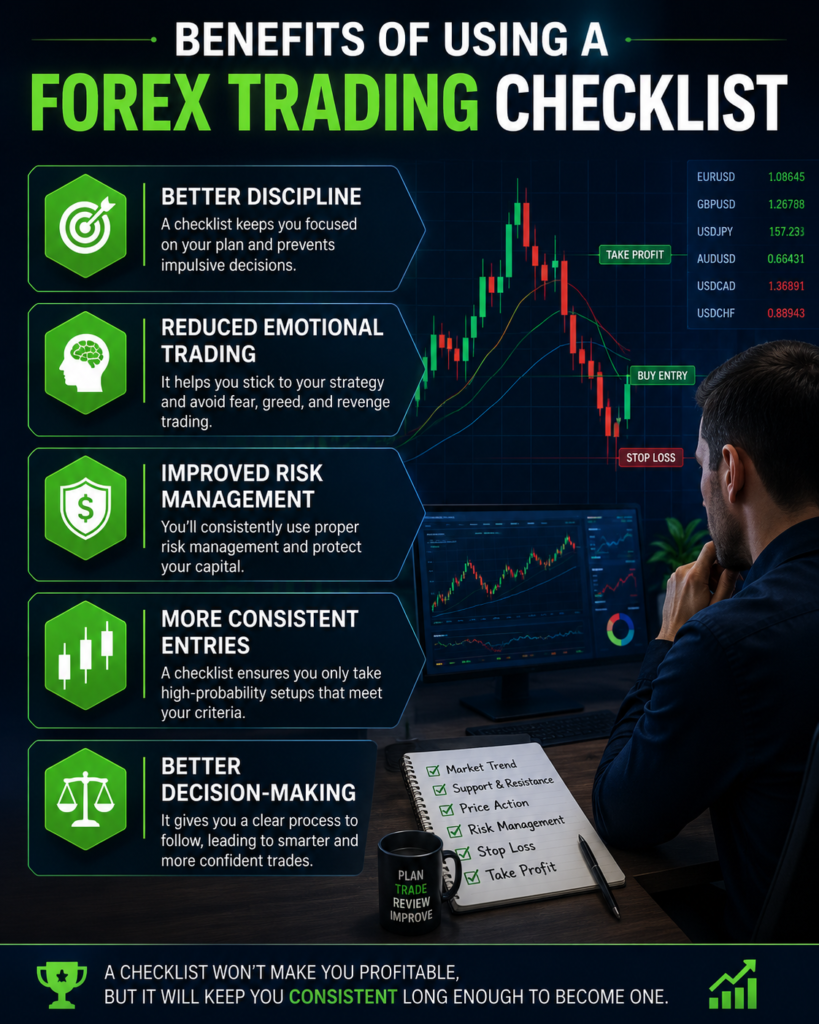
One of the biggest differences between successful Forex traders and struggling beginners is discipline. While many new traders focus on finding the “perfect” strategy or indicator, experienced traders understand that consistency comes from following a structured trading process. A Forex trading checklist provides that structure. Before completing your trading checklist, it’s important to understand the basics of technical analysis, which helps traders identify trends, support and resistance levels, and potential entry opportunities.
Without a checklist, it’s easy to make decisions based on emotions rather than logic. You might enter a trade because you’re afraid of missing out (FOMO), revenge trade after a loss, or ignore your risk management rules because a setup “looks good.” These emotional decisions often lead to unnecessary losses.
A trading checklist acts as a personal quality control system. Before risking any money, it forces you to pause and confirm that the trade meets your predefined rules. If the setup doesn’t satisfy your checklist, you simply wait for a better opportunity. This helps remove guesswork from your trading routine.
1. It Helps You Stay Disciplined
Discipline is one of the most valuable skills in Forex trading. A checklist encourages you to follow the same process before every trade, regardless of market conditions.
Instead of asking:
“Should I enter this trade?”
You ask:
- Is the trend clear?
- Is price at a key support or resistance level?
- Do I have a valid entry signal?
- Does this trade fit my strategy?
If the answers don’t match your trading rules, you avoid the trade.
2. It Reduces Emotional Trading
Fear and greed are responsible for many beginner trading mistakes.
For example:
- Entering a trade because price is moving quickly.
- Closing a profitable trade too early because you’re afraid the market will reverse.
- Holding a losing trade too long, hoping the market will recover.
A checklist helps you focus on facts instead of emotions. By following objective rules, you become less likely to make impulsive decisions.
3. It Improves Trade Quality
Not every trade setup is worth taking.
A checklist helps you filter out weak opportunities by requiring multiple confirmations before entering a trade.
For example, your checklist may require:
- The higher timeframe trend agrees with your trade.
- Price is at a significant support or resistance level.
- A strong candlestick pattern has formed.
- Risk-to-reward is at least 1:2.
If one of these conditions is missing, the trade may not be worth taking.
4. It Encourages Better Risk Management
Good traders protect their capital before thinking about profits.
A trading checklist reminds you to verify important risk management questions such as:
- Have I calculated my position size correctly?
- Is my stop loss placed logically?
- Am I risking only 1–2% of my account on this trade?
- Is my take profit realistic?
These simple checks can help prevent costly mistakes and improve long-term consistency.
5. It Builds Consistency
Successful Forex trading isn’t about winning every trade. It’s about following a repeatable process over hundreds of trades.
By using the same checklist every time, you create a consistent trading routine. Even when individual trades lose, you’ll know you followed your plan instead of making random decisions.
Over time, this consistency helps you evaluate your strategy more accurately and identify areas for improvement.
Practical Example
Imagine two beginner traders analyzing the same EUR/USD setup.
Trader A sees a bullish candlestick and immediately buys because the market looks strong.
Trader B follows a checklist before entering:
- Daily trend is bullish.
- Price has pulled back to a key support level.
- A bullish engulfing pattern has formed.
- The economic calendar shows no major news in the next hour.
- Risk-to-reward ratio is 1:3.
- Position size is correctly calculated.
Only after confirming every point does Trader B enter the trade.
Even if both traders take the same position, Trader B is following a structured process rather than relying on emotion or guesswork.
Key Takeaway
A Forex trading checklist is much more than a simple to-do list. It is a decision-making framework that helps you:
- Stay disciplined.
- Reduce emotional trading.
- Filter out poor-quality setups.
- Improve risk management.
- Build consistency over time.
Professional traders understand that success comes from consistently following a well-defined process, not from chasing every market opportunity. In the next section, you’ll discover the key benefits of using a Forex trading checklist and how it can improve both your confidence and long-term trading performance.
Benefits of Using a Forex Trading Checklist
A Forex trading checklist does much more than remind you what to look for before entering a trade. It helps you develop the habits and discipline needed for long-term trading success. Whether you’re a beginner or an experienced trader, following a checklist can improve your decision-making, reduce costly mistakes, and make your trading process more consistent.
Here are some of the biggest benefits of using a Forex trading checklist.
1. Improves Trading Discipline
One of the biggest challenges beginner traders face is maintaining discipline. It’s tempting to enter trades based on excitement, fear, or the hope of making quick profits. A trading checklist encourages you to slow down and evaluate every setup carefully before risking your money.
Instead of making emotional decisions, you follow a structured routine. Over time, this habit helps you become a more patient and disciplined trader.
2. Reduces Costly Mistakes
Even experienced traders can overlook important details when markets move quickly. A checklist acts as a final review before entering a trade.
For example, it reminds you to verify:
- The direction of the overall trend.
- Important support and resistance levels.
- Entry confirmation signals.
- Stop-loss placement.
- Position size.
- Risk-to-reward ratio.
Checking these items before every trade helps reduce avoidable errors that could negatively affect your trading account.
3. Increases Confidence
Trading with uncertainty often leads to hesitation and emotional decision-making. A checklist gives you confidence because every trade follows a proven process.
When all the conditions on your checklist are satisfied, you can enter the market knowing you’ve done your analysis thoroughly rather than relying on guesswork.
Confidence built on preparation is much more reliable than confidence based on emotions.
4. Encourages Better Risk Management
Successful traders focus on protecting their capital before chasing profits. A checklist reminds you to manage risk properly before opening any position.
For example, your checklist may include questions like:
- Am I risking only 1–2% of my account?
- Is my stop loss placed beyond a logical support or resistance level?
- Does this trade offer at least a 1:2 risk-to-reward ratio?
Following these rules consistently can help protect your account from significant losses.
5. Helps You Stay Consistent
Consistency is one of the most important qualities of successful Forex traders.
Using the same checklist before every trade creates a repeatable routine. Instead of making random decisions based on changing emotions, you evaluate every opportunity using the same objective criteria.
This consistency makes it easier to review your trades, identify weaknesses in your strategy, and improve your performance over time.
6. Improves Trading Psychology
Many beginner traders struggle with emotions such as fear, greed, impatience, and the fear of missing out (FOMO). These emotions often lead to poor trading decisions.
A checklist encourages you to pause before entering the market and ask:
- Am I following my trading plan?
- Am I entering because the setup is valid or because I’m afraid of missing an opportunity?
- Am I emotionally calm enough to trade?
These simple questions help you maintain emotional control and avoid impulsive trades.
7. Supports Long-Term Success
Forex trading is not about winning every trade; it’s about following a profitable process over hundreds of trades.
A trading checklist helps you develop professional habits that can improve your performance over time. Even when individual trades result in losses, you’ll know you followed your trading plan instead of making emotional decisions.
This mindset is essential for becoming a consistent and disciplined trader.
Practical Example
Imagine two traders using the same Forex strategy.
Trader A opens trades whenever they feel confident, without checking trend direction, news events, or risk management.
Trader B carefully reviews a trading checklist before every trade:
- Trend confirmed.
- Support or resistance identified.
- Entry signal confirmed.
- Economic calendar checked.
- Stop loss and take profit set.
- Position size calculated correctly.
Although both traders use the same strategy, Trader B is more likely to achieve consistent results because they follow a structured decision-making process rather than relying on emotions.
Key Takeaway
A Forex trading checklist helps you:
- Develop trading discipline.
- Reduce unnecessary mistakes.
- Improve confidence.
- Strengthen risk management.
- Control emotions.
- Build long-term consistency.
By following a checklist before every trade, you create a professional routine that allows you to focus on quality setups instead of reacting emotionally to every market movement. In the next section, you’ll learn the first and most important step in creating your own Forex trading checklist: checking the overall market trend before considering any trade.
Step 1: Check the Overall Market Trend
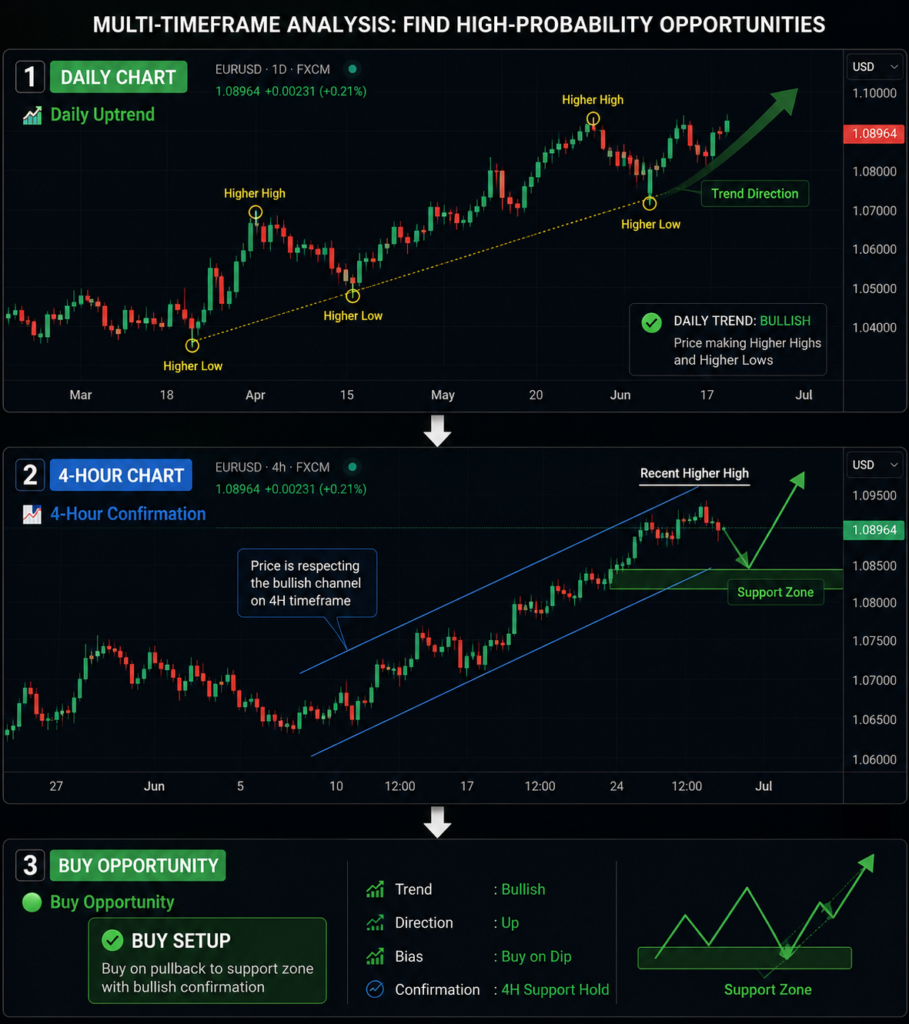
The first and most important step in any Forex trading checklist is identifying the overall market trend. Before thinking about entry signals, stop-loss placement, or profit targets, you need to understand the direction in which the market is moving. Learn how central bank policies can influence currency markets and trading opportunities.
Many beginner traders skip this step and immediately look for trading opportunities on lower timeframes. While they may occasionally make profitable trades, they also increase their chances of trading against the dominant trend, which often leads to unnecessary losses. Successful traders usually focus on trading with the trend because it increases the probability of finding high-quality trade setups.
Professional traders follow a simple principle:
“The trend is your friend until it bends.”
This means trading in the direction of the prevailing market trend generally offers a higher probability of success than trying to predict reversals. Using multiple-timeframe analysis allows traders to confirm the overall trend before searching for entry opportunities on lower timeframes.
Why the Trend Matters
The Forex market is driven by the continuous battle between buyers (bulls) and sellers (bears). When buyers are stronger, prices generally move upward, creating an uptrend. When sellers dominate, prices move downward, forming a downtrend.
Knowing who is in control allows you to trade with market momentum instead of fighting against it.
For example:
- If the overall trend is bullish, you should focus on finding buying opportunities.
- If the overall trend is bearish, you should look for selling opportunities.
- If the market is moving sideways, it may be better to wait until a clearer trend develops.
Trading in the direction of the trend often improves both your win rate and your confidence because you’re aligning your trades with the market’s dominant direction.
How to Identify the Trend
Before every trade, ask yourself these questions:
- Is the market making higher highs and higher lows?
- Is the market making lower highs and lower lows?
- Is price moving sideways within a range?
- Is price respecting a trendline or moving average?
These observations can quickly tell you whether buyers or sellers are currently in control.
Practical Example
Imagine you’re analyzing the EUR/USD currency pair.
You begin by checking the Daily (D1) chart.
You notice that price has been making:
- Higher High
- Higher Low
- Higher High
- Higher Low
This tells you the market is in a bullish trend.
Instead of searching for sell trades, your trading checklist reminds you to focus only on buying opportunities.
Next, you move to the 4-Hour (H4) chart.
Price has pulled back to a strong support level while the overall trend remains bullish.
Finally, you switch to the 1-Hour (H1) chart and wait for a bullish confirmation signal, such as:
- A Bullish Engulfing pattern.
- A Hammer candlestick.
- A breakout followed by a successful retest.
Only after all these conditions are met do you consider entering the trade.
Beginner Checklist
Before placing any trade, confirm:
- I have identified the overall market trend.
- I am trading in the direction of the trend.
- The higher timeframe supports my trading idea.
- I am not trying to predict a reversal without strong confirmation.
If you cannot confidently answer “Yes” to these questions, it’s usually better to wait. Remember, patience is a trading skill, and waiting for high-quality setups often produces better long-term results than forcing trades.
Key Takeaway
Checking the overall market trend should always be the first item on your Forex trading checklist. It provides the foundation for every other trading decision, helping you filter out low-probability setups and focus on opportunities that align with the market’s direction.
Once you’ve confirmed the trend, the next step is to identify key support and resistance levels, where price is most likely to react before you plan your trade.
Step 2: Identify Support and Resistance Levels
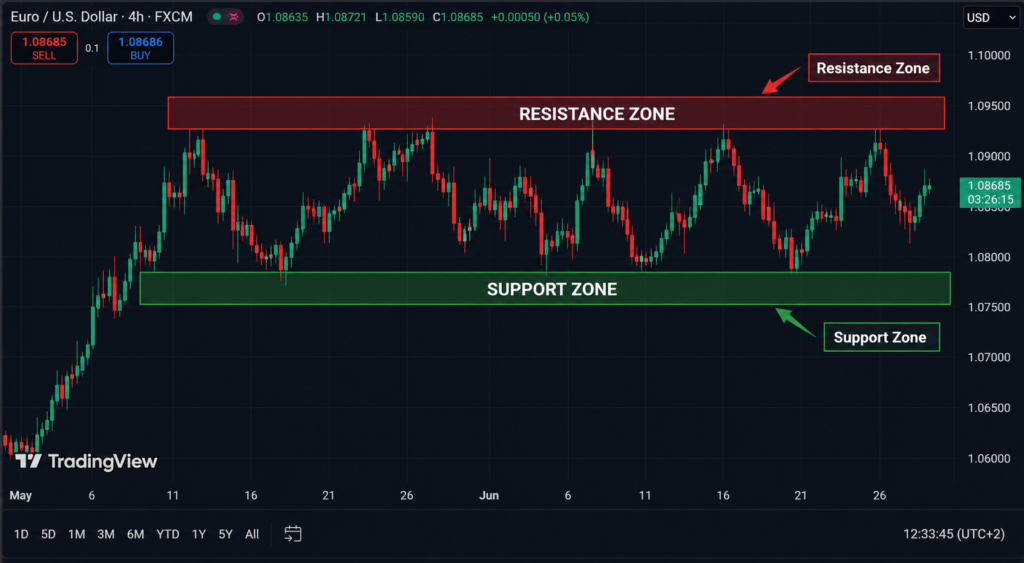
After confirming the overall trend, the next step is to identify important support and resistance levels. Learning to identify support and resistance levels is one of the most important skills in creating a reliable trading checklist.
Support is an area where buying pressure may become strong enough to stop price from falling. Resistance is an area where selling pressure may prevent price from rising further. Practice your checklist using live Forex charts.
These levels are important because price often reacts when it reaches them. A trader who enters without checking support and resistance may buy directly below a major resistance level or sell directly above strong support.
Before entering a trade, ask:
- Is price near support or resistance?
- Has price reacted at this level before?
- Is the level visible on a higher timeframe?
- Is the level a clear zone rather than a single random line?
Buy Trade Example
Suppose EUR/USD is in an uptrend on the Daily chart.
On the 4-Hour chart, price pulls back to a support zone that has previously pushed the market higher. Instead of buying immediately, you wait for evidence that buyers are returning.
This support area now becomes a possible location for a buy setup.
Sell Trade Example
Imagine GBP/USD is in a downtrend.
Price rises toward a resistance zone where sellers have entered several times before. If bearish confirmation appears at this level, it may provide a possible selling opportunity.
Checklist Questions
Before continuing:
- ✔ Have I marked the nearest support level?
- ✔ Have I marked the nearest resistance level?
- ✔ Is my planned entry at a meaningful price zone?
- ✔ Is there enough room for price to reach my profit target?
- ✔ Am I avoiding buying directly below resistance?
- ✔ Am I avoiding selling directly above support?
Support and resistance should provide the location of the trade. The next step is finding confirmation that the market may move in your expected direction.
Step 3: Look for Price Action Confirmation
A strong trend and a good support or resistance zone are not enough by themselves. You also need a reason to enter the trade. Waiting for reliable candlestick patterns such as a Bullish Engulfing or Hammer can improve the quality of your trade entries.
This reason is often called entry confirmation.
Price action confirmation shows that buyers or sellers may be taking control at your chosen level. It helps prevent you from entering simply because price has touched support or resistance. Instead of relying on indicators alone, many traders use price action confirmation to determine whether buyers or sellers are taking control.
Common confirmation signals include:
- Bullish Engulfing pattern
- Bearish Engulfing pattern
- Hammer
- Shooting Star
- Pin Bar
- Inside Bar breakout
- Breakout and retest
- Strong candle close beyond a key level
Bullish Confirmation Example
Suppose the Daily trend is bullish and price has pulled back to support on the 4-Hour chart.
On the 1-Hour chart, a Bullish Engulfing candle forms.
This suggests buyers may be returning. The combination of trend, support, and bullish confirmation creates a stronger setup than the candlestick pattern alone. Your checklist should also help you distinguish between genuine breakouts and fakeouts before entering a trade.
Bearish Confirmation Example
The Daily trend is bearish, and price reaches resistance.
A Bearish Engulfing candle forms on the 1-Hour chart and closes below the previous candle.
This may confirm that sellers are regaining control.
Why You Should Wait for the Candle to Close
Many beginners enter while a confirmation candle is still forming. The candle may look bullish or bearish at first but completely change before it closes.
Waiting for the candle to close helps you avoid acting on incomplete information.
Checklist Questions
- Has a valid price action signal formed?
- Has the confirmation candle closed?
- Is the signal forming at support or resistance?
- Does the signal agree with the higher-timeframe trend?
- Am I entering because of confirmation rather than excitement?
A candlestick pattern in the middle of nowhere is often weak. A pattern aligned with trend and market structure is usually more meaningful.
Step 4: Check the Economic Calendar
Before entering any Forex trade, check the economic calendar for scheduled news events. Check the economic calendar before placing your trades.
Economic announcements can cause sudden volatility, wider spreads, slippage, and rapid price reversals. Even a technically strong setup can fail when important news changes market expectations.
High-impact events include:
- Interest-rate decisions
- Consumer Price Index reports
- Non-Farm Payrolls
- Gross Domestic Product releases
- Unemployment reports
- Retail-sales data
- Central-bank speeches
Practical Example
You identify a strong EUR/USD buy setup.
The Daily trend is bullish, price is at support, and a Bullish Engulfing candle has formed. However, the U.S. inflation report will be released in 15 minutes.
Entering immediately may expose the trade to unpredictable volatility.
A disciplined trader may wait for the announcement, allow the market to settle, and then reassess the setup.
What to Look for on the Calendar
Check:
- The event’s release time
- The affected currency
- Its expected impact
- Previous results
- Market expectations
Events marked as high impact deserve the most attention.
Checklist Questions
- Have I checked today’s economic calendar?
- Is major news scheduled for either currency in the pair?
- How soon will the event be released?
- Am I prepared for increased volatility?
- Should I wait until after the announcement?
Checking the calendar does not mean you must avoid every news event. It means you should understand the risks before entering.
Step 5: Calculate the Risk-to-Reward Ratio
The risk-to-reward ratio compares the amount you may lose with the amount you aim to gain.
For example:
- Potential loss: 30 pips
- Potential profit: 60 pips
- Risk-to-reward ratio: 1:2
This means you are risking one unit to potentially earn two units.
Many disciplined traders prefer setups offering at least 1:2, although the appropriate ratio depends on the strategy and market conditions.
Why It Matters
You do not need to win every trade to become profitable.
Suppose you take ten trades:
- Five lose $20 each: total loss of $100
- Five win $40 each: total profit of $200
Your result is a $100 profit, even though your win rate was only 50%.
A favorable risk-to-reward ratio can help compensate for losing trades.
How to Calculate It
First, determine the distance between your entry and Stop Loss.
Then determine the distance between your entry and Take Profit.
Example:
- Buy entry: 1.1000
- Stop Loss: 1.0970
- Risk: 30 pips
- Take Profit: 1.1060
- Reward: 60 pips
The ratio is 1:2.
Do Not Force a Ratio
A 1:3 target is not automatically good if major resistance is only 40 pips away.
Your target should remain realistic and based on market structure.
Checklist Questions
- How many pips am I risking?
- How many pips could I gain?
- Is the potential reward greater than the risk?
- Is the target supported by market structure?
- Am I avoiding an unrealistic Take Profit?
Rejecting an otherwise attractive setup because the reward is too small can protect you from low-quality trades.
Step 6: Set the Stop Loss and Take Profit
Before entering, decide exactly where the trade will close if you are wrong and where you will secure profit if the trade succeeds. Correctly placing your stop loss and take profit is an essential part of every Forex trading checklist.
A Stop Loss limits your potential loss. A Take Profit automatically closes the trade at your intended target.
These levels should be based on market analysis, not fear, greed, or random pip amounts.
Stop Loss for a Buy Trade
For a buy position, the Stop Loss may be placed:
- Below support
- Below the recent swing low
- Below the confirmation candle
- Beyond the level that invalidates the trade idea
Stop Loss for a Sell Trade
For a sell position, it may be placed:
- Above resistance
- Above the recent swing high
- Above the confirmation candle
- Beyond the invalidation level
Setting Take Profit
Possible Take Profit locations include:
- The next resistance for a buy trade
- The next support for a sell trade
- A previous swing high or low
- A level that provides a suitable risk-to-reward ratio
Practical Example
You enter a buy trade at 1.2050.
Support lies at 1.2015, so you place the Stop Loss below it at 1.2005.
The next resistance is at 1.2140, so you set Take Profit slightly below it at 1.2135.
This gives the trade a logical exit plan before money is at risk.
Checklist Questions
- Is my Stop Loss at a logical invalidation point?
- Is it far enough from normal market noise?
- Is my Take Profit near a realistic market level?
- Does the setup offer a favorable risk-to-reward ratio?
- Have I set both levels before entering?
Never move your Stop Loss farther away simply because you do not want to accept a loss.
Step 7: Confirm the Correct Position Size
Position size determines how much of a currency pair you trade. Proper position sizing and account management help ensure that each trade risks only a small percentage of your trading capital.
It should be calculated from:
- Your account balance
- The percentage you are willing to risk
- Your Stop-Loss distance
- The value of each pip
A wider Stop Loss normally requires a smaller position. A tighter Stop Loss may permit a larger position while keeping the same amount of money at risk.
Practical Example
Suppose you have a $1,000 account and decide to risk 1%.
Your maximum loss is:
$1,000 × 1% = $10
If your Stop Loss is 50 pips away, your position size must be small enough that 50 pips equals approximately $10.
The goal is not to choose the largest position your broker allows. It is to choose the size that matches your risk plan.
Why Beginners Get This Wrong
Many beginners choose their lot size first and then place a Stop Loss afterward.
The correct order is:
- Identify the setup.
- Select the logical Stop Loss.
- Decide the amount to risk.
- Calculate the position size.
Checklist Questions
- What percentage of my account am I risking?
- What is my maximum acceptable loss?
- How far is my Stop Loss?
- Have I calculated the correct lot size?
- Is my exposure too large when combined with other open trades?
Never increase position size simply because you lost the previous trade. That is revenge trading, not risk management.
Step 8: Review Your Trading Psychology
The final step is checking your emotional state.
A technically valid trade can still become a bad decision if you enter while angry, fearful, impatient, exhausted, or desperate to recover a loss.
Before placing the trade, pause and ask why you want to enter.
Emotional Warning Signs
Avoid trading when:
- You are afraid of missing out.
- You are trying to recover a previous loss.
- You are entering because another trader posted a signal.
- You feel pressured to make money quickly.
- You have already exceeded your daily loss limit.
- You are tired or unable to concentrate.
- You are changing your rules to justify the trade.
Practical Example
You have lost two trades in a row.
A third setup appears, but it only meets some of your checklist conditions. You feel tempted to enter with a larger position to recover your losses.
Your checklist should stop you.
A disciplined response is to reject the trade, step away, and return when you are calm.
Create a Personal Emotional Rule
Your checklist may include rules such as:
- Stop trading after two consecutive losses.
- Do not trade when angry or tired.
- Never increase risk to recover losses.
- Take a break after a highly emotional trade.
- Follow the daily loss limit without exception.
Checklist Questions
- Am I calm and focused?
- Am I following my plan?
- Am I entering because the setup is valid?
- Am I free from FOMO or revenge-trading pressure?
- Can I accept the planned loss without changing the trade?
- Have I stayed within my daily risk limit?
Sometimes the best trading decision is not to trade.
Complete Pre-Trade Checklist
Before pressing Buy or Sell, confirm:
- The overall trend is clear.
- The trade agrees with the higher timeframe.
- Support or resistance has been identified.
- A valid confirmation signal has formed.
- The economic calendar has been checked.
- The risk-to-reward ratio is acceptable.
- Stop Loss and Take Profit are correctly placed.
- Position size has been calculated.
- Total account risk remains controlled.
- You are calm, focused, and following your plan.
When one of your essential conditions is missing, wait for another opportunity. The market will always produce more setups, but protecting your capital must remain the priority.
Final Thoughts
A Forex trading checklist is much more than a simple list of tasks; it is a powerful tool that helps you become a more disciplined, confident, and consistent trader. While no checklist can guarantee profitable trades, following a structured trading process can significantly reduce emotional decision-making and prevent many of the common mistakes that beginners make. Understanding the Forex trading risks involved before entering the market can help you avoid costly beginner mistakes.
Remember, successful Forex trading is not about taking as many trades as possible. It’s about waiting patiently for high-quality opportunities that meet your trading rules. Every item on your checklist acts as a filter, helping you avoid impulsive decisions and focus only on trades that align with your strategy. Before risking real money, it’s a good idea to practice your checklist on a demo account until you can follow it consistently.
As you gain more experience, don’t be afraid to refine your checklist. You may discover new confirmation signals, improve your risk management rules, or adjust your entry criteria based on your trading style. Your checklist should grow with your experience while remaining simple, practical, and easy to follow.
The most successful traders treat their checklist as a non-negotiable part of their trading routine. Before every trade, they carefully review each item to ensure the setup meets their standards. Developing this habit can help you build consistency, protect your trading capital, and improve your decision-making over the long term.
Above all, remember that discipline often matters more than finding the “perfect” strategy. A simple strategy followed consistently with a well-designed checklist is usually more effective than a complicated strategy applied without discipline.
Frequently Asked Questions (FAQs)
1. What is a Forex trading checklist?
A Forex trading checklist is a step-by-step list of conditions that traders review before entering a trade. It helps ensure every trade follows a structured trading plan instead of being based on emotions or guesswork.
2. Why should beginners use a trading checklist?
A checklist helps beginners stay disciplined, reduce emotional trading, improve risk management, and avoid common trading mistakes such as entering trades without confirmation.
3. What should be included in a Forex trading checklist?
A complete Forex trading checklist should include:
- Overall market trend
- Support and resistance levels
- Entry confirmation
- Economic calendar review
- Risk-to-reward ratio
- Stop loss and take profit
- Position sizing
- Emotional readiness
4. Can a trading checklist guarantee profitable trades?
No. A trading checklist improves the quality of your trading decisions, but it cannot eliminate market risk or guarantee profits.
5. Should I use the same checklist for every strategy?
The basic principles remain the same, but you can customize your checklist to suit your preferred trading strategy, timeframe, and risk tolerance.
6. How often should I update my trading checklist?
Review your checklist regularly, especially as your experience grows or when you refine your trading strategy. However, avoid making frequent changes based on a few winning or losing trades.
Continue Your Forex Learning Journey
Creating a Forex trading checklist is one of the best ways to develop discipline and consistency, but it’s only one part of becoming a successful trader. Continue building your trading knowledge by exploring our beginner-friendly guides on Price Action Trading, Support and Resistance, Candlestick Patterns, Risk Management, Multiple Timeframe Analysis, and Trend Trading.
At BuildSmartAfri, we’re committed to helping beginners develop practical Forex trading skills through easy-to-follow tutorials, real-world examples, and proven trading concepts. Once you’ve developed confidence using your trading checklist, the next step is opening your first Forex trading account with a regulated broker.
If you found this guide helpful, consider sharing it with friends or fellow traders who are beginning their Forex journey. Don’t forget to bookmark BuildSmartAfri and visit regularly for new Forex tutorials, trading strategies, AI guides, and practical digital skills content designed to help you grow with confidence.
Start applying your Forex trading checklist before every trade and take another step toward becoming a more disciplined and confident trader.
Risk Disclaimer
Disclaimer: Forex trading involves substantial risk and may not be suitable for every investor. Currency prices can fluctuate rapidly, and you may lose part or all of your invested capital. The information provided in this article is for educational purposes only and should not be considered financial, investment, or trading advice. Always conduct your own research, practice on a demo account when learning new strategies, and use appropriate risk management before trading with real money. Past performance does not guarantee future results. Review the CFTC’s investor education resources to better understand the risks of Forex trading.