
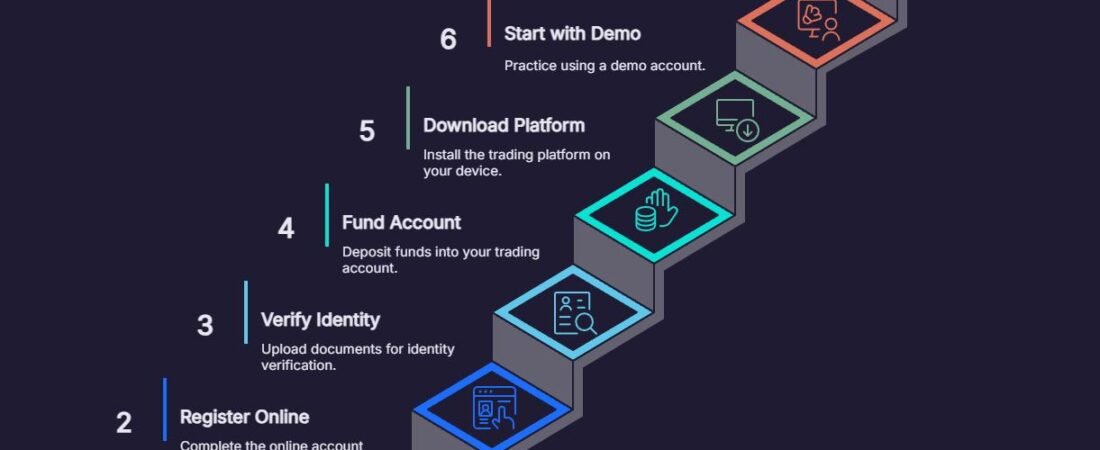
Introduction:
How to Open Your First Forex Trading Account: 8 Step-by-Step Guide for Beginners. Opening your first Forex trading account is an exciting milestone in your trading journey. Before opening an account, beginners should understand how Forex trading works and the risks involved in participating in the global currency market.
After learning about Forex trading, risk management, trading plans, demo accounts, and brokers, the next logical step is setting up an account that allows you to participate in the market. If you’re completely new to the currency market, start by reading our guide on What Is Forex Trading? A Beginner’s Guide before opening your first trading account.
However, many beginners feel overwhelmed when they reach this stage.
Questions often arise such as:
- Which type of account should I choose?
- What documents do I need?
- How much money should I deposit?
- Is my information secure?
- Should I start with a demo account or a live account?
These concerns are completely normal.
Opening a Forex trading account is similar to opening a bank account. Brokers must verify your identity, comply with financial regulations, and ensure the security of their trading environment.
While the process is generally straightforward, making the right decisions from the beginning can save time and prevent unnecessary mistakes.
Imagine two beginners.
The first trader carefully researches brokers, understands account types, prepares the necessary documents, and starts with a small amount of capital.
The second trader rushes through the registration process, chooses an unsuitable account type, and deposits more money than they can afford to lose.
Several weeks later, the first trader feels confident and organized, while the second trader experiences confusion and frustration.
The difference is not intelligence or luck.
The difference is preparation.
This guide will walk you through every step of opening your first Forex trading account, from choosing a broker to making your first deposit.
By the end of this article, you will understand:
- How Forex trading accounts work
- The different account types available
- What documents brokers require
- How account verification works
- How to fund your account
- Common mistakes beginners should avoid
- Best practices for starting safely
Let’s begin.
What Is a Forex Trading Account?
A Forex trading account is an account provided by a broker that allows traders to buy and sell currencies in the foreign exchange market.
Think of it as your gateway to the Forex market.
Without a trading account, you cannot place trades or access Forex trading platforms.
A trading account typically allows you to:
- Access currency markets
- View real-time price charts
- Place buy and sell orders
- Use technical analysis tools
- Monitor account performance
- Manage deposits and withdrawals
Once your account is approved and funded, you can begin trading according to your strategy and risk management plan.
Step 1: Choose a Reliable Forex Broker
Before opening an account, you must select a broker. Choosing the right broker is crucial, so consider reading How to Choose the Best Forex Broker for Beginners before making your decision.
This is one of the most important decisions you will make because your broker will handle your deposits, withdrawals, and trading activities.
What to Look For
A beginner-friendly broker should provide:
✔ Regulation and security
✔ Transparent fees
✔ User-friendly trading platforms
✔ Educational resources
✔ Responsive customer support
✔ Demo accounts
✔ Convenient payment methods
Practical Example
Suppose Broker A is regulated, provides educational resources, and has positive customer reviews.
Broker B promises guaranteed profits but provides little information about regulation.
Most beginners would be better served by choosing Broker A because transparency and security are more important than marketing promises.
Remember:
A reliable broker forms the foundation of a safe trading experience.
Step 2: Understand the Different Types of Forex Accounts
Most brokers offer several account types.
Choosing the right account depends on your experience level, financial goals, and risk tolerance.
Demo Account
A demo account uses virtual money. Before funding a live account, many traders benefit from understanding the differences between Demo Trading vs Live Trading.
It allows beginners to practice trading without risking real funds.
Best For
- Complete beginners
- Learning trading platforms
- Testing strategies
- Practicing risk management
Advantages
- No financial risk
- Builds confidence
- Helps develop trading skills
Standard Live Account
A standard account uses real money and provides full access to the market.
Best For
- Traders ready to risk real capital
- Individuals who have practiced on demo accounts
- Beginners transitioning into live trading
Advantages
- Real trading experience
- Exposure to actual market conditions
- Development of emotional discipline
Cent Account
A cent account displays balances in cents rather than dollars.
For example:
$10 = 1,000 cents
Best For
- Beginners transitioning from demo to live trading
- Traders wanting lower risk exposure
Advantages
- Small financial commitment
- Real market experience
- Reduced emotional pressure
Islamic (Swap-Free) Account
Some brokers provide swap-free accounts that do not charge overnight interest fees.
Best For
- Traders seeking swap-free trading conditions
- Individuals requiring alternative account structures
Always review the broker’s specific terms and conditions.
Step 3: Complete the Registration Process
Once you choose a broker and account type, you can begin registration.
Most brokers allow online registration through their websites.
You will typically provide:
- Full name
- Email address
- Phone number
- Country of residence
- Date of birth
- Residential address
The process usually takes only a few minutes.
Security Tip
Always ensure that you are registering on the broker’s official website.
Check for:
- Secure HTTPS connections
- Professional website design
- Correct broker branding
- Official contact information
Never provide sensitive information on suspicious websites.
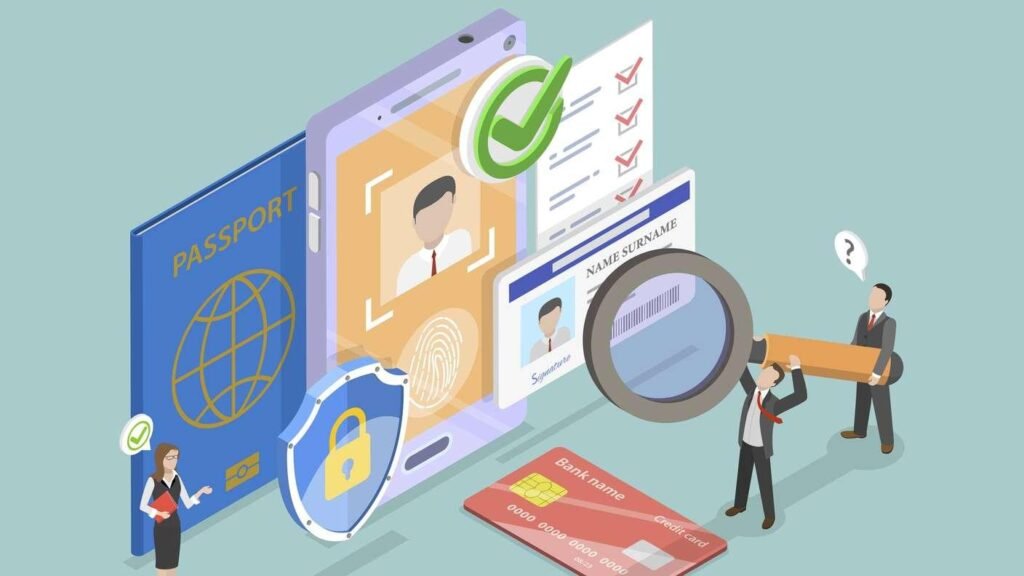
Step 4: Verify Your Identity (KYC Process)
After registration, brokers usually require identity verification.
This process is commonly known as:
Know Your Customer (KYC)
Financial regulations require brokers to verify customer identities to prevent fraud and maintain security.
Common Documents Required
Proof of Identity
Examples include:
- Passport
- National ID card
- Driver’s license
Proof of Address
Examples include:
- Utility bill
- Bank statement
- Government correspondence
Most brokers review submitted documents within a few hours to several business days.
Why Verification Matters
Verification helps:
- Protect your account
- Prevent unauthorized activity
- Enable withdrawals
- Comply with regulations
Completing verification early can prevent future delays.
Step 5: Download and Set Up Your Trading Platform
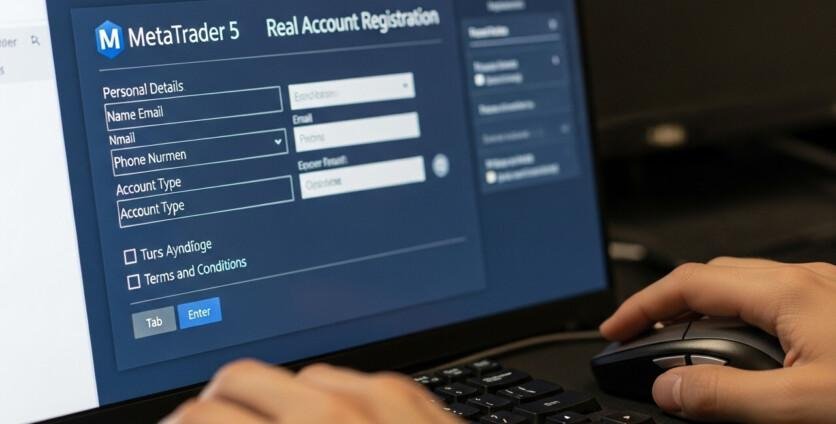
Once your account has been verified, the next step is to access the trading platform provided by your broker.
The trading platform is the software you will use to:
- Monitor market prices
- Analyze charts
- Place trades
- Manage risk
- Track account performance
- Deposit and withdraw funds
Think of the trading platform as your trading workspace.
Learning how to use it properly before placing your first trade can help prevent costly mistakes.
Popular Forex Trading Platforms
Most Forex brokers offer one or more of the following platforms:
MetaTrader 4 (MT4)
MetaTrader 4 is one of the most widely used Forex trading platforms in the world.
It is known for:
✔ User-friendly interface
✔ Technical indicators
✔ Fast trade execution
✔ Charting tools
✔ Automated trading support
Many beginner traders start with MT4 because of its simplicity and extensive educational resources.
MetaTrader 5 (MT5)
MetaTrader 5 is the newer version of MT4.
It offers additional features such as:
✔ More technical indicators
✔ Additional chart timeframes
✔ Advanced analytical tools
✔ Faster processing capabilities
Many brokers now provide both MT4 and MT5 options.
Broker Proprietary Platforms
Some brokers develop their own custom platforms.
These platforms often include:
- Integrated educational resources
- Simplified interfaces
- Mobile applications
- Additional market analysis tools
Before choosing a platform, explore its features and determine whether it suits your needs.
Installing the Platform
Most brokers provide trading platforms for:
- Windows computers
- Mac computers
- Android devices
- iPhones and iPads
- Web browsers
Practical Example
After opening your account, your broker sends login details by email.
You:
- Download the platform.
- Install it on your device.
- Enter your account credentials.
- Log in successfully.
- Begin exploring charts and features.
This process usually takes only a few minutes.
Familiarize Yourself with the Platform
Before risking real money, spend time learning the platform.
Important features include:
Market Watch
Displays available currency pairs and their prices.
Examples:
- EUR/USD
- GBP/USD
- USD/JPY
- AUD/USD
Charts
Charts help traders analyze price movements.
You should learn how to:
- Change timeframes
- Add indicators
- Zoom in and out
- Identify trends
Order Window
This is where trades are placed.
You’ll use it to:
- Buy positions
- Sell positions
- Set stop-loss orders
- Set take-profit targets
Account History
Allows you to review:
- Past trades
- Profits and losses
- Deposits
- Withdrawals
Understanding these tools before trading can increase confidence and reduce mistakes.
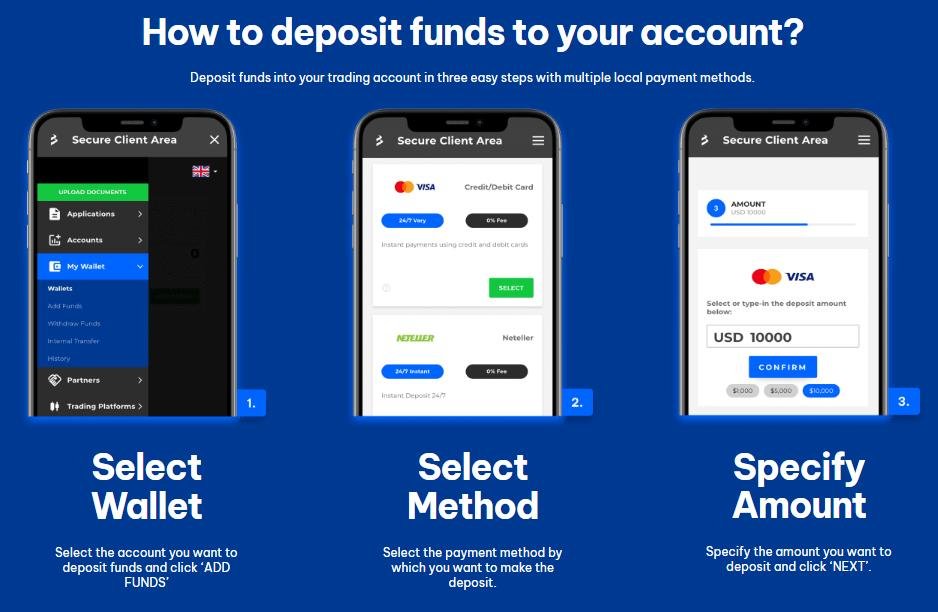
Step 6: Fund Your Trading AccountH
After your platform is ready, the next step is funding your account.
Funding means depositing money that you will use for trading.
Most brokers offer several payment options.
Common Deposit Methods
Bank Transfer
A direct transfer from your bank account to your trading account.
Advantages:
✔ Secure
✔ Widely accepted
Disadvantages:
❌ May take several business days
Debit or Credit Card
Many brokers accept major debit and credit cards.
Advantages:
✔ Fast processing
✔ Convenient
Disadvantages:
❌ Some banks may impose fees
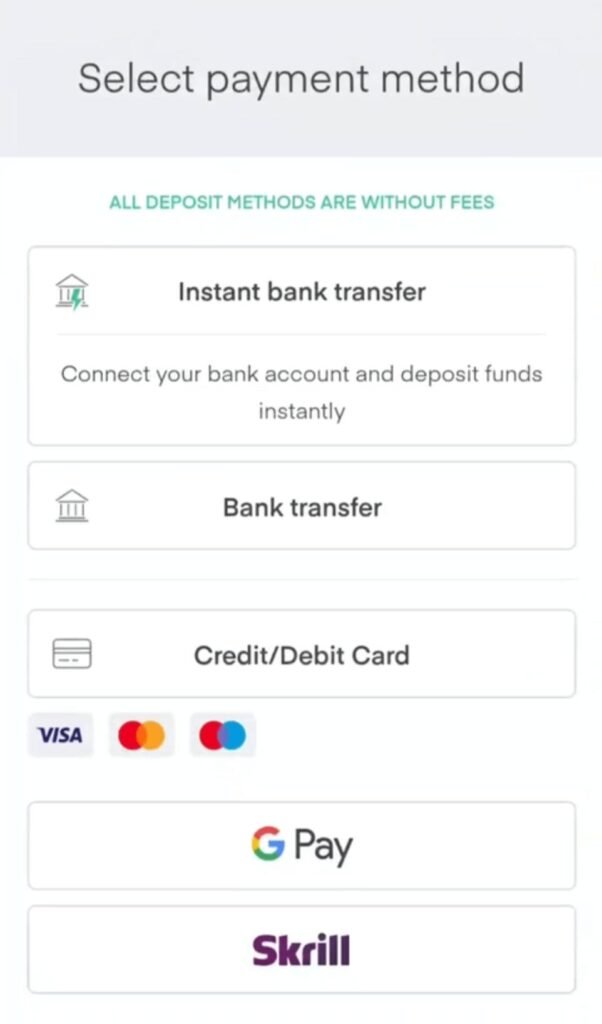
Mobile Payment Services
Depending on your region, brokers may support:
- Mobile money
- Digital wallets
- Electronic payment systems
Advantages:
✔ Quick deposits
✔ Convenient access
How Much Should Beginners Deposit?
One of the most common beginner questions is:
“How much money do I need to start Forex trading?”
The answer depends on your financial situation and trading goals.
However, beginners should focus on learning rather than trying to make large profits immediately.
Good Beginner Approach
Only deposit money that you can comfortably afford to lose.
Trading involves risk, and losses are part of the learning process.
Practical Example
Imagine two beginner traders.
Trader A
Deposits $100.
Their goal is learning.
They focus on:
- Risk management
- Strategy development
- Building experience
Trader B
Deposits $5,000 without sufficient knowledge.
Because of the larger amount at risk, they feel significant pressure to make profits quickly.
This pressure often leads to emotional trading and poor decisions.
In many cases, Trader A develops skills more effectively because they are focused on learning rather than chasing profits.
Beginner Deposit Guidelines
Although requirements vary by broker, many beginners choose:
| Experience Level | Suggested Starting Amount |
|---|---|
| Complete Beginner | $50 – $200 |
| Beginner with Demo Experience | $200 – $500 |
| Experienced Beginner | $500 – $1,000 |
These amounts are examples only.
Your actual deposit should depend on:
- Financial circumstances
- Risk tolerance
- Trading goals
Remember:
Never borrow money or use funds needed for essential expenses to start trading.
Check Your Deposit Before Trading
Before placing your first trade:
✔ Confirm your funds have arrived.
✔ Verify your account balance.
✔ Review transaction records.
✔ Ensure your trading platform displays the correct balance.
Taking a few minutes to confirm everything is working properly can prevent unnecessary confusion later.
Step 7: Configure Basic Risk Management Settings
Before making your first trade, establish risk management rules. Developing strong risk management habits is essential for protecting trading capital and surviving long enough to gain experience.
This is one of the most important steps new traders often overlook.
Successful trading is not about avoiding losses completely.
It is about controlling losses when they occur.
Basic Risk Management Rules
Consider:
✔ Risking only a small percentage of your account per trade.
✔ Using stop-loss orders.
✔ Avoiding excessive leverage.
✔ Following a trading plan.
Practical Example
Account Balance: $500
Risk Per Trade: 2%
Maximum Risk:
$500 × 2% = $10
This means you should not lose more than $10 on a single trade.
Following simple risk management rules can help protect your capital while you gain experience.
Remember:
Your first goal as a beginner trader is not making money. Your first goal is staying in the game long enough to learn.
Step 8: Making Your First Forex Trade
After selecting a broker, verifying your account, funding it, and setting up your trading platform, you are finally ready to place your first Forex trade.
This is an exciting milestone for every beginner trader.
However, many new traders become overly excited at this stage and rush into the market without following a plan.
Your first trade should not be about making a large profit.
Instead, it should focus on learning how the trading process works in a real market environment.
Think of your first trade as a practical lesson rather than a money-making opportunity.
Understanding a Basic Forex Trade
A Forex trade involves buying one currency while simultaneously selling another.
Currencies are traded in pairs.
Examples include:
- EUR/USD
- GBP/USD
- USD/JPY
- AUD/USD
When you trade a currency pair, you are predicting whether the first currency will strengthen or weaken relative to the second currency.
Example
Suppose you believe the Euro will strengthen against the US Dollar.
You may decide to buy EUR/USD.
If the price rises, you can potentially make a profit.
If the price falls, you may experience a loss.
Before Placing Your First Trade
Ask yourself the following questions:
✔ Why am I entering this trade?
✔ Does this trade follow my trading plan?
✔ Have I identified my stop-loss?
✔ Have I identified my take-profit target?
✔ Am I risking an appropriate amount?
If you cannot answer these questions confidently, you may need additional preparation before entering the trade.
Remember:
Professional traders plan their trades before entering the market.
Example of a Beginner Trade Setup
Account Information
Account Balance: $500
Risk Per Trade: 2%
Maximum Risk:
$500 × 2% = $10
This means your stop-loss should be placed so that your maximum loss does not exceed $10.
Trade Setup
Currency Pair: EUR/USD
Direction: Buy
Entry Price: 1.1000
Stop-Loss: 1.0980
Take-Profit: 1.1040
Risk: $10
Potential Reward: $20
This setup creates a risk-to-reward ratio of:
1:2
For every $1 risked, the potential reward is $2.
Many successful traders seek favorable risk-to-reward ratios because they help maintain profitability over the long term.
Placing the Trade
The exact process depends on your trading platform, but it generally involves:
Step 1
Select the currency pair.
Example:
EUR/USD
Step 2
Choose trade direction.
- Buy if you expect prices to rise.
- Sell if you expect prices to fall.
Step 3
Specify position size.
This determines how much market exposure you are taking.
Beginners should generally use smaller position sizes while learning.
Step 4
Set a stop-loss order.
A stop-loss automatically closes the trade if the market moves against you by a predetermined amount.
This helps protect your account from large losses.
Step 5
Set a take-profit order.
A take-profit automatically closes the trade when your profit target is reached.
This helps maintain discipline and prevents emotional decision-making.
Step 6
Review everything carefully.
Check:
✔ Entry price
✔ Position size
✔ Stop-loss
✔ Take-profit
✔ Risk amount
Only after confirming these details should you place the trade.
What Happens After You Enter the Trade?
Once your trade is active, the market will begin moving.
One of three things will happen:
Scenario 1: The Market Reaches Your Take-Profit
The trade closes automatically at your profit target.
You secure a gain.
Scenario 2: The Market Reaches Your Stop-Loss
The trade closes automatically at your maximum acceptable loss.
Although losing is never enjoyable, this is a normal part of trading.
Successful traders accept losses as business expenses.
Scenario 3: The Market Continues Moving
The trade remains open until one of your exit conditions is met.
During this period, it is important to remain patient and avoid emotional decisions.
Common First-Trade Mistakes
Many beginners make similar mistakes during their first few trades.
Understanding these mistakes can help you avoid them.
Mistake 1: Trading Without a Plan
Entering trades based on emotions or random market movements often produces inconsistent results.
Mistake 2: Risking Too Much Money
Large risks can quickly damage both your account and your confidence.
Mistake 3: Removing Stop-Loss Orders
Some traders move or remove stop-losses hoping the market will reverse.
This can lead to larger losses.
Mistake 4: Closing Trades Too Early
Fear often causes beginners to exit profitable trades before their targets are reached.
Mistake 5: Overtrading
Opening too many trades at once can increase risk and reduce focus.
The Importance of Trade Journaling
After your first trade, begin keeping a trading journal.
Record:
- Currency pair
- Entry price
- Exit price
- Profit or loss
- Reason for entering
- Lessons learned
Practical Example
Trade:
EUR/USD Buy
Result:
+$15
Lesson:
Waited patiently for setup and followed risk management rules.
Over time, a journal can help identify strengths, weaknesses, and areas for improvement.
Your First Trade Is About Learning
Many beginners focus too heavily on whether their first trade is profitable.
This mindset can be misleading.
A profitable trade made through poor decisions is not necessarily a success.
Likewise, a losing trade that followed proper risk management may still be considered a successful execution.
The real goal is to develop consistent habits and disciplined decision-making.
Remember:
Your first trade should teach you how the market works, how emotions affect decisions, and how important risk management is not how quickly you can make money.
Common Mistakes Beginners Make When Opening Their First Forex Trading Account
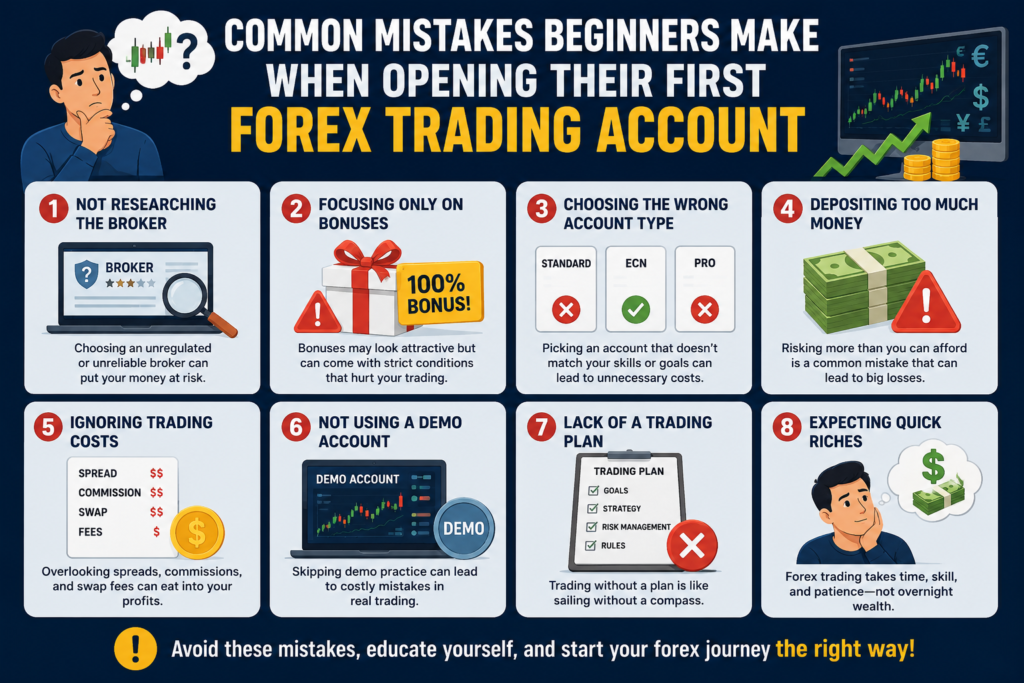
Opening a Forex trading account is relatively simple, but many beginners make mistakes that can create problems later.
Understanding these common mistakes can help you start your trading journey on the right foot.
1. Choosing a Broker Without Research
Some beginners select the first broker they find online without checking regulation, reviews, or trading conditions.
Always verify that your broker is regulated and transparent.
2. Depositing Too Much Money Too Soon
Many new traders believe they need a large account to succeed.
In reality, beginners should focus on learning rather than risking large amounts of capital.
Start small and increase your investment only as your skills improve.
3. Skipping the Demo Account
A demo account provides valuable experience without financial risk.
Skipping this step can result in avoidable mistakes when real money is involved.
4. Ignoring Risk Management
Some traders focus entirely on profits while neglecting risk management.
Remember:
Protecting your capital is more important than chasing quick profits.
5. Trading Without a Plan
Opening an account is only the beginning.
Successful traders follow structured trading plans that define:
- Entry rules
- Exit rules
- Risk limits
- Trading goals
Without a plan, trading decisions often become emotional and inconsistent.
Practical Example: A Beginner’s Journey
Consider a beginner named David.
Step 1
David research regulated brokers and chose one with positive reviews and educational resources.
Step 2
He opens a demo account and practices for several weeks.
Step 3
After becoming familiar with the platform, he opens a live account and deposits $200.
Step 4
He follows a trading plan and risks only 2% of his account per trade.
Maximum Risk:
$200 × 2% = $4
Step 5
David keeps a trading journal and reviews his performance regularly.
Although he experiences both wins and losses, he gains valuable experience while protecting his capital.
This is a realistic example of how beginners can approach Forex trading responsibly.
Frequently Asked Questions (FAQ)
How long does it take to open a Forex trading account?
Most brokers allow you to complete registration within a few minutes. Verification may take anywhere from a few hours to several business days.
Can I open a Forex account with no experience?
Yes.
However, beginners should spend time learning and practicing on a demo account before trading with real money.
What documents do I need?
Most brokers require:
- Proof of identity
- Proof of address
Examples include passports, national ID cards, driver’s licenses, utility bills, or bank statements.
How much money do I need to start?
Many brokers allow traders to start with relatively small deposits.
Beginners should only deposit money they can comfortably afford to lose.
Should I use a demo account first?
Yes.
Demo accounts help beginners learn platform functions, test strategies, and build confidence without financial risk.
Is Forex trading safe?
Forex trading itself is legal in many countries, but it involves risk.
Choosing a regulated broker and applying proper risk management practices can improve safety and security.
Final Thoughts
Opening your first Forex trading account is an important step toward participating in the global currency market.
However, simply opening an account does not guarantee success. Successful trading requires more than technical knowledge; understanding trading psychology can help traders manage emotions and make better decisions.
Successful traders understand that preparation is just as important as execution.
Before placing your first trade:
✔ Choose a reliable broker
✔ Verify your account
✔ Learn your trading platform
✔ Understand risk management
✔ Practice on a demo account
✔ Develop a trading plan
The Forex market offers opportunities, but long-term success comes from education, discipline, patience, and continuous improvement.
Think of opening your trading account as the beginning of a learning journey rather than the start of a quick-money opportunity.
The traders who focus on developing skills often outperform those who focus only on profits.
Start Your Forex Trading Journey the Right Way
If you found this guide helpful, continue building your trading knowledge with these beginner-friendly resources:
📚 What Is Forex Trading? A Beginner’s Guide
📚 Demo Trading vs Live Trading: Which Should Beginners Start With?
📚 How to Choose the Best Forex Broker for Beginners
📚 Forex Trading Risks for Beginners
📚 How to Create a Forex Trading Plan for Beginners
📚 How Stop-Loss Orders Help Limit Investment Losses and Risk
Every successful trader started as a beginner.
Learn consistently, practice patiently, and focus on protecting your capital as you build experience.
Disclaimer
The information provided in this article is for educational and informational purposes only and should not be considered financial, investment, or trading advice.
Forex trading involves substantial risk and may not be suitable for all investors. There is always the possibility of losing some or all of your invested capital.
Before opening a live trading account, conduct your own research, understand the risks involved, and consider seeking advice from a qualified financial professional.
Always trade responsibly and never invest money that you cannot afford to lose.