
Introduction:
Artificial Intelligence (AI) is one of the most transformative technologies of the 21st century. From smartphones and virtual assistants to self-driving cars and medical diagnosis systems, AI is changing how people live, work, communicate, and solve problems. Whether you realize it or not, you probably interact with AI multiple times every day.
Think about how Netflix recommends movies, how Google suggests search results before you finish typing, or how your smartphone unlocks using facial recognition. These everyday experiences are powered by Artificial Intelligence. Businesses also rely on AI to improve customer service, detect fraud, analyze large amounts of data, and automate repetitive tasks.
As AI continues to evolve, it is becoming an essential skill for students, professionals, entrepreneurs, and business owners. Understanding the basics of AI can help you make informed decisions, adapt to technological changes, and discover new career opportunities. You do not need to be a programmer or data scientist to understand how AI works. Learning the fundamentals is enough to appreciate its potential and use AI tools effectively.
In this beginner-friendly guide, you will learn what Artificial Intelligence is, how it works, the different types of AI, its real-world applications, benefits, challenges, and practical ways to start learning AI. By the end of this article, you will have a solid foundation for understanding one of the world’s most exciting technologies.
What Is Artificial Intelligence?
Artificial Intelligence, commonly known as AI, is a branch of computer science that focuses on creating systems capable of performing tasks that normally require human intelligence. These tasks include learning from experience, recognizing patterns, understanding language, solving problems, making decisions, and even generating creative content.
Unlike traditional computer programs that follow fixed instructions, AI systems can analyze information, identify relationships, and improve their performance over time using data. This ability allows AI to adapt to new situations and produce increasingly accurate results.
For example, imagine teaching a child to recognize cats. Instead of giving the child a written list of rules, you show hundreds of pictures of cats. Eventually, the child learns to identify cats based on common features. AI works in a similar way. It learns from large datasets and uses that knowledge to make predictions or decisions.
Artificial Intelligence is often confused with automation, but the two are different. Automation follows predefined rules to complete repetitive tasks, while AI can learn from data, recognize patterns, and adapt its behavior based on new information. For instance, a traditional calculator performs mathematical operations using fixed programming, whereas an AI-powered language model can understand questions, generate human-like responses, and improve through training. If you’d like to explore how leading organizations are advancing AI research and developing real-world applications, visit OpenAI.
Today, AI powers countless technologies that millions of people use every day, including:
- Voice assistants like Siri and Google Assistant.
- Recommendation systems used by Netflix and Spotify.
- Email spam filters.
- Navigation apps that calculate the fastest routes.
- Online shopping recommendations.
- Fraud detection systems used by banks.
- Translation tools that convert one language into another.
- AI chatbots that answer customer questions.
As computing power increases and more data becomes available, Artificial Intelligence continues to become smarter, faster, and more useful across different industries.
Why Is Artificial Intelligence Important?
Artificial Intelligence is important because it helps people solve complex problems more efficiently than traditional methods. AI can process enormous amounts of information in seconds, identify hidden patterns, and provide insights that would take humans much longer to discover.
Businesses use AI to improve productivity, reduce operational costs, and deliver better customer experiences. Healthcare providers use AI to support disease diagnosis and analyze medical images. Financial institutions use AI to detect fraudulent transactions almost instantly. Farmers use AI-powered sensors and drones to monitor crop health, while manufacturers use AI to predict equipment failures before they happen.
AI also enables personalized experiences. Streaming platforms recommend movies based on your viewing history, e-commerce websites suggest products you might like, and navigation apps provide real-time traffic updates to help you reach your destination faster.
Beyond business, AI is helping researchers tackle global challenges such as climate change, disaster prediction, and disease prevention. Scientists use AI to analyze massive datasets that would otherwise take years to process manually.
Because AI is becoming increasingly integrated into daily life, understanding its capabilities and limitations is valuable for everyone, not just technology professionals.
Key Characteristics of Artificial Intelligence
Artificial Intelligence systems share several characteristics that distinguish them from traditional computer software.
Learning
AI systems can learn from data rather than relying only on fixed programming. As they receive more information, they improve their ability to make predictions and solve problems.
Reasoning
AI can evaluate different possibilities, analyze information, and recommend the most appropriate solution based on available data.
Problem Solving
Many AI systems are designed to identify problems and determine efficient ways to solve them. This ability makes AI valuable in industries such as healthcare, finance, logistics, and engineering.
Pattern Recognition
AI excels at recognizing patterns within large datasets. This capability allows it to identify faces, detect fraudulent financial transactions, recognize speech, and interpret handwriting.
Natural Language Understanding
Modern AI systems can understand and generate human language. This enables virtual assistants, chatbots, translation services, and AI writing tools to communicate naturally with users.
Continuous Improvement
Unlike many traditional software applications, AI models can improve their accuracy over time as they receive additional training data and user feedback.
How Does Artificial Intelligence Work?
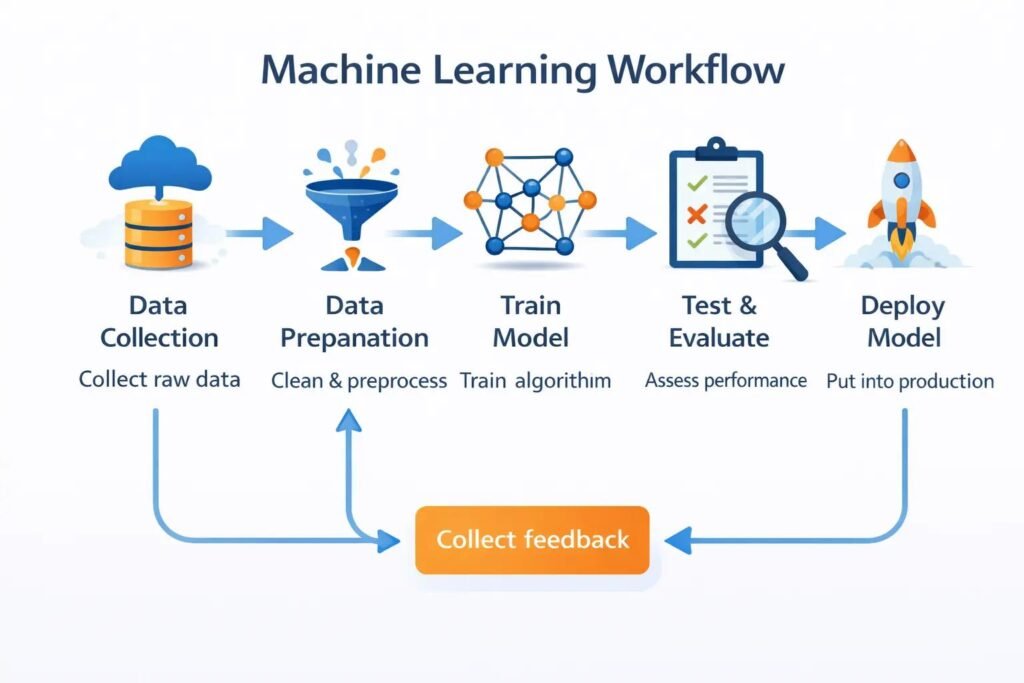
Although Artificial Intelligence may seem complex, its basic process is relatively straightforward. AI systems learn from data, identify patterns, make predictions or decisions, and continuously improve their performance through experience. Google provides helpful resources explaining AI technologies, machine learning, and responsible AI through its Google AI platform.
Most AI systems follow a series of steps that enable them to perform intelligent tasks. For a deeper understanding of AI hardware and deep learning, explore the educational resources available from NVIDIA AI.
Step 1: Collecting Data
Everything begins with data. AI requires large amounts of information to learn effectively. This data may include:
- Images
- Videos
- Text documents
- Audio recordings
- Customer transactions
- Sensor readings
- Medical records
- Weather information
The quality and quantity of data directly influence how well an AI system performs. Accurate, diverse, and well-organized datasets usually produce better results.
Step 2: Training the AI Model
Once enough data has been collected, developers train an AI model using machine learning algorithms. During training, the model analyzes thousands or even millions of examples to identify relationships and recurring patterns.
For example, if an AI is being trained to recognize dogs, it may analyze millions of labeled images showing different dog breeds, sizes, colors, and backgrounds. Over time, it learns the features that distinguish dogs from other animals.
The more high-quality data the model receives, the better its predictions generally become.
Step 3: Making Predictions
After training, the AI uses what it has learned to analyze new information.
For instance:
- An email service predicts whether a message is spam.
- A navigation app predicts the fastest route.
- A streaming platform predicts which movies you might enjoy.
- An online retailer predicts products you are likely to purchase.
Instead of following fixed instructions, the AI uses learned patterns to make informed decisions based on probability.
Step 4: Improving Through Feedback
Many AI systems continue improving after deployment. By comparing predictions with actual outcomes, they identify mistakes and adjust their internal models to become more accurate over time.
For example, if a music recommendation platform notices that users frequently skip certain suggested songs, it updates its recommendation algorithm to provide more relevant suggestions in the future.
This ability to learn and improve is one of the defining features that separates Artificial Intelligence from traditional software.
Practical Example
Imagine you want to build an AI system that identifies ripe and unripe mangoes.
- You collect 50,000 images of mangoes.
- Each image is labeled as ripe or unripe.
- The AI studies differences in color, texture, and shape.
- After training, you upload a new mango image.
- The AI analyzes the image and predicts whether the mango is ripe with a high level of confidence.
This same learning process is used in many real-world AI applications, including medical diagnosis, facial recognition, fraud detection, autonomous vehicles, and quality control in manufacturing.
Types of Artificial Intelligence
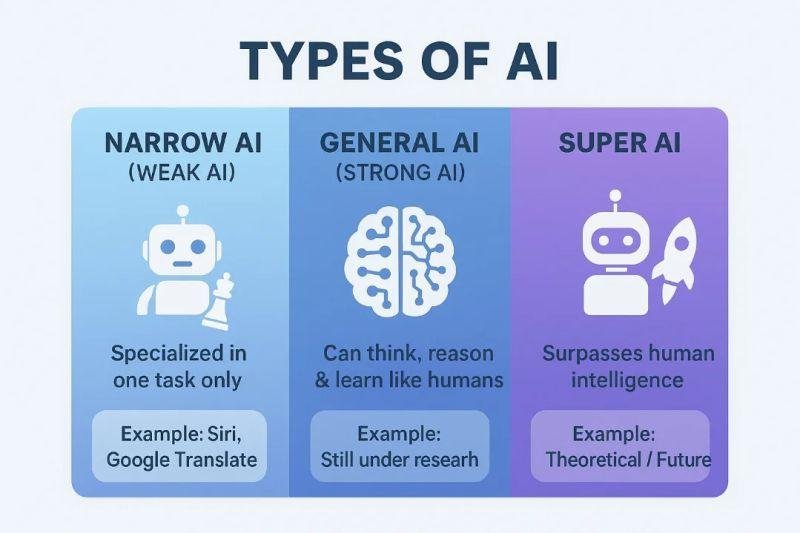
Artificial Intelligence is not a single technology. Instead, it consists of different types based on capability and functionality. Understanding these categories helps beginners appreciate what AI can currently do and what researchers hope it will achieve in the future.
Although AI is advancing rapidly, most of the AI systems available today belong to one category: Narrow AI. More advanced forms of AI remain theoretical and are still under active research.
Let’s explore the main types of Artificial Intelligence.
1. Narrow Artificial Intelligence (Narrow AI)
Narrow AI, also known as Weak AI, is designed to perform a specific task or a limited set of tasks. It cannot think beyond the purpose for which it was created.
Almost every AI application you use today falls into this category.
Examples include:
- ChatGPT answering questions
- Siri responding to voice commands
- Google Translate translating languages
- Netflix recommending movies
- Spotify suggesting music
- Gmail detecting spam emails
- Google Maps suggesting the fastest route
- Amazon recommending products
Although Narrow AI appears intelligent, it does not truly understand the world like humans do. It recognizes patterns, follows learned relationships, and produces results based on the data it was trained on.
For example, ChatGPT can explain complex topics and generate text, but it does not possess human consciousness or emotions.
Characteristics of Narrow AI
- Designed for one specific purpose
- Fast and accurate within its area
- Cannot perform unrelated tasks
- Learns from data
- Most common form of AI today
2. General Artificial Intelligence (General AI)
General Artificial Intelligence, often called Strong AI or Artificial General Intelligence (AGI), refers to machines that can think, learn, reason, and solve problems similarly to humans.
Unlike Narrow AI, General AI would not be limited to one task.
A General AI system could:
- Learn a new language
- Solve mathematical problems
- Drive a car
- Write a book
- Cook a meal
- Diagnose diseases
- Teach students
all without requiring separate programming for each activity.
General AI would be capable of transferring knowledge from one task to another, just as humans do.
For example, if a person learns to ride a bicycle, they can use their understanding of balance to learn how to ride a motorcycle more easily. General AI aims to possess this kind of adaptable intelligence.
However, General AI does not yet exist. Scientists and researchers around the world are still exploring whether it can be achieved safely and effectively.
Potential Advantages of General AI
- Human-like reasoning
- Better decision-making
- Adaptability across many tasks
- Ability to learn continuously
- Increased productivity across industries
Challenges
Creating General AI raises important technical and ethical questions, including safety, control, transparency, and responsible use.
3. Super Artificial Intelligence (Super AI)
Super Artificial Intelligence describes a hypothetical future AI that surpasses human intelligence in every possible area.
A Super AI could potentially outperform humans in:
- Scientific research
- Medical diagnosis
- Engineering
- Creativity
- Strategic planning
- Problem-solving
- Innovation
- Learning speed
Some experts believe Super AI could help solve humanity’s greatest challenges, such as climate change, disease, and energy shortages.
Others warn that such powerful systems would require careful governance to ensure they remain aligned with human values and goals.
It is important to understand that Super AI is purely theoretical. No existing AI system has reached this level of intelligence.
Types of AI Based on Functionality
Another common way to classify Artificial Intelligence is by examining how it functions.
Reactive Machines
Reactive Machines are the simplest form of AI.
These systems:
- Do not remember past experiences.
- React only to current inputs.
- Cannot learn from previous interactions.
One famous example is IBM’s Deep Blue, the chess-playing computer that defeated world chess champion Garry Kasparov in 1997.
Deep Blue analyzed the current chessboard and selected the best move, but it had no memory of previous games.
Limited Memory AI
Limited Memory AI can use historical information to improve decisions.
This is the most common type of AI used today.
Examples include:
- Self-driving cars
- AI-powered recommendation systems
- Virtual assistants
- Fraud detection software
- Weather forecasting systems
A self-driving car, for example, remembers the positions and speeds of nearby vehicles to make safer driving decisions.
Theory of Mind AI
Theory of Mind AI refers to AI systems that would understand human emotions, beliefs, intentions, and social interactions.
Such systems could communicate with people in ways that closely resemble human relationships.
Researchers continue to study this area, but practical Theory of Mind AI has not yet been achieved.
Self-Aware AI
Self-Aware AI represents the most advanced theoretical stage of Artificial Intelligence.
This type of AI would possess:
- Self-awareness
- Consciousness
- Emotions
- Independent thoughts
- Personal goals
Currently, no Self-Aware AI exists. It remains a concept explored in scientific research and science fiction.
Comparison of AI Types
| AI Type | Current Status | Examples |
|---|---|---|
| Narrow AI | Exists today | ChatGPT, Siri, Netflix, Google Translate |
| General AI | Under research | No real-world examples yet |
| Super AI | Theoretical | Does not exist |
| Reactive Machines | Exists | IBM Deep Blue |
| Limited Memory AI | Exists | Self-driving cars, recommendation systems |
| Theory of Mind AI | Research stage | No practical applications |
| Self-Aware AI | Theoretical | Science fiction concept |
Which Type of AI Should Beginners Focus On?
For beginners, the most important type to understand is Narrow AI because it powers the AI tools we use every day.
Whether you’re using:
- ChatGPT
- Google Gemini
- Microsoft Copilot
- Grammarly
- Canva AI
- Google Maps
- Netflix
- Spotify
you are interacting with Narrow AI.
Learning how these systems work provides an excellent foundation before exploring more advanced AI concepts like machine learning, deep learning, or Artificial General Intelligence.
Real-World Examples of Artificial Intelligence
Artificial Intelligence is no longer a futuristic concept. It has become an integral part of modern life, helping individuals and organizations perform tasks more efficiently, make better decisions, and improve user experiences. From the moment you unlock your smartphone in the morning to the time you stream your favorite movie at night, AI is likely working behind the scenes. IBM offers practical examples of how Artificial Intelligence is being used across industries such as healthcare, finance, manufacturing, and customer service on its IBM AI platform.
Understanding these everyday applications makes it easier to appreciate the practical value of Artificial Intelligence.
1. Virtual Assistants
Virtual assistants such as Siri, Google Assistant, Amazon Alexa, and Microsoft Copilot use AI to understand spoken language and respond to user commands.
They can:
- Answer questions
- Set reminders
- Play music
- Make phone calls
- Control smart home devices
- Provide weather forecasts
- Search the internet
These assistants use natural language processing (NLP) and machine learning to improve their responses over time.
2. Recommendation Systems
AI analyzes your preferences and behavior to recommend content or products you may enjoy.
Examples include:
- Netflix suggesting movies and TV shows.
- YouTube recommending videos.
- Spotify creating personalized playlists.
- Amazon recommending products.
- TikTok showing videos based on your interests.
These recommendations help users discover relevant content while improving customer satisfaction.
3. AI Chatbots
Businesses increasingly use AI chatbots to provide customer support around the clock.
AI chatbots can:
- Answer frequently asked questions.
- Help customers place orders.
- Track deliveries.
- Recommend products.
- Resolve simple support issues.
This reduces waiting times and improves customer service while allowing human agents to focus on more complex requests.
4. Healthcare
Artificial Intelligence is transforming healthcare by assisting doctors and medical professionals.
AI applications include:
- Detecting diseases from medical images.
- Predicting patient risks.
- Supporting diagnosis.
- Monitoring patient health.
- Assisting with drug discovery.
- Personalizing treatment plans.
Rather than replacing healthcare professionals, AI helps them make faster and more informed decisions.
5. Banking and Finance
Financial institutions use AI to improve security and efficiency.
Examples include:
- Fraud detection.
- Credit scoring.
- Investment analysis.
- Automated customer support.
- Personalized financial recommendations.
AI can analyze millions of transactions in real time, identifying suspicious activity much faster than traditional methods.
Artificial Intelligence is being adopted across nearly every industry because it can process large amounts of data, automate repetitive tasks, and improve decision-making. Here are more examples of how AI is making an impact in everyday life and business.
6. Education
AI is transforming education by making learning more personalized and accessible.
Examples include:
- AI tutors that explain difficult concepts.
- Personalized learning platforms that adapt to each student’s progress.
- Automated grading systems.
- Language-learning applications.
- AI-powered writing assistants.
Students can also use AI to summarize notes, practice interview questions, solve mathematical problems, and improve their writing skills.
7. Transportation
Transportation companies use AI to improve safety and efficiency.
Examples include:
- Self-driving vehicle technology.
- Traffic prediction systems.
- Route optimization.
- Ride-sharing apps matching drivers and passengers.
- Smart traffic lights that reduce congestion.
Navigation apps such as Google Maps use AI to estimate travel times based on real-time traffic conditions.
8. E-commerce
Online retailers rely heavily on AI to improve the shopping experience.
AI helps by:
- Recommending products.
- Predicting customer preferences.
- Detecting fraudulent purchases.
- Managing inventory.
- Providing virtual shopping assistants.
These technologies help businesses increase sales while giving customers a more personalized experience.
9. Agriculture
Modern farming is becoming smarter through Artificial Intelligence.
Farmers use AI to:
- Monitor crop health.
- Detect plant diseases.
- Predict weather patterns.
- Optimize irrigation.
- Improve harvest planning.
- Reduce waste.
AI-powered drones and sensors collect valuable data that helps farmers make better decisions.
10. Manufacturing
Manufacturers use AI to increase productivity and reduce operational costs.
Applications include:
- Quality inspection.
- Predictive equipment maintenance.
- Robotics.
- Supply chain optimization.
- Production scheduling.
Instead of replacing every worker, AI often assists employees by handling repetitive tasks and identifying potential problems before they become serious.
11. Cybersecurity
Cybersecurity professionals use AI to identify and prevent cyber threats.
AI systems can:
- Detect unusual network activity.
- Identify malware.
- Prevent phishing attacks.
- Monitor suspicious login attempts.
- Respond to security incidents more quickly.
Since cyber threats evolve constantly, AI helps organizations stay one step ahead of attackers.
12. Content Creation
Generative AI has become a powerful tool for creating digital content.
Content creators use AI to:
- Write articles.
- Generate marketing copy.
- Create images.
- Produce videos.
- Generate presentation slides.
- Brainstorm ideas.
- Edit grammar and spelling.
AI helps creators work faster, but human creativity, fact-checking, and editorial judgment remain essential for producing high-quality content.
Benefits of Artificial Intelligence
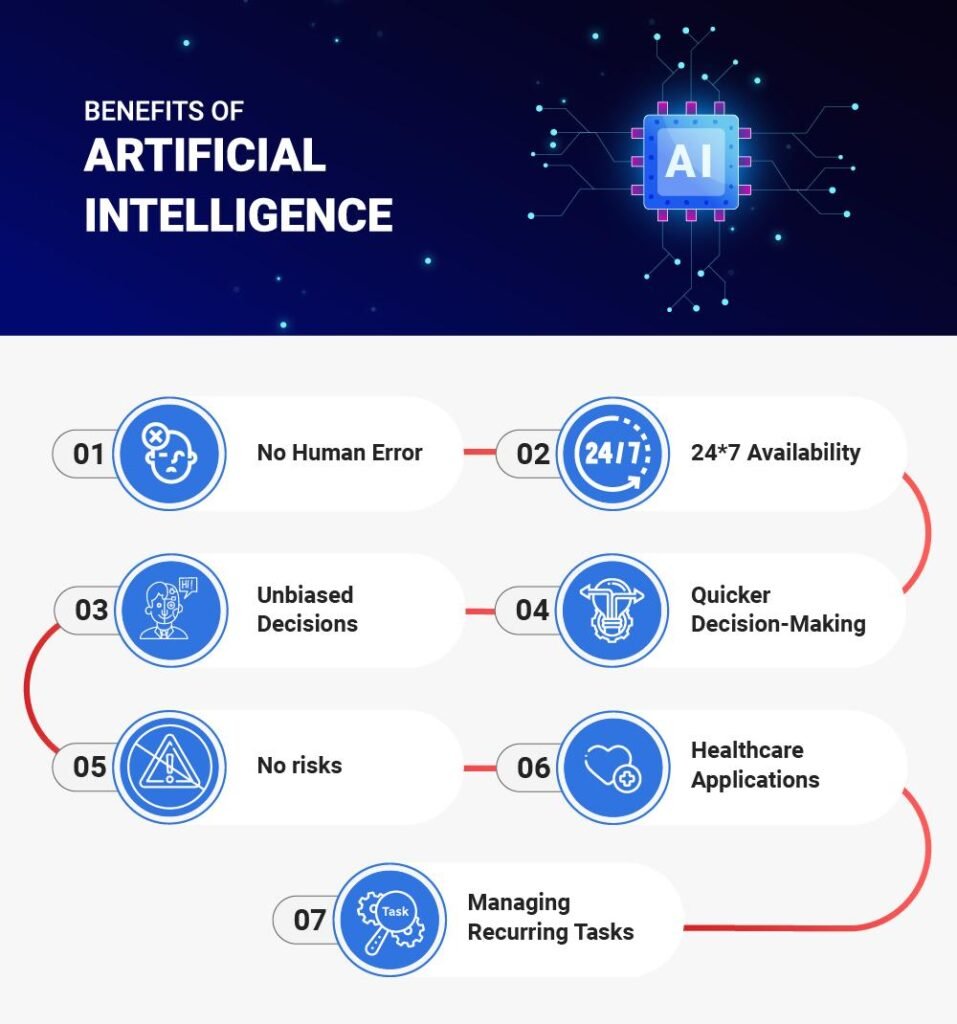
Artificial Intelligence offers numerous advantages for individuals, businesses, governments, and society. When used responsibly, AI can improve productivity, reduce costs, enhance decision-making, and solve complex problems more efficiently than traditional methods. Microsoft also highlights how AI is transforming businesses, education, healthcare, and productivity through its Microsoft AI initiatives.
Here are some of the most significant benefits of AI.
1. Increased Productivity
AI automates repetitive and time-consuming tasks, allowing people to focus on more valuable work.
For example, customer support chatbots can answer routine questions, enabling human representatives to handle more complex issues.
2. Faster Decision-Making
AI can analyze enormous datasets within seconds and identify useful insights.
Businesses use AI to:
- Predict customer demand.
- Analyze financial markets.
- Detect fraud.
- Forecast sales.
- Optimize supply chains.
This enables faster and more informed decision-making.
3. Improved Accuracy
Unlike humans, AI does not become tired or distracted when performing repetitive tasks.
When trained with high-quality data, AI can produce highly accurate results in areas such as:
- Medical image analysis.
- Face recognition.
- Speech recognition.
- Manufacturing quality inspection.
However, AI accuracy still depends on the quality of the data used during training.
4. Cost Savings
By automating repetitive processes, businesses can reduce operational costs.
Examples include:
- Automated customer service.
- Inventory management.
- Data entry.
- Predictive maintenance.
- Marketing automation.
Lower operating costs often allow businesses to invest more in innovation and growth.
5. 24/7 Availability
AI systems can operate continuously without needing breaks or sleep.
Examples include:
- Customer service chatbots.
- Virtual assistants.
- Fraud monitoring systems.
- Website support agents.
This improves customer experience by providing assistance at any time of the day.
6. Better Personalization
AI analyzes user behavior to deliver personalized experiences.
Examples include:
- Product recommendations.
- Music suggestions.
- Personalized advertisements.
- Customized online courses.
- Social media feeds.
Personalization helps users discover relevant content more quickly.
7. Solving Complex Problems
AI assists researchers and professionals in solving problems that involve large amounts of data.
Applications include:
- Climate modeling.
- Drug discovery.
- Disease prediction.
- Financial forecasting.
- Space exploration.
By processing information rapidly, AI supports innovations that would otherwise take much longer to achieve.
8. Improved Accessibility
AI technologies make digital services more accessible for people with disabilities.
Examples include:
- Speech-to-text tools.
- Text-to-speech systems.
- Real-time translation.
- Voice-controlled devices.
- Image recognition for visually impaired users.
These technologies help create more inclusive digital experiences.
Challenges and Limitations of Artificial Intelligence
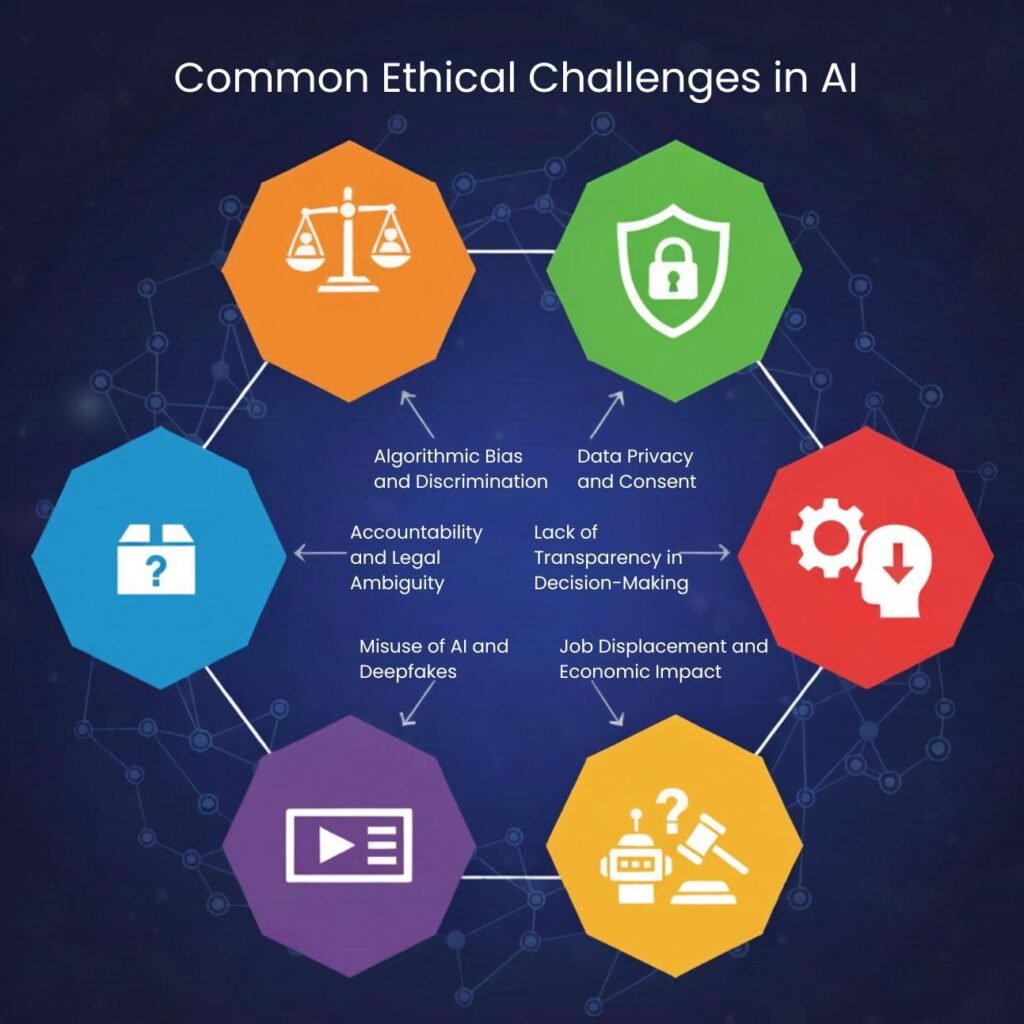
Although AI offers remarkable benefits, it also presents significant challenges. Understanding these limitations helps people use AI responsibly and recognize that it is not a perfect technology.
1. Job Displacement
Automation may reduce the demand for certain repetitive jobs.
Tasks involving:
- Data entry.
- Basic customer support.
- Manufacturing.
- Administrative work.
can increasingly be handled by AI-powered systems.
However, AI also creates new career opportunities in software development, data science, cybersecurity, AI ethics, prompt engineering, and digital transformation.
2. Privacy Concerns
Many AI systems rely on large amounts of personal data.
This raises concerns about:
- Data collection.
- User privacy.
- Data security.
- Consent.
- Information misuse.
Organizations must protect user information and comply with privacy regulations.
3. Bias and Fairness
AI learns from historical data.
If that data contains bias, the AI system may produce unfair or discriminatory results.
For example:
- Hiring systems.
- Loan approval algorithms.
- Facial recognition software.
Developers must continuously evaluate AI models to reduce bias and improve fairness.
4. Lack of Human Judgment
AI can analyze information quickly, but it cannot fully replace human judgment, empathy, ethics, or common sense.
Important decisions involving healthcare, law, education, or public safety still require human oversight.
5. Security Risks
AI technologies can be misused.
Potential risks include:
- Deepfake videos.
- AI-generated scams.
- Automated cyberattacks.
- Fake news.
- Identity theft.
Responsible development and regulation are essential to reduce these risks.
6. High Development Costs
Building advanced AI systems often requires:
- Powerful computers.
- Large datasets.
- Skilled engineers.
- Significant financial investment.
This can make AI development expensive for smaller organizations.
7. Dependence on Quality Data
An AI system is only as good as the data it learns from.
Poor-quality data can result in:
- Incorrect predictions.
- Biased recommendations.
- Reduced accuracy.
- Unreliable outcomes.
For this reason, collecting clean, accurate, and diverse data is one of the most important steps in developing AI.
Common AI Terms Every Beginner Should Know
As you begin learning Artificial Intelligence, you will encounter many technical terms. Understanding these concepts will make it easier to follow AI discussions and use AI tools effectively.
Algorithm
A set of instructions that tells a computer how to solve a problem or complete a task.
Machine Learning (ML)
A branch of AI that enables computers to learn from data without being explicitly programmed for every situation.
Deep Learning
A specialized area of machine learning that uses artificial neural networks with multiple layers to recognize complex patterns.
Neural Network
A computer model inspired by the structure of the human brain that helps AI recognize relationships within data.
Dataset
A collection of information used to train and evaluate AI systems.
Training
The process of teaching an AI model by exposing it to large amounts of data.
Natural Language Processing (NLP)
A field of AI that enables computers to understand, interpret, and generate human language.
Examples include chatbots, translation software, and AI writing assistants.
Computer Vision
A branch of AI that enables computers to analyze and interpret images and videos.
Applications include facial recognition, medical imaging, and autonomous vehicles.
Prompt
The instruction or question given to an AI system to generate a response.
For example:
“Write a beginner’s guide to Artificial Intelligence.”
Generative AI
A type of AI that creates new content, including text, images, audio, videos, and computer code based on user prompts.
Popular examples include ChatGPT and image-generation tools.
How to Start Learning Artificial Intelligence
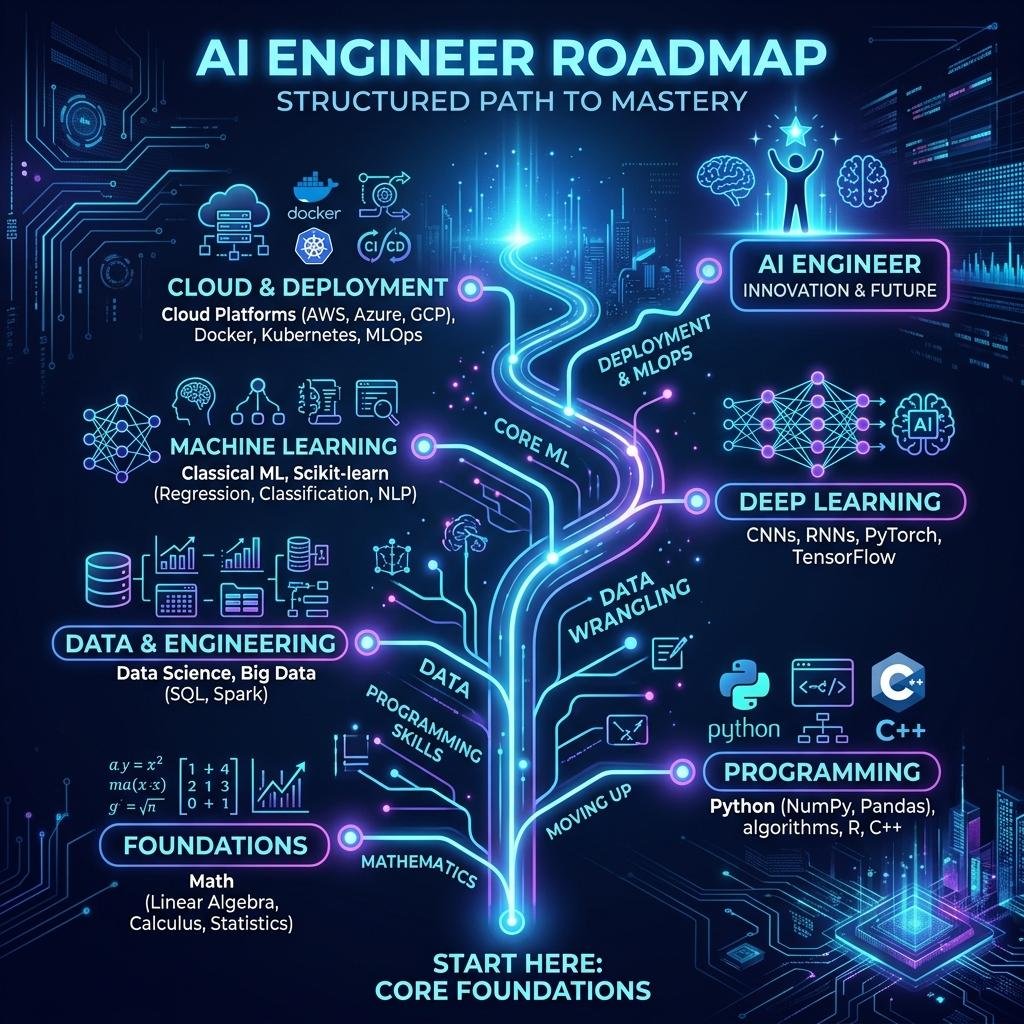
Artificial Intelligence may seem intimidating at first, but learning AI is more accessible today than ever before. Thanks to free online courses, educational videos, interactive tools, and AI-powered applications, anyone with curiosity and a willingness to learn can begin their AI journey. Once you’ve learned the basics, practice your skills on Kaggle, where you can work with real datasets and participate in machine learning competitions.
You do not need an advanced degree in computer science to understand the fundamentals. In fact, many successful professionals started by learning the basics before gradually exploring more advanced topics.
Here are practical steps to help beginners get started.
1. Understand the Fundamentals
Before diving into coding or advanced AI tools, take time to understand the basic concepts.
Learn about topics such as:
- What Artificial Intelligence is.
- Machine Learning.
- Deep Learning.
- Natural Language Processing.
- Computer Vision.
- Data.
- Algorithms.
- Neural Networks.
A strong foundation makes it much easier to understand more advanced AI concepts later.
2. Learn Basic Programming
Although you can use many AI tools without programming, learning to code opens up many more opportunities.
Python is the most popular programming language for Artificial Intelligence because it is beginner-friendly and has a large collection of AI libraries.
Popular Python libraries include:
- TensorFlow
- PyTorch
- Scikit-learn
- Pandas
- NumPy
If programming feels overwhelming, start by learning basic Python before exploring AI development.
3. Learn Basic Mathematics
Artificial Intelligence relies on mathematics to analyze data and build predictive models.
Important areas include:
- Basic algebra
- Statistics
- Probability
- Linear algebra
- Calculus (for advanced AI)
Don’t worry if you’re not a math expert. Beginners can start with the fundamentals and improve gradually.
4. Use AI Tools Yourself
One of the fastest ways to learn AI is by using it regularly.
Experiment with tools such as:
- ChatGPT
- Google Gemini
- Microsoft Copilot
- Claude
- Canva AI
- Grammarly
- Notion AI
Ask questions, summarize articles, generate ideas, write emails, or create study notes. Hands-on practice helps you understand AI’s strengths and limitations.
5. Take Online Courses
Many organizations offer beginner-friendly AI courses.
Look for courses that cover:
- AI fundamentals
- Machine Learning basics
- Prompt engineering
- Responsible AI
- Practical AI applications
Learning through structured lessons helps you build knowledge step by step.
6. Build Small Projects
The best way to learn is by applying your knowledge.
Beginner-friendly AI projects include:
- A chatbot.
- A movie recommendation system.
- A spam email classifier.
- An image recognition application.
- A simple AI-powered website.
Projects help reinforce concepts while building your portfolio.
7. Stay Updated
Artificial Intelligence evolves rapidly.
Follow:
- Technology blogs.
- AI newsletters.
- Research updates.
- Industry conferences.
- Educational YouTube channels.
Continuous learning helps you stay informed about new tools, trends, and best practices.
Tips for Beginners
If you’re just starting, remember these simple tips:
- Learn consistently instead of trying to learn everything at once.
- Practice using AI every day.
- Focus on understanding concepts before advanced programming.
- Verify AI-generated information using reliable sources.
- Treat AI as a learning assistant rather than a replacement for critical thinking.
Small, consistent progress will help you build confidence over time.
The Future of Artificial Intelligence
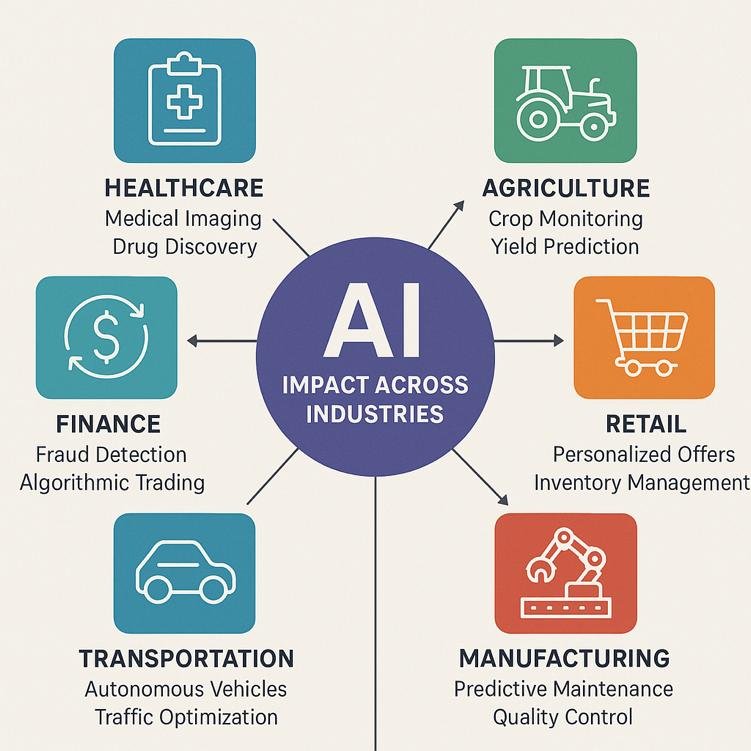
Artificial Intelligence is expected to play an even greater role in society over the coming decades. As computing power increases and AI models become more capable, new applications will continue to emerge across almost every industry.
In healthcare, AI may help doctors diagnose diseases earlier, develop personalized treatments, and accelerate medical research.
In education, AI-powered learning platforms could provide personalized lessons tailored to each student’s learning style and pace.
Businesses will increasingly use AI to automate routine tasks, analyze customer behavior, improve decision-making, and create more efficient operations.
Agriculture may benefit from smarter farming techniques that improve crop yields while reducing environmental impact.
Transportation is also expected to evolve through autonomous vehicles, smarter traffic management systems, and AI-assisted logistics.
Creative industries are already using AI to assist with writing, graphic design, music production, video editing, and software development. Rather than replacing human creativity, AI is becoming a valuable tool that helps professionals work faster and explore new ideas.
However, the future of AI also depends on responsible development. Governments, researchers, technology companies, and communities must work together to ensure AI is used ethically, transparently, and safely.
Important discussions about privacy, fairness, accountability, cybersecurity, and employment will continue as AI becomes more integrated into daily life.
While no one can predict exactly how Artificial Intelligence will evolve, one thing is clear: AI will remain one of the most influential technologies shaping the future of business, education, healthcare, science, and society.
Learning AI today is therefore an investment in tomorrow’s opportunities.
Practical Example: How Artificial Intelligence Works in Everyday Life

Imagine you enjoy watching action movies on a streaming platform.
During your first week, you watch several action and adventure films. The platform’s AI records information such as:
- The genres you watch.
- The movies you finish.
- The films you skip.
- The ratings you give.
- The time you spend watching.
After analyzing this information, the AI identifies patterns in your preferences.
The next time you open the app, it recommends more action movies, superhero films, and adventure series because it predicts you are likely to enjoy them.
If you suddenly begin watching documentaries and educational videos instead, the AI gradually updates its recommendations to reflect your changing interests.
This simple example demonstrates one of AI’s greatest strengths: learning from data and improving its predictions over time.
Rather than being manually programmed for every individual user, the AI continuously analyzes information and adapts its recommendations based on observed behavior.
The same principle is used in online shopping, music streaming, navigation apps, social media platforms, fraud detection systems, and many other AI-powered services we use every day.

Final Thoughts
Artificial Intelligence is no longer a technology of the distant future; it is already transforming the way we live, learn, communicate, and work. From recommending movies and translating languages to assisting doctors and improving business operations, AI has become an essential part of modern society.
For beginners, understanding the basics of AI is an important first step toward becoming digitally prepared in an increasingly technology-driven world. You don’t need to become a programmer overnight to benefit from AI. Simply learning how AI works, recognizing its capabilities and limitations, and using AI tools responsibly can improve your productivity, creativity, and decision-making.
As AI continues to evolve, new career opportunities, industries, and innovations will emerge. Individuals who develop AI knowledge today will be better positioned to adapt to future technological changes and take advantage of new possibilities.
The journey into Artificial Intelligence begins with curiosity and continuous learning. Start with the fundamentals, practice using AI tools, keep exploring new concepts, and always evaluate AI-generated information critically. By doing so, you’ll not only understand one of the world’s most important technologies but also be prepared to thrive in the digital future.
Frequently Asked Questions (FAQ)
1. What is Artificial Intelligence (AI)?
Artificial Intelligence (AI) is a branch of computer science that enables computers and machines to perform tasks that normally require human intelligence, such as learning, problem-solving, understanding language, recognizing images, and making decisions.
2. Is Artificial Intelligence the same as Machine Learning?
No. Artificial Intelligence is the broader field of creating intelligent systems, while Machine Learning is a subset of AI that allows computers to learn from data without being explicitly programmed for every task.
3. Can beginners learn Artificial Intelligence?
Yes. Anyone can begin learning AI by understanding the basics, using AI-powered tools, taking online courses, and gradually exploring concepts like machine learning and prompt engineering.
4. Do I need to know programming to use AI?
No. Many AI tools, such as ChatGPT, Google Gemini, Microsoft Copilot, and Canva AI, can be used without programming knowledge. However, learning Python is beneficial if you want to build AI applications.
5. What industries use Artificial Intelligence?
AI is widely used in healthcare, finance, education, agriculture, manufacturing, transportation, cybersecurity, entertainment, retail, marketing, and many other industries.
6. Will Artificial Intelligence replace human jobs?
AI is expected to automate certain repetitive tasks, but it is also creating new career opportunities. In many cases, AI is designed to assist people rather than replace them entirely.
7. Is Artificial Intelligence safe?
AI can provide significant benefits when developed and used responsibly. However, issues such as privacy, bias, misinformation, and cybersecurity require careful management and ethical oversight.
8. How can I start learning AI today?
Start by learning the fundamentals of AI, experimenting with AI tools, taking beginner-friendly courses, reading educational articles, and practicing regularly. Consistent learning is the best way to build your understanding.
Ready to Explore the World of Artificial Intelligence?
Artificial Intelligence is transforming the future, and now is the perfect time to start learning. Whether you’re a student, entrepreneur, professional, or simply curious about technology, building your AI knowledge today can help you stay ahead in an increasingly digital world.
At BuildSmartAfri, we’re committed to providing practical, beginner-friendly guides that make complex technology easy to understand.
Explore more AI, Technology, Online Business, and Forex articles on BuildSmartAfri to continue expanding your digital skills and prepare for tomorrow’s opportunities.
Disclaimer
Disclaimer: This article is intended for educational and informational purposes only. While every effort has been made to provide accurate and up-to-date information, Artificial Intelligence is a rapidly evolving field, and technologies may change over time. Readers are encouraged to verify important information through official sources and continue learning from trusted educational resources.