
Introduction:
Forex Trading Risks for Beginners: What Every New Trader Should Know: Forex trading has become increasingly popular among people looking to learn about financial markets and potentially grow their income. With just a smartphone, laptop, and internet connection, beginners can access the world’s largest financial market and trade currencies from almost anywhere. Before understanding the risks involved, it is important to learn how the Forex market operates and why millions of traders participate in it every day.
The Forex market processes trillions of dollars in transactions every day, making it one of the most liquid and active markets in the world. This accessibility and potential for profit attract millions of new traders each year.
However, Forex trading is not a guaranteed path to financial success.
Many beginners enter the market with unrealistic expectations. Social media often highlights successful trades and stories of traders making significant profits, but it rarely shows the losses, challenges, and risks involved in trading.
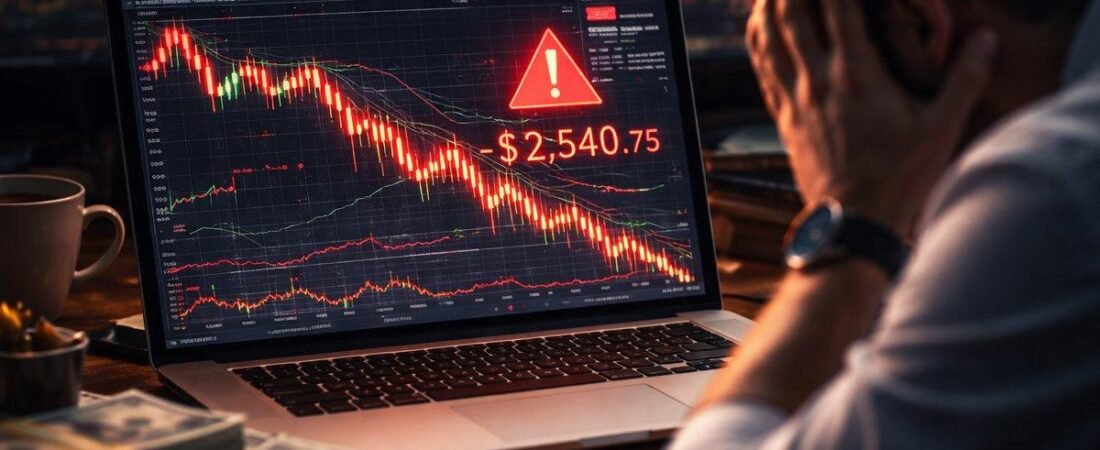
The reality is that Forex trading carries substantial risks. Currency prices can move unexpectedly due to economic news, inflation reports, interest rate decisions, political developments, and global events. Without proper knowledge and risk management, beginners can lose money quickly.
This does not mean Forex trading should be avoided.
Instead, it means that every new trader must understand the risks involved before risking real money.
Successful traders understand a simple but powerful principle:
Risk cannot be eliminated, but it can be managed.
Understanding the risks of Forex trading helps beginners make informed decisions, avoid common mistakes, and develop realistic expectations about the market.
Consider this example.
Imagine two beginners start trading with $1,000 each.
The first trader believes every trade will be profitable. They risk large amounts of money, ignore stop-loss orders, and trade based on emotions.
After several losing trades, most of the account balance is gone.
The second trader spends time learning about risk management. They risk only a small percentage of their account on each trade, use stop-loss orders, and follow a trading plan.
Although both traders experience losses, the second trader preserves most of their capital and continues learning and improving.
This example highlights one of the most important lessons in trading:
Your ability to manage risk often determines your long-term success more than your ability to predict market movements.
In this guide, you will learn about the major risks every beginner should understand before trading Forex and discover practical ways to protect your capital and trade more responsibly.
What Is Risk in Forex Trading?
Risk in Forex trading refers to the possibility of losing money because the market moves differently from what you expected.
Every trade involves uncertainty.
When you buy or sell a currency pair, there is no guarantee that the market will move in your favor. Prices can change within seconds because of economic reports, central bank announcements, geopolitical events, or shifts in market sentiment.
For example, suppose you buy the EUR/USD currency pair because you believe the euro will strengthen against the US dollar.
Instead of rising, unexpected economic data is released, causing the euro to weaken.
The market moves against your position, and your trade begins losing money.
This possibility of financial loss is known as trading risk.
Many beginners mistakenly believe that risk only means losing money on individual trades.
In reality, risk is much broader.
Forex trading risks include:
- Losing more money than expected
- Making emotional decisions
- Overusing leverage
- Trading without proper knowledge
- Depending on unreliable brokers
- Experiencing technical problems during trading
- Mismanaging trading capital
Because risk is unavoidable, the objective of successful trading is not to avoid risk completely.
Instead, successful traders focus on managing risk effectively.
Professional traders know that losses are part of trading.
They accept that some trades will fail and create systems that prevent small losses from becoming devastating ones.
This approach allows them to stay in the market long enough to learn, improve, and take advantage of future opportunities.
One of the most important principles in Forex trading is:
Protecting your trading capital is more important than chasing profits.
Without capital, you cannot continue trading.
But with proper risk management, even a series of losses can be survived, allowing you to remain in the market and continue developing your skills.
Why Beginners Often Underestimate Forex Trading Risks
One of the biggest reasons many new traders lose money is that they underestimate the risks involved in Forex trading.
Because the Forex market is easily accessible and filled with stories of successful traders, many beginners assume that making money is simple. They see screenshots of profitable trades on social media, watch videos about financial freedom, and hear stories about traders turning small accounts into large ones.
Unfortunately, these success stories often leave out one important fact:
Every successful trader has experienced losses and learned how to manage risk.
Many beginners enter the market focusing entirely on potential profits while paying little attention to the possibility of losing money.
This mindset can lead to unrealistic expectations and poor decision-making.
1. The Desire for Quick Profits
One of the most common reasons beginners underestimate risk is the desire to make money quickly.
Forex trading offers opportunities to earn profits, but it is not a get-rich-quick scheme.
Some new traders believe they can double or triple their money within a few days or weeks.
This expectation often causes traders to:
- Risk too much money on individual trades
- Use excessive leverage
- Ignore stop-loss orders
- Trade impulsively
- Overtrade in search of quick profits
For example, imagine a beginner with a $500 trading account.
Instead of risking only $10 or $20 per trade, they risk $150 because they hope to make large profits quickly.
If the trade goes against them, a significant portion of their account can disappear within minutes.
Chasing quick profits usually increases risk rather than reducing it.
2. Lack of Education
Many beginners start trading without fully understanding how the Forex market works.
Because opening a trading account is easy, some people begin trading immediately without learning essential concepts such as:
- Risk management
- Position sizing
- Leverage
- Stop-loss orders
- Market volatility
- Trading psychology
Without this knowledge, traders often make decisions based on emotions rather than informed analysis.
Imagine someone driving a car without understanding traffic rules.
The chances of making mistakes and having accidents become significantly higher.
The same principle applies to Forex trading.
The less knowledge you have, the greater your exposure to unnecessary risks.
3. Overconfidence After Early Success
Sometimes beginners experience success during their first few trades.
While making profits feels exciting, early success can create dangerous overconfidence.
A trader who wins several trades may begin to believe that trading is easy and that losses are unlikely.
This confidence can lead to risky behaviors such as:
- Increasing position sizes dramatically
- Ignoring trading plans
- Removing stop-loss orders
- Taking trades without proper analysis
- Trading too frequently
Eventually, one bad trade can erase weeks or months of profits.
Successful traders understand that every trade carries uncertainty regardless of previous success.
4. Underestimating the Power of Leverage
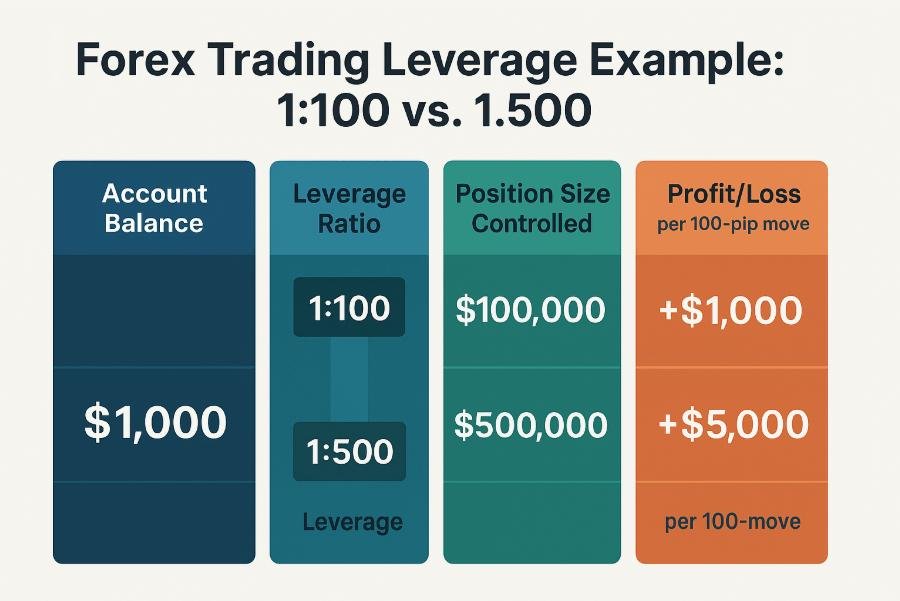
Forex brokers often provide leverage that allows traders to control larger positions with relatively small amounts of money.
While leverage can increase profits, it can also magnify losses. Although leverage can increase profit potential, understanding how leverage in Forex trading works is essential because it can magnify losses just as quickly.
Many beginners focus on the profit potential of leverage and overlook its risks.
For example:
Suppose you have $500 in your account.
Using leverage, you control a much larger position in the market.
If the trade moves in your favor, profits can grow quickly.
However, if the market moves against you, losses can also increase rapidly.
A small price movement can result in significant financial damage.
This is why experienced traders treat leverage with caution.
5. Emotional Decision-Making
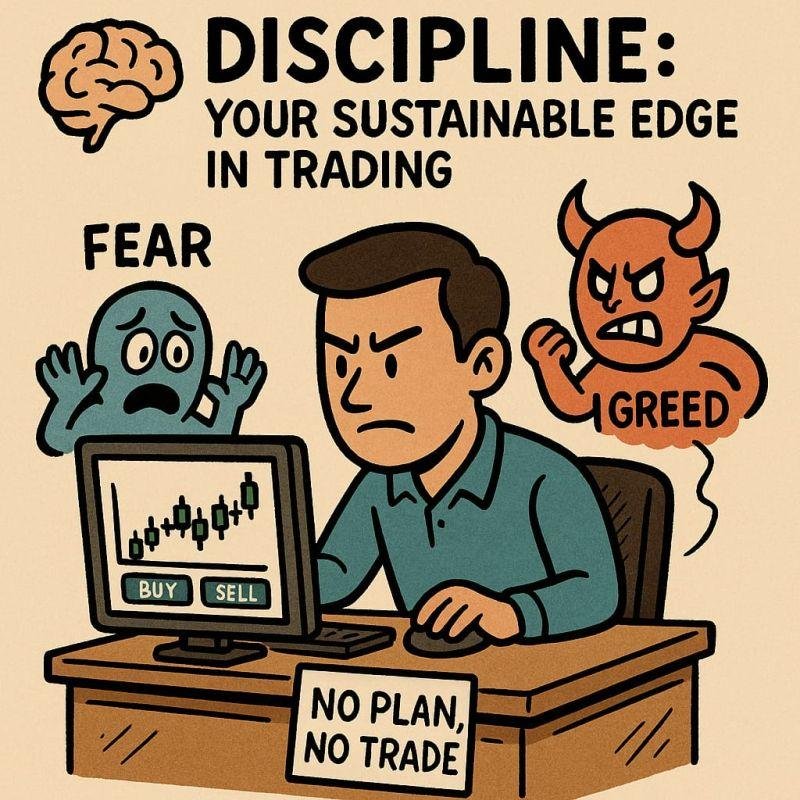
Emotions are one of the biggest risks in trading.
Many beginners underestimate how strongly emotions can influence their decisions.
Common emotions include:
Fear
Fear causes traders to close profitable trades too early or avoid taking valid trading opportunities.
Greed
Greed encourages traders to risk too much money or hold trades for unrealistic profits.
Hope
Hope causes traders to hold losing positions because they believe the market will eventually reverse.
Frustration
After losses, frustration often leads to revenge trading and impulsive decisions.
Professional traders understand that emotional control is just as important as technical analysis.
6. Believing Losses Will Never Happen
Perhaps the biggest mistake beginners make is believing that they can avoid losses entirely.
Every successful trader experiences losing trades.
Losses are not signs of failure.
They are simply part of participating in financial markets.
The difference between successful and unsuccessful traders is not the number of losses they experience.
The difference lies in how they respond to those losses.
Successful traders:
- Accept losses as part of trading
- Keep losses small
- Protect their capital
- Follow their trading plans
- Learn from mistakes
- Focus on long-term improvement
Understanding this principle changes the way traders approach the market.
Instead of trying to win every trade, they concentrate on managing risk and preserving their accounts.
Key Takeaway
Most beginners underestimate Forex trading risks because they focus heavily on profits while overlooking the challenges of the market.
They chase quick money, underestimate leverage, ignore education, and allow emotions to influence their decisions.
However, successful trading begins when traders recognize that risk is unavoidable and learn how to manage it responsibly.
The goal is not to eliminate risk completely.
The goal is to understand risk, prepare for it, and develop habits that protect your capital and support long-term success in the Forex market.
Liquidity Risk
Liquidity refers to how easily a currency pair can be bought or sold without causing significant price changes.
The Forex market is generally considered highly liquid because it involves enormous trading volumes every day. However, liquidity is not always the same across all currency pairs or trading sessions.
Certain situations can reduce liquidity, including:
- Trading exotic currency pairs
- Market holidays
- Late trading sessions
- Major economic announcements
- Unexpected global events
When liquidity decreases, price movements can become unpredictable.
Practical Example
Suppose you enter a trade involving an exotic currency pair during a period of low market activity.
You decide to close your position, but because there are fewer buyers and sellers in the market, the trade is executed at a less favorable price than expected.
As a result, your losses become larger than anticipated.
This is known as liquidity risk.
How to Reduce Liquidity Risk
- Focus on major currency pairs such as EUR/USD, GBP/USD, and USD/JPY.
- Avoid trading during market holidays and low-volume periods.
- Be cautious when trading exotic currency pairs.
- Pay attention to market conditions before entering trades.
Broker Risk
Forex traders depend heavily on brokers to execute trades and provide access to the market.
Unfortunately, not all brokers operate with the same level of reliability and professionalism.
Broker risk refers to the possibility of losing money because of issues related to your trading broker.
These issues may include:
- Poor trade execution
- Excessive spreads and fees
- Platform outages
- Withdrawal difficulties
- Lack of transparency
- Weak regulatory oversight
Practical Example
Imagine making profitable trades and deciding to withdraw your money.
However, your broker delays the withdrawal process or imposes unexpected restrictions.
Even though your trades were successful, accessing your funds becomes difficult.
This is an example of broker risk.
How to Reduce Broker Risk
- Research brokers carefully before opening an account.
- Choose brokers regulated by reputable financial authorities.
- Read reviews from other traders.
- Understand the broker’s fees and trading conditions.
- Test the broker’s customer support and withdrawal process.
Remember:
Choosing the right broker is just as important as choosing the right trading strategy.
Technology Risk
Forex trading relies heavily on technology.
Most traders execute trades using trading platforms, internet connections, computers, and mobile devices.
Technology problems can interfere with trading and sometimes result in unexpected losses.
Technology risk may involve:
- Internet outages
- Trading platform failures
- Power interruptions
- Device malfunctions
- Delayed trade execution
- Software errors
Practical Example
Suppose you have an open trade that requires close monitoring.
Suddenly, your internet connection fails.
During the outage, the market moves sharply against your position.
Because you cannot access your trading platform, you are unable to manage the trade effectively.
By the time your connection is restored, your losses are significantly larger.
This is technology risk.
How to Reduce Technology Risk
- Use stable and reliable internet connections.
- Keep trading software updated.
- Have backup internet access whenever possible.
- Use stop-loss orders to protect open positions.
- Avoid relying entirely on technology without risk management measures.
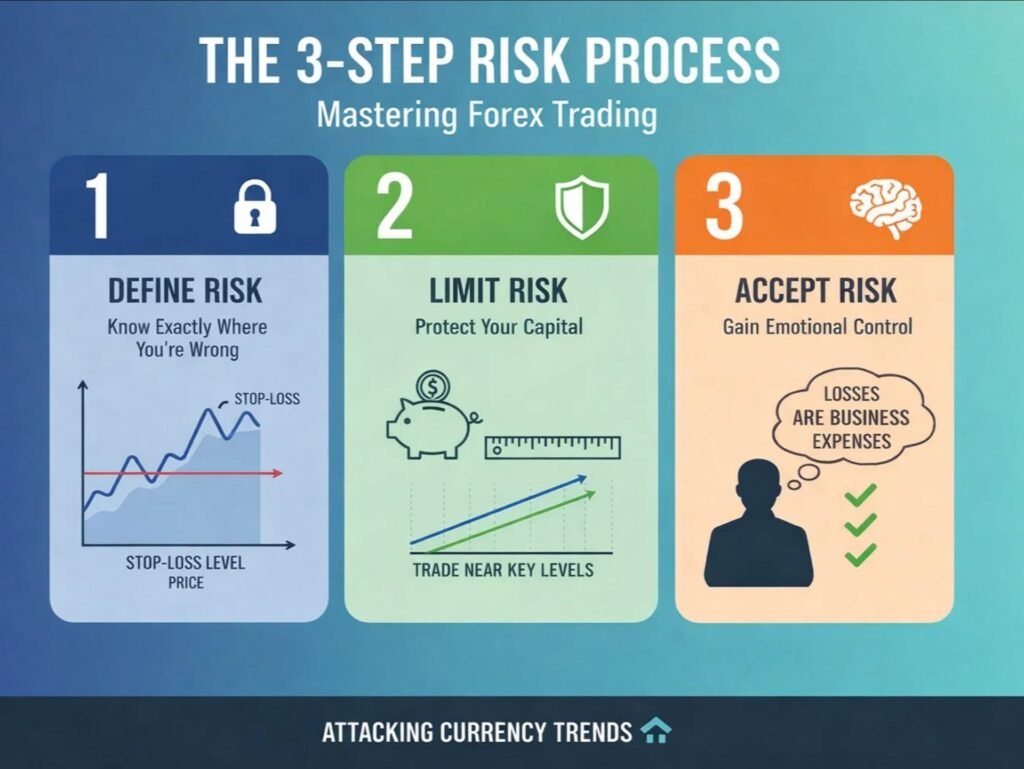
Practical Example: How Multiple Risks Can Affect One Trade
Imagine you have a trading account balance of $1,000.
You see an opportunity in EUR/USD and decide to risk a large amount because you feel confident.
You use high leverage and open a position much larger than your account size.
Moments later, an unexpected economic report causes the market to become highly volatile.
The market moves sharply against your trade.
At the same time:
- Market risk causes prices to move unexpectedly.
- Leverage risk magnifies your losses.
- Volatility risk accelerates the price movement.
- Emotional risk causes you to panic.
- Technology risk prevents you from quickly adjusting your trade because of a poor internet connection.
Within minutes, you lose a significant portion of your account.
This example demonstrates why successful trading requires more than predicting market direction.
It requires understanding and managing risk.
Key Lessons for Beginners
Before risking real money in Forex trading, remember these important principles:
Developing strong risk management principles can help traders protect their capital and survive periods of market uncertainty.
✔ Losses are a normal part of trading.
✔ Never risk money that you cannot afford to lose.
✔ Protecting your capital is more important than chasing profits.
✔ Small losses are easier to recover from than large losses.
✔ Emotional control is a major factor in trading success.
✔ Proper risk management can help you survive difficult market conditions.
✔ Successful trading is a long-term journey, not a get-rich-quick scheme.
Final Thoughts
Forex trading offers exciting opportunities, but it also comes with significant risks that every beginner must understand.
Market movements are unpredictable, leverage can magnify losses, emotions can influence decisions, and technology or broker-related problems can affect trading performance.
The good news is that these risks can be managed.
Successful traders do not ignore risk or assume that every trade will be profitable. Instead, they prepare for losses, protect their capital, and follow disciplined trading practices.
Remember this important principle:
Your first responsibility as a trader is not making money. Your first responsibility is protecting your trading capital.
A trader who manages risk effectively can survive losses, continue learning, and remain in the market long enough to develop valuable experience and improve their skills.
The goal is not to win every trade.
The goal is to make sure that no single trade has the power to end your trading journey.
By understanding the risks involved and developing strong risk management habits, beginners can approach Forex trading with realistic expectations, greater confidence, and a much better chance of achieving long-term success.
Continue Your Forex Learning Journey
Remember, successful trading is not about finding a perfect strategy or winning every trade. It is about protecting your capital, controlling your emotions, and making informed decisions consistently. Beginners should consider practicing with demo trading account before risking real money, allowing them to gain experience and test strategies in a risk-free environment.
Ready to deepen your Forex knowledge? Continue your learning journey with these beginner-friendly guides:
How Stop-Loss Orders Help Limit Investment Losses and Risk – Discover how stop-loss orders can protect your trading capital.
Risk Management in Forex Trading: The Beginner’s Guide to Protecting Your Capital – Master the principles that help traders survive losing streaks.
The Psychology of a Successful Trader – Understand how emotions influence trading decisions and learn strategies to stay disciplined.
Disclaimer
The information provided in this article is for educational and informational purposes only and should not be considered financial or investment advice. Forex trading involves substantial risk and may not be suitable for every investor.
Past performance does not guarantee future results, and there is always the possibility of losing part or all of your invested capital.
Before making any trading decisions, conduct your own research, assess your financial situation and risk tolerance, and consider seeking advice from a qualified financial professional. Always trade responsibly and never invest money that you cannot afford to lose.