What Is Forex Backtesting?
How to Backtest a Forex Trading Strategy. One of the biggest mistakes beginner Forex traders make is risking real money on a trading strategy they have never tested. While a strategy may look profitable on paper or in a YouTube video, there’s no guarantee it will work consistently in real market conditions. This is why experienced traders spend time backtesting their strategies before using them in live trading. Learn more about Forex trading strategies and market analysis.
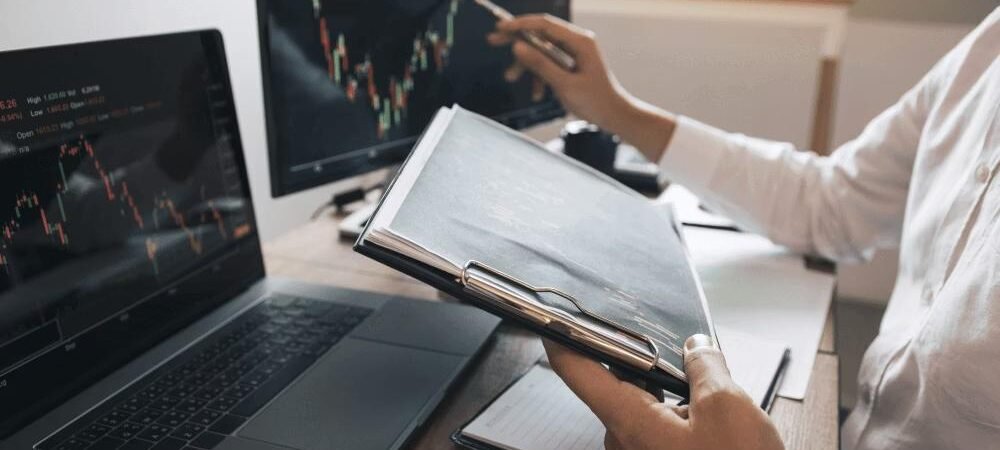
Forex backtesting is the process of testing a trading strategy using historical market data to evaluate how it would have performed in the past. Instead of guessing whether a strategy works, backtesting allows you to apply your trading rules to previous price movements and analyze the results. Before you can successfully backtest a strategy, you need a solid understanding of technical analysis, which helps traders interpret price charts and identify trading opportunities.
Think of backtesting as a practice session before an important football match. Professional football teams don’t step onto the field without training first. They spend hours practicing tactics, identifying weaknesses, and improving their performance. Likewise, successful Forex traders use backtesting to test their strategies, identify strengths and weaknesses, and build confidence before risking real capital.
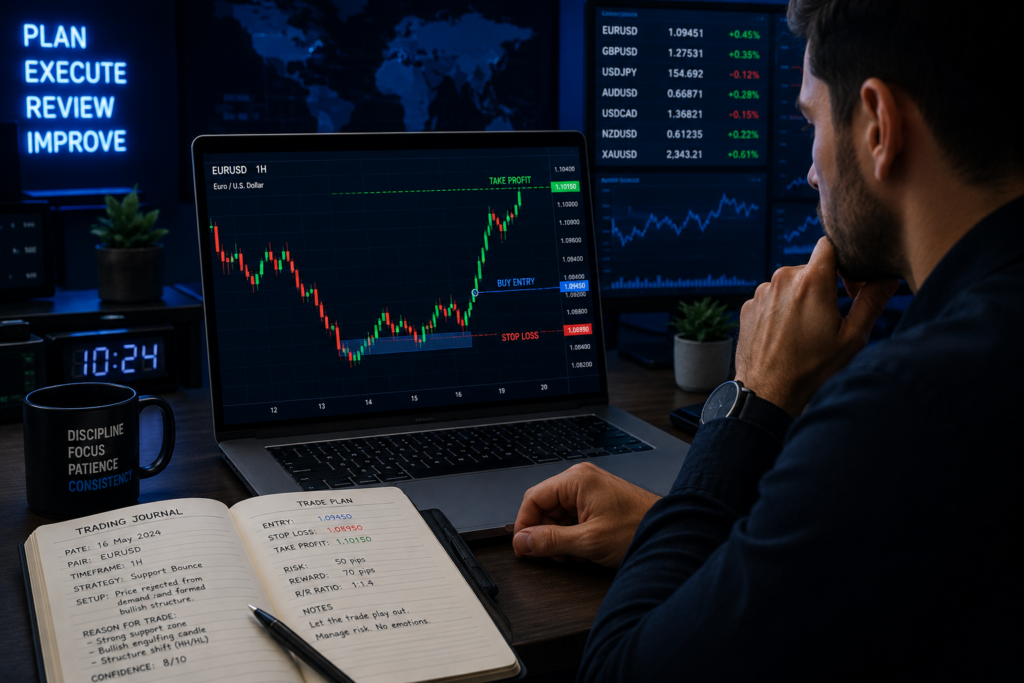
During backtesting, you manually or automatically scroll through historical Forex charts and apply the exact rules of your trading strategy. Every time a valid trade setup appears, you record the entry price, stop loss, take profit, risk-to-reward ratio, and the final outcome of the trade. After testing dozens or even hundreds of trades, you can calculate important performance statistics such as your win rate, average profit, average loss, and overall profitability.
For example, suppose you have developed a simple trading strategy based on:
- Trading only in the direction of the Daily trend.
- Waiting for price to reach a key support or resistance level.
- Entering after a Bullish or Bearish Engulfing candlestick pattern.
- Using a 1:2 risk-to-reward ratio.
Instead of immediately using this strategy on a live account, you can open historical charts on a platform such as TradingView or MetaTrader, scroll back several months or years, and test whether the strategy would have produced consistent results.
Imagine you test the strategy across 150 historical trades and discover the following results:
- Winning Trades: 87
- Losing Trades: 63
- Win Rate: 58%
- Average Risk-to-Reward Ratio: 1:2
- Overall Result: Consistently Profitable
These results don’t guarantee future profits, but they provide valuable evidence that the strategy has performed well under past market conditions. They also help you understand how the strategy behaves during winning streaks, losing streaks, trending markets, and ranging markets. Many traders choose price action trading because it focuses on market structure and candlestick behavior instead of relying heavily on indicators
One of the greatest advantages of backtesting is that it helps remove emotions from the learning process. Instead of relying on hope or opinions, you base your trading decisions on actual historical data. This allows you to improve your strategy objectively while building confidence in your trading plan.
It’s important to understand that past performance does not guarantee future results. Financial markets constantly evolve due to changing economic conditions, central bank decisions, and global events. However, backtesting remains one of the best ways to determine whether a strategy has a logical edge before risking real money.
Whether you are developing a price action strategy, testing a breakout system, or refining your multiple timeframe analysis, back testing should always be an essential part of your trading preparation. It helps you identify what works, eliminate what doesn’t, and become a more disciplined and confident Forex trader.
Benefits of Backtesting Your Forex Trading Strategy
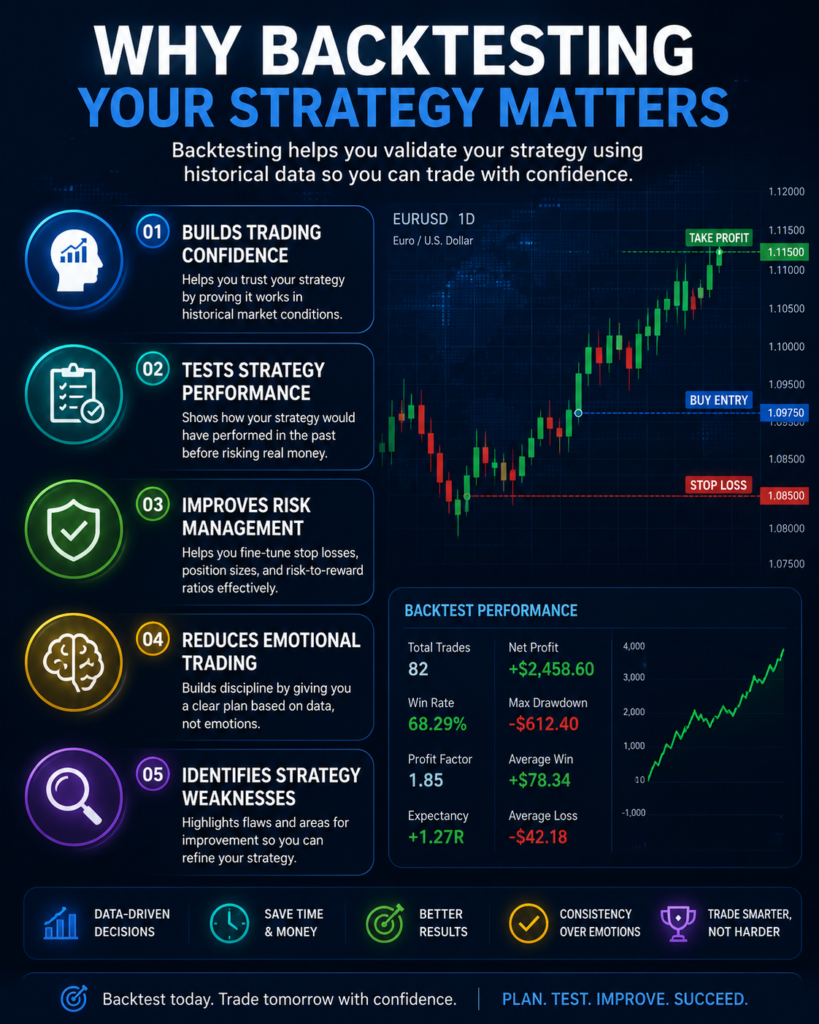
Backtesting is one of the most valuable habits a Forex trader can develop. While many beginners are eager to start trading with real money, experienced traders understand that testing a strategy before using it in the live market can save both time and capital.
A well-executed backtest allows you to evaluate your trading strategy using historical market data, helping you identify its strengths, weaknesses, and overall performance. Instead of relying on opinions or emotions, you make trading decisions based on facts and measurable results.
Here are some of the biggest benefits of backtesting your Forex trading strategy.
1. Builds Confidence in Your Strategy
One of the main reasons traders abandon their strategies is a lack of confidence. After one or two losing trades, many beginners assume the strategy no longer works and immediately start looking for another one.
Backtesting helps solve this problem by showing how your strategy has performed over a large number of historical trades. When you see that your trading plan has produced positive results over 100 or more trades, you’re more likely to trust the strategy during temporary losing streaks.
Confidence built on historical evidence is much stronger than confidence based on hope.
2. Identifies Strengths and Weaknesses
Every trading strategy has strengths and weaknesses. Some perform well during trending markets, while others are more effective during ranging or sideways conditions.
Backtesting helps you answer important questions such as:
- Which currency pairs perform best?
- Which timeframes produce the highest-quality setups?
- During which market conditions does the strategy struggle?
- Which entry signals are the most reliable?
Understanding these strengths and weaknesses allows you to improve your trading plan before risking real money.
3. Improves Trading Discipline
Successful Forex trading requires consistency. Backtesting encourages you to follow the same trading rules repeatedly instead of making random decisions.
During a backtest, every trade must follow your predefined rules for:
- Entry
- Stop Loss
- Take Profit
- Position Size
- Risk Management
This habit carries over into live trading and helps reduce emotional decision-making.
4. Helps You Understand Risk
Many beginners focus only on how much money they could make, but professional traders pay just as much attention to potential losses.
Backtesting helps you understand:
- Average losing streaks
- Maximum drawdown
- Average profit per trade
- Average loss per trade
- Overall risk-to-reward ratio
Knowing these statistics prepares you mentally for real trading and prevents unrealistic expectations.
5. Reveals Your Strategy’s Win Rate
One of the most useful results of backtesting is calculating your strategy’s win rate.
For example, after testing 200 historical trades, you may discover:
- Winning Trades: 118
- Losing Trades: 82
- Win Rate: 59%
This information helps you understand how often your strategy is likely to succeed over the long term.
Remember, a lower win rate can still be profitable if your winning trades are significantly larger than your losing trades.
6. Saves Money
Backtesting is much less expensive than learning through trial and error on a live account. Your backtest should verify whether price reacts consistently around important support and resistance levels before entering a trade.
Instead of paying for mistakes with real money, you identify problems using historical charts.
For example, you might discover that:
- Your Stop Loss is too tight.
- Your entries are too early.
- Your Take Profit targets are unrealistic.
- Your strategy performs poorly during major news events.
Correcting these issues before live trading can help protect your trading capital.
7. Reduces Emotional Trading
Fear, greed, impatience, and the fear of missing out (FOMO) often cause beginners to break their trading rules.
Backtesting encourages a more objective mindset because every decision is based on predefined criteria rather than emotions.
When you eventually transition to live trading, you’ll already have experience following your strategy consistently.
Practical Example
Imagine you’ve created a simple Forex strategy based on:
- Daily trend direction.
- Support and resistance.
- Bullish or Bearish Engulfing patterns.
- A minimum risk-to-reward ratio of 1:2.
Instead of risking money immediately, you test the strategy on 150 historical trades.
Your results show:
- Win Rate: 60%
- Average Risk-to-Reward Ratio: 1:2
- Consistent profitability over several months of historical data.
Although these results cannot predict future performance with certainty, they provide evidence that your strategy has shown a positive historical edge.
Key Takeaway
Backtesting is not about proving that a strategy will win every trade. Instead, it’s about gathering evidence that your trading plan has a logical edge over time.
By backtesting your Forex strategy, you can:
- Build confidence.
- Improve discipline.
- Identify strengths and weaknesses.
- Understand your risk.
- Measure your strategy’s performance.
- Reduce emotional decision-making.
- Prepare for live trading with greater confidence.
The more thoroughly you test your strategy, the better prepared you’ll be to handle real market conditions. In the next section, you’ll learn the difference between manual and automated backtesting, along with the advantages and disadvantages of each method.
Manual vs Automated Backtesting
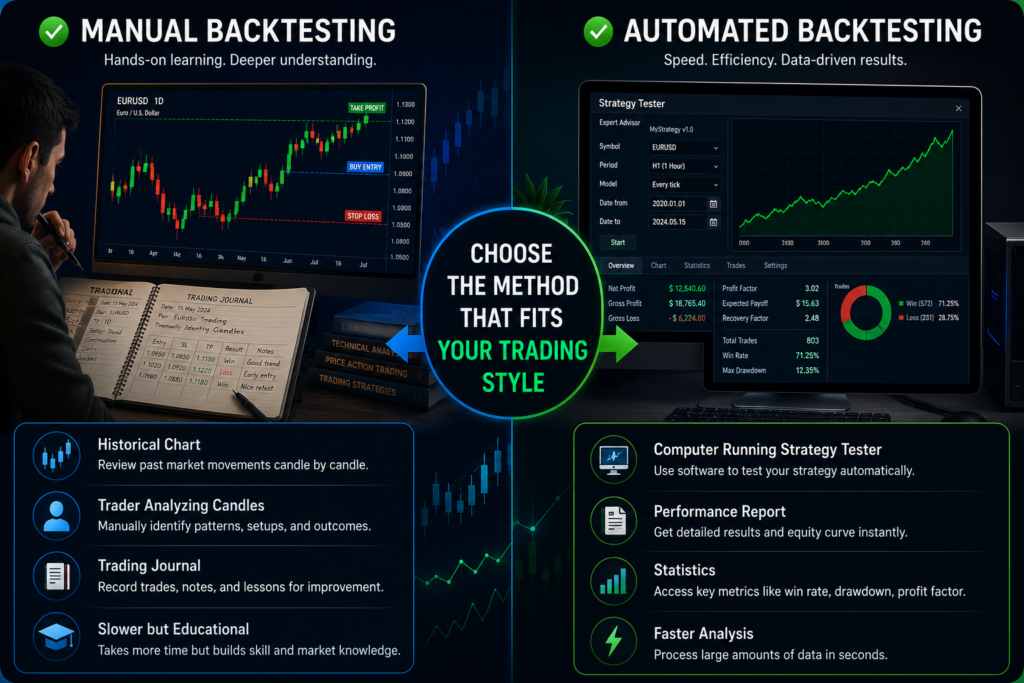
Once you understand why backtesting is important, the next step is learning how to do it. There are two primary methods of backtesting a Forex trading strategy: manual backtesting and automated backtesting. Both approaches have the same objective: evaluating a trading strategy using historical market data, but they differ in how the testing process is carried out.
For beginners, manual backtesting is usually the best place to start because it helps you understand how the market behaves and strengthens your chart-reading skills. Automated backtesting, on the other hand, is more suitable for traders who use algorithmic or rule-based strategies that can be programmed into trading software.
Let’s explore each method in more detail.
What Is Manual Backtesting?
Manual backtesting involves reviewing historical Forex charts candle by candle and applying your trading strategy exactly as you would in live market conditions.
Instead of allowing software to generate results automatically, you become the trader. You identify trade setups, decide where you would enter, place your stop loss and take profit, and record the outcome of every trade.
This process may take longer, but it teaches you how to read charts, recognize patterns, and make decisions using your trading rules.
Example of Manual Backtesting
Suppose your strategy is based on:
- Daily trend direction
- Support and resistance
- Bullish Engulfing candlestick
- 1:2 risk-to-reward ratio
You open a historical EUR/USD chart on TradingView or MetaTrader.
You scroll back six months so you cannot see future price movements.
Then, candle by candle, you ask:
- Is the Daily trend bullish?
- Has price reached a support level?
- Has a Bullish Engulfing candle formed?
- Does this setup meet all my trading rules?
If the answer is Yes, you record the trade in your trading journal.
You continue this process until you’ve tested at least 100–200 trades.
This gives you a realistic understanding of how your strategy performs over time.
Advantages of Manual Backtesting
- Improves chart-reading skills.
- Helps you understand market structure.
- Strengthens discipline by following trading rules.
- Allows you to recognize price action patterns more easily.
- Ideal for beginners learning technical analysis.
Disadvantages of Manual Backtesting
- Time-consuming.
- Requires patience.
- Human error can affect results.
- Results may vary if trading rules are not followed consistently.
Despite these disadvantages, manual backtesting is one of the best ways for beginners to gain practical trading experience without risking real money.
What Is Automated Backtesting?
Automated backtesting uses specialized trading software to test a strategy automatically.
Instead of manually reviewing charts, you program your trading rules into a trading platform or Expert Advisor (EA). The software then scans historical data and executes every trade that matches your conditions.
Within minutes, the program can test several years of historical data and generate detailed performance statistics.
Automated backtesting is commonly used by:
- Algorithmic traders
- Quantitative traders
- Developers of Expert Advisors (EAs)
- Professional trading firms
Example of Automated Backtesting
Imagine you’ve created a strategy with these rules:
- Buy when the 50-period Moving Average crosses above the 200-period Moving Average.
- Stop Loss: 30 pips.
- Take Profit: 60 pips.
Instead of manually checking thousands of historical candles, you program these rules into MetaTrader’s Strategy Tester.
The software automatically:
- Opens every qualifying trade.
- Closes trades at the Stop Loss or Take Profit.
- Calculates profit and loss.
- Produces a complete performance report.
In just a few minutes, you can analyze years of historical market data.
Advantages of Automated Backtesting
- Extremely fast.
- Eliminates emotional bias.
- Can test thousands of historical trades.
- Produces detailed performance statistics.
- Useful for optimizing rule-based strategies.
Disadvantages of Automated Backtesting
- Requires programming knowledge or an Expert Advisor.
- Cannot always evaluate discretionary price action accurately.
- May produce misleading results if historical data quality is poor.
- Doesn’t teach chart-reading skills like manual backtesting.
Manual vs Automated Backtesting Comparison
| Feature | Manual Backtesting | Automated Backtesting |
|---|---|---|
| Speed | Slower | Very Fast |
| Best for Beginners | ✔ Yes | ❌ Usually No |
| Improves Chart Reading | ✔ Excellent | ❌ Limited |
| Emotional Bias | Low | None |
| Programming Required | No | Usually Yes |
| Suitable for Price Action | ✔ Yes | Limited |
| Suitable for Algorithmic Strategies | Limited | ✔ Excellent |
Explore the MetaTrader 5 Strategy Tester for automated backtesting.
Which Method Should Beginners Choose?
If you’re new to Forex trading, manual backtesting is the better choice.
It helps you:
- Learn how markets move.
- Recognize trading setups.
- Improve patience and discipline.
- Gain confidence in your strategy.
- Practice following your trading plan.
As your experience grows, you may choose to explore automated backtesting for more advanced, rule-based strategies. However, understanding manual backtesting first provides a stronger foundation for long-term success.
Many professional traders actually use both methods. They manually test new ideas to understand market behavior, then automate proven strategies to evaluate larger amounts of historical data more efficiently.
Key Takeaway
Both manual and automated backtesting are valuable tools for evaluating a Forex trading strategy. The best method depends on your trading style, experience, and the type of strategy you’re using.
For most beginners, manual backtesting offers the greatest educational value because it develops technical analysis skills, strengthens discipline, and builds confidence through hands-on practice.
Once you’ve decided which backtesting method you’ll use, the next step is preparing everything you need before testing your strategy. In the next section, you’ll learn what tools, data, and trading rules you should have ready before you begin backtesting.
Final Thoughts
Backtesting is one of the most important steps in becoming a disciplined and successful Forex trader. While it cannot predict future market movements with complete certainty, it gives you valuable insight into how your trading strategy has performed under past market conditions. This knowledge helps you trade with greater confidence, improve your decision-making, and reduce costly mistakes. Practice backtesting using historical Forex charts on TradingView.
Many beginner traders make the mistake of rushing into live trading after learning a new strategy. They often assume that because a strategy looks good on a chart or has worked for someone else, it will automatically produce profits. However, every trading strategy should be tested thoroughly before real money is placed at risk. After completing your backtesting, move to demo trading so you can practice your strategy in live market conditions without risking real money.
Backtesting allows you to answer important questions such as:
- Is my strategy consistently profitable?
- Which market conditions produce the best results?
- How often does my strategy win?
- How large are my average profits and losses?
- Am I following my trading rules consistently?
By answering these questions, you replace uncertainty with evidence and build confidence based on data rather than emotions.
Remember that no trading strategy wins every trade. Even professional traders experience losing streaks. The goal of backtesting is not to find a strategy that never loses but to identify one that has a positive edge over a large number of trades.
As you gain experience, continue reviewing your backtesting results and refining your strategy. Small improvements in your entry rules, risk management, or trade management can significantly improve your long-term performance.
Most importantly, don’t stop after backtesting. Once your strategy has shown promising historical results, move on to demo trading before risking real money. This allows you to practice executing your strategy under live market conditions without exposing your trading capital to unnecessary risk.
Successful Forex trading is built on preparation, patience, discipline, and continuous improvement. Backtesting is one of the strongest foundations you can build before beginning your live trading journey.
Frequently Asked Questions (FAQs)
1. What is Forex backtesting?
Forex backtesting is the process of testing a trading strategy using historical market data to evaluate how it would have performed in the past.
2. Why is backtesting important?
Backtesting helps traders verify whether a strategy has a positive historical edge before risking real money. It also improves confidence, discipline, and risk management.
3. How many trades should I backtest?
Most experienced traders recommend testing at least 100 to 200 historical trades before evaluating a strategy. Larger sample sizes generally provide more reliable results.
4. Can backtesting guarantee future profits?
No. Past performance does not guarantee future results. However, backtesting helps traders identify strategies that have demonstrated consistent historical performance.
5. Which software can I use for Forex backtesting?
Popular Forex backtesting platforms include:
- TradingView
- MetaTrader 4 (MT4)
- MetaTrader 5 (MT5)
- Forex Tester
Choose a platform that provides reliable historical data and chart analysis tools.
6. Should beginners use manual or automated backtesting?
Beginners should start with manual backtesting because it improves chart-reading skills, strengthens technical analysis, and helps traders understand market structure before exploring automated methods.
Continue Your Forex Learning Journey
Learning how to backtest a Forex trading strategy is an essential step toward becoming a disciplined trader, but it’s only one part of building a complete trading plan. Continue expanding your knowledge with our beginner-friendly guides on Price Action Trading, Support and Resistance, Candlestick Patterns, Multiple Timeframe Analysis, Forex Trading Checklists, Risk Management, and Trend Trading.
At BuildSmartAfri, our mission is to help beginners develop practical Forex trading skills through clear explanations, real-world examples, and step-by-step educational content.
If you found this guide helpful, consider sharing it with fellow traders who want to improve their trading skills. Don’t forget to bookmark BuildSmartAfri and visit regularly for new Forex tutorials, trading strategies, AI resources, and practical digital skills content designed to help you grow with confidence. Read the CFTC’s investor education resources to better understand the risks of Forex trading.
Start backtesting your trading strategy today, build confidence through data, and prepare yourself for smarter, more disciplined Forex trading.
Risk Disclaimer
Disclaimer: Forex trading involves substantial risk and may not be suitable for every investor. Currency prices are highly volatile, and you may lose part or all of your invested capital. The information provided in this article is for educational purposes only and should not be considered financial, investment, or trading advice. Always perform your own research, practice new strategies on a demo account, and apply proper risk management before trading with real money. Past performance is not a guarantee of future results. Review the Forex Factory Economic Calendar to identify major news events that could influence your strategy. Understanding the Forex trading risks involved before trading a live account can help you develop realistic expectations and protect your capital.