
Introduction:
Trading Breakouts and Fakeouts: How to Spot Real Moves in Forex. One of the most exciting moments in Forex trading is when price breaks above resistance or below support. These movements, known as breakouts, often signal the beginning of a strong new trend and can provide traders with excellent trading opportunities.
However, not every breakout leads to a profitable trade.
Sometimes, price briefly moves beyond a key support or resistance level before quickly reversing in the opposite direction. This is known as a fakeout or false breakout. Fakeouts are one of the biggest reasons beginner traders lose money because they often enter trades too early without waiting for confirmation.
Imagine watching EUR/USD break above a resistance level that has held for days. Believing a new uptrend has begun, you immediately place a buy trade. Minutes later, the market reverses sharply, drops below the resistance level again, and triggers your stop loss.
If this has happened to you, you’re not alone.
Learning to distinguish between genuine breakouts and fakeouts is an essential skill for every Forex trader. Professional traders don’t simply react when price breaks a level; they wait for confirmation that the breakout is likely to continue. Before learning breakout trading, it’s important to understand how price behaves on a chart. Start with our beginner’s guide on What Is Price Action Trading? A Beginner’s Guide to build a solid foundation.
In this guide, you’ll learn what breakouts and fakeouts are, why they occur, how to identify high-probability breakout opportunities, and how to avoid common traps that catch inexperienced traders.
What Is a Breakout?
A breakout occurs when the price moves beyond an important support, resistance, trendline, or chart pattern with enough momentum to suggest that a new trend may be beginning. If you’re new to Forex trading and want to strengthen your understanding of breakout strategies, the BabyPips School of Pipsology offers beginner-friendly lessons on chart patterns, market structure, and breakout trading concepts.
Breakouts happen because buyers or sellers gain enough strength to overcome a level that has previously stopped price from moving further.
For example, imagine EUR/USD has repeatedly failed to rise above 1.1200.
Each time price reaches this level, sellers enter the market and push it back down.
Eventually, buyers become stronger than sellers.
Price closes above 1.1200 with strong bullish momentum.
This movement is called a bullish breakout.
Similarly, if price falls below a strong support level, it is known as a bearish breakout.
Breakouts are important because they often indicate that market sentiment has changed. When confirmed, they can lead to significant price movements and provide attractive trading opportunities. Most successful breakouts occur around key support and resistance levels. Learn how to identify these important price zones in our guide on Support and Resistance in Forex Trading for Beginners.
Why Do Breakouts Happen?
Breakouts occur when supply and demand shift dramatically.
Several factors can trigger a breakout, including:
- Strong economic news
- Interest rate decisions
- Increased buying or selling pressure
- Institutional trading activity
- Changes in market sentiment
For example, if a central bank unexpectedly raises interest rates, investors may rush to buy that country’s currency. Increased demand can push price through a resistance level, creating a breakout.
Likewise, disappointing economic data may encourage traders to sell a currency aggressively, causing price to break below support.
This is why experienced traders pay attention to both technical levels and fundamental events before entering breakout trades.
What Is a Fakeout?
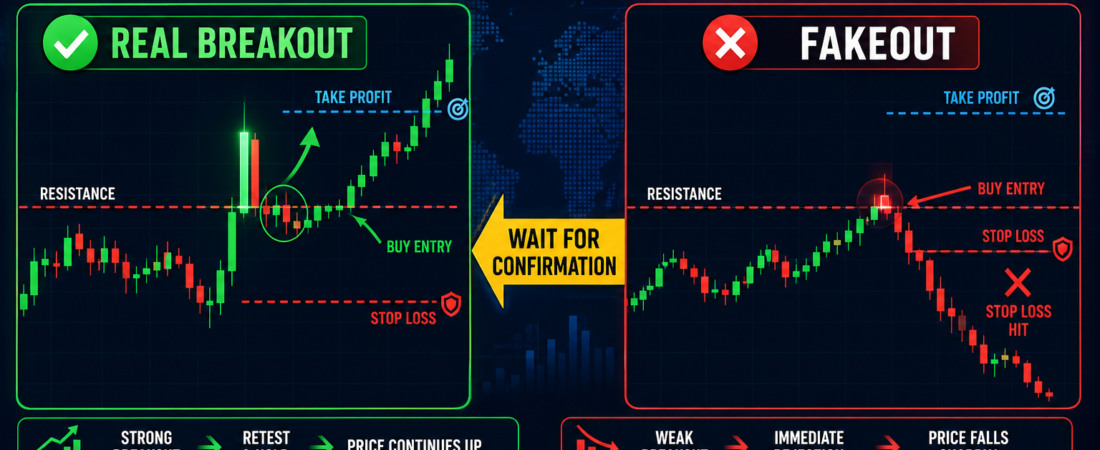
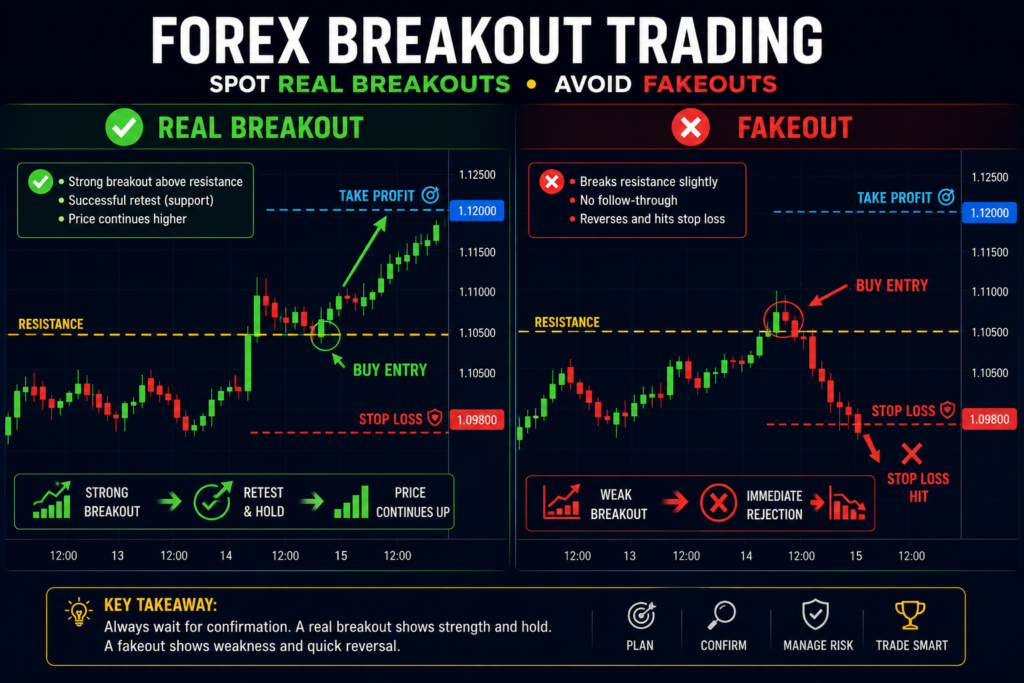
A fakeout occurs when price briefly breaks above resistance or below support but fails to continue in the breakout direction.
Instead, the market quickly reverses and returns inside the previous trading range.
Fakeouts trap traders who enter too early.
Many beginners assume that every breakout will continue.
Professional traders know this isn’t always the case.
A fakeout usually happens because there isn’t enough buying or selling pressure to sustain the move.
Instead of beginning a new trend, the market simply tests the level before reversing.
Recognizing fakeouts can help traders avoid unnecessary losses and improve the quality of their trade entries.
Why Fakeouts Happen
Fakeouts occur for several reasons.
One common reason is low market momentum. Price may briefly move beyond a support or resistance level without enough buyers or sellers to continue the move.
Another reason is liquidity.
Large institutions sometimes push price beyond obvious support or resistance levels to trigger stop-loss orders placed by retail traders. Once these orders are activated, institutions may enter trades in the opposite direction, causing the market to reverse.
This behavior is often referred to as a liquidity grab or stop hunt.
It’s important to understand that these movements are not personal attacks on retail traders. Large market participants simply seek liquidity to execute large orders efficiently.
For this reason, experienced traders wait for confirmation before assuming that a breakout is genuine. Candlestick patterns often provide valuable confirmation before entering a breakout trade. Explore the most reliable setups in our guide on Top 11 Candlestick Patterns Every Forex Trader Should Know.
Types of Breakouts
Not all breakouts occur in the same way. Traders commonly encounter several types of breakouts.
Resistance Breakout
A resistance breakout occurs when price closes above a level where sellers previously prevented further upward movement.
If confirmed, this often signals the start of a bullish trend.
Support Breakout
A support breakout occurs when price falls below an important support level.
This often indicates increasing selling pressure and the potential beginning of a bearish trend.
Trendline Breakout
Trendlines help traders identify the direction of the market.
When price breaks through a well-established trendline, it may signal that the current trend is weakening or reversing.
Chart Pattern Breakout
Many chart patterns end with a breakout.
Examples include:
- Ascending Triangle
- Descending Triangle
- Rectangle
- Flag
- Pennant
When price breaks out of these formations with strong momentum, traders often look for continuation in the breakout direction.
How to Confirm a Real Breakout
One of the biggest mistakes beginner traders make is entering a trade the moment price breaks above resistance or below support.
While this may sometimes lead to profitable trades, it also increases the risk of getting caught in a fakeout.
Professional traders know that confirmation is more important than speed. Instead of rushing into the market, they wait for evidence that the breakout is genuine.
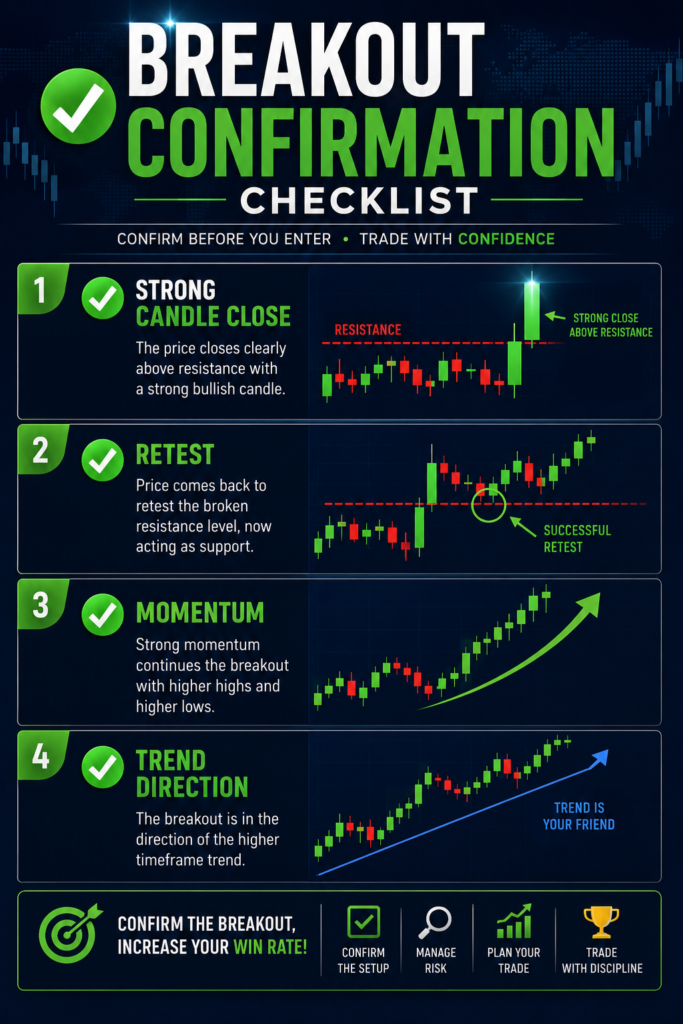
Here are five ways to confirm a real breakout.
1. Wait for a Strong Candle Close
A genuine breakout is usually confirmed when a candle closes clearly above resistance or below support, rather than just briefly touching or crossing the level.
Many fakeouts occur when price spikes beyond a level but closes back inside the previous range.
Example
Suppose EUR/USD has strong resistance at 1.1050.
During the trading session, price rises to 1.1055 but then falls back and closes at 1.1042.
This is not a confirmed breakout because the candle closed below the resistance level.
However, if the candle closes strongly at 1.1065, it shows buyers successfully overcame the resistance, making the breakout more reliable.
2. Look for Strong Momentum
Real breakouts are often accompanied by strong price movement.
Large bullish or bearish candles suggest that buyers or sellers are in control.
Warning signs of a weak breakout include:
- Small candles
- Long upper or lower wicks
- Slow price movement
- Immediate hesitation after the breakout
When momentum is weak, the breakout is more likely to fail.
3. Wait for a Retest
One of the safest ways to trade a breakout is to wait for a retest.
After breaking through resistance, price often returns to test that level before continuing upward.
The old resistance now acts as new support.
Likewise, after breaking below support, price may return to test the old support as new resistance before continuing downward.
Waiting for this retest helps traders avoid many false breakouts.
Example
Price breaks above 1.2000.
Instead of buying immediately, you wait.
Price returns to 1.2000, finds support, and begins rising again.
This successful retest provides stronger confirmation that the breakout is genuine. Combining breakout confirmation with proper trade management can significantly improve your results. Read our guide on How to Set Stop Loss and Take Profit Correctly in Forex to learn where to place your exits.
4. Check Higher Timeframes
A breakout on a 5-minute chart may look exciting, but if the 4-hour or daily chart shows strong resistance just above, the move could quickly fail.
Professional traders often compare multiple timeframes before entering a trade.
For example:
- Use the Daily chart to identify the overall trend.
- Use the 4-hour chart to locate key support and resistance levels.
- Use the 1-hour or 15-minute chart to fine-tune your entry.
Trading in the direction of the higher timeframe trend generally improves the probability of success.
5. Consider Market Conditions
A breakout is more likely to succeed when supported by strong market conditions.
Ask yourself:
- Is there important economic news driving the move?
- Is the overall market trend bullish or bearish?
- Is volatility increasing?
- Is the breakout occurring during an active trading session such as London or New York?
For example, a breakout during the London–New York session overlap often carries more strength than one occurring late in the Sydney session when trading activity is relatively low.
Always consider the broader market context before entering a trade.
Signs of a Fakeout
Although fakeouts can look convincing at first, they often leave clues that experienced traders recognize.
Learning these warning signs can help you avoid entering low-quality trades.
1. Long Wicks
One of the clearest signs of a fakeout is a candle with a long wick beyond support or resistance.
This shows that price briefly moved beyond the level but was quickly rejected.
A long upper wick above resistance suggests sellers have regained control.
A long lower wick below support suggests buyers have stepped in.
2. Weak Breakout Candles
A breakout should display confidence.
If the breakout candle is very small or lacks momentum, it may simply be testing the level rather than beginning a new trend.
Strong breakouts usually produce large, decisive candles.
3. Immediate Reversal
One of the most obvious fakeout signals occurs when price breaks a level and then immediately reverses.
For example:
Price breaks above resistance.
Several traders enter buy positions.
Within minutes, price falls back below resistance.
The breakout has failed.
This often traps traders who entered too early.
4. No Follow-Through
A real breakout usually continues moving in the breakout direction.
If price stalls immediately after breaking a level and fails to make new highs or new lows, the breakout may lack strength.
Markets need momentum to sustain trends.
Without follow-through, the probability of reversal increases.
5. Breakout Against the Main Trend
Trading against the overall trend increases the likelihood of failure.
Imagine the daily trend is strongly bearish.
Suddenly, the 15-minute chart shows a small bullish breakout.
Although the breakout appears attractive, the larger trend still favors sellers.
This increases the risk that buyers will lose control and price will resume moving downward.
For this reason, many experienced traders prefer taking breakouts that align with the higher timeframe trend.
Key Takeaways
Successful breakout trading isn’t about being the first trader to enter the market; it’s about entering high-probability setups. Waiting for a strong candle close, confirming momentum, looking for a retest, checking higher timeframes, and considering overall market conditions can help you separate genuine breakouts from fakeouts. Patience often leads to better entries and fewer unnecessary losses.
How to Trade a Breakout Step by Step
Trading breakouts successfully requires patience and discipline. Instead of jumping into a trade as soon as price breaks a level, follow a structured process to improve your chances of success.
Step 1: Identify a Key Support or Resistance Level
The first step is to locate important price levels where the market has reacted several times in the past.
These could include:
- Horizontal support and resistance levels
- Trendlines
- Chart patterns like triangles or rectangles
The more times price respects a level, the more significant it becomes.
Step 2: Wait for the Breakout
Allow price to break above resistance or below support.
Avoid entering the trade immediately.
Many false breakouts occur because traders react too quickly.
Instead, observe how price behaves after the breakout.
Step 3: Look for Confirmation
Before entering, ask yourself:
- Did the candle close beyond the level?
- Is momentum strong?
- Is the breakout supported by the overall trend?
- Has price successfully retested the breakout level?
If the answer to most of these questions is yes, the breakout has a higher probability of succeeding.
Step 4: Enter the Trade
Once the breakout is confirmed, enter your position.
For a bullish breakout:
- Buy after confirmation or after a successful retest.
For a bearish breakout:
- Sell after confirmation or after a successful retest.
Patience often leads to better entries and lower risk.
Step 5: Place Your Stop Loss
Never trade a breakout without a Stop Loss.
For a buy trade:
Place the Stop Loss below the breakout level or below the recent swing low.
For a sell trade:
Place the Stop Loss above the breakout level or above the recent swing high.
This helps protect your account if the breakout fails.
Step 6: Set Your Take Profit
Plan your exit before entering the trade.
Some traders use:
- The next support or resistance level
- A fixed Risk-to-Reward Ratio (such as 1:2 or 1:3)
- Trailing Stop Loss
Always ensure your potential reward is greater than your risk.
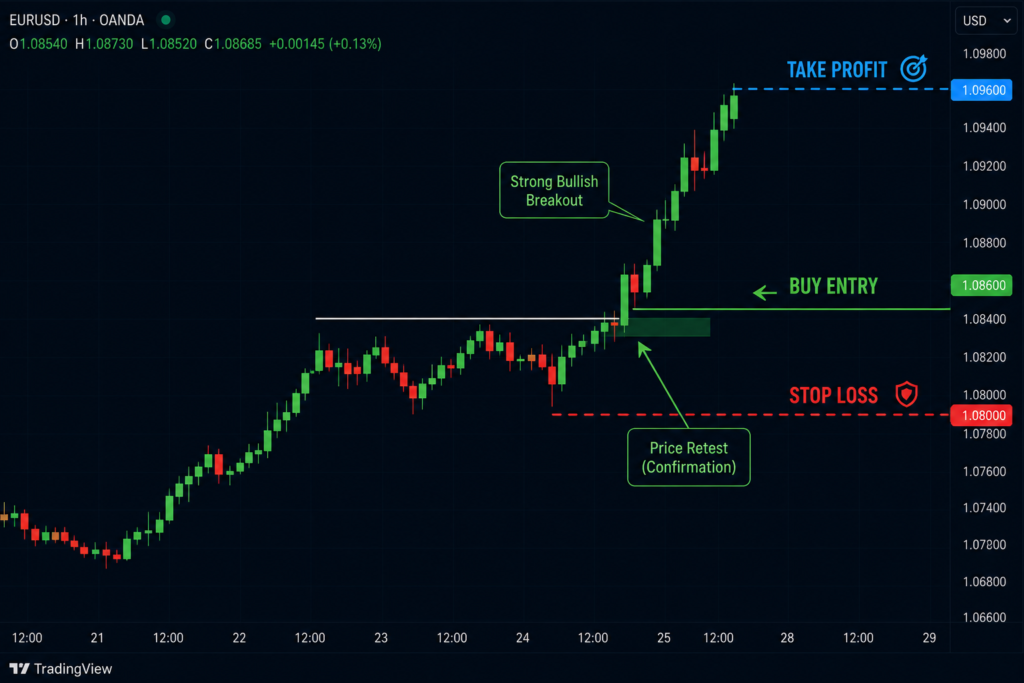
Practical Example: Trading a Bullish Breakout
Imagine EUR/USD has been trading below a strong resistance level at 1.1000 for several days. One of the best ways to improve your breakout trading skills is by studying live charts. TradingView provides interactive Forex charts where you can practice identifying support, resistance, and breakout opportunities in real time.
Price finally breaks above the resistance with a large bullish candle and closes at 1.1020. Before entering a breakout trade, always check for major economic announcements that could increase volatility. Our guide on How to Use an Economic Calendar in Forex Trading explains how to prepare for these events.
Instead of buying immediately, you wait for a retest.
A few hours later, price returns to 1.1000, finds support, and starts moving upward again.
You decide to enter a buy trade at 1.1010.
Your Stop Loss is placed below the new support at 1.0985.
Your Take Profit is set near the next resistance level at 1.1070.
As buying momentum continues, price reaches your Take Profit target, resulting in a successful breakout trade.
This example demonstrates why patience and confirmation often produce better results than entering immediately after the breakout.
Common Breakout Trading Mistakes
Many beginner traders lose money because they repeat the same mistakes.
Here are some of the most common ones.
Entering Too Early
Buying or selling before confirmation increases the risk of getting trapped in a fakeout.
Always wait for the market to prove the breakout is genuine.
Ignoring the Higher Timeframe
A breakout on a lower timeframe may fail if it goes against the overall market trend. Many breakout failures occur during unexpected market events. Understanding what moves the Forex market can help you avoid trading during periods of excessive uncertainty.
Always check higher timeframes before making a trading decision.
Chasing the Market
Some traders enter after price has already moved a long distance.
This often leads to poor entries and unfavorable risk-to-reward ratios.
Instead, wait patiently for a pullback or retest.
Trading Without a Stop Loss
Even high-quality breakouts can fail.
Without a Stop Loss, a small mistake can turn into a significant loss.
Risk management should always come first.
Ignoring High-Impact News
Major economic announcements can create sudden volatility. Before trading a breakout, always check whether an important economic announcement is scheduled. The Investing.com Economic Calendar helps traders monitor upcoming events that can trigger sudden market volatility.
If you’re unaware of scheduled news events, your breakout trade may reverse unexpectedly.
Checking the economic calendar before trading can help you avoid unnecessary surprises.
Tips for Successful Breakout Trading
Professional traders follow simple habits that improve consistency over time. Trading breakouts that align with the overall trend generally offers higher-probability setups. Learn more in our Trend Trading for Beginners: How to Follow Market Direction guide.
Some of these include:
- Wait for confirmation instead of guessing.
- Trade in the direction of the overall trend.
- Focus on high-quality setups rather than frequent trades.
- Use proper risk management on every trade.
- Keep a trading journal to review successful and unsuccessful breakout trades.
- Practice your strategy on a demo account before risking real money.
Remember, consistency is more important than trying to catch every breakout.
Frequently Asked Questions (FAQs)
What is a breakout in Forex trading?
A breakout occurs when price moves beyond a significant support, resistance, trendline, or chart pattern, often indicating the start of a new trend.
What is a fakeout?
A fakeout is a false breakout where price briefly moves beyond a key level before reversing back into its previous range.
How can I avoid fakeouts?
Wait for confirmation, such as a strong candle close, a successful retest, and momentum in the breakout direction before entering a trade.
Should beginners trade every breakout?
No. It’s better to focus on high-quality breakouts that occur in the direction of the overall trend and are supported by strong confirmation signals.
Which timeframe is best for breakout trading?
Many traders prefer the 1-hour, 4-hour, and Daily charts because they generally produce more reliable breakout signals than very short timeframes.
Is breakout trading suitable for beginners?
Yes, provided beginners learn to wait for confirmation, manage risk properly, and avoid chasing every market movement.
Final Thoughts
Breakout trading is one of the most popular Forex trading strategies because it allows traders to capture strong market movements as new trends begin. However, not every breakout leads to a profitable trade. Learning to recognize fakeouts is just as important as identifying genuine breakouts.
Successful traders don’t rush into every opportunity. They wait for confirmation, analyze the broader market context, and follow a clear trading plan. By combining breakout analysis with support and resistance, candlestick patterns, price action, and sound risk management, you can improve your confidence and make more informed trading decisions. Breakout trading becomes even more effective when combined with strong chart analysis, price action, and disciplined risk management. Continue building your skills by exploring our beginner guides on Price Action Trading, Support and Resistance, Candlestick Patterns, Trend Trading, and Stop Loss & Take Profit.
Like every trading strategy, breakout trading requires practice. Spend time studying historical charts, testing your approach on a demo account, and reviewing your trades. With patience and discipline, you’ll become better at identifying high-probability setups while avoiding common traps.
Disclaimer
Disclaimer: This article is for educational purposes only and should not be considered financial or investment advice. Forex trading involves substantial risk and may not be suitable for all investors. Always conduct your own research, practice on a demo account, and consult a qualified financial advisor before making investment decisions. Breakout trading involves risk, especially during volatile market conditions. The U.S. Commodity Futures Trading Commission (CFTC) offers educational resources to help traders understand market risks and make informed decisions.
Continue Learning with BuildSmartAfri
Want to improve your Forex trading skills? Explore these beginner-friendly guides:
- What Is Price Action Trading? A Beginner’s Guide
- Support and Resistance in Forex Trading for Beginners
- Top 11 Candlestick Patterns Every Forex Trader Should Know
- How to Set Stop Loss and Take Profit Correctly in Forex
- How to Use an Economic Calendar in Forex Trading
- What Moves the Forex Market?
Each guide builds on the previous one, helping you develop a strong understanding of Forex trading from the ground up.