Introduction:
How to Use an Economic Calendar in Forex Trading: A Complete Beginner’s Guide. The Forex market is influenced by far more than just price charts and technical indicators.
Every day, governments, central banks, and financial institutions release important economic reports that can cause currency prices to rise or fall within seconds. If you’re new to the currency market, start by reading our What Is Forex Trading? A Beginner’s Guide to understand the fundamentals before learning how an economic calendar works.
These scheduled events are one of the main reasons the Forex market experiences periods of high volatility.
Imagine placing a trade after carefully analyzing a currency pair.
Everything looks perfect.
Your technical indicators align, your entry point is ideal, and your risk management plan is in place.
Suddenly, the market moves sharply against your position, causing your stop-loss to be triggered within minutes.
What happened?
In many cases, the answer is simple:
An important economic announcement was released.
Many beginner traders overlook economic news because they focus only on charts.
However, experienced traders understand that major economic events can significantly influence market direction.
This is where an economic calendar becomes one of the most valuable tools in Forex trading.
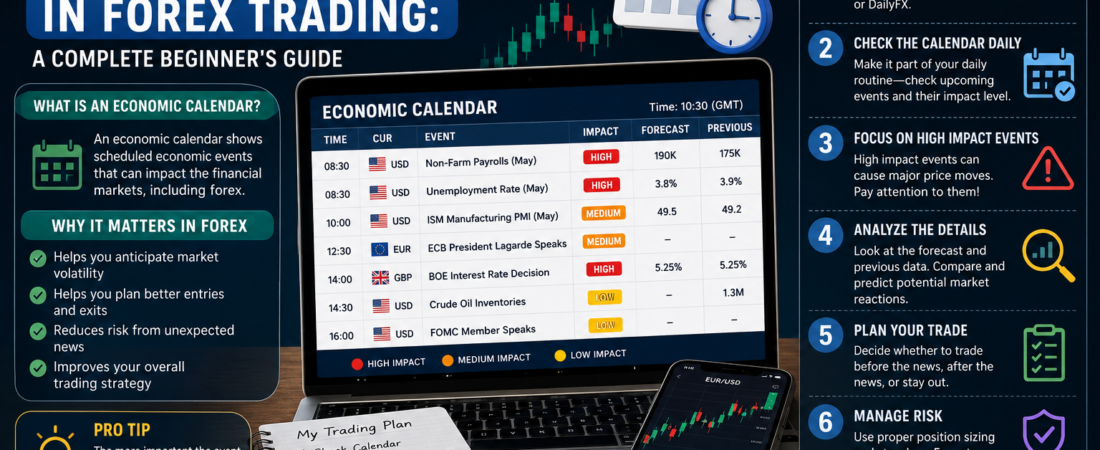
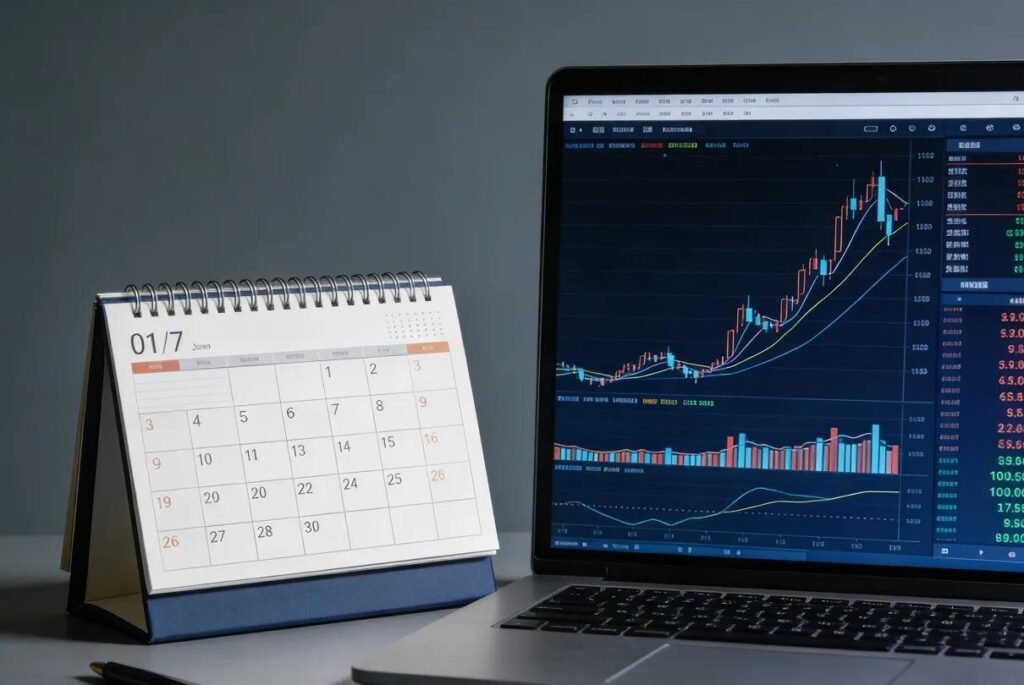
An economic calendar provides a schedule of upcoming financial events, economic reports, and central bank announcements that may affect currency prices.
By checking the calendar before entering trades, traders can prepare for periods of increased market activity instead of being caught by surprise.
Learning how to use an economic calendar does not mean you must become an economist.
Instead, it means understanding when important events are scheduled, how they may impact the market, and how to manage your trades accordingly.
In this guide, you’ll learn:
- What an economic calendar is
- Why every Forex trader should use one
- How to read an economic calendar
- The meaning of each calendar column
- High-impact, medium-impact, and low-impact events
- The most important economic reports for Forex traders
- Practical examples of trading around news events
- Common beginner mistakes
- Best practices for using an economic calendar
By the end of this article, you’ll understand how an economic calendar can become an essential part of your daily trading routine.
What Is an Economic Calendar?
An economic calendar is a schedule that lists upcoming economic events, financial reports, and government announcements that can influence financial markets. Before using an economic calendar, you’ll first need a trading account. Follow our guide on How to Open Your First Forex Trading Account to get started.
These events occur throughout the week and are closely monitored by traders around the world.
Examples include:
- Interest rate decisions
- Inflation reports
- Employment reports
- Gross Domestic Product (GDP) releases
- Retail sales data
- Manufacturing reports
- Consumer confidence reports
Each event has the potential to affect one or more currencies depending on its importance and the actual results released.
For example, if the United States releases stronger-than-expected employment data, the US Dollar may strengthen against other currencies because investors interpret the report as a sign of a healthy economy.
Similarly, weaker-than-expected economic data may cause a currency to decline as traders adjust their expectations.
An economic calendar allows traders to prepare for these events before they happen rather than reacting after prices have already moved.
Why Is an Economic Calendar Important in Forex Trading?
The Forex market operates 24 hours a day, five days a week, and currency prices constantly react to new information.
Economic announcements are among the biggest drivers of market volatility.
Without checking an economic calendar, traders may unknowingly enter positions just minutes before a major news release.
This can result in:
- Sudden price spikes
- Increased market volatility
- Wider spreads
- Slippage
- Unexpected losses
Using an economic calendar helps traders:
✔ Prepare for major market events.
✔ Avoid unnecessary trading during highly volatile periods.
✔ Plan entries and exits more effectively.
✔ Understand why currencies are moving.
✔ Improve overall risk management.
Think of an economic calendar as a weather forecast for the Forex market.
Just as a traveler checks the weather before leaving home, a trader should check the economic calendar before placing trades.
Although it cannot predict the exact market direction, it helps traders anticipate periods when significant market movement is more likely.
How to Read an Economic Calendar
At first glance, an economic calendar can seem confusing. Many regulated brokers provide built-in economic calendars, so it’s important to first learn How to Choose the Best Forex Broker for Beginners.
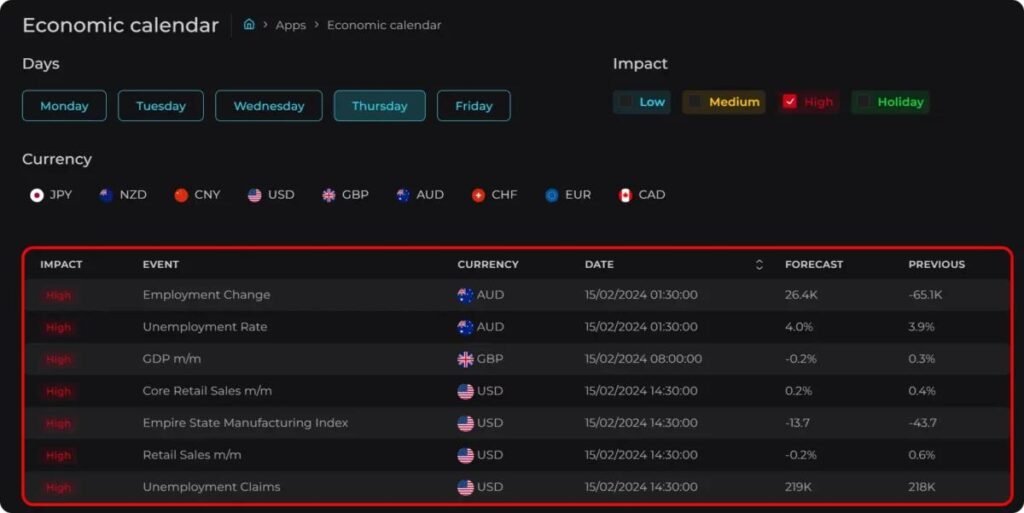
You’ll see multiple columns filled with numbers, dates, times, currencies, and impact ratings.
For a beginner, it may look like information meant only for economists or financial analysts.
The good news is that you don’t need to understand every economic term to use an economic calendar effectively.
Once you learn what each section means, you’ll be able to identify important market-moving events within seconds.
Most economic calendars follow a similar format, regardless of the website or broker providing them.
They typically display:
- Date
- Time
- Currency
- Event
- Impact level
- Previous result
- Forecast
- Actual result
Understanding these columns is the key to making informed trading decisions.
Understanding Each Column in an Economic Calendar
1. Date and Time
The first column tells you when an economic event is scheduled to occur.
This is one of the most important pieces of information because Forex markets often become more volatile shortly before and after major announcements.
For example:
| Time | Event |
|---|---|
| 13:30 GMT | U.S. Non-Farm Payrolls |
This means the report will be released at 1:30 PM GMT.
If you have an open trade involving the U.S. Dollar around that time, you should be prepared for increased market activity.
Beginner Tip
Always make sure your economic calendar displays times in your local time zone or the time zone used by your trading platform.
Otherwise, you could miss important announcements or accidentally enter trades just before high-impact news.
2. Currency
The currency column shows which country’s currency is likely to be affected by the upcoming event.
Examples include:
- USD – United States Dollar
- EUR – Euro
- GBP – British Pound
- JPY – Japanese Yen
- AUD – Australian Dollar
- CAD – Canadian Dollar
- CHF – Swiss Franc
- NZD – New Zealand Dollar
Practical Example
Suppose the calendar shows:
Currency: USD
This means the news is expected to influence the US Dollar.
Currency pairs that may experience increased volatility include:
- EUR/USD
- GBP/USD
- USD/JPY
- USD/CHF
- AUD/USD
If you’re trading one of these pairs, you should pay close attention to the announcement.
3. Event
This column tells you what economic report or announcement is being released.
Some of the most common events include:
- Interest Rate Decision
- Non-Farm Payrolls (NFP)
- Consumer Price Index (CPI)
- Gross Domestic Product (GDP)
- Retail Sales
- Unemployment Rate
- Manufacturing PMI
- Consumer Confidence
Each event measures a different part of the economy.
Some events have a much greater impact on the Forex market than others.
As a beginner, you don’t need to memorize every report immediately.
Instead, focus on learning the major reports that frequently move the market.
4. Impact Level
One of the most useful columns for beginners is the impact level.
Economic calendars usually classify events as:
🟢 Low Impact
🟡 Medium Impact
🔴 High Impact
These ratings estimate how much the event is expected to influence the financial markets.
Low-Impact Events
These reports usually cause little market movement.
Many traders continue trading normally during low-impact announcements.
Medium-Impact Events
These reports can create moderate price movements depending on the market’s expectations.
Traders should monitor them carefully, especially if they involve the currencies, they are trading.
High-Impact Events
High-impact events often generate significant volatility.
Examples include:
- Interest rate decisions
- Non-Farm Payrolls
- Inflation reports
- Central bank speeches
Prices can move rapidly within seconds of these announcements.
Many beginner traders prefer to avoid opening new positions immediately before high-impact news unless they have a specific news-trading strategy.
5. Previous
The Previous column shows the result from the last time the report was released.
Example:
Previous Unemployment Rate:
4.2%
This provides a benchmark that traders use to compare current economic conditions.
6. Forecast
The Forecast column represents analysts’ expectations before the report is released.
Example:
Forecast Inflation Rate:
2.5%
Financial markets often begin pricing in these expectations even before the announcement.
If the actual result matches expectations, market reactions may be relatively small.
7. Actual
The Actual column displays the official result once the economic report has been released.
This is often the most closely watched number because it determines how the market may react.
Practical Example
Imagine the following data for a U.S. employment report:
Previous:
180,000 jobs
Forecast:
190,000 jobs
Actual:
245,000 jobs
The actual result is much stronger than expected.
This may increase confidence in the U.S. economy, causing the US Dollar to strengthen against other currencies.
On the other hand, if the actual result had been only 150,000 jobs, traders might interpret the report as weaker than expected, potentially causing the US Dollar to decline.
Putting It All Together
Let’s look at a simple example of an economic calendar entry:
| Time | Currency | Event | Impact | Previous | Forecast | Actual |
|---|---|---|---|---|---|---|
| 13:30 GMT | USD | Non-Farm Payrolls | 🔴 High | 180K | 190K | 245K |
From this single row, you can quickly understand:
- The announcement occurs at 1:30 PM GMT.
- It affects the US Dollar.
- It is a high-impact event.
- Analysts expected 190,000 new jobs.
- The actual result was 245,000, which is stronger than expected.
A trader holding positions involving the U.S. Dollar should be prepared for increased volatility and possible price movements after this release.
By learning to interpret these columns, you’ll be able to use an economic calendar confidently and make better-informed trading decisions.
High-, Medium-, and Low-Impact Economic Events
Not every event listed on an economic calendar will cause major price movements.
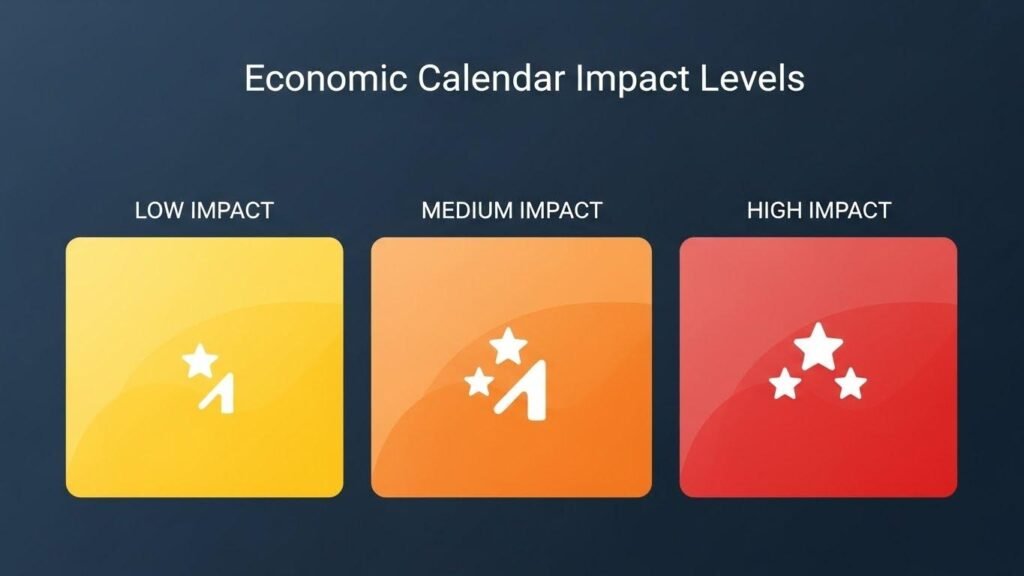
Some reports receive little attention from traders, while others can move the Forex market within seconds.
This is why economic calendars classify events according to their expected market impact.
Understanding these impact levels helps traders decide whether to trade normally, reduce their risk, or stay out of the market until the news has passed.
Let’s look at each impact level in more detail.
High-Impact Events (🔴)
High-impact events are the most important announcements on the economic calendar.
These releases often create sharp price movements because they provide significant information about the health of an economy. High-impact news can increase market volatility, which is why understanding Forex Trading Risks for Beginners is essential.
Banks, hedge funds, institutional investors, and retail traders all pay close attention to these announcements.
As a result, market volatility usually increases before and after the release.
Examples of High-Impact Events
- Interest Rate Decisions
- Non-Farm Payrolls (NFP)
- Consumer Price Index (CPI)
- Gross Domestic Product (GDP)
- Central Bank Press Conferences
- Federal Reserve (Fed) Statements
- European Central Bank (ECB) Announcements
How the Market Reacts
Suppose the U.S. Federal Reserve unexpectedly raises interest rates.
Many investors may buy the US Dollar because higher interest rates can make a country’s currency more attractive.
As demand for the US Dollar increases, currency pairs such as EUR/USD may fall while USD/JPY may rise.
These movements can happen very quickly, sometimes within seconds.
What Should Beginners Do?
If you’re new to Forex trading, it’s often best to avoid opening new trades just before a high-impact announcement.
Instead:
✔ Check the calendar before trading.
✔ Wait for the market to settle after the news.
✔ Avoid emotional decisions during periods of extreme volatility.
Many experienced traders also reduce their position sizes or stay on the sidelines until market conditions become more stable.
Medium-Impact Events (🟡)
Medium-impact events usually generate moderate market movement.
Although these reports may not cause dramatic price swings like high-impact events, they can still influence market sentiment, especially when results differ significantly from expectations.
Examples of Medium-Impact Events
- Retail Sales
- Manufacturing PMI
- Consumer Confidence Index
- Housing Market Reports
- Trade Balance
- Business Activity Surveys
Practical Example
Imagine the Australian Retail Sales report is much stronger than analysts expected.
The Australian Dollar (AUD) may strengthen as investors interpret the report as a sign of increased consumer spending and economic growth.
However, the market reaction is generally less dramatic than an interest rate announcement.
How Beginners Should Respond
Medium-impact events should not be ignored.
Before placing a trade:
✔ Check whether the event affects the currency pair you’re trading.
✔ Be aware that temporary volatility may occur.
✔ Follow your trading plan instead of reacting emotionally.
Low-Impact Events (🟢)
Low-impact events rarely cause significant price movements.
These reports are still important because they provide additional information about an economy, but they usually have limited influence on the Forex market.
Examples of Low-Impact Events
- Minor government reports
- Industry-specific surveys
- Smaller economic indicators
- Local business reports
Market Behavior
During low-impact announcements, many currency pairs continue trading normally.
Price fluctuations are often small unless unexpected news accompanies the report.
Should Beginners Pay Attention?
Yes, but don’t let low-impact events distract you from your overall trading strategy.
Use them as background information while focusing primarily on higher-impact events.
Comparing the Three Impact Levels
| Impact Level | Expected Market Movement | Beginner Recommendation |
|---|---|---|
| 🔴 High | Large price movements and increased volatility | Monitor closely and consider waiting until volatility settles before trading. |
| 🟡 Medium | Moderate market movement | Trade carefully and follow your risk management plan. |
| 🟢 Low | Small or limited price movement | Continue trading normally while remaining aware of scheduled events. |
Why Impact Levels Matter
Many beginner traders make the mistake of treating every news event the same.
In reality, the market reacts differently depending on the importance of the announcement.
For example:
A local manufacturing survey may have very little effect on EUR/USD.
However, a U.S. Non-Farm Payrolls report released on the same day could trigger price movements of more than 100 pips within minutes.
Understanding impact levels helps you prioritize which events deserve your attention.
Rather than trying to follow every economic report, focus on the announcements most likely to influence the currencies you trade.
Building an Economic Calendar Routine
Before your trading session begins, spend just a few minutes reviewing the day’s economic calendar.
Ask yourself:
- Are there any high-impact events scheduled today?
- Which currencies are expected to be affected?
- Will these events occur while my trades are open?
- Should I delay entering new positions until after the announcements?
Making this simple habit part of your daily routine can help you avoid unnecessary surprises and make more informed trading decisions.
Remember:
Successful Forex traders don’t just analyze charts they also prepare for the economic events that can move the market.
Most Important Economic Events Every Forex Trader Should Know
While an economic calendar contains dozens of events each week, only a handful consistently have a major impact on the Forex market. Among all economic reports, Non-Farm Payrolls (NFP) is one of the most closely watched because it can significantly affect the value of the U.S. Dollar.
As a beginner, you don’t need to memorize every report immediately. Instead, focus on understanding the events that professional traders watch most closely.
1. Interest Rate Decisions
Interest rates are announced by central banks such as:
- The U.S. Federal Reserve (Fed)
- The European Central Bank (ECB)
- The Bank of England (BoE)
- The Bank of Japan (BoJ)
Interest rate decisions often create significant volatility because they influence borrowing costs, inflation, and investor confidence. Changes in interest rates can have a major impact on currency values because they influence investment flows and borrowing costs.
Higher interest rates can strengthen a country’s currency, while lower rates may weaken it.
2. Non-Farm Payrolls (NFP)
The U.S. Non-Farm Payrolls report is released on the first Friday of most months.
It measures how many jobs were added or lost in the U.S. economy, excluding farm workers.
Because employment is a strong indicator of economic health, this report frequently causes large movements in USD currency pairs.
3. Consumer Price Index (CPI)
The Consumer Price Index measures inflation by tracking changes in the prices consumers pay for goods and services. The Consumer Price Index (CPI) measures inflation and often influences central bank decisions on interest rates.
Higher-than-expected inflation may increase the likelihood of interest rate hikes, which can strengthen a currency.
Lower inflation may have the opposite effect.
4. Gross Domestic Product (GDP)
GDP measures the total value of goods and services produced by a country.
Strong GDP growth generally indicates a healthy economy and can support a stronger currency.
Weak GDP figures may reduce investor confidence. Gross Domestic Product (GDP) is a key measure of a country’s economic performance and can influence investor confidence.
5. Central Bank Speeches
Even when interest rates remain unchanged, speeches by central bank governors can move the market. Traders closely monitor announcements from the Federal Reserve because its monetary policy decisions often drive movements in the U.S. Dollar.
Traders listen carefully for clues about future monetary policy.
Sometimes, a single comment from a central bank official can trigger significant price movements.
Practical Example: Using an Economic Calendar Before Trading
Imagine it’s Monday morning, and you’re planning to trade the EUR/USD currency pair. Practice using an economic calendar in a demo account before risking real money. Learn more in our Demo Trading vs Live Trading guide.
Before opening your trading platform, you check the economic calendar.
You notice the following events:
- 10:00 GMT – Eurozone Consumer Price Index (High Impact)
- 13:30 GMT – U.S. Consumer Price Index (High Impact)
Instead of placing a trade immediately, you decide to wait until both announcements have been released.
After the news, the market experiences sharp volatility for about 30 minutes before settling into a clearer trend.
Once price action becomes more stable, you analyze the charts again, identify a high-quality setup, and enter your trade according to your trading plan.
By simply checking the economic calendar first, you avoided entering the market during a period of unpredictable volatility.
This example demonstrates how an economic calendar helps traders make better-informed decisions rather than reacting emotionally to sudden market movements.
Common Mistakes Beginners Make When Using an Economic Calendar
Even traders who check the economic calendar can still make avoidable mistakes. During major news events, using Stop-Loss Orders can help limit unexpected losses caused by sudden price movements.
Here are some of the most common ones.
1. Ignoring High-Impact News
Some beginners focus entirely on technical analysis and forget to check for scheduled economic announcements.
This can result in unexpected losses when the market suddenly becomes volatile.
2. Trading During Major News Without a Plan
News trading requires experience and a well-tested strategy.
Beginners should avoid entering trades simply because they expect large price movements.
3. Forgetting Time Zone Settings
If your calendar displays a different time zone from your trading platform, you could miss important announcements or enter trades just before major news releases.
Always verify your time settings.
4. Watching Every News Event
Not every economic report deserves equal attention.
Focus on high-impact events affecting the currencies you trade most frequently.
5. Ignoring Risk Management
Some traders increase their position size during news events hoping for larger profits.
However, higher volatility also increases the potential for larger losses.
Continue following your risk management plan regardless of market conditions.
Frequently Asked Questions (FAQ)
What is the best economic calendar for Forex trading?
Many traders use economic calendars provided by reputable financial websites, Forex brokers, or educational platforms. The most important factor is choosing a calendar that is accurate, regularly updated, and allows you to filter events by currency and impact level.
Should beginners avoid trading during major news releases?
In many cases, yes.
High-impact announcements can create rapid price movements that are difficult for inexperienced traders to manage.
Many beginners prefer to wait until the market stabilizes before entering new trades.
How often should I check the economic calendar?
Ideally, you should check it before every trading session.
Reviewing the day’s scheduled events only takes a few minutes and can help you avoid unnecessary surprises.
Can an economic calendar predict market direction?
No.
An economic calendar tells you when important events will occur, not how the market will react.
Unexpected results and changing market sentiment can influence price movements in different ways.
Do day traders and swing traders both use economic calendars?
Yes.
Day traders often monitor intraday announcements because they can create short-term volatility.
Swing traders also use economic calendars to avoid holding positions through major news events unless their strategy allows for it.
Final Thoughts
An economic calendar is one of the simplest yet most valuable tools every Forex trader should use.
It doesn’t require advanced technical knowledge or expensive software.
Instead, it provides awareness of the events that can influence currency prices and helps traders prepare for periods of increased market volatility.
As a beginner, developing the habit of checking the economic calendar before every trading session can improve your decision-making and reduce unnecessary risk.
Remember these key lessons:
✔ Know when important economic events are scheduled.
✔ Understand which currencies may be affected.
✔ Pay close attention to high-impact announcements.
✔ Combine economic news with technical analysis rather than relying on either one alone.
✔ Always follow your trading plan and risk management rules.
Successful Forex trading is not just about identifying profitable opportunities—it’s also about knowing when to stay out of the market.
By making the economic calendar part of your daily routine, you’ll become a more informed, disciplined, and confident trader.
Continue Your Forex Learning Journey
If this guide helped you understand how to use an economic calendar, continue expanding your knowledge with our beginner-friendly Forex guides:
- What Is Forex Trading? A Beginner’s Guide
- How to Choose the Best Forex Broker for Beginners
- How to Open Your First Forex Trading Account
- Demo Trading vs Live Trading: Which Should Beginners Start With?
- What Is Leverage in Forex Trading?
- Forex Trading Risks for Beginners
- How to Create a Forex Trading Plan for Beginners
- How Stop-Loss Orders Help Limit Investment Losses and Risk
Every article is designed to help you build a strong foundation and trade with greater confidence.
Disclaimer
The information provided in this article is for educational and informational purposes only and should not be considered financial, investment, or trading advice.
Forex trading involves substantial risk and may not be suitable for every investor. Economic news and market events can increase price volatility, leading to both potential gains and losses.
Before making any trading decisions, conduct your own research, understand the risks involved, and consider consulting a qualified financial advisor if necessary. An economic calendar becomes even more powerful when it’s included in your Forex Trading Plan for Beginners.
Always trade responsibly and never risk money that you cannot afford to lose.