
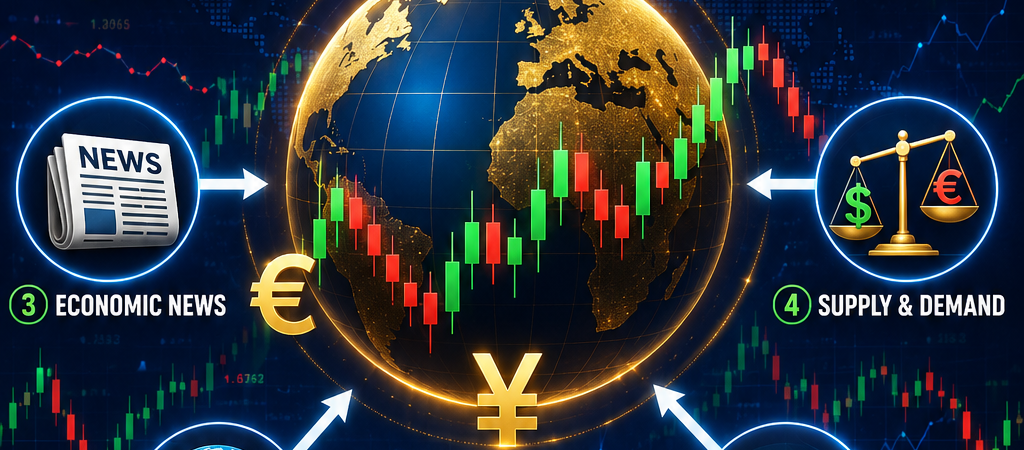
Introduction:
Have you ever wondered why the value of one currency rises while another falls? Why does the EUR/USD currency pair suddenly move hundreds of pips after a news announcement? Or why does the Forex market sometimes remain calm before becoming extremely volatile? Before exploring the factors that move currency prices, it’s helpful to understand how Forex charts are analyzed. Read our beginner’s guide on What Is Technical Analysis? A Beginner’s Guide to Reading Forex Charts.
The answer lies in understanding what moves the Forex market.
The Forex (foreign exchange) market is the largest financial market in the world, with more than $7 trillion worth of currencies traded every day. Unlike the stock market, which focuses on buying and selling shares of companies, the Forex market revolves around the exchange of one currency for another. Because countries have different economies, interest rates, political conditions, and financial policies, currency values are constantly changing.
Every movement in the Forex market is driven by the interaction of buyers and sellers. Traders, banks, multinational corporations, hedge funds, governments, and central banks all participate in the market, buying and selling currencies for different reasons. These activities create continuous price fluctuations that traders seek to profit from.
Understanding what causes these price movements is one of the most important skills every beginner trader should develop. Instead of guessing where the market might go next, successful traders learn to identify the economic, political, and psychological factors that influence currency prices.
In this beginner-friendly guide, you’ll learn the key factors that move the Forex market, including interest rates, inflation, economic news, central bank decisions, political events, and market sentiment. By the end of this article, you’ll have a solid understanding of why currencies rise and fall and how you can use this knowledge to make more informed trading decisions.
What Moves the Forex Market?
The Forex market is driven by one fundamental principle:
Supply and Demand.
Just like any other market, the price of a currency changes depending on how many people want to buy or sell it. If you’re just getting started with Forex trading, BabyPips School of Pipsology offers beginner-friendly lessons that explain how currencies move and the factors that influence exchange rates in simple, easy-to-understand language.
When demand for a currency increases, its value generally rises. Many traders use Price Action Trading to understand how buyers and sellers influence price movements without relying heavily on technical indicators.
When demand decreases and more traders begin selling, its value usually falls.
Think about it this way.
Imagine a popular smartphone has just been released.
Thousands of people want to buy it.
Because demand is high and supply is limited, the price increases.
Currencies work in a similar way.
If investors around the world believe that a country’s economy is becoming stronger, they are more likely to buy that country’s currency.
As buying pressure increases, the currency appreciates.
If investors lose confidence due to economic problems or political uncertainty, they begin selling the currency.
This causes the currency to depreciate.
Every price movement you see on a Forex chart is simply the result of buyers and sellers interacting in the market.
Understanding this basic concept makes it much easier to understand why different events affect currency prices.
Why Currency Prices Constantly Change
Unlike fixed assets, currencies are constantly being exchanged around the world.
Every day:
- International companies pay suppliers in foreign currencies.
- Tourists exchange money before traveling.
- Governments repay international debt.
- Investors move money between countries.
- Central banks buy or sell currencies.
- Forex traders speculate on price movements.
All these activities influence supply and demand.
For example:
A European company purchasing products from the United States must buy U.S. dollars before making payment.
This increases demand for the U.S. dollar.
Now imagine thousands of companies doing the same thing every day.
The increased demand can strengthen the dollar against other currencies.
Likewise, if many investors decide to sell the dollar because they expect lower interest rates in the United States, the value of the dollar may decline.
The Forex market reflects these changes almost instantly.
This is why currency prices appear to move continuously throughout the trading day.
Who Moves the Forex Market?
Many beginners believe that retail traders are responsible for moving currency prices.
In reality, individual traders account for only a small percentage of the overall Forex market.
The biggest market participants include:
Central Banks
Central banks influence currency values by adjusting interest rates and implementing monetary policies.
Examples include:
- Federal Reserve (United States)
- European Central Bank (Eurozone)
- Bank of England (United Kingdom)
- Bank of Japan (Japan)
Their decisions often cause significant market movements.
Commercial Banks
Large international banks process billions of dollars in currency transactions every day.
Because of their enormous trading volume, they have a major influence on exchange rates.
Multinational Companies
Companies operating internationally regularly exchange currencies when importing goods, exporting products, paying employees, or investing overseas.
These transactions contribute to daily market activity.
Investment Funds
Hedge funds, pension funds, and asset management firms frequently buy and sell currencies as part of their investment strategies.
Large institutional trades can create noticeable price movements.
Retail Forex Traders
Individual traders like you also participate in the market.
Although retail traders represent only a small portion of total trading volume, they contribute to market liquidity and price discovery.
Why Understanding Market Movers Matters
Knowing who participates in the Forex market helps traders understand why prices move unexpectedly.
For example, a sudden increase in trading volume during a central bank announcement is often driven by institutional investors reacting to new information.
Rather than assuming the market is moving randomly, experienced traders recognize that major participants are responding to economic developments.
This perspective allows beginners to approach Forex trading with greater confidence and a better understanding of how the market works.
Interest Rates: One of the Biggest Market Movers
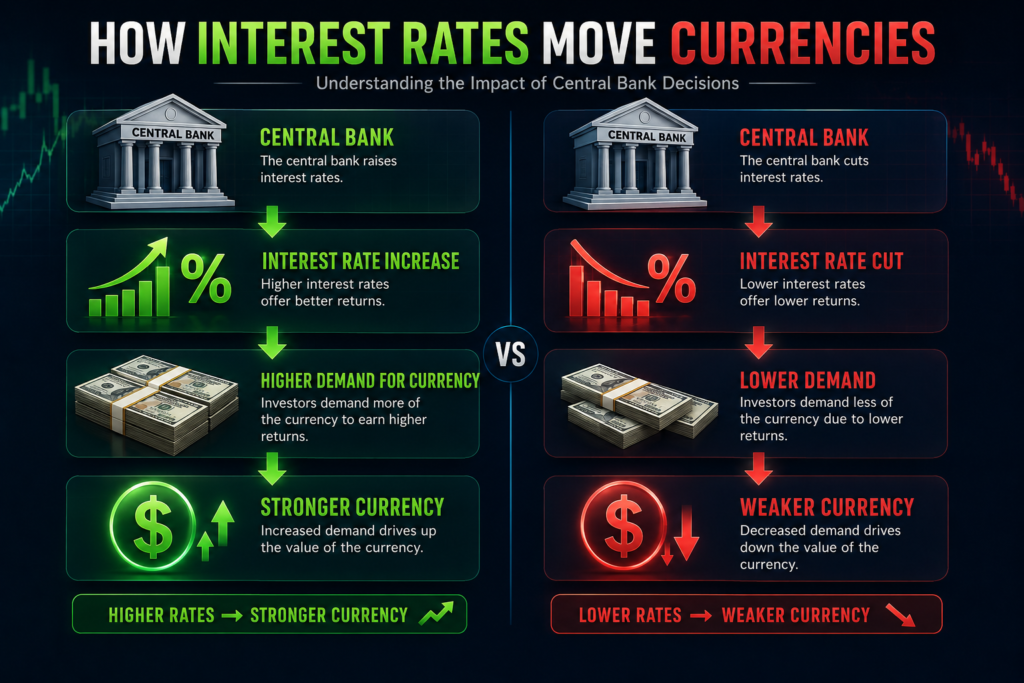
Interest rates are one of the most powerful forces behind movements in the Forex market. Almost every major currency pair reacts when a country’s central bank changes its interest rates.
But what exactly are interest rates?
An interest rate is the percentage charged when borrowing money or earned when saving money. Central banks use interest rates to control inflation, encourage economic growth, and maintain financial stability.
When interest rates increase, investors often receive higher returns on savings and investments in that country’s currency. As a result, demand for the currency usually increases, causing its value to rise.
When interest rates decrease, investors may move their money to countries offering better returns. This reduces demand for the currency, causing its value to fall.
Practical Example
Imagine the U.S. Federal Reserve raises interest rates from 4% to 5%.
Investors around the world now earn more interest by holding U.S. dollar assets.
As more investors buy U.S. dollars, demand increases.
The U.S. dollar strengthens against many other currencies.
This is why currency pairs such as EUR/USD often fall when the U.S. dollar becomes stronger.
Why Central Banks Change Interest Rates
Central banks don’t change interest rates randomly. Interest rate decisions made by the U.S. Federal Reserve are closely watched by Forex traders because they can significantly influence the value of the U.S. dollar and global financial markets.
They carefully monitor the economy before making decisions. Understanding how interest rate announcements affect the market becomes much easier when you regularly monitor an economic calendar before placing trades.
Some of the factors they consider include:
- Inflation
- Employment levels
- Economic growth
- Consumer spending
- Business investment
- Financial stability
For example:
If inflation rises too quickly, a central bank may increase interest rates to slow spending.
If the economy becomes weak, it may lower interest rates to encourage borrowing and investment.
These decisions often create significant volatility in the Forex market because traders immediately adjust their expectations.
Inflation and Currency Value
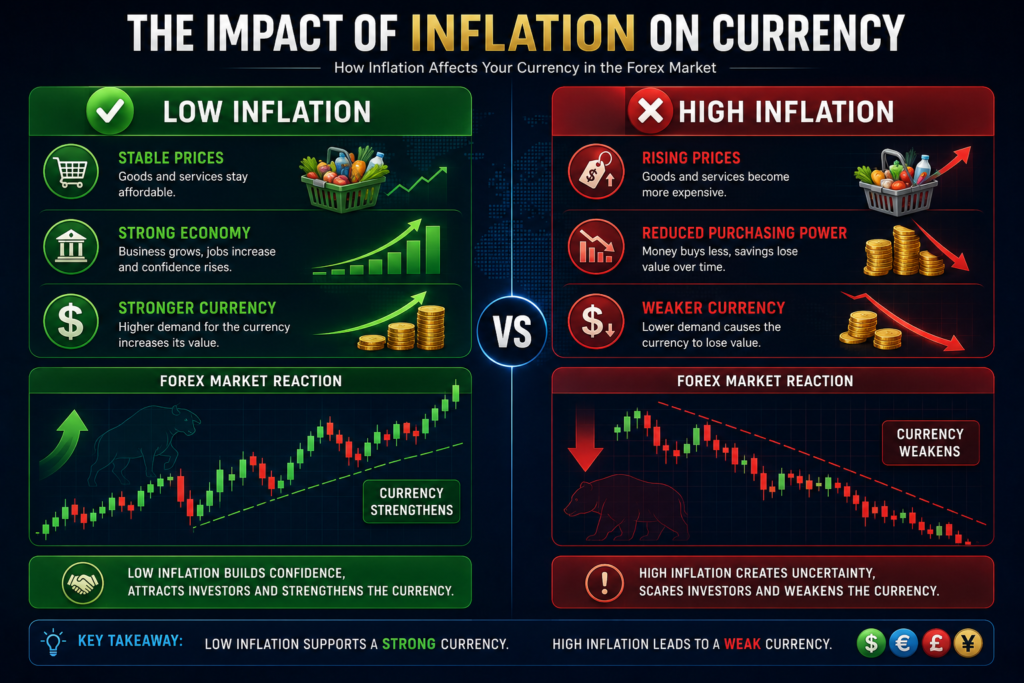
Inflation measures how quickly the prices of goods and services increase over time.
A moderate level of inflation is considered healthy for most economies.
However, extremely high inflation reduces the purchasing power of a country’s currency.
For example:
If a loaf of bread costs $2 today but $3 next year, inflation has increased.
When inflation becomes too high, investors may lose confidence in the country’s economy.
As confidence falls, demand for the currency may decline.
This often weakens the currency.
How Inflation Affects Forex Trading
Inflation influences the decisions made by central banks.
If inflation rises above the central bank’s target, officials may increase interest rates.
Higher interest rates often strengthen the currency.
On the other hand, if inflation falls too low, central banks may reduce interest rates to stimulate economic activity.
This can weaken the currency.
Forex traders therefore pay close attention to inflation reports because they often provide clues about future interest rate decisions.
One of the most closely watched inflation reports is the Consumer Price Index (CPI).
Higher-than-expected CPI figures often cause increased market volatility.
Central Banks: The Most Influential Institutions in Forex
Central banks play a crucial role in determining the value of a country’s currency.
They control monetary policy and use various tools to influence economic conditions.
Some of the world’s most influential central banks include:
- Federal Reserve (United States)
- European Central Bank (Eurozone)
- Bank of England (United Kingdom)
- Bank of Japan (Japan)
- Swiss National Bank (Switzerland)
- Reserve Bank of Australia (Australia)
Whenever these institutions announce changes in interest rates or future economic plans, the Forex market reacts almost immediately.
Monetary Policy Explained
Monetary policy refers to the actions central banks take to manage a country’s money supply and economic activity.
There are two main types:
Expansionary Monetary Policy
Used when the economy is slowing down.
Central banks may:
- Lower interest rates.
- Increase money supply.
- Encourage borrowing.
This often weakens the currency but supports economic growth.
Contractionary Monetary Policy
Used when inflation becomes too high.
Central banks may:
- Raise interest rates.
- Reduce money supply.
- Slow consumer spending.
This often strengthens the currency.
Understanding these policies helps traders anticipate potential market movements.
Economic News That Moves the Forex Market
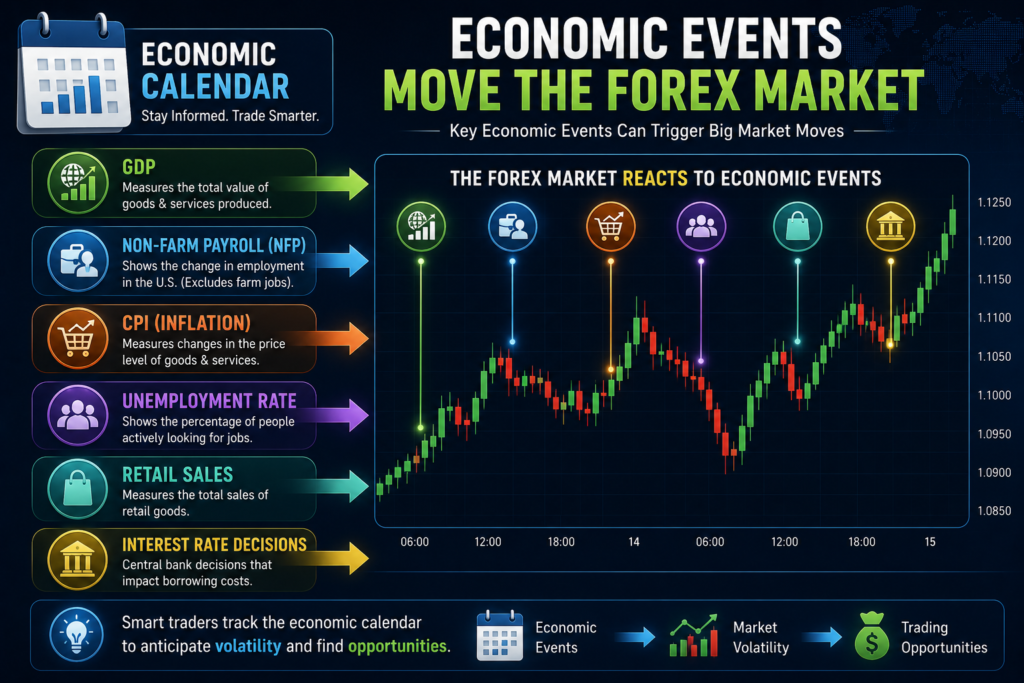
The Forex market responds quickly to important economic announcements. To stay informed about upcoming high-impact events such as interest rate decisions, inflation reports, and employment data, traders can use the Investing.com Economic Calendar, which provides a schedule of major economic releases from around the world.
These reports provide valuable information about the health of a country’s economy. Once you understand how news affects the market, the next step is learning how to protect your trades. Our guide on How to Set Stop Loss and Take Profit Correctly in Forex explains how to manage risk during volatile market conditions.
Some reports have a greater impact than others.
Non-Farm Payrolls (NFP)
The U.S. Non-Farm Payroll report measures how many new jobs were created during the previous month.
It is released on the first Friday of every month.
A strong NFP report usually strengthens the U.S. dollar because it suggests a healthy economy.
A weak report often weakens the dollar.
Many traders avoid opening new trades immediately before the NFP release because volatility can increase dramatically.
Gross Domestic Product (GDP)
GDP measures the total value of goods and services produced within a country.
Strong GDP growth usually indicates:
- Higher business activity.
- Increased employment.
- Strong consumer spending.
These factors often strengthen the country’s currency.
Weak GDP growth may have the opposite effect.
Consumer Price Index (CPI)
CPI measures inflation.
Higher inflation may encourage central banks to raise interest rates.
Because higher interest rates often strengthen a currency, CPI announcements receive significant attention from Forex traders.
Unemployment Rate
The unemployment rate measures the percentage of people actively looking for work but unable to find employment.
A falling unemployment rate generally suggests a healthier economy.
This often strengthens the currency.
A rising unemployment rate may weaken it.
Retail Sales
Retail Sales measure consumer spending.
Strong consumer spending usually reflects confidence in the economy.
Higher Retail Sales figures often support a stronger currency.
Weak spending may have the opposite effect.
Why Traders Watch the Economic Calendar
Professional traders rarely enter trades without checking the economic calendar first.
The calendar highlights upcoming events that could cause large price movements.
Examples include:
- Interest rate decisions
- Inflation reports
- Employment reports
- GDP announcements
- Central bank speeches
Ignoring these events can expose traders to unexpected volatility.
Internal Link Opportunity: Learn how to interpret these events in our guide on How to Use an Economic Calendar in Forex Trading.
Key Takeaways
Interest rates, inflation, central bank decisions, and economic reports are among the most important drivers of the Forex market. These factors influence investor confidence and currency demand, often causing significant price movements. By understanding how these economic indicators work, beginner traders can better prepare for market volatility and make more informed trading decisions.
Political Events and Their Impact on the Forex Market
Politics can have a significant influence on currency prices. When political events create uncertainty, investors often react by buying or selling currencies, causing exchange rates to fluctuate.
Some political events that commonly move the Forex market include:
- National elections
- Changes in government
- Trade agreements
- International conflicts
- Economic sanctions
- Political instability
For example, if investors believe a newly elected government will improve economic growth, confidence in that country’s currency may increase, causing it to strengthen.
On the other hand, political uncertainty often causes investors to move their money into safer currencies until conditions improve.
This is why major elections and government announcements frequently generate increased volatility in the Forex market.
Market Sentiment: Understanding Investor Confidence
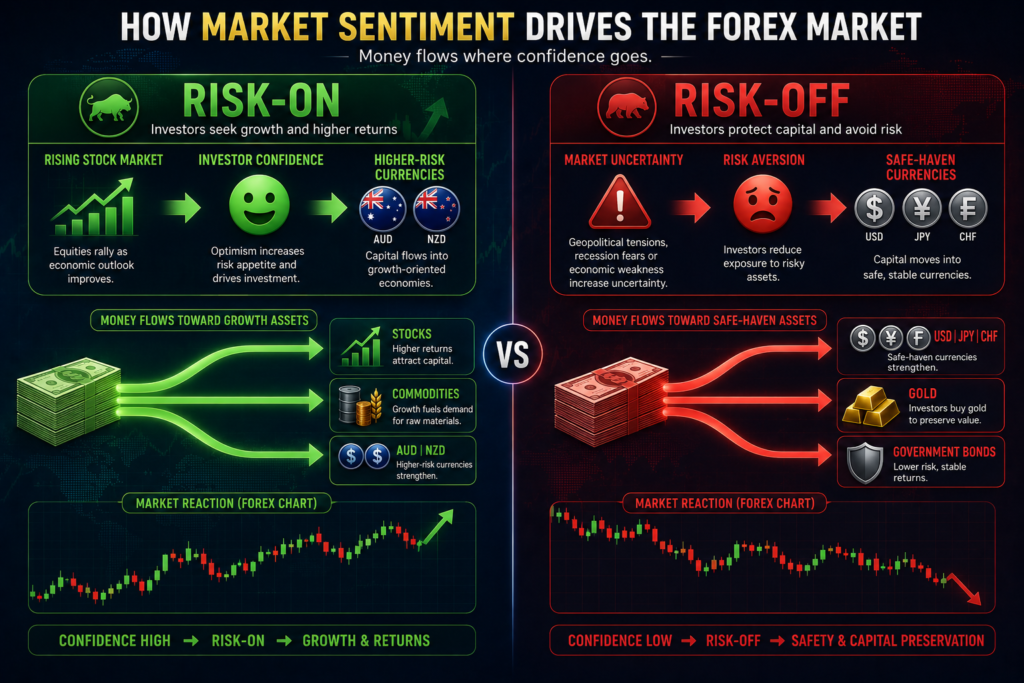
Market sentiment refers to the overall attitude of investors toward financial markets.
Sometimes traders feel optimistic and are willing to take more risks.
At other times they become cautious and move their money into safer investments.
Understanding market sentiment helps Forex traders anticipate how currencies may react during different market conditions.
Risk-On Sentiment
During a Risk-On environment, investors are confident about economic growth.
They are more willing to invest in:
- Stocks
- Emerging market currencies
- Higher-risk assets
Currencies such as the Australian Dollar (AUD) and New Zealand Dollar (NZD) often benefit during Risk-On periods because they are associated with global economic growth.
Risk-Off Sentiment
During uncertain periods, investors seek safety.
This is known as a Risk-Off environment.
They often move their money into currencies considered relatively stable, including:
- U.S. Dollar (USD)
- Japanese Yen (JPY)
- Swiss Franc (CHF)
For example, during major financial crises or geopolitical tensions, demand for these safe-haven currencies often increases.
Supply and Demand in the Forex Market
Every movement in the Forex market ultimately comes back to supply and demand.
If more traders want to buy a currency than sell it, demand increases and the currency generally appreciates.
If more traders want to sell than buy, supply exceeds demand and the currency usually depreciates.
Several factors influence supply and demand, including:
- Interest rates
- Inflation
- Economic performance
- Political stability
- Investor confidence
- Central bank policies
By understanding these factors, traders can better understand why prices move the way they do.
Major Forex Trading Sessions
The Forex market operates 24 hours a day because financial centers around the world open and close at different times.
There are four major trading sessions.
Sydney Session
The Sydney session begins the Forex trading week.
Although trading activity is generally lower than in other sessions, it provides opportunities for traders focusing on Australian and New Zealand currency pairs.
Tokyo Session
The Tokyo session is the primary trading session for Asian markets.
Currency pairs involving the Japanese Yen often experience increased activity during this period.
London Session
The London session is the busiest Forex trading session.
Large financial institutions and banks execute significant trading volume during these hours.
Many of the day’s strongest price movements occur while London is open.
New York Session
The New York session overlaps with the London session for several hours.
This overlap creates the highest trading volume and volatility of the day.
Many experienced traders prefer trading during this period because of the increased liquidity.
How Beginners Can Prepare for Market Movements
Understanding what moves the Forex market is only the first step. Successful traders also prepare before entering a trade.
Here are a few habits every beginner should develop:
Check the Economic Calendar
Always review upcoming economic events before placing a trade.
High-impact announcements can significantly increase market volatility.
Follow Central Bank Announcements
Interest rate decisions and policy statements from central banks often create large market movements.
Knowing when these announcements are scheduled helps you avoid unexpected surprises.
Practice on a Demo Account
Before risking real money, practice identifying how different news events affect currency prices using a demo account.
This allows you to gain experience without financial risk.
Use Proper Risk Management
Never trade without:
- A Stop Loss
- A Take Profit
- Appropriate position sizing
Even if your market analysis is correct, unexpected events can still cause losses.
Continue Learning
The Forex market is constantly changing.
Successful traders invest time in improving their knowledge, reviewing past trades, and adapting to new market conditions.
Continuous learning is one of the keys to long-term trading success.
Frequently Asked Questions (FAQs)
What is the biggest factor that moves the Forex market?
Interest rate decisions made by central banks are among the most influential factors because they directly affect investor demand for currencies.
Why do currencies become stronger or weaker?
Currencies strengthen when demand increases and weaken when demand falls. Economic performance, inflation, political events, and interest rates all influence demand.
Why does economic news create volatility?
Economic reports provide new information about the health of an economy. Traders quickly adjust their positions based on this information, causing prices to move rapidly.
Can political events affect currency prices?
Yes. Elections, government policies, international conflicts, and trade agreements can all influence investor confidence and currency values.
Should beginners trade during major news releases?
Many beginners choose to avoid trading immediately before high-impact news events because price movements can become highly unpredictable.
How can I stay informed about important market events?
Use a reliable economic calendar, follow central bank announcements, and stay updated with financial news from trusted sources.
Final Thoughts
The Forex market moves because millions of buyers and sellers react to economic conditions, political developments, central bank decisions, and investor sentiment every day. While these price movements may seem random at first, they often reflect logical changes in supply and demand.
As a beginner, you don’t need to predict every market move. Instead, focus on understanding the key factors that influence currency prices and learn how to prepare for important events before placing a trade.
By combining knowledge of economic fundamentals with technical analysis, price action, and proper risk management, you can make more informed trading decisions and build a stronger foundation for long-term success in Forex trading.
Remember, successful traders don’t simply react to market movements; they understand why the market is moving.
Risk Disclaimer
Disclaimer: This article is for educational purposes only and should not be considered financial or investment advice. Forex trading carries significant risk and may not be suitable for every investor. Past performance is not a guarantee of future results. Always conduct your own research, practice on a demo account, and consult a qualified financial advisor before making financial decisions. Before trading with real money, it’s important to understand the risks involved. The U.S. Commodity Futures Trading Commission (CFTC) provides educational resources to help traders understand leveraged markets and make informed trading decisions.
Continue Your Forex Learning Journey
If you enjoyed this guide, continue building your Forex knowledge with these beginner-friendly articles on BuildSmartAfri:
- What Is Technical Analysis? A Beginner’s Guide to Reading Forex Charts
- How to Use an Economic Calendar in Forex Trading
- Support and Resistance in Forex Trading for Beginners
- What Is Price Action Trading? A Beginner’s Guide
- How to Set Stop Loss and Take Profit Correctly in Forex
- The Psychology of a Successful Trader