
Introduction:
The Forex market is constantly moving as currencies rise and fall in value. Some days, prices change only slightly, while on other days they can move dramatically within minutes. These price fluctuations are known as volatility, and understanding them is essential for anyone learning to trade Forex. Explore more of our Forex articles: What is Forex trading? Learn the basics of Forex trading
Volatility affects every aspect of trading, from identifying opportunities to managing risk. High volatility can create the potential for larger profits, but it also increases the chance of significant losses. Low volatility, on the other hand, often leads to slower price movements and fewer trading opportunities.
Whether you plan to become a day trader, swing trader, or long-term investor, understanding how volatility works will help you make more informed trading decisions.
In this guide, you’ll learn what volatility in Forex trading is, what causes it, how it impacts currency prices, and practical ways beginners can trade confidently during both calm and volatile market conditions.
What Is Volatility in Forex Trading?
Volatility in Forex trading refers to the degree and speed at which a currency pair’s price changes over a specific period. In simple terms, it measures how much the market moves. Learn more about Forex volatility
A currency pair with high volatility experiences large and rapid price swings, while a pair with low volatility moves more slowly and within a smaller price range.
For example, if the EUR/USD currency pair moves only 20 pips during an entire trading session, it is considered relatively calm. However, if the same pair suddenly moves 150 pips in a short period after a major economic announcement, it is experiencing high volatility.
Volatility itself does not indicate the direction of the market. Prices can become highly volatile while moving upward, downward, or even reversing multiple times. Instead, volatility simply describes the intensity of price movement.
Many professional traders welcome volatility because it creates more opportunities to enter and exit trades. However, inexperienced traders may find highly volatile markets difficult to manage because prices can change rapidly, increasing the likelihood of emotional decisions.
Understanding volatility helps traders choose suitable trading strategies, set realistic stop-loss levels, and determine whether current market conditions match their trading style.
Why Volatility Matters in Forex Trading
Volatility is one of the most important concepts in Forex because it directly affects both trading opportunities and risk. Every trader, regardless of experience, should understand how changing market conditions influence price movements before placing a trade.
Here are some of the main reasons volatility matters:
It Creates Trading Opportunities
Price movement is essential for making profits in Forex trading. Without volatility, currency prices would remain almost unchanged, leaving traders with few opportunities to enter or exit positions. Moderate to high volatility often provides more setups for traders following trends, breakouts, or price action strategies.
It Increases Risk
While larger price movements can increase profit potential, they also expose traders to greater losses. During periods of high volatility, prices may move quickly enough to trigger stop-loss orders or cause unexpected losses if proper risk management is not in place.
It Influences Trading Strategy
Different trading strategies perform better under different market conditions. For example:
- Trend-following strategies often work well when volatility supports strong directional moves.
- Range trading strategies are generally more suitable during periods of lower volatility when prices move within established support and resistance levels.
Understanding the current level of volatility helps traders choose strategies that are more appropriate for prevailing market conditions.
It Helps Manage Risk
Knowing whether the market is calm or highly volatile allows traders to adjust their position size, stop-loss distance, and profit targets. Adapting these elements to market conditions can improve consistency and reduce unnecessary risk.
What Causes Volatility in the Forex Market?

Volatility in the Forex market doesn’t happen randomly. It is driven by economic events, political developments, market sentiment, and changes in the global economy. When traders receive new information that affects the value of a currency, they react by buying or selling, causing prices to move. Check the latest economic calendar
Understanding what causes volatility can help you anticipate periods of increased market activity and make better-informed trading decisions. What moves the Forex market, factors that move currency prices
1. Economic News Releases

One of the biggest drivers of Forex volatility is the release of important economic data. Governments and financial institutions regularly publish reports that provide insights into a country’s economic health. economic calendar
Some of the most influential reports include:
- Gross Domestic Product (GDP)
- Consumer Price Index (CPI)
- Non-Farm Payrolls (NFP)
- Unemployment Rate
- Retail Sales
- Manufacturing PMI
For example, if the United States reports stronger-than-expected job growth through the monthly Non-Farm Payrolls report, the U.S. dollar often strengthens rapidly as traders expect a healthier economy. This can lead to significant price movements across many USD currency pairs.
2. Central Bank Decisions
Central banks play a crucial role in determining the value of their country’s currency. Institutions such as the U.S. Federal Reserve (Fed), European Central Bank (ECB), Bank of England (BoE), and Bank of Japan (BoJ) regularly announce monetary policy decisions. Learn more about interest rates and monetary policy
These announcements may include:
- Interest rate changes
- Inflation outlook
- Economic forecasts
- Future policy guidance
An unexpected interest rate increase can make a currency more attractive to investors, increasing demand and causing its value to rise. Conversely, interest rate cuts often weaken a currency.
3. Political Events
Political developments can create uncertainty, which often leads to increased market volatility.
Examples include:
- National elections
- Changes in government
- Trade disputes
- International conflicts
- Economic sanctions
- Major policy announcements
When uncertainty increases, traders quickly adjust their positions, leading to sharp price movements.
4. Market Sentiment
Forex prices are influenced not only by economic data but also by how traders feel about the market.
During periods of optimism (known as risk-on sentiment), investors often buy higher-risk currencies such as the Australian Dollar (AUD) and New Zealand Dollar (NZD).
During periods of uncertainty or fear (risk-off sentiment), traders usually move their money into safer assets such as the U.S. Dollar (USD), Japanese Yen (JPY), and Swiss Franc (CHF).
Changes in market sentiment can create significant volatility even without major economic news.
5. Unexpected Global Events
Some of the largest market movements occur after unexpected events that cannot be predicted.
Examples include:
- Natural disasters
- Global pandemics
- Geopolitical conflicts
- Financial crises
- Major banking failures
These events often cause investors to rapidly reassess risk, leading to sudden increases in volatility across multiple currency pairs.
6. Low Market Liquidity
Volatility can also increase when fewer traders are actively participating in the market.
Periods of lower liquidity commonly occur:
- Before major market sessions open
- During public holidays
- Between the close of the New York session and the opening of the Asian session
With fewer buyers and sellers in the market, even relatively small trades can cause larger-than-normal price movements.
Key Takeaway
Volatility is primarily driven by economic data, central bank decisions, political events, market sentiment, unexpected global developments, and changes in market liquidity. While these factors cannot always be controlled or predicted, understanding them helps traders prepare for periods of increased market activity instead of being caught off guard.
By monitoring economic calendars and staying informed about major global events, beginners can better anticipate when volatility is likely to increase and adjust their trading strategies accordingly.
Types of Volatility in Forex Trading
Not all market movements are the same. Sometimes prices move gradually over several days, while at other times they can surge or fall within minutes. To better understand these market conditions, traders generally classify volatility into two main types: historical volatility and implied volatility. Learn how market volatility affects financial markets
Understanding these types helps traders analyze past price behavior and prepare for future market movements.
1. Historical Volatility
Historical volatility measures how much a currency pair’s price has moved in the past over a specific period.
It is calculated using previous price data to determine the average level of price fluctuations. Traders use historical volatility to understand whether a currency pair has recently been calm or highly active.
For example, if the GBP/USD currency pair has been moving between 120 and 180 pips per day over the last month, it has experienced relatively high historical volatility.
Historical volatility helps traders:
- Analyze past market behavior
- Compare different currency pairs
- Select suitable trading strategies
- Estimate appropriate stop-loss and take-profit levels
However, it’s important to remember that past volatility does not guarantee future volatility. Market conditions can change quickly due to new economic or political events.
2. Implied Volatility
Implied volatility refers to the market’s expectation of future price movements.
Unlike historical volatility, which looks backward, implied volatility attempts to estimate how much traders believe prices may fluctuate in the future.
Implied volatility often increases before major events such as:
- Central bank interest rate decisions
- Non-Farm Payroll (NFP) releases
- Inflation reports
- National elections
- Major geopolitical developments
For example, if traders expect the U.S. Federal Reserve to announce an unexpected interest rate increase, implied volatility for USD currency pairs may rise before the announcement because traders anticipate significant market movement.
Although implied volatility is more commonly discussed in options trading, the concept is still useful for Forex traders because it reflects overall market expectations and uncertainty.
Which Type Is More Important for Beginners?
For most beginner Forex traders, historical volatility is the more practical type to understand.
Historical volatility allows you to:
- Study how a currency pair typically behaves
- Identify periods of high and low market activity
- Improve your risk management
- Choose trading strategies that match current market conditions
As you gain experience, you’ll also learn to pay attention to implied volatility by monitoring economic calendars, central bank meetings, and major news events that can influence future price movements.
Key Takeaway
There are two main types of Forex volatility:
- Historical Volatility looks at past price movements and helps traders understand how active a currency pair has been.
- Implied Volatility reflects market expectations about future price movements, especially before major economic or political events.
Both types provide valuable insights, but beginners should first focus on understanding historical volatility while gradually learning how market expectations influence future price action.
High Volatility vs Low Volatility in Forex Trading
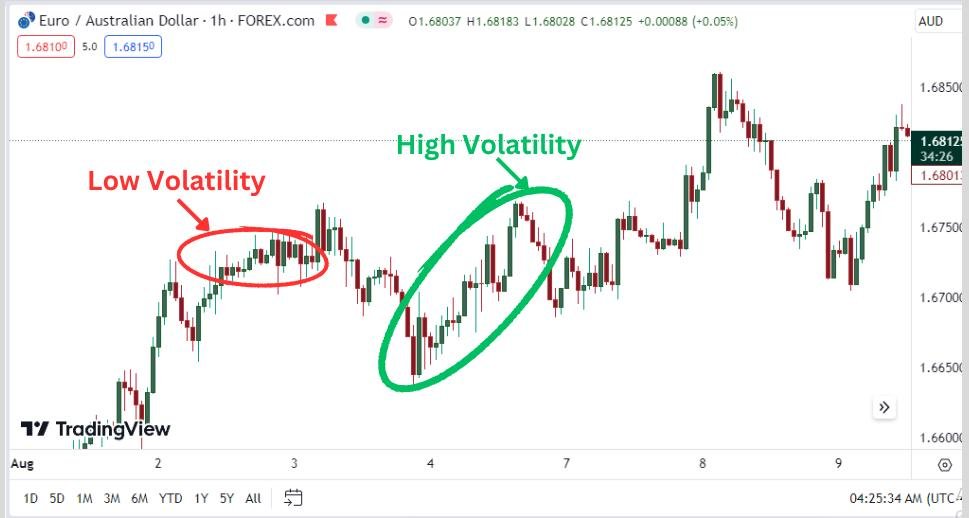
The Forex market does not move at the same pace all the time. Some trading sessions experience rapid and large price swings, while others remain relatively calm with only minor fluctuations. These different market conditions are known as high volatility and low volatility. trend trading strategies
Understanding the difference between the two is important because it helps traders choose appropriate strategies, manage risk effectively, and avoid unnecessary losses.
What Is High Volatility?
High volatility occurs when a currency pair experiences large and rapid price movements within a short period. During highly volatile conditions, prices can rise or fall sharply as traders react to major news, economic reports, or unexpected global events.
High volatility is common during:
- Major economic news releases
- Interest rate announcements
- Non-Farm Payroll (NFP) reports
- Inflation data releases
- Political elections
- Geopolitical conflicts
- The overlap of the London and New York trading sessions
For example, if the EUR/USD moves 180 pips within a few hours after a U.S. inflation report, the market is experiencing high volatility.
Advantages of High Volatility
- More trading opportunities
- Larger profit potential
- Stronger market trends
- Faster price movement toward profit targets
Disadvantages of High Volatility
- Greater trading risk
- Higher chance of stop-loss orders being triggered
- Wider spreads during major news events
- Increased emotional pressure for inexperienced traders
What Is Low Volatility?
Low volatility occurs when a currency pair moves within a small price range over a period of time. During these conditions, buyers and sellers are relatively balanced, and there is little market excitement.
Low volatility often occurs:
- Before important economic announcements
- During public holidays
- During the late U.S. trading session
- When there is little economic news
- During periods of market uncertainty where traders are waiting for new information
For example, if the USD/CHF moves only 25 pips throughout an entire trading session, it is experiencing low volatility.
Advantages of Low Volatility
- More stable market conditions
- Easier for beginners to manage risk
- Smaller price fluctuations
- Better suited for range trading strategies
Disadvantages of Low Volatility
- Fewer trading opportunities
- Smaller profit potential
- Longer waiting times for trades to reach targets
- Increased likelihood of false breakouts due to weak market momentum
High Volatility vs Low Volatility
| High Volatility | Low Volatility |
|---|---|
| Large price movements | Small price movements |
| Higher potential profits | Lower potential profits |
| Higher trading risk | Lower trading risk |
| Strong market momentum | Weak market momentum |
| Common during major news events | Common during quiet market periods |
| Suitable for trend and breakout strategies | Suitable for range-bound strategies |
Which Market Condition Is Better for Beginners?
Neither high nor low volatility is inherently better; it depends on your experience, strategy, and risk tolerance.
For beginners, moderate volatility is often the most manageable because it provides trading opportunities without the extreme price swings that can occur during major news events.
If you are new to Forex trading:
- Avoid trading immediately before high-impact economic news releases.
- Always use a stop-loss order to limit potential losses.
- Reduce your position size during highly volatile market conditions.
- Practice identifying volatility on a demo account before risking real money.
As you gain experience, you’ll become more comfortable adapting your trading strategies to different levels of market volatility.
Key Takeaway
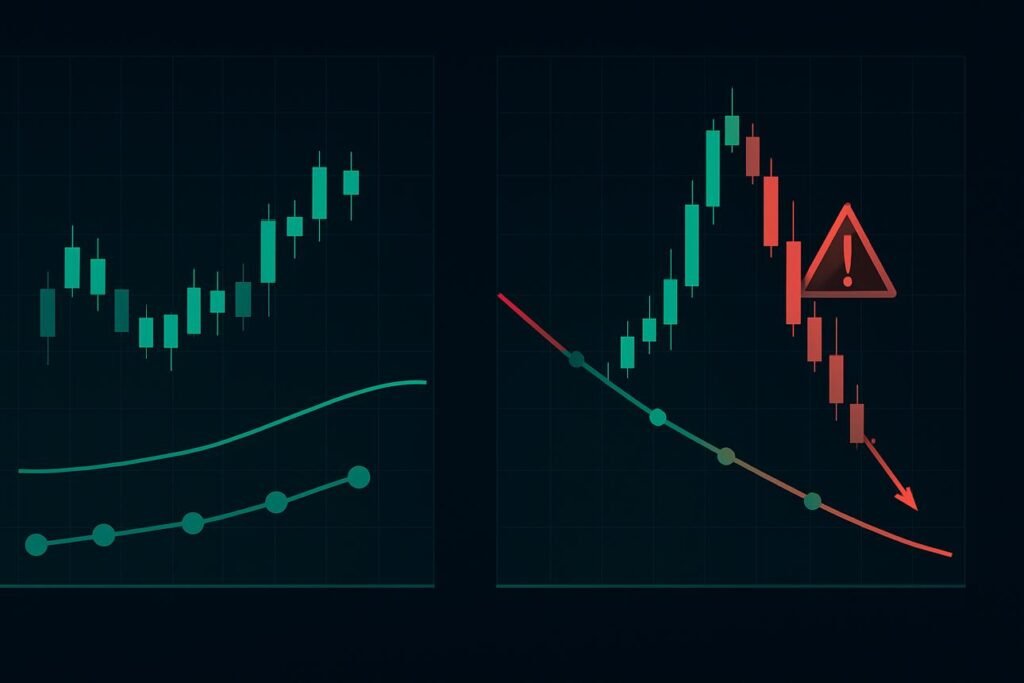
High volatility means prices are moving quickly and over larger distances, creating both greater opportunities and greater risks. Low volatility means prices are moving slowly within a smaller range, resulting in fewer opportunities but generally lower risk.
Successful Forex traders do not simply chase volatile markets. Instead, they understand current market conditions, adjust their strategies accordingly, and apply sound risk management regardless of whether volatility is high or low.
How to Trade During High Volatility
High volatility can create exciting trading opportunities, but it also comes with increased risk. Prices can move rapidly in either direction, making it easier to earn profits or incur losses within a short period. For beginners, the key is not to fear volatility but to learn how to manage it effectively. Understand the risks of Forex trading
Here are some practical tips for trading during highly volatile market conditions.
1. Follow the Economic Calendar
Major economic announcements are one of the biggest causes of volatility in the Forex market. Before placing a trade, always check the economic calendar for high-impact events such as:
- Interest rate decisions
- Non-Farm Payroll (NFP)
- Inflation (CPI) reports
- Gross Domestic Product (GDP)
- Central bank speeches
Knowing when these events are scheduled allows you to prepare for increased market activity or avoid trading during unpredictable periods.
2. Always Use a Stop-Loss Order
A stop-loss order automatically closes your trade if the market moves against you by a specified amount. During volatile conditions, price swings can be much larger than usual, making a stop-loss essential for protecting your trading capital.
Avoid moving your stop-loss further away simply because the market becomes more volatile.
3. Reduce Your Position Size
Higher volatility increases both profit potential and risk. One way to control risk is by reducing your trade size.
For example, instead of risking 1 standard lot during a major news event, you may choose to trade 0.25 or 0.50 lots. Smaller positions help limit potential losses if the market moves unexpectedly.
4. Avoid Emotional Trading
Rapid price movements can trigger fear and greed, leading traders to make impulsive decisions.
Avoid:
- Chasing the market
- Entering trades without confirmation
- Removing stop-loss orders
- Overtrading after a winning or losing trade
Stick to your trading plan and only take setups that meet your strategy.
5. Wait for Confirmation
Immediately after major news releases, prices can move erratically before choosing a clear direction. Instead of entering a trade too quickly, wait for the market to stabilize and confirm the trend.
Patience often leads to better entry points and reduces the risk of being caught in false breakouts.
6. Match Your Strategy to Market Conditions
Different strategies perform better under different volatility levels.
For example:
- Trend-following strategies often perform well during sustained high volatility.
- Breakout strategies may benefit from increased momentum.
- Range trading strategies are generally more effective during lower volatility.
Understanding current market conditions helps you choose the most appropriate trading approach.
Common Mistakes Beginners Make
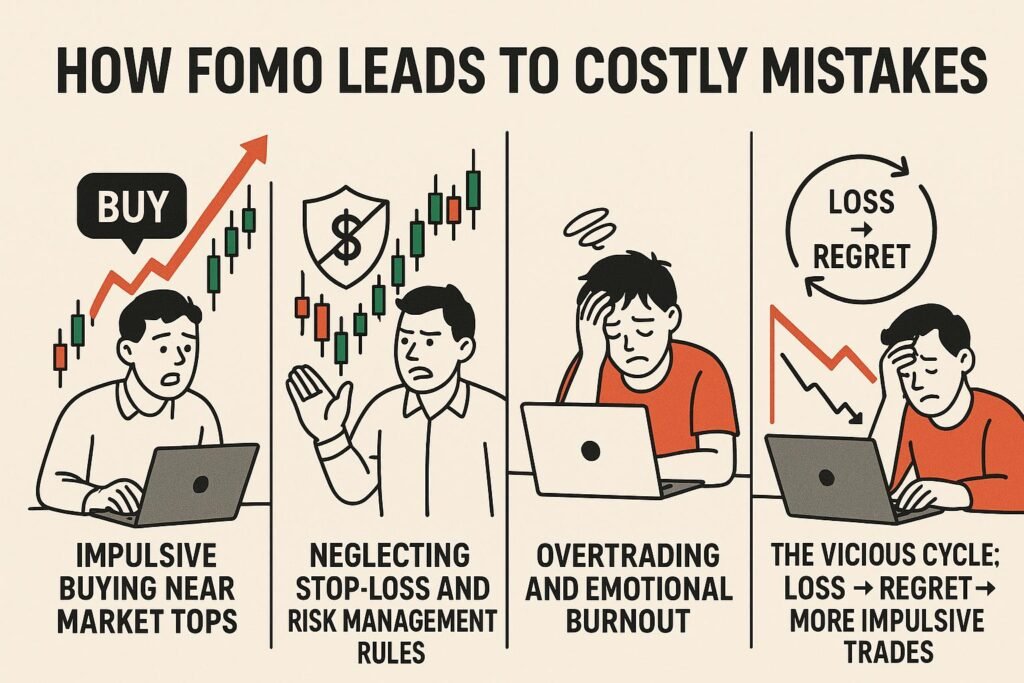
Many new traders struggle with volatility because they underestimate its impact on the market. Avoiding these common mistakes can improve your trading discipline and reduce unnecessary losses.
Some of the most common mistakes include:
- Trading during major news events without understanding the risks.
- Using position sizes that are too large.
- Ignoring the economic calendar.
- Removing or widening stop-loss orders.
- Entering trades based on emotions instead of a trading plan.
- Chasing large price movements after they have already occurred.
- Assuming volatility always leads to profits.
Remember that volatility increases both opportunity and risk. Successful traders focus on protecting their capital first and seeking profits second.
Practical Example: Volatility in Action
Imagine you are watching the EUR/USD currency pair on a normal trading day.
Scenario 1: Low Volatility
At 9:00 AM, EUR/USD is trading at 1.1200.
By 5:00 PM, the price has only moved to 1.1220.
That is a movement of just 20 pips throughout the day.
In this situation:
- The market is relatively calm.
- Price moves slowly.
- There are fewer trading opportunities.
- Risk is generally lower.
A trader might wait longer for their trade to reach the take-profit target because the market lacks strong momentum.
Scenario 2: High Volatility
Now imagine the U.S. releases a stronger-than-expected Non-Farm Payroll (NFP) report.
Before the announcement:
EUR/USD = 1.1200
Within the next 30 minutes, the price drops to 1.1080.
That’s a movement of 120 pips in just half an hour.
During this period:
- Traders react quickly to the economic news.
- Selling pressure increases.
- Price moves much faster than usual.
- Profit opportunities increase, but so does the risk.
A trader who correctly anticipated the move could make a significant profit. However, a trader without a stop-loss or proper risk management could also experience substantial losses.
What Can We Learn from This Example?
This example shows that volatility measures how much and how quickly prices move—not whether they move up or down.
During low volatility, markets tend to be stable, making them suitable for range trading strategies.
During high volatility, prices move more aggressively, creating opportunities for trend-following or breakout traders—but requiring stronger risk management.
The key lesson is that successful Forex traders don’t try to avoid volatility. Instead, they understand what causes it, prepare for it, and adjust their trading strategy and risk management to match current market conditions.
Final Thoughts
Volatility is one of the defining characteristics of the Forex market. It represents the speed and magnitude of price movements and plays a major role in creating both trading opportunities and potential risks.
By understanding what causes volatility, recognizing the difference between high and low volatility, and learning how to adapt your trading strategy, you can become a more confident and disciplined trader.
Instead of trying to avoid volatile markets entirely, focus on developing strong risk management habits. Use stop-loss orders, monitor the economic calendar, adjust your position sizes, and trade according to a well-defined plan.
As your experience grows, you’ll learn to view volatility not as something to fear, but as a normal part of the Forex market that can be managed effectively with knowledge, patience, and discipline.
Frequently Asked Questions (FAQ)
What is volatility in Forex trading?
Volatility in Forex trading refers to the rate and extent of price movements in a currency pair over a given period. Higher volatility means larger and faster price changes, while lower volatility indicates smaller and slower movements.
Is high volatility good for Forex traders?
High volatility can create more trading opportunities and larger profit potential, but it also increases risk. Traders should use proper risk management and avoid overexposing their accounts during highly volatile periods.
What causes volatility in the Forex market?
Volatility is mainly caused by economic news releases, central bank decisions, political events, market sentiment, global crises, and changes in market liquidity.
Which currency pairs are usually the most volatile?
Currency pairs such as GBP/JPY, GBP/USD, XAU/USD (Gold), and some exotic currency pairs are often more volatile than major pairs like EUR/USD or USD/CHF.
How can beginners manage volatility?
Beginners should monitor the economic calendar, use stop-loss orders, reduce position sizes during major news events, avoid emotional trading, and practice on a demo account before trading with real money.
Disclaimer
Disclaimer: This article is for educational and informational purposes only and should not be considered financial or investment advice. Forex trading involves significant risk, and you may lose some or all of your invested capital. Always conduct your own research, use proper risk management, and consult a qualified financial advisor before making trading decisions.
Continue Your Forex Learning Journey
Understanding volatility is just one step toward becoming a more confident Forex trader. The more you learn about how the market behaves, the better prepared you’ll be to identify trading opportunities, manage risk, and make informed decisions.
If you found this guide helpful, continue building your Forex knowledge with these beginner-friendly resources on BuildSmartAfri:
- What Is Forex Trading? A Beginner’s Guide
- What Moves the Forex Market?
- How to Use an Economic Calendar in Forex Trading
- Support and Resistance in Forex Trading
- Top 11 Candlestick Patterns Every Forex Trader Should Know
- How to Set Stop Loss and Take Profit Correctly
- The Complete Forex Trading Glossary (A–Z)
At BuildSmartAfri, our mission is to help beginners across Africa and beyond develop practical Forex trading skills through clear, easy-to-understand educational content.