
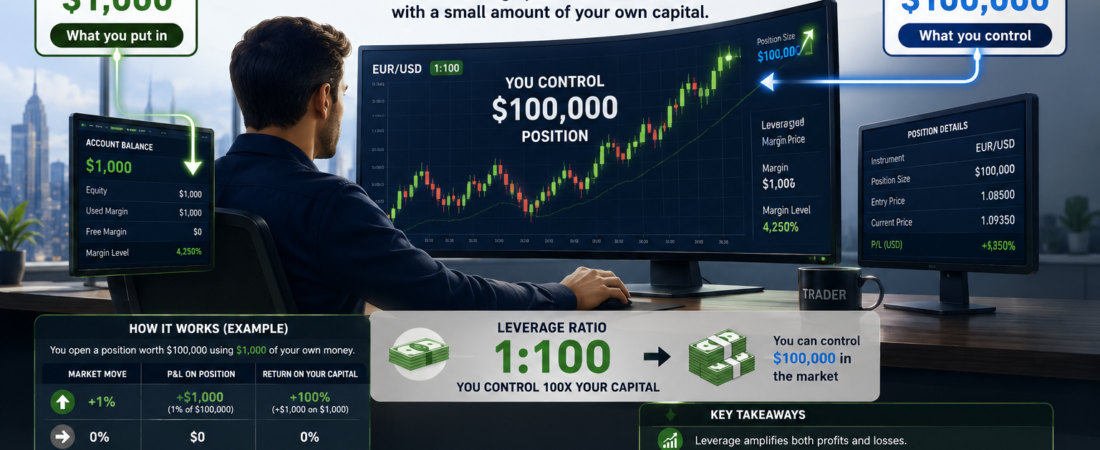
What is leverage in Forex? Forex trading allows traders to control positions much larger than the amount of money they deposit into their trading accounts. This is possible through leverage, one of the most important concepts in the Forex market. Without leverage, many retail traders would need very large amounts of capital to participate meaningfully in currency trading. Leverage makes Forex trading more accessible by allowing traders to increase their market exposure using a relatively small amount of money.
Leverage in Forex is a tool that allows traders to borrow capital from a broker in order to control a larger trading position with a smaller amount of money. It is commonly expressed as a ratio such as 1:10, 1:50, 1:100, or even higher depending on the broker and regulations in different countries. These ratios represent how much larger your trading position can be compared to the amount of money you personally provide.
For example, with 1:100 leverage, a trader can control a $10,000 position with only $100 of their own money as margin. This means the trader gains exposure to a much larger market position than their actual account balance would normally allow. Because currency prices often move in small increments, leverage helps traders potentially generate meaningful returns from relatively small market movements.
Leverage is one of the main reasons why Forex trading attracts many traders around the world. It increases buying power and allows traders to participate in larger market movements without needing huge capital. However, leverage is often described as a double-edged sword because it can work both for and against the trader. While it can increase profits significantly, it can also magnify losses just as quickly if risk is not managed properly. This is why understanding leverage thoroughly is essential before trading real money.
What is Leverage in Forex?
Leverage in Forex trading refers to the use of borrowed funds to increase the size of a trading position beyond what your account balance would normally allow. Brokers provide this borrowing power so traders can take larger positions in the currency market by depositing only a fraction of the total trade value.
In simple terms, leverage allows traders to open larger trades using a relatively small deposit called margin. Instead of paying the full value of a trade upfront, traders only need to provide a percentage of the total position size. The broker temporarily covers the remaining amount while the trade remains open.
Think of leverage like using a small lever to lift a heavy object. A small amount of force controls something much bigger. In Forex trading, your deposit acts as the small force while leverage increases your market exposure. This concept is what makes Forex trading unique compared to many other financial markets because traders can participate with smaller amounts of capital while still accessing larger opportunities.
For example:
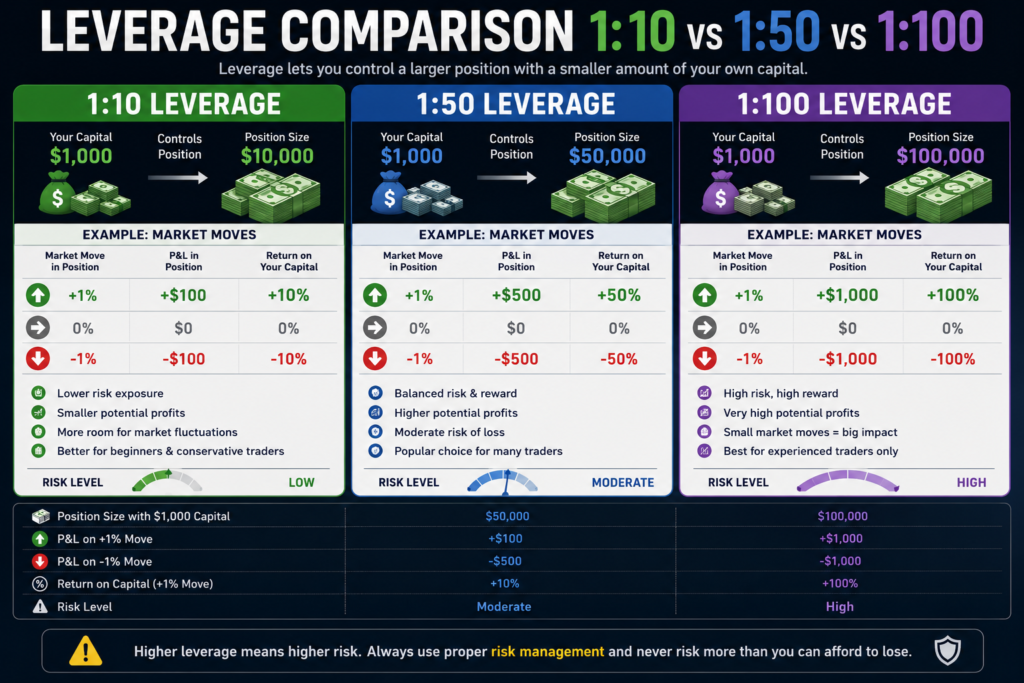
- 1:10 leverage means every $1 controls $10
- 1:50 leverage means every $1 controls $50
- 1:100 leverage means every $1 controls $100
The higher the leverage, the larger the position size you can control. However, higher leverage also means higher risk because even small market movements can have a much bigger impact on your account balance. This is why experienced traders often use leverage carefully rather than simply choosing the highest ratio available.
How Leverage Works in Forex Trading
Leverage works together with margin. Margin is the amount of money required to open and maintain a leveraged position. It acts as a security deposit that allows the broker to provide additional buying power to the trader.
Suppose a broker offers 1:100 leverage.
This means:
- you only need 1% of the total trade value
- the broker temporarily provides the remaining amount
For example:
If you want to open a $10,000 trade using 1:100 leverage, you only need $100 in your trading account as margin. The remaining amount is effectively provided by the broker for the duration of the trade.
The broker allows you to control the remaining $9,900. Although you are controlling a larger position, profits and losses are still calculated based on the full trade size rather than just your deposited margin. This is why leverage can dramatically increase both gains and losses.
This increased exposure means even small price movements can produce larger profits or losses. In the Forex market, currency pairs often move by small percentages, so leverage amplifies the financial impact of those movements. While this can create opportunities for higher returns, it also increases the importance of proper risk management and disciplined trading. Leverage becomes even more important when combined with a proper understanding of lot size in Forex trading. Lot size in Forex trading
Leverage Example Explained
Imagine two traders opening the same EUR/USD trade:
Trader A — No Leverage
- Account balance: $1,000
- Trade size: $100
- Small profit potential
- Small risk exposure
Trader B — Using 1:100 Leverage
- Account balance: $1,000
- Trade size: $10,000
- Higher profit potential
- Much higher risk exposure
If the market moves in favor of both traders, Trader B earns significantly more because of the larger position size. Even a small movement in the currency pair can generate noticeable profits due to the amplified exposure created by leverage.
However, if the market moves against them, losses are also amplified. Trader B could lose money much faster than Trader A because the leveraged position reacts more aggressively to price changes. This demonstrates why leverage can be powerful but also dangerous when used irresponsibly.
This is why leverage must always be combined with proper risk management. Successful traders understand that protecting capital is more important than chasing large profits. Using stop losses, controlling position sizes, and avoiding excessive leverage are all essential practices for long-term survival in Forex trading. Even small pip movements can create large gains or losses when high leverage is used. pip movements
Benefits of Leverage in Forex
Leverage provides several advantages for traders when used responsibly. It allows traders to maximize opportunities in the Forex market without needing extremely large amounts of capital.
Increased Buying Power
Leverage allows traders to control larger market positions without needing large capital. This means traders with smaller accounts can still participate in meaningful trades and potentially benefit from market movements that would otherwise produce very small returns.
Access to Bigger Opportunities
Small market movements can become more meaningful because profits are calculated based on the larger leveraged position. Since Forex pairs often move in small increments, leverage helps traders take advantage of these movements more effectively.
Capital Efficiency
Traders can keep part of their capital free while still participating in the market. Instead of using all available funds on one trade, leverage allows traders to diversify positions or maintain additional funds for risk management purposes.
Flexibility
Leverage gives traders more flexibility in managing multiple positions and strategies. Traders can allocate capital more efficiently across different currency pairs and trading opportunities while maintaining exposure to the market.
Risks of High Leverage
Although leverage can increase profits, it also increases potential losses. This is why leverage should always be approached carefully, especially by beginners who may not yet fully understand market volatility.
Many beginner traders focus only on the profit side of leverage and ignore the dangers. This often leads to overtrading, emotional decisions, and excessive risk-taking that can quickly damage a trading account.
Amplified Losses
Losses increase just as quickly as profits when using high leverage. Even a small unfavorable market movement can result in significant losses because the position size is much larger than the trader’s actual deposit.
Emotional Trading
Large leveraged positions can create emotional pressure and poor decision-making. Traders may panic during market fluctuations or become overly confident after short-term profits, leading to impulsive trading behavior.
Margin Calls
If losses become too large, brokers may automatically close positions to protect the remaining account balance. This process is known as a margin call or stop-out and can happen very quickly in highly leveraged accounts.
Account Blowouts
Excessive leverage combined with poor risk management is one of the main reasons beginner traders lose their accounts. Many traders underestimate how quickly losses can accumulate when using large leverage ratios without proper planning. Higher leverage can also increase the impact of spread costs during trading. spread costs
Leverage vs Margin
Leverage and margin are closely related concepts, but they are not the same thing. Understanding the difference between them is important for managing trades correctly.
- Leverage refers to the borrowing power provided by the broker.
- Margin refers to the money required to open the leveraged trade.
For example:
- 1:100 leverage requires 1% margin
- 1:50 leverage requires 2% margin
The higher the leverage, the lower the margin requirement. However, lower margin requirements also mean traders can open larger positions more easily, which increases overall risk exposure if trades are not managed carefully.
How Beginners Should Use Leverage
Beginners should approach leverage carefully and avoid using extremely high leverage immediately. Starting with lower leverage allows new traders to focus on learning market behavior and developing discipline without exposing themselves to unnecessary risk.
Some important guidelines include:
- start with low leverage
- use proper stop losses
- risk only a small percentage per trade
- focus on consistency instead of quick profits
- understand lot size before increasing leverage
Many professional traders survive long term because they prioritize risk management over aggressive leverage. Consistent trading and controlled risk are often more important than trying to achieve large profits quickly.
Common Leverage Mistakes Beginners Make
One common mistake is using the maximum leverage available simply because the broker allows it. Just because high leverage is accessible does not mean it should always be used.
Another mistake is confusing leverage with guaranteed profit. Leverage only increases exposure — it does not improve trading accuracy or predict market direction. A bad trade remains a bad trade regardless of leverage.
Some traders also ignore stop losses while using high leverage, which can quickly lead to large account losses. Without proper protection, even a single trade can significantly damage an account.
Overtrading with excessive leverage is another major reason many beginners fail in Forex trading. Emotional trading combined with large position sizes often leads to poor decisions and unnecessary losses.
Frequently Asked Questions
Is leverage good for beginners?
Leverage can be useful for beginners if used carefully and responsibly. Low leverage is generally safer for new traders because it reduces the risk of large losses while they are still learning.
What is the safest leverage in Forex?
Many experienced traders recommend beginners start with low leverage such as 1:10 or 1:20 while learning risk management. Lower leverage helps traders maintain better control over their positions.
Can leverage increase losses?
Yes. Leverage magnifies both profits and losses. Higher leverage increases trading risk significantly because larger positions react more strongly to market movements.
What happens if my losses become too large?
Brokers may issue a margin call or automatically close positions to prevent the account balance from going negative. This protects both the trader and the broker from excessive losses.
Is leverage the same as margin?
No. Leverage is the borrowing ratio provided by the broker, while margin is the amount of money needed to maintain the leveraged trade. They work together but represent different concepts.
Final Thoughts
Leverage is one of the most powerful tools in Forex trading, but it must be used carefully and responsibly. While it allows traders to control larger positions with smaller capital, it also increases risk exposure significantly. Understanding both the advantages and dangers of leverage is essential for becoming a disciplined trader.
Successful traders do not use leverage to gamble for quick profits. They use it strategically alongside proper risk management, disciplined position sizing, and controlled emotional decision-making. Long-term success in Forex trading depends more on consistency and capital preservation than on aggressive trading.
Understanding leverage properly is essential for long-term survival and consistency in the Forex market. Traders who respect leverage and manage risk carefully are far more likely to build sustainable trading habits over time.
Disclaimer
This article is intended for educational and informational purposes only and does not constitute financial or investment advice. Forex trading involves significant risk and may not be suitable for all investors. Always conduct your own research, practice proper risk management, and consider your financial situation before trading.