
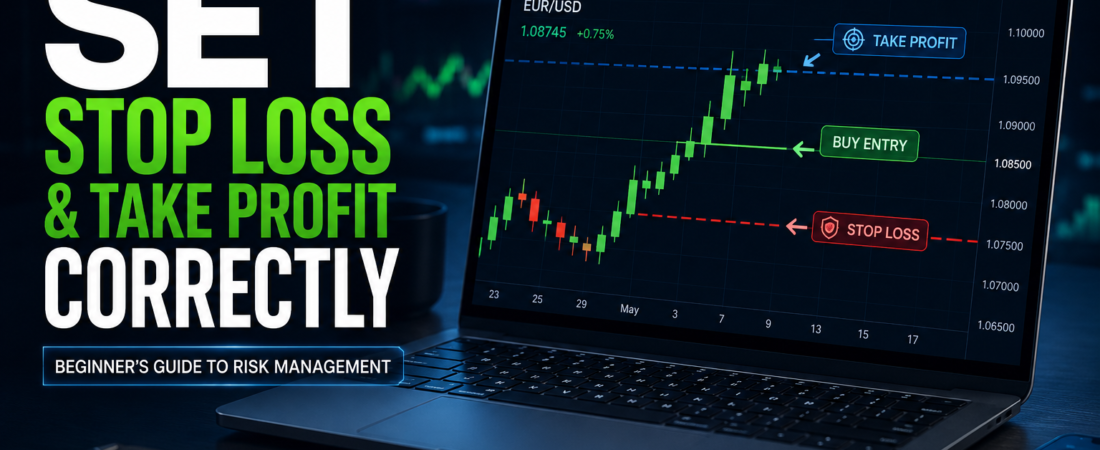
A Complete Beginner’s Guide to Protecting Your Capital and Maximizing Profits
Introduction:
One of the most important skills every successful Forex trader develops is knowing when to exit a trade. While many beginners spend countless hours learning how to identify trading opportunities using candlestick patterns, technical indicators, and chart analysis, they often overlook one of the most critical aspects of profitable trading: setting a proper Stop Loss (SL) and Take Profit (TP).
Watch the Video Version
Prefer watching instead of reading? Watch the complete tutorial below, then continue reading for more detailed explanations and additional tips.
No matter how accurate your market analysis is, the Forex market is unpredictable. Economic news, unexpected political events, changes in investor sentiment, and sudden market volatility can cause prices to move against your expectations within seconds. This is why experienced traders never enter a trade without first deciding how much they are willing to risk and how much profit they expect to make.
A Stop Loss is designed to protect your trading account by automatically closing a losing trade once the market reaches a predetermined price level. On the other hand, a Take Profit order secures your profits by automatically closing a winning trade when your desired target is reached.
These two simple tools remove emotions from trading and help traders remain disciplined even when markets become highly volatile. Instead of making emotional decisions driven by fear or greed, traders follow a predefined trading plan that protects their capital and improves long-term consistency. Stop Loss and Take Profit orders work best when combined with sound technical analysis. If you’re new to chart reading, start with our comprehensive guide on What Is Technical Analysis? A Beginner’s Guide to Reading Forex Charts.
Unfortunately, many beginners either ignore Stop Loss and Take Profit orders or place them incorrectly. Some place their Stop Loss too close to the entry price, causing trades to close before the market has a chance to move in the expected direction. Others set unrealistic Take Profit targets that the market is unlikely to reach. These mistakes often result in frustration, inconsistent results, and avoidable losses.
In this comprehensive guide, you’ll learn how to set Stop Loss and Take Profit correctly in Forex, understand the different methods professional traders use, discover how to calculate the ideal risk-to-reward ratio, and avoid the common mistakes that prevent many beginners from becoming consistently profitable.
Whether you are just starting your Forex journey or looking to improve your trading discipline, mastering Stop Loss and Take Profit placement is one of the most valuable skills you can develop.
Why Stop Loss and Take Profit Matter in Forex Trading
Forex trading is not about winning every trade; it is about managing risk effectively and protecting your capital over the long term. Even professional traders experience losing trades regularly. What separates successful traders from unsuccessful ones is not their win rate but how they control losses and maximize profitable opportunities. If you’re new to Forex trading, understanding risk management is just as important as learning trading strategies. BabyPips offers beginner-friendly lessons that explain how Stop Loss and Take Profit fit into a complete trading plan. Proper risk management also begins with choosing the right broker. If you haven’t opened a trading account yet, read our step-by-step guide on How to Open Your First Forex Trading Account.
Every trade carries risk. The market can move in your favor, against you, or remain unpredictable. Since no one can accurately predict every price movement, successful traders prepare for every possible outcome before entering a position.
Using Stop Loss and Take Profit orders helps traders:
- Protect their trading capital from excessive losses.
- Remove emotional decision-making during active trades.
- Maintain consistency by following a predefined trading plan.
- Improve overall risk management.
- Lock in profits automatically without constantly monitoring charts.
- Reduce stress and impulsive trading decisions.
Professional traders understand that preserving capital is the foundation of long-term success. A trader who protects their account can always trade another day, while a trader who ignores risk management may lose their account after only a few poor decisions.
For this reason, many experienced traders consider risk management even more important than finding the perfect trading strategy.
What Is a Stop Loss?
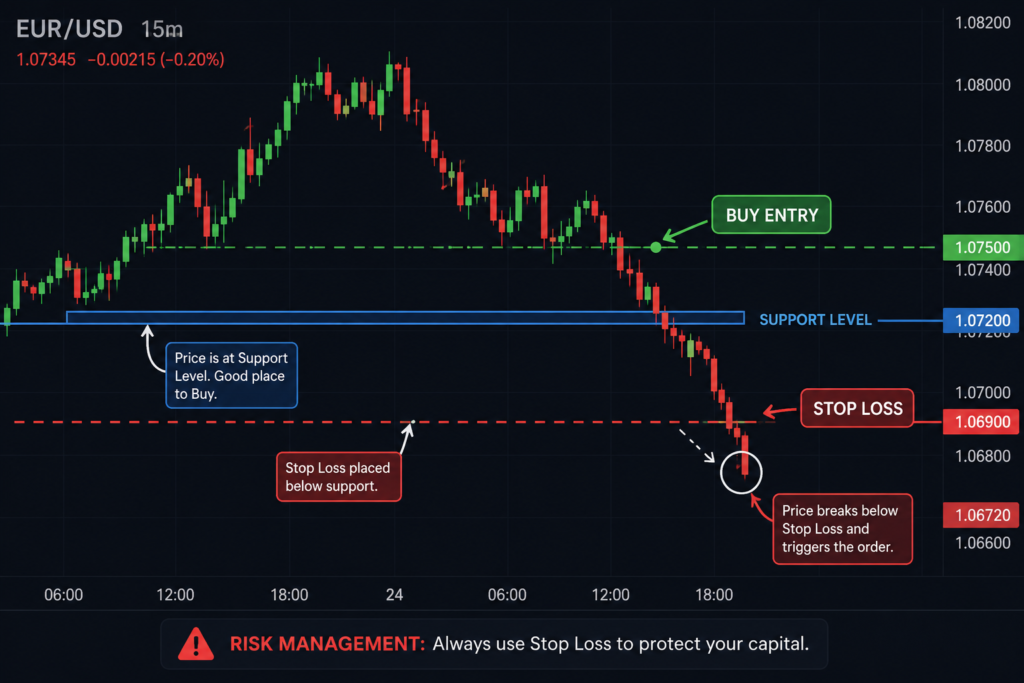
A Stop Loss is a protective order placed with your Forex broker that automatically closes your trade when the market reaches a specific price level. Its main purpose is to limit potential losses if the market moves against your trading position. Before deciding where to place your Stop Loss, it’s important to understand how support and resistance levels influence price movements. Our beginner’s guide explains how to identify these key market zones.
Think of a stop-loss as your financial safety net. It allows you to define your maximum acceptable loss before entering a trade, helping you avoid emotional decisions during market fluctuations.
Without a Stop Loss, traders often hold losing positions for too long, hoping that the market will eventually reverse. While this may occasionally happen, relying on hope instead of a structured trading plan is one of the fastest ways to lose money in Forex trading.
A Stop Loss removes uncertainty by ensuring that your loss is limited to an amount you have already decided is acceptable.
Example
Imagine you buy the EUR/USD currency pair at 1.1000 because your analysis suggests that the price will rise.
However, you also recognize that your analysis could be wrong.
Instead of risking an unlimited loss, you decide that if the price falls to 1.0950, your trading idea is no longer valid.
You place your Stop Loss at 1.0950.
If the market moves against you and reaches that level, your broker automatically closes the trade.
Although you experience a small loss, your trading account remains protected, allowing you to continue trading future opportunities.
Why Every Trader Should Use a Stop Loss
Using a Stop Loss provides several important benefits. Knowing how much to risk on each trade is equally important. Learn how professional traders calculate trade size in our guide on Top 10 Ways to Calculate Position Size in Forex Trading.
1. Protects Your Trading Capital
Capital preservation is the first priority of every successful trader. A stop-loss prevents one bad trade from causing significant damage to your account.
For example, if you have a $1,000 trading account and risk only 2% per trade, your maximum loss is limited to $20. Even after several losing trades, you still have enough capital to continue trading.
2. Removes Emotional Trading
Fear and hope are two of the biggest enemies of successful trading.
Without a Stop Loss, many traders refuse to close losing trades because they believe the market will eventually reverse.
A Stop Loss removes this emotional decision by automatically executing your exit strategy.
3. Encourages Better Trade Planning
Professional traders never enter the market without knowing:
- Their entry price.
- Their Stop Loss.
- Their Take Profit.
- Their Risk-to-Reward Ratio.
Planning these factors before entering a trade helps maintain discipline and consistency.
4. Supports Proper Risk Management
Most experienced traders risk only 1% to 2% of their account balance on a single trade.
Using a properly calculated Stop Loss makes this level of risk management possible and helps protect your account during losing streaks.
What Is a Take Profit?
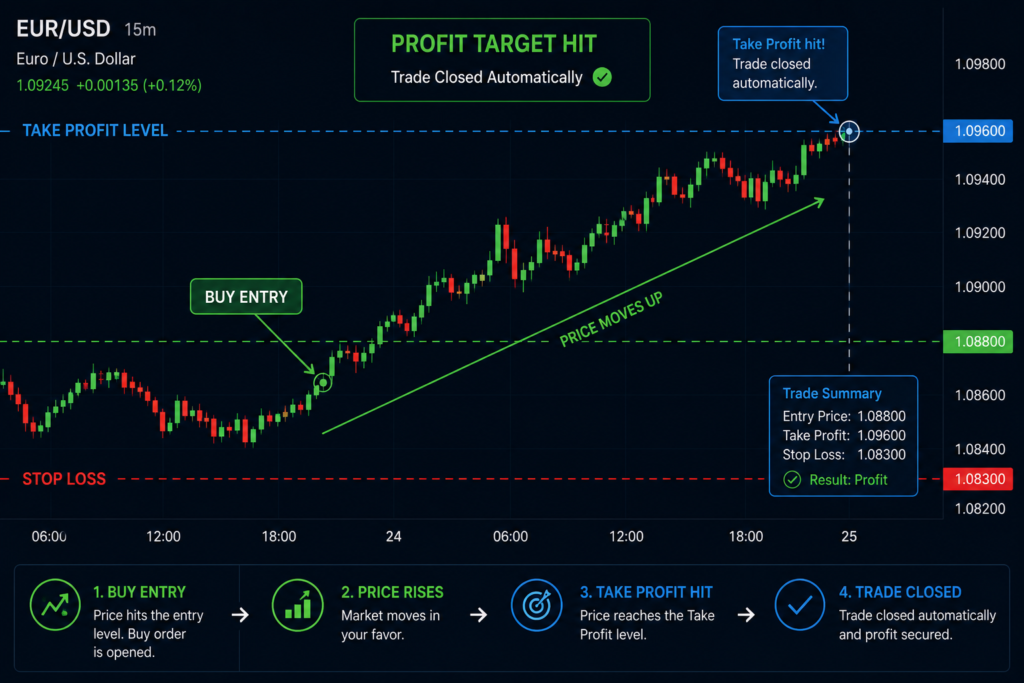
A Take Profit (TP) is an order placed with your Forex broker that automatically closes your trade once the market reaches your desired profit target.
Instead of manually watching the market and deciding when to exit, a Take Profit allows you to secure profits automatically according to your trading plan.
This helps remove greed from trading decisions and ensures that profitable trades are closed at predetermined levels.
Example
Suppose you buy GBP/USD at 1.2700 after identifying a bullish trading opportunity.
Based on your analysis, you believe the next major resistance level is at 1.2800.
You place your Take Profit at 1.2800.
If the market reaches that price, your broker automatically closes the trade, locking in your profit without requiring further action from you.
Even if the market later reverses, your profit has already been secured.
Why Every Trader Should Use a Take Profit
A Take Profit order is just as important as a Stop Loss because it helps traders remain disciplined and avoid emotional decision-making.
Its key benefits include:
Locks in Profits Automatically
Markets can reverse unexpectedly. A Take Profit ensures that profits are secured before that happens.
Eliminates Greed
Many beginners hold profitable trades for too long, hoping to earn even more. Unfortunately, the market often reverses before they exit.
A Take Profit removes this temptation by closing the trade automatically.
Improves Consistency
Following a predefined profit target helps traders build discipline and avoid making impulsive decisions based on emotions.
Supports Better Risk-to-Reward Planning
Take Profit orders allow traders to calculate whether a trade offers a favorable balance between potential profit and potential loss before entering the market.
Different Types of Stop Loss Orders
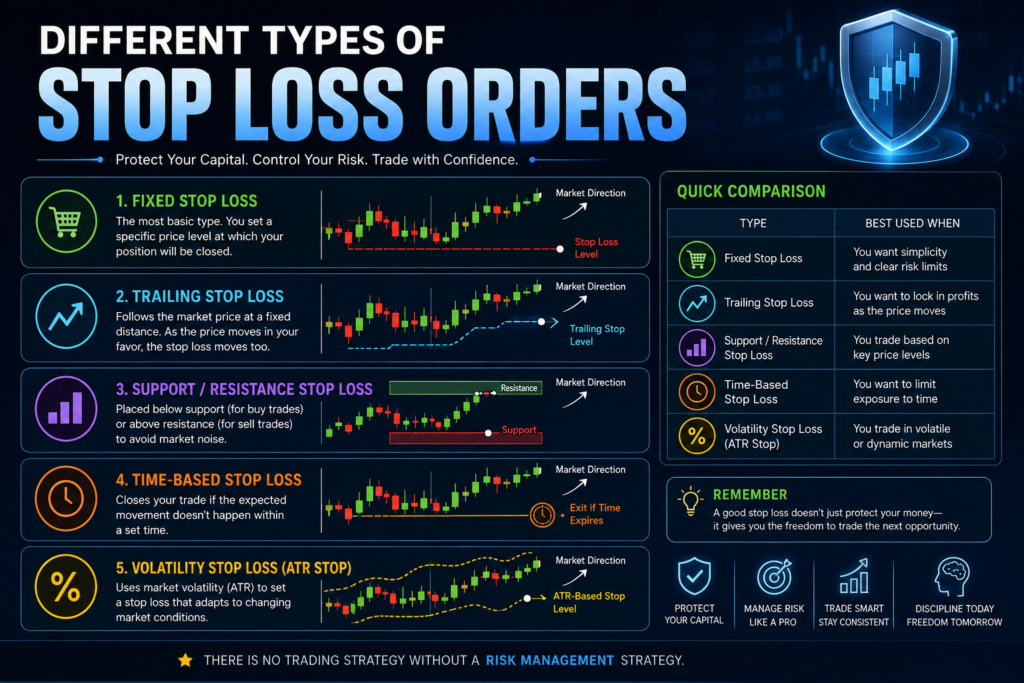
Not all Stop Loss orders are the same. Depending on your trading strategy, market conditions, and risk tolerance, you can use different types of Stop Loss orders to manage your trades effectively. Technical Stop Loss placement often relies on price action signals such as Hammer, Bullish Engulfing, or Doji candlestick patterns. Learn more in our complete guide to Top 11 Candlestick Patterns Every Forex Trader Should Know.
Understanding these different types helps you choose the most appropriate method for each trading situation.
1. Fixed Stop Loss
A Fixed Stop Loss is the simplest and most commonly used Stop Loss method. It involves placing your Stop Loss a predetermined number of pips away from your entry price.
For example, if you decide that you will risk 30 pips on every trade, you will always place your Stop Loss exactly 30 pips from your entry regardless of market conditions.
Advantages
- Easy to calculate.
- Suitable for beginners.
- Encourages consistent risk management.
Disadvantages
- Ignores current market volatility.
- May be too tight during volatile markets.
- May be unnecessarily wide during quiet markets.
Although a fixed Stop Loss is simple, experienced traders usually prefer more dynamic methods that consider actual market conditions.
2. Technical Stop Loss
A Technical Stop Loss is placed based on chart analysis rather than a fixed number of pips.
Instead of guessing where your Stop Loss should be, you use technical levels such as:
- Support levels
- Resistance levels
- Swing highs
- Swing lows
- Trendlines
- Chart patterns
Many professional traders prefer this method because it allows the market enough room to move naturally without stopping out trades unnecessarily.
Example
Suppose EUR/USD is trading at 1.1200.
You identify a strong support level at 1.1175.
Instead of placing your Stop Loss only 10 pips below your entry, you place it slightly below the support level at 1.1170.
This allows for normal market fluctuations while still protecting your account if support fails.
3. Trailing Stop Loss
A Trailing Stop Loss automatically moves your Stop Loss as the market moves in your favor.
Unlike a fixed Stop Loss, a trailing Stop helps protect profits while allowing winning trades to continue running.
For example:
You buy EUR/USD at 1.1000.
You set a trailing Stop of 40 pips.
If price rises to 1.1050, your Stop Loss automatically moves upward.
If the market later reverses, the trade closes automatically, locking in part of your profit.
Advantages
- Protects profits automatically.
- Allows traders to ride strong trends.
- Removes emotional decision-making.
Disadvantages
- May close trades too early during volatile markets.
- Requires proper distance from current price.
Trailing Stops work particularly well in strong trending markets.
4. Volatility-Based Stop Loss
Some traders place their Stop Loss according to current market volatility using indicators such as the Average True Range (ATR).
During highly volatile periods, wider Stop Losses may be necessary.
During quiet markets, smaller Stop Losses may be more appropriate.
This method adjusts naturally to changing market conditions.
We’ll discuss ATR in more detail later in this guide.
How to Set Stop Loss Correctly
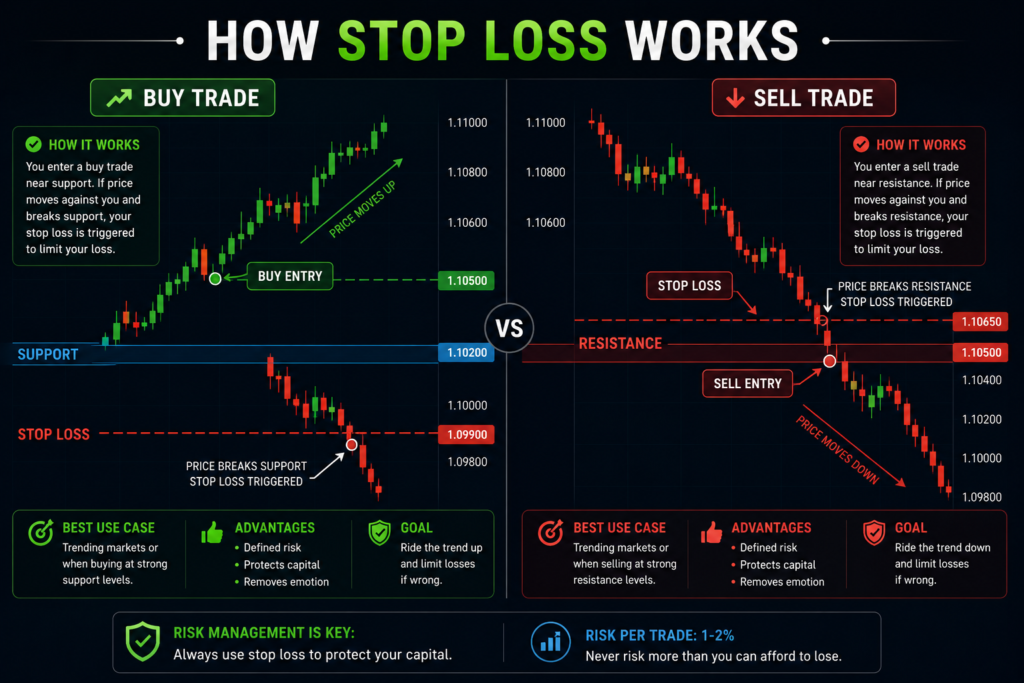
Knowing where to place your Stop Loss is one of the most important skills in Forex trading. The effectiveness of this strategy improves significantly when trading in the direction of the overall market trend. Learn how to identify trends in our guide on Trend Trading for Beginners: How to Follow Market Direction.
A poorly placed Stop Loss can result in unnecessary losses even if your market analysis is correct.
The goal is not simply to reduce losses but to place the Stop Loss at a logical level where your trading idea becomes invalid.
Professional traders ask themselves:
“At what price would my trading setup no longer make sense?”
That is where the Stop Loss belongs.
Method 1: Place Stop Loss Below Support
When buying, many traders place their Stop Loss slightly below a significant support level.
Why?
Because if price breaks below support, the bullish setup may no longer be valid.
Example
EUR/USD reaches a strong support level at 1.1000.
A Hammer candlestick forms.
You enter a Buy trade at 1.1020.
Instead of placing your Stop Loss at 1.1010, you place it below support at 1.0985.
This gives the trade enough room to breathe while protecting your capital if support fails.
Method 2: Place Stop Loss Above Resistance
When selling, traders often place their Stop Loss slightly above resistance.
If price breaks above resistance, the bearish setup may no longer be valid.
Example
GBP/USD reaches resistance at 1.2800.
A Bearish Engulfing pattern forms.
You sell at 1.2785.
Your Stop Loss is placed above resistance at 1.2820.
If price rises above resistance, the trade closes automatically.
Method 3: Place Stop Loss Below Swing Low
Swing lows often act as natural support during an uptrend.
When buying, placing your Stop Loss below the most recent swing low gives the market enough room to fluctuate naturally.
This method is popular among trend traders.
Method 4: Place Stop Loss Above Swing High
For sell trades, placing your Stop Loss above the previous swing high protects against temporary market pullbacks.
If the market creates a new higher high, your bearish setup may no longer be valid.
Why You Should Never Place Stop Loss Too Close
One of the biggest mistakes beginners make is placing their Stop Loss too close to their entry price.
Markets naturally move up and down before continuing in the intended direction.
A Stop Loss that is too tight often gets triggered even though the overall analysis was correct.
Imagine entering EUR/USD after spotting a bullish breakout.
You place your Stop Loss only 5 pips below your entry.
Price pulls back slightly before continuing upward.
Your Stop Loss is triggered.
Moments later, price rallies exactly as you predicted.
Your analysis was correct, but your Stop Loss placement was not.
Professional traders give the market enough space while still controlling risk.
Common Stop Loss Mistakes Beginners Make
Even after understanding how Stop Loss works, many traders continue making costly mistakes.
Avoid these common errors:
1. Trading Without a Stop Loss
Some beginners believe they can manually close losing trades.
Unfortunately, markets move very quickly.
Unexpected news can cause prices to move dozens or even hundreds of pips within minutes.
Without a Stop Loss, losses can become much larger than expected.
2. Moving Stop Loss Further Away
This is one of the most dangerous habits.
Suppose your Stop Loss is about to be hit.
Instead of accepting the planned loss, you move it further away hoping price will reverse.
This increases your risk and often turns a small loss into a much larger one.
Professional traders accept losses as part of trading.
3. Using the Same Stop Loss for Every Trade
Every trade is different.
Some market conditions require wider Stop Losses.
Others require tighter protection.
Always base your Stop Loss on market structure rather than using the same number of pips for every trade.
4. Ignoring Market Volatility
Major economic news can cause significant price swings.
Using a very tight Stop Loss during these periods often results in unnecessary stop-outs.
Always check the economic calendar before entering trades.
5. Risking Too Much on One Trade
Even with a Stop Loss, risking a large percentage of your account on one trade is dangerous.
Many professional traders risk no more than 1%–2% of their account balance per trade.
This approach helps them survive losing streaks and remain consistent over the long term.
Key Takeaways
A Stop Loss is much more than a protective order; it is an essential part of every successful trading plan. The best Stop Loss placement is based on market structure, not emotions or arbitrary pip distances. By using support and resistance, swing highs and lows, or market volatility to guide your decisions, you give your trades room to develop while protecting your capital.
Remember, a well-placed Stop Loss won’t prevent every losing trade, but it will help ensure that no single trade has the power to significantly damage your trading account.
How to Set Take Profit Correctly
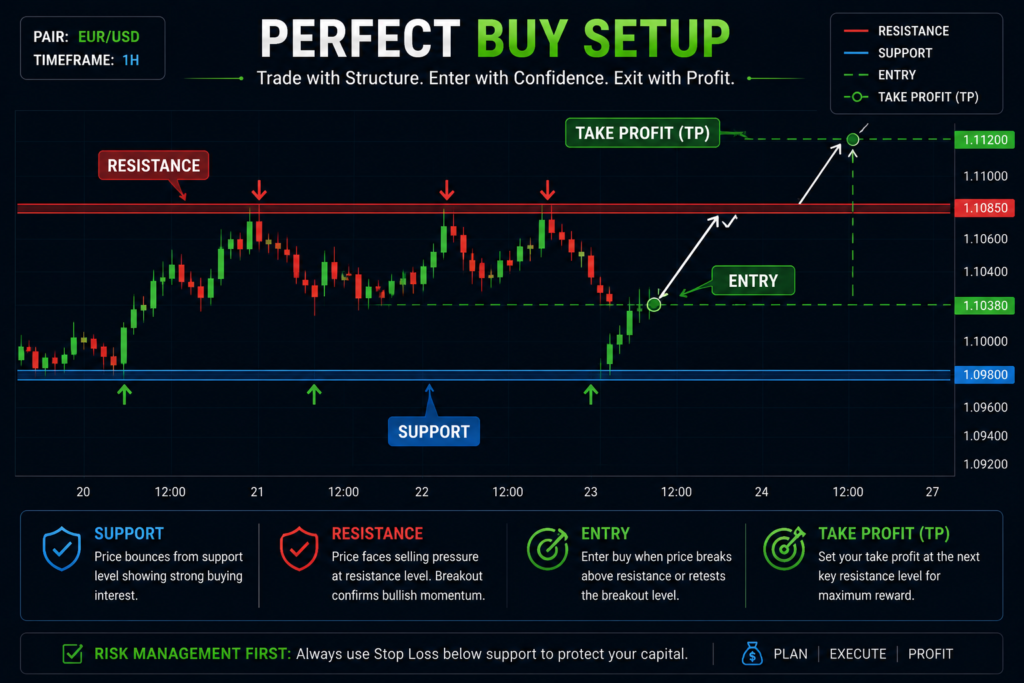
While a Stop Loss protects your trading account from excessive losses, a Take Profit (TP) ensures that you secure your profits before the market has a chance to reverse. Understanding price action makes it easier to identify realistic profit targets. Candlestick patterns can provide valuable confirmation before setting Take Profit levels. You can read more on our Top 11 Candlestick Patterns Every Forex Trader Should Know
Many beginner traders focus only on finding good trade entries and forget to plan their exits. As a result, they often watch profitable trades reverse into losses because they become greedy or hope the market will continue moving in their favor.
Professional traders don’t rely on emotions when deciding when to exit a trade. Instead, they determine their Take Profit level before entering the market based on technical analysis and a well-defined trading plan.
A properly placed Take Profit should be realistic, logical, and supported by market structure.
Method 1: Use Support and Resistance Levels
One of the most effective ways to set a Take Profit target is by identifying major support and resistance levels.
Price frequently reacts around these areas because many traders place buy and sell orders there.
Buy Trade Example
Suppose EUR/USD is trading at 1.1000.
You identify:
- Entry Price: 1.1015
- Stop Loss: 1.0985
- Next Resistance: 1.1080
Instead of choosing a random Take Profit level, you place it just before resistance at 1.1075.
Why?
Because many traders begin taking profits near resistance, increasing the likelihood of a price reversal.
Sell Trade Example
GBP/USD is trading at 1.2800.
You enter a Sell trade at 1.2780.
The next major support level is 1.2705.
Instead of aiming for an unrealistic target, you place your Take Profit slightly above support at 1.2710.
This increases the probability of your trade reaching its target before buyers step back into the market.
Method 2: Use the Risk-to-Reward Ratio
Professional traders rarely enter trades without calculating their Risk-to-Reward Ratio (R:R). To gain a deeper understanding of the Risk-to-Reward Ratio and why it is essential for long-term trading success, you can explore this comprehensive guide from Investopedia.
The Risk-to-Reward Ratio compares how much money you are willing to lose with how much you expect to gain.
For example:
- Risk = 25 pips
- Reward = 50 pips
Your Risk-to-Reward Ratio is:
1 : 2
This means you are risking one unit to potentially earn two units.
Many successful traders aim for a minimum ratio of 1:2 or 1:3.
This allows them to remain profitable even if only half of their trades are successful.
Example
Imagine you take ten trades.
You risk $20 on each trade.
Five trades lose.
Five trades win.
If your Risk-to-Reward Ratio is 1:1, you break even.
However, if your Risk-to-Reward Ratio is 1:2, your five winning trades earn $40 each, while your losing trades lose $20 each.
Your results become:
- Total Loss = $100
- Total Profit = $200
Overall Profit = $100
This demonstrates why professional traders care more about risk management than having an extremely high win rate.
Method 3: Use Trend Strength
Strong trends often continue much further than expected.
Instead of exiting too early, many traders allow profitable trades to continue until signs of reversal appear.
For example:
During a strong bullish trend:
- Higher highs continue forming.
- Higher lows continue forming.
- Moving averages remain bullish.
- Buying momentum remains strong.
Rather than setting a very close Take Profit, traders allow the trend to develop while using a Trailing Stop Loss to protect profits.
This approach allows them to capture larger market moves.
Method 4: Use Fibonacci Extension Levels
Many experienced Forex traders use Fibonacci Extension levels to identify realistic Take Profit targets.
Common extension levels include:
- 127.2%
- 161.8%
- 261.8%
When these levels align with support, resistance, or previous market structure, they often become strong Take Profit zones.
Although beginners do not need to master Fibonacci immediately, it becomes a valuable tool as trading experience grows.
Understanding the Risk-to-Reward Ratio
One of the biggest misconceptions among beginner traders is that they must win most of their trades to become profitable. A good Risk-to-Reward Ratio becomes even more effective when combined with proper position sizing, helping you protect your trading capital over the long term.
In reality, profitability depends on the relationship between risk and reward.
The Risk-to-Reward Ratio measures how much money you are willing to lose compared to your expected profit.
For example:
| Risk | Reward | Ratio |
|---|---|---|
| 20 pips | 20 pips | 1:1 |
| 20 pips | 40 pips | 1:2 |
| 20 pips | 60 pips | 1:3 |
| 30 pips | 90 pips | 1:3 |
The higher the reward compared to the risk, the fewer winning trades you need to remain profitable over the long term.
Which Risk-to-Reward Ratio Is Best?
There is no single perfect ratio.
However, many professional traders use:
1 : 2
Suitable for:
- Beginner traders
- Swing trading
- Trend trading
1 : 3
Suitable for:
- Strong trending markets
- High-quality trade setups
1 : 1
Generally suitable only when:
- Win rate is consistently high.
- Scalping strategies.
- Short-term trading.
Most beginners should aim for at least 1:2 whenever market conditions allow.
Practical Forex Trading Example
Let’s apply everything we’ve learned. Before entering the trade, experienced traders also check the economic calendar for high-impact news events that could increase market volatility.
Scenario
You are analyzing EUR/USD on the 4-hour chart.
After several days of declining prices, the pair reaches a strong support level at 1.0950. The best way to improve your stop-loss and take-profit placement is through regular chart practice. You can analyze live Forex markets and test your trading ideas using TradingView before risking real money.
A Bullish Engulfing candlestick pattern forms.
You also notice:
- RSI indicates oversold conditions.
- Support has held multiple times previously.
- The overall higher timeframe trend remains bullish.
Trade Plan
Entry Price:
1.0980
Stop Loss:
Below support at 1.0945
Risk:
35 pips
Next Resistance:
1.1050
Take Profit:
1.1045
Potential Reward:
65 pips
Risk-to-Reward Ratio:
Approximately 1 : 1.9
Because the trade offers nearly twice the potential reward compared to the risk, it satisfies a disciplined trading plan.
If the trade loses, your loss remains limited.
If the trade succeeds, the reward outweighs the risk.
This is exactly how professional traders approach every trade.
Why Planning Before Entering Matters
One of the biggest differences between amateur and professional traders is that professionals complete their entire trading plan before placing a trade.
They know:
- Their entry price.
- Their Stop Loss.
- Their Take Profit.
- Their position size.
- Their maximum acceptable loss.
- Their expected reward.
This preparation removes emotional decision-making and allows them to execute trades consistently.
Successful trading is not about reacting emotionally after entering the market—it is about following a well-prepared plan.
Key Takeaways
A Take Profit should never be chosen randomly. It should be based on technical analysis, market structure, and a favorable Risk-to-Reward Ratio. Combining Take Profit targets with support and resistance, trend analysis, and disciplined risk management helps traders build consistency and avoid emotional decisions.
Remember, the objective is not to capture every pip in the market. The goal is to consistently protect your capital while taking profits at logical price levels.
Common Stop Loss and Take Profit Mistakes Beginners Make
Even after understanding what Stop Loss and Take Profit orders are, many beginner traders still make costly mistakes that reduce their chances of long-term success. Recognizing these common errors can help you avoid unnecessary losses and become a more disciplined trader. Many of these mistakes occur because traders allow emotions to influence their decisions. Developing patience, discipline, and emotional control is essential for long-term success. Learn more in our guide on The Psychology of a Successful Trader.
1. Trading Without a Stop Loss
This is perhaps the biggest mistake a beginner can make.
Some traders believe they can manually close a losing trade before it becomes too large. However, the Forex market can move extremely quickly, especially during major economic news releases.
Without a Stop Loss, a small loss can grow into a significant one within minutes.
Always protect your trading account by placing a Stop Loss before entering a trade.
2. Moving the Stop Loss Further Away
Many beginners refuse to accept a losing trade.
Instead of allowing the Stop Loss to close the trade, they move it further away, hoping the market will reverse.
This behavior is driven by emotion rather than discipline.
Professional traders accept small losses because they understand that protecting capital is more important than being right on every trade.
3. Placing the Stop Loss Too Close
A Stop Loss placed too close to the entry price is often triggered by normal market fluctuations.
Markets naturally move up and down before continuing in the intended direction.
Always place your Stop Loss at a logical technical level rather than choosing an arbitrary number of pips.
4. Setting Unrealistic Take Profit Targets
Greed causes many traders to expect extremely large profits from every trade.
For example, risking 20 pips while expecting 300 pips without technical justification is unrealistic.
Instead, use support and resistance, trend analysis, and the Risk-to-Reward Ratio to determine achievable profit targets.
5. Ignoring Market Conditions
Different market conditions require different Stop Loss and Take Profit placements.
During periods of high volatility, wider Stop Losses may be necessary.
During quieter market sessions, tighter Stop Losses may be more appropriate.
Always adapt your strategy to current market conditions.
6. Ignoring Major Economic News
Even the best technical setup can fail during major economic announcements.
Before opening any trade, check the economic calendar for events such as:
- Interest rate decisions
- Inflation reports
- Non-Farm Payrolls (NFP)
- GDP announcements
- Central bank speeches
These events can create significant volatility and affect Stop Loss and Take Profit levels.
Best Practices for Setting Stop Loss and Take Profit
To improve your trading consistency, follow these proven practices:
- Always define your Stop Loss before entering a trade.
- Never risk more than 1%–2% of your trading account on a single trade.
- Use support and resistance to determine logical Stop Loss and Take Profit levels.
- Maintain a minimum Risk-to-Reward Ratio of 1:2 whenever possible.
- Avoid moving your Stop Loss after entering a trade unless you’re using a planned Trailing Stop strategy.
- Review every completed trade to identify areas for improvement.
- Practice these techniques on a demo account before trading with real money.
Consistent application of these principles can significantly improve your long-term trading performance.
Frequently Asked Questions (FAQs)
1. What is the difference between Stop Loss and Take Profit?
A Stop Loss limits your potential losses by automatically closing a losing trade, while a Take Profit locks in your profits by automatically closing a winning trade once your target is reached.
2. Should I always use a Stop Loss?
Yes. Every Forex trade should have a Stop Loss. It protects your trading capital and helps maintain disciplined risk management.
3. What is the best Risk-to-Reward Ratio?
Many professional traders prefer a minimum Risk-to-Reward Ratio of 1:2 because it allows them to remain profitable even if they do not win every trade.
4. Can I move my Stop Loss after entering a trade?
You may move your Stop Loss only as part of a planned strategy, such as moving it to break-even or using a Trailing Stop. Avoid moving it further away simply to avoid taking a loss.
5. Can every trade reach its Take Profit?
No. Market conditions constantly change, and no trading setup guarantees success. This is why proper risk management is more important than trying to predict every market move correctly.
Final Thoughts
Learning how to set Stop Loss and Take Profit correctly is one of the most valuable skills every Forex trader can develop. While many beginners focus primarily on finding the perfect entry, experienced traders understand that long-term success depends just as much on managing exits and controlling risk. Building consistent trading skills requires continuous learning. We recommend exploring our beginner guides on technical analysis, support and resistance, trend trading, candlestick patterns, and position sizing to develop a well-rounded understanding of the Forex market.
A well-placed Stop Loss protects your capital, while a realistic Take Profit helps you secure profits without allowing emotions to influence your decisions. Together, they form the foundation of disciplined trading and consistent risk management.
Remember that there is no perfect Stop Loss or Take Profit strategy that works in every market condition. The key is to combine technical analysis, market structure, support and resistance, and a favorable Risk-to-Reward Ratio to make informed trading decisions.
Most importantly, remain patient and consistent. Forex trading is a long-term journey, and developing good risk management habits today can significantly improve your chances of becoming a consistently profitable trader in the future.
Risk Disclaimer
Disclaimer: This article is provided for educational purposes only and should not be considered financial or investment advice. Forex trading involves significant risk and may not be suitable for all investors. Past market performance does not guarantee future results. Always conduct your own research, practice on a demo account, and consult a qualified financial advisor before making any trading decisions. Before trading with real money, take time to understand the risks involved. The U.S. Commodity Futures Trading Commission (CFTC) provides educational resources to help traders make informed decisions and recognize the risks associated with leveraged trading.
Continue Your Forex Learning Journey
Now that you understand how to set Stop Loss and Take Profit correctly, continue building your trading knowledge with these beginner-friendly guides on BuildSmartAfri:
- What Is Technical Analysis? A Beginner’s Guide to Reading Forex Charts
- Support and Resistance in Forex Trading for Beginners
- Trend Trading for Beginners: How to Follow Market Direction
- Top 10 Ways to Calculate Position Size in Forex Trading
- Top 11 Candlestick Patterns Every Forex Trader Should Know
- How to Use an Economic Calendar in Forex Trading
The more you learn and practice, the better prepared you’ll be to make informed trading decisions and manage risk effectively.
If you found this guide helpful, share it with fellow traders and bookmark BuildSmartAfri for more beginner-friendly Forex tutorials, trading strategies, and practical investing tips.