

Introduction:
Trend Trading for Beginners: How to Follow Market Direction. One of the oldest sayings in financial markets is:
“The trend is your friend.”
This simple phrase has guided successful traders for decades because it highlights one of the most important principles in Forex trading: trading in the direction of the market rather than against it. If you’re new to the currency market, start by reading our What Is Forex Trading? A Beginner’s Guide to learning trend trading strategies. A reliable broker provides the trading tools you’ll need to identify and trade market trends. Learn how to choose one in our guide on How to Choose the Best Forex Broker for Beginners.
Many beginner traders make the mistake of trying to predict market reversals.
They see a currency pair rising for several days and assume it must fall soon.
Others see prices falling and immediately start looking for buying opportunities.
Unfortunately, markets can continue trending much longer than beginners expect.
Trying to fight a strong trend often leads to unnecessary losses and frustration.
Trend trading offers a different approach.
Instead of guessing where the market might turn, trend traders focus on identifying the current market direction and looking for opportunities to trade alongside it.
Imagine you’re swimming across a river.
Swimming with the current requires less effort and increases your chances of reaching the other side.
Swimming against the current is much more difficult and exhausting.
The Forex market works in a similar way.
Trading with the trend generally provides higher-probability opportunities than constantly trying to predict reversals.
Trend trading is popular because it is relatively simple to understand and can be applied to almost every currency pair and timeframe.
Whether you trade for a few hours or hold positions for several days, understanding market trends can help you make more informed trading decisions.
In this guide, you’ll learn:
- What trend trading is
- Why trends occur in the Forex market
- The three types of market trends
- How to identify a trend
- The best tools for trend trading
- When to enter and exit trend trades
- Common beginner mistakes
- Practical examples of trend trading
- Risk management tips for trend traders
By the end of this guide, you’ll understand how to recognize market direction and use trend trading as part of a disciplined Forex trading strategy.
What Is Trend Trading?
Trend trading is a trading strategy that involves identifying the overall direction of the market and placing trades that follow that direction. A market trend refers to the general direction in which prices are moving over a period of time and forms the foundation of trend trading. Before placing your first trend trade, make sure you’ve completed the steps in our guide on How to Open Your First Forex Trading Account.
Instead of trying to predict market reversals, trend traders aim to benefit from sustained price movements.
The basic idea is simple:
- Buy when the market is moving upward.
- Sell when the market is moving downward.
- Avoid forcing trades when the market has no clear direction.
Trend trading is based on the belief that once a market establishes a direction, it is more likely to continue moving in that direction until something significant changes.
This doesn’t mean prices move in a straight line.
Markets naturally rise, pull back, and continue moving.
Trend traders look beyond these short-term fluctuations and focus on the bigger picture.
For example, if the EUR/USD currency pair has been making higher highs and higher lows for several weeks, many traders consider it to be in an uptrend.
Rather than trying to sell against that trend, a trend trader waits for temporary pullbacks before looking for buying opportunities.
The same principle applies to downtrends.
If GBP/USD continues making lower highs and lower lows, trend traders look for opportunities to sell during temporary rallies rather than buying against the prevailing market direction.
Trend trading is popular among beginners because it encourages patience, discipline, and logical decision-making instead of emotional trading.
Why Trends Occur in the Forex Market
Currency prices rarely move randomly for long periods.
Instead, they often develop trends because of changing economic conditions and market sentiment.
Several factors contribute to the formation of trends.
Economic Data
Strong employment reports, rising inflation, or improving GDP figures can strengthen a country’s currency.
Weak economic data may weaken it.
When similar reports continue over time, the market may establish a sustained trend.
Central Bank Policies
Interest rate decisions made by central banks play a major role in Forex trends.
For example, if a central bank raises interest rates while another keeps rates unchanged, investors may move money toward the higher-yielding currency.
This increased demand can create a long-term trend.
Political and Global Events
Political stability, elections, trade agreements, and geopolitical developments can influence investor confidence.
Major global events often create new trends that last for weeks or even months.
Market Psychology
Markets are driven by millions of buyers and sellers.
When enough traders believe a currency will continue rising, buying pressure increases and reinforces the trend.
Likewise, widespread selling can strengthen a downward trend.
This collective behavior often causes trends to persist longer than many beginners expect.
Understanding why trends develop helps traders appreciate that market direction is often supported by real economic and psychological factors not random price movements.
Recognizing these forces can improve your confidence when trading with the trend instead of against it.
The Three Types of Market Trends
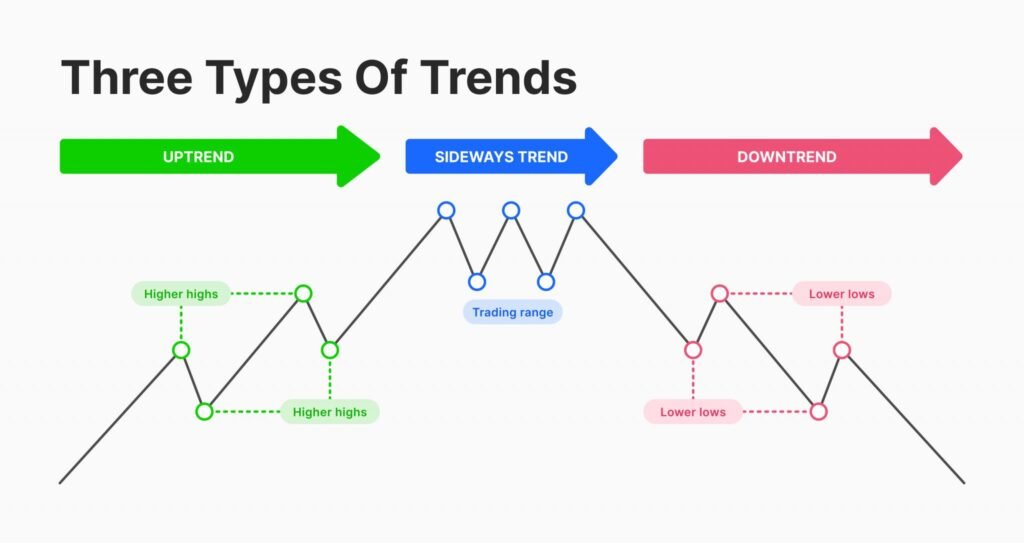
Before you can successfully trade with the trend, you must first learn how to recognize the different types of market movement.
One of the biggest mistakes beginners make is assuming that every market is trending.
In reality, the Forex market can move in three different ways:
- Uptrend (Bullish Trend)
- Downtrend (Bearish Trend)
- Sideways Trend (Range-Bound Market)
Each type of market requires a different approach.
Understanding these market conditions will help you decide when to trade, when to stay patient, and when to avoid entering the market altogether.
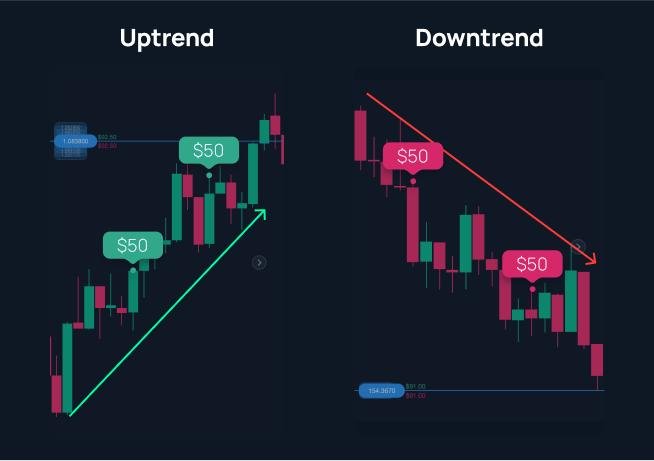
1. Uptrend (Bullish Market)
An uptrend occurs when the overall market is moving higher over time.
In an uptrend, buyers are stronger than sellers, causing prices to gradually increase.
The easiest way to identify an uptrend is by looking for:
✔ Higher Highs (HH)
✔ Higher Lows (HL)
Imagine a staircase.
Each step takes you slightly higher than the previous one.
Price behaves in a similar way during a healthy uptrend.
It rises, pulls back slightly, then rises again to create a new high.
Example
Suppose EUR/USD moves:
- From 1.1000 to 1.1100
- Pulls back to 1.1060
- Rises again to 1.1180
- Pulls back to 1.1130
- Continues rising to 1.1250
Notice that:
- Every new high is higher than the previous high.
- Every pullback stops above the previous low.
This pattern signals that buyers remain in control.
How Trend Traders Respond
Rather than trying to sell because the market has already risen, trend traders wait for temporary pullbacks before looking for buying opportunities.
Their goal is to trade with the prevailing direction, not against it.
Beginner Tip
During a strong uptrend, remember:
“Buy the dips, don’t chase the highs.”
Waiting for a pullback often provides a better entry price and a more favorable risk-to-reward ratio.
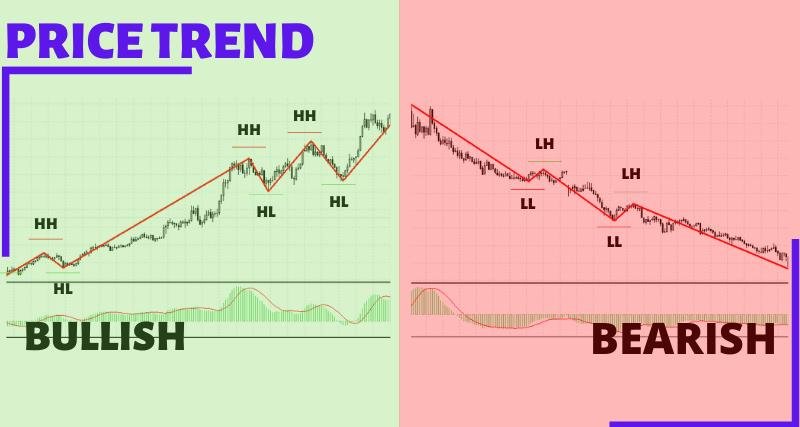
2. Downtrend (Bearish Market)
A downtrend is the opposite of an uptrend.
Here, sellers dominate the market, pushing prices lower over time.
A healthy downtrend forms:
✔ Lower Highs (LH)
✔ Lower Lows (LL)
Instead of climbing a staircase, imagine walking down one.
Each step takes you lower than the last.
The market falls, rebounds slightly, then continues downward.
Example
Suppose GBP/USD moves:
- From 1.3000 to 1.2880
- Rallies to 1.2930
- Falls to 1.2800
- Rallies to 1.2850
- Drops again to 1.2720
Each rally fails to break above the previous high, while every decline reaches a new low.
This shows that sellers remain in control.
How Trend Traders Respond
Instead of buying because the market appears “cheap,” experienced trend traders wait for short-term rallies before looking for selling opportunities.
This approach allows them to join the dominant market direction instead of fighting it.
Beginner Tip
One of the most expensive mistakes beginners make is assuming:
“The market has fallen too much, so it must go back up.”
Unfortunately, strong downtrends can continue much longer than expected.
Always wait for confirmation before assuming a reversal.
3. Sideways Trend (Range-Bound Market)
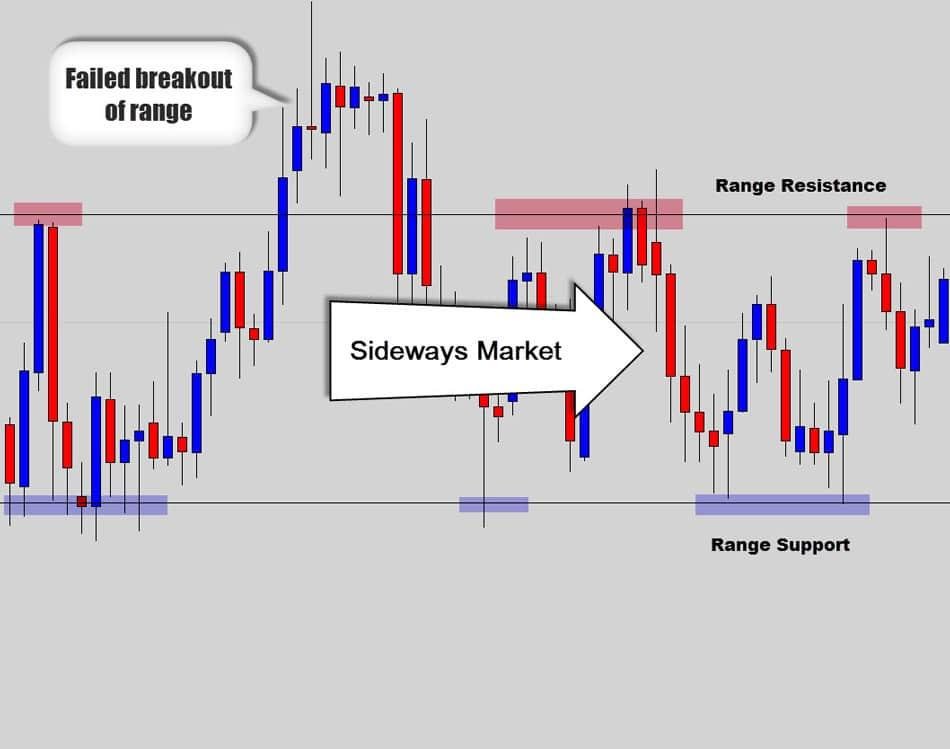
Not every market moves upward or downward.
Sometimes, buyers and sellers are evenly matched.
When this happens, prices move sideways within a relatively narrow range.
This is known as a:
- Sideways Market
- Consolidation
- Range-Bound Market
Instead of creating higher highs or lower lows, price repeatedly bounces between a support level and a resistance level.
Example
Imagine USD/JPY trading between:
Support: 145.20
Resistance: 146.10
For several days, the pair rises toward resistance, falls back to support, and repeats the same movement without establishing a clear direction.
This indicates that neither buyers nor sellers have gained control.
Should Beginners Trade Sideways Markets?
For many beginners, the answer is not immediately.
Trend-following strategies generally perform best when the market has a clear direction.
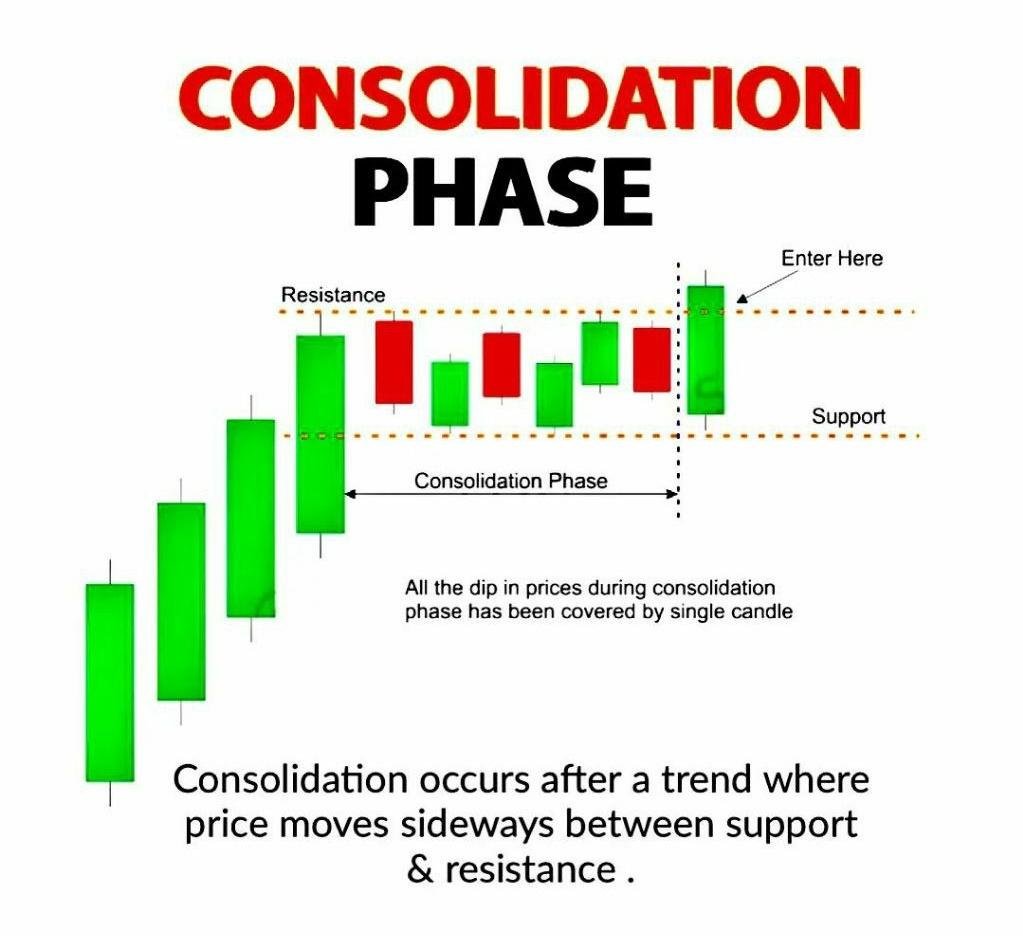
Sideways markets often produce:
- False breakouts
- Choppy price action
- Confusing signals
- Increased emotional trading
Many experienced traders choose to wait until the market breaks out of the range and establishes a new trend before entering a position.
Remember:
“No trend is also valuable information.”
Sometimes the best trade is the one you don’t take.
Comparing the Three Market Trends
| Market Condition | Price Pattern | Who Controls the Market? | Typical Trading Approach |
|---|---|---|---|
| Uptrend | Higher highs and higher lows | Buyers | Look for buying opportunities during pullbacks |
| Downtrend | Lower highs and lower lows | Sellers | Look for selling opportunities during rallies |
| Sideways | Price moves between support and resistance | Neither buyers nor sellers | Wait for a clear breakout or avoid trend-following trades |
Why Identifying the Trend Matters
Many beginner traders lose money not because their analysis is completely wrong, but because they trade against the dominant market direction. Major economic news can create or strengthen trends. Learn how to prepare for these events in our guide on How to Use an Economic Calendar in Forex Trading.
Imagine trying to paddle a canoe upstream against a fast-moving river.
You might make some progress, but it requires far more effort and carries greater risk than simply moving with the current.
Trend trading follows the same principle.
By identifying whether the market is moving up, down, or sideways, you can choose strategies that match current market conditions instead of fighting them.
Learning to recognize these three market types is the first step toward becoming a more patient, disciplined, and consistent Forex trader.
How to Identify a Trend in Forex Trading
Recognizing a market trend is one of the most valuable skills a Forex trader can develop. Many traders use moving averages to filter market noise and identify the overall direction of a trend.
Many beginners believe they can identify a trend simply by looking at a chart for a few seconds.
While experienced traders can often spot trends quickly, beginners should follow a structured approach instead of relying on guesswork.
The goal isn’t to predict where the market will go next.
Instead, it’s to determine what the market is doing right now.
Fortunately, there are several reliable methods that can help you identify the market direction with greater confidence.
1. Look at Price Action First
Before using any technical indicators, always start by observing the price itself.
Price action is the movement of the market displayed on your chart. Learning price action allows traders to interpret market behavior directly from candlestick movements without relying solely on indicators.
Since every indicator is based on price, learning to read price action gives you a clearer understanding of market behavior.
Ask yourself these questions:
- Is the market making higher highs and higher lows?
- Is it making lower highs and lower lows?
- Or is it simply moving sideways?
If you consistently see higher highs and higher lows, you’re likely looking at an uptrend.
If you consistently see lower highs and lower lows, you’re likely looking at a downtrend.
If neither pattern is present, the market may be ranging.
Beginner Tip
Before adding indicators to your chart, spend a few minutes looking only at the candlesticks.
Learning to read price action will improve your trading decisions more than relying on dozens of indicators.
2. Use Moving Averages
Moving averages are among the most popular tools for identifying trends.
A moving average calculates the average price over a specific period and displays it as a smooth line on the chart.
This helps reduce market noise and makes the overall direction easier to see.
Some commonly used moving averages include:
- 20-period Moving Average
- 50-period Moving Average
- 100-period Moving Average
- 200-period Moving Average
Identifying an Uptrend
When price remains above a moving average and the moving average is sloping upward, the market is generally considered bullish.
Identifying a Downtrend
When price stays below a moving average and the moving average slopes downward, the market is generally considered bearish.
Why Beginners Like Moving Averages
Moving averages help remove much of the emotion from trading.
Instead of guessing whether the market is trending, traders can use the moving average as an objective reference point.
However, remember that moving averages are lagging indicators, meaning they follow price rather than predict it.
3. Draw Trendlines
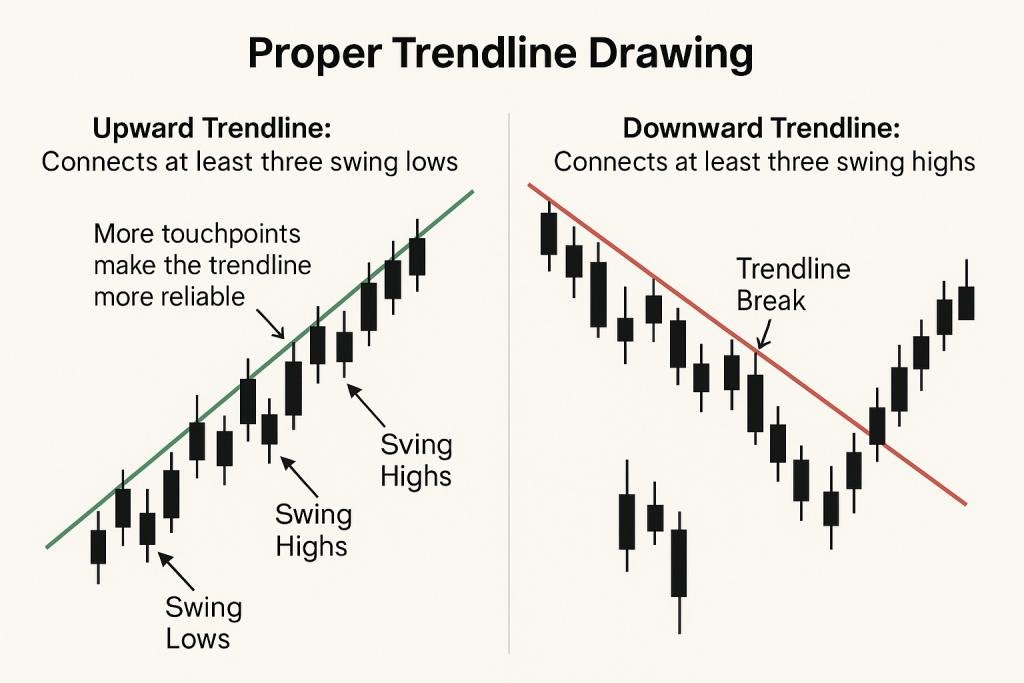
Trendlines are another simple but effective way to identify market direction.
A trendline is created by connecting important swing highs or swing lows.
In an Uptrend
Connect two or more higher lows.
The resulting line acts as dynamic support.
As long as price continues respecting the trendline, buyers remain in control.
In a Downtrend
Connect two or more lower highs.
The trendline acts as dynamic resistance.
Repeated rejection from the trendline suggests sellers are still dominating the market.
Practical Example
Suppose EUR/USD has pulled back three times over the past week, and each pullback touches the same upward-sloping trendline before moving higher again.
This suggests buyers continue defending that area, making the trendline a useful guide for identifying potential buying opportunities.
4. Analyze Multiple Timeframes
One common mistake beginners make is analyzing only one timeframe.
For example, a trader may see an uptrend on the 15-minute chart and immediately place a buy trade.
However, the daily chart could be showing a strong downtrend.
This creates conflicting signals.
Experienced traders often use multiple timeframe analysis to gain a clearer understanding of the market.
For example:
- Daily chart → Overall trend
- 4-hour chart → Medium-term trend
- 1-hour chart → Entry opportunities
When trends align across multiple timeframes, traders generally have greater confidence in the direction of the market.
Beginner Tip
Always check at least one higher timeframe before entering a trade.
It helps you avoid trading against the broader market direction.
5. Use Trend Strength Indicators
Sometimes a market appears to be trending, but the movement is actually weak.
This is where trend strength indicators can help. The Average Directional Index (ADX) helps traders measure the strength of a trend, regardless of whether the market is moving up or down.
One popular example is the Average Directional Index (ADX).
The ADX measures the strength of a trend rather than its direction.
Generally:
- Below 20 → Weak or ranging market
- 20–25 → Trend may be developing
- Above 25 → Strong trend
While beginners don’t need to rely heavily on the ADX, it can provide additional confirmation alongside price action and moving averages.
Combine Multiple Methods for Better Accuracy
No single tool can identify trends perfectly every time.
Instead of depending on one indicator, combine several methods.
For example:
✅ Price is making higher highs and higher lows.
✅ Price is above the 50-period moving average.
✅ The trendline is holding.
✅ The daily and 4-hour charts are both bullish.
When several forms of analysis point in the same direction, the probability of trading with the dominant trend increases.
Remember:
The goal isn’t to predict every market move it’s to identify the most likely direction and trade with it, not against it.
Once you can confidently identify trends, the next step is learning when to enter a trade without chasing the market. That’s exactly what we’ll cover in the next section.
How to Enter and Exit a Trend Trade
Identifying a trend is only half the battle.
The next challenge is knowing when to enter the market and, just as importantly, when to exit.
Many beginners lose money because they enter trades too late after the market has already made a large move.
Others exit winning trades too early because they become nervous, while some hold losing trades for too long hoping the market will reverse.
Successful trend traders follow a structured process instead of making emotional decisions.
Entering a Trend Trade
One of the golden rules of trend trading is:
Never chase the market.
If a currency pair has already made a large move upward, buying immediately can expose you to unnecessary risk because the market may be due for a temporary pullback.
Instead, experienced trend traders wait patiently for price to retrace before looking for an entry.
Entry During an Uptrend
In an uptrend:
- Confirm that price is making higher highs and higher lows.
- Wait for a temporary pullback.
- Look for signs that buyers are returning.
- Enter the trade when the trend resumes.
This approach allows you to buy at a better price rather than chasing the market after a strong rally.
Entry During a Downtrend
In a downtrend:
- Confirm that price is making lower highs and lower lows.
- Wait for a temporary rally.
- Look for signs that sellers are regaining control.
- Enter a sell trade as the downtrend continues.
Patience is one of the biggest advantages trend traders have over impulsive traders.
Using Support and Resistance
Support and resistance levels help traders identify potential entry areas. Understanding support and resistance levels can help traders find better entry and exit points within a trend.
In an Uptrend
Temporary pullbacks often stop near support before continuing higher.
Support may come from:
- Previous swing lows
- Trendlines
- Moving averages
In a Downtrend
Temporary rallies often stop near resistance before continuing lower.
Resistance may include:
- Previous swing highs
- Downward trendlines
- Moving averages
Combining support or resistance with trend confirmation can improve the quality of your trade entries.
Setting a Stop-Loss
Every trend trade should include a stop-loss order. While leverage can increase profits in a strong trend, it can also magnify losses. Learn more in What Is Leverage in Forex Trading?
A stop-loss protects your trading account if the market moves against your position. Every trend trade should include Stop-Loss Orders to protect your capital if the market moves against you.
For Buy Trades
Place the stop-loss below the most recent swing low or below a key support level.
For Sell Trades
Place the stop-loss above the most recent swing high or above a key resistance level.
Avoid placing stop-losses too close to current price, as normal market fluctuations could trigger them unnecessarily.
Setting a Take-Profit
Your take-profit should offer a favorable risk-to-reward ratio.
Many traders aim for at least:
1:2 Risk-to-Reward Ratio
Example:
Risk:
20 pips
Potential Reward:
40 pips
This means even if only half your trades are successful, you may still remain profitable over the long term.
Practical Trend Trading Example
Imagine EUR/USD has been making higher highs and higher lows for several days. Before applying trend trading with real money, practice the strategy in a demo account. Read our comparison of Demo Trading vs Live Trading to understand why this step is important.
You observe the following:
- Price remains above the 50-period Moving Average.
- An upward trendline continues to hold.
- The market pulls back toward support.
- A bullish candlestick forms at the support level.
Your trading plan:
Entry:
Buy after bullish confirmation.
Stop-Loss:
Below the recent swing low.
Take-Profit:
Twice the size of your risk.
As the trend resumes, price continues moving higher and reaches your profit target.
Rather than guessing where the market would reverse, you simply followed the existing trend.
Common Trend Trading Mistakes Beginners Should Avoid
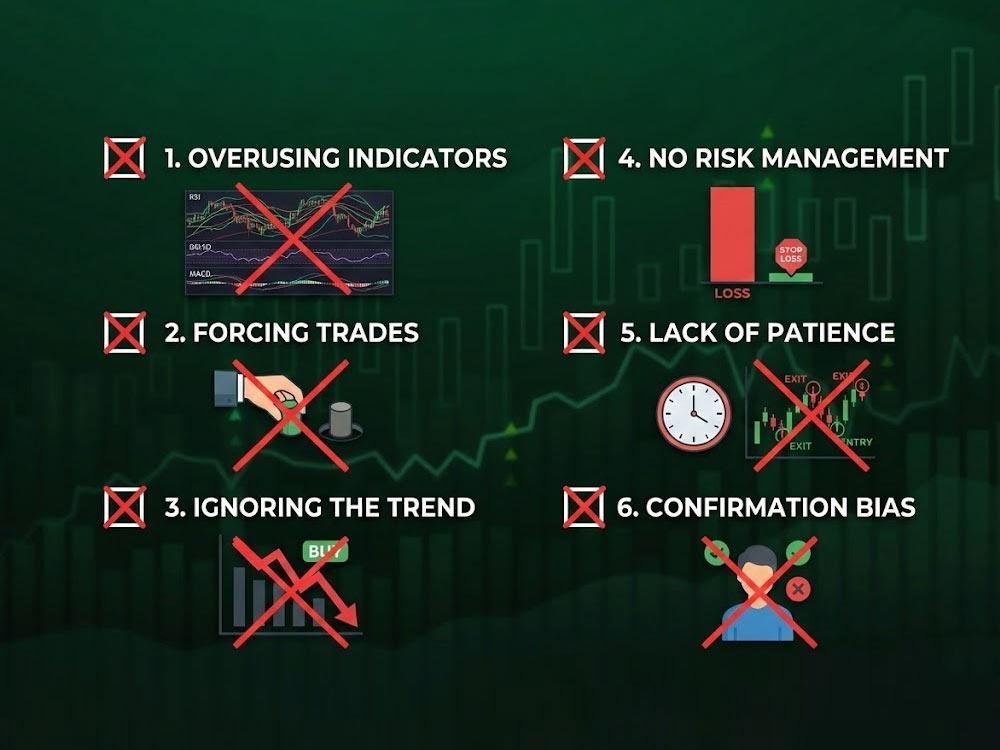
Even though trend trading is considered one of the simplest Forex strategies, beginners often make avoidable mistakes. Trading against the trend is just one of many mistakes covered in our article on Forex Trading Risks for Beginners.
1. Trading Against the Trend
Trying to predict market reversals usually leads to unnecessary losses.
Trade with the trend until clear evidence suggests it has changed.
2. Chasing Price
Entering after a large price movement often results in poor entry points.
Instead, wait for pullbacks before joining the trend.
3. Ignoring Risk Management
Even strong trends can reverse unexpectedly.
Always use stop-loss orders and avoid risking too much on a single trade.
4. Overcomplicating the Chart
Many beginners add too many indicators, creating conflicting signals.
Keep your chart simple.
Price action, trendlines, and one or two indicators are often enough.
5. Becoming Impatient
Not every day offers a quality trend.
Sometimes the best decision is to wait until the market provides a clear opportunity.
Frequently Asked Questions (FAQ)
Is trend trading suitable for beginners?
Yes.
Trend trading is one of the easiest Forex strategies for beginners because it encourages trading with the market rather than against it.
Which timeframe is best for trend trading?
There is no single best timeframe.
Many beginners use:
- Daily chart for identifying the main trend.
- 4-hour chart for confirmation.
- 1-hour chart for entries.
Which indicators are best for trend trading?
Popular trend-following tools include:
- Moving Averages
- Trendlines
- Average Directional Index (ADX)
However, price action should always remain your primary focus.
Can trends last for weeks or months?
Yes.
Some Forex trends continue for several weeks or even months depending on economic conditions and market sentiment.
Should I trade every trend?
No.
Only trade trends that clearly fit your trading plan and risk management rules.
Quality trades are more important than frequent trades.
Final Thoughts
Trend trading is one of the most effective and beginner-friendly strategies in Forex trading because it focuses on following the market instead of fighting it. Effective risk management is essential because even the strongest market trends can reverse unexpectedly.
Rather than trying to predict every reversal, trend traders patiently wait for high-probability opportunities to join the prevailing market direction. Trend trading becomes much more effective when it’s part of a structured Forex Trading Plan for Beginners.
Remember these key lessons:
✔ Identify whether the market is in an uptrend, downtrend, or sideways trend.
✔ Trade in the direction of the dominant trend.
✔ Wait for pullbacks instead of chasing price.
✔ Use support, resistance, and moving averages for confirmation.
✔ Always protect your capital with proper risk management.
Most importantly, understand that no strategy wins every trade.
Even successful trend traders experience losing trades.
The difference is that they remain disciplined, follow their trading plan, and allow the probabilities to work in their favor over time.
With consistent practice and patience, trend trading can become one of the strongest foundations of your Forex trading journey.
Continue Your Forex Learning Journey
If you found this guide helpful, continue building your Forex knowledge with our beginner-friendly articles:
- What Is Forex Trading? A Beginner’s Guide
- How to Open Your First Forex Trading Account
- How to Choose the Best Forex Broker for Beginners
- Demo Trading vs Live Trading: Which Should Beginners Start With?
- How to Use an Economic Calendar in Forex Trading
- What Is Leverage in Forex Trading?
- Forex Trading Risks for Beginners
- How Stop-Loss Orders Help Limit Investment Losses and Risk
- How to Create a Forex Trading Plan for Beginners
Each guide is designed to help you become a more informed, disciplined, and confident trader.
Disclaimer
The information provided in this article is for educational and informational purposes only and should not be considered financial, investment, or trading advice.
Forex trading involves significant risk, and past market trends do not guarantee future results. All trading decisions should be based on your own research, trading plan, and risk tolerance.
Always practice proper risk management, consider using a demo account before trading with real money, and never invest funds that you cannot afford to lose.