
Introduction:
Forex Trading Mistakes: Forex trading has attracted millions of people worldwide, including a growing number of young Africans looking to build digital skills and participate in global financial markets. With the promise of flexibility, accessibility, and profit potential, Forex trading often appears to be an attractive opportunity for beginners.
However, there is a harsh reality that many new traders discover only after losing money: success in Forex trading is not easy. While the market offers opportunities, it also punishes mistakes quickly. Many beginner traders enter the market with unrealistic expectations, little education, and poor risk management practices.
The truth is that most beginner losses are caused by avoidable errors rather than bad luck. Understanding these common Forex trading mistakes can save you time, money, and frustration.
In this guide, we will explore the ten most common Forex trading mistakes beginners make, explain why they happen, and provide practical strategies to help you avoid them.
Table of content
Why Most Beginner Forex Traders Lose Money
Before discussing specific mistakes, it is important to understand why many beginner traders struggle.
Most new traders focus on profits instead of learning. They spend more time searching for winning strategies than developing discipline and risk management skills.
Successful trading requires:
- Education
- Patience
- Consistency
- Emotional control
- Risk management
Unfortunately, many traders try to skip these fundamentals and pay the price later.
1. Trading Without Learning the Basics
One of the biggest Forex trading mistakes beginners make is entering the market without understanding how it works.
Many people watch a few videos, join a signal group, or follow influencers on social media and immediately begin trading with real money. Learn Forex terminology and trading concepts
Why This Mistake Happens
The internet is filled with advertisements promoting Forex as a quick p
ath to wealth. This creates the false impression that trading is easy.
The Problem
Without understanding fundamental concepts such as:
- Currency pairs
- Pips
- Spreads
- Leverage
- Margin
- Market sessions
traders are essentially gambling rather than investing.
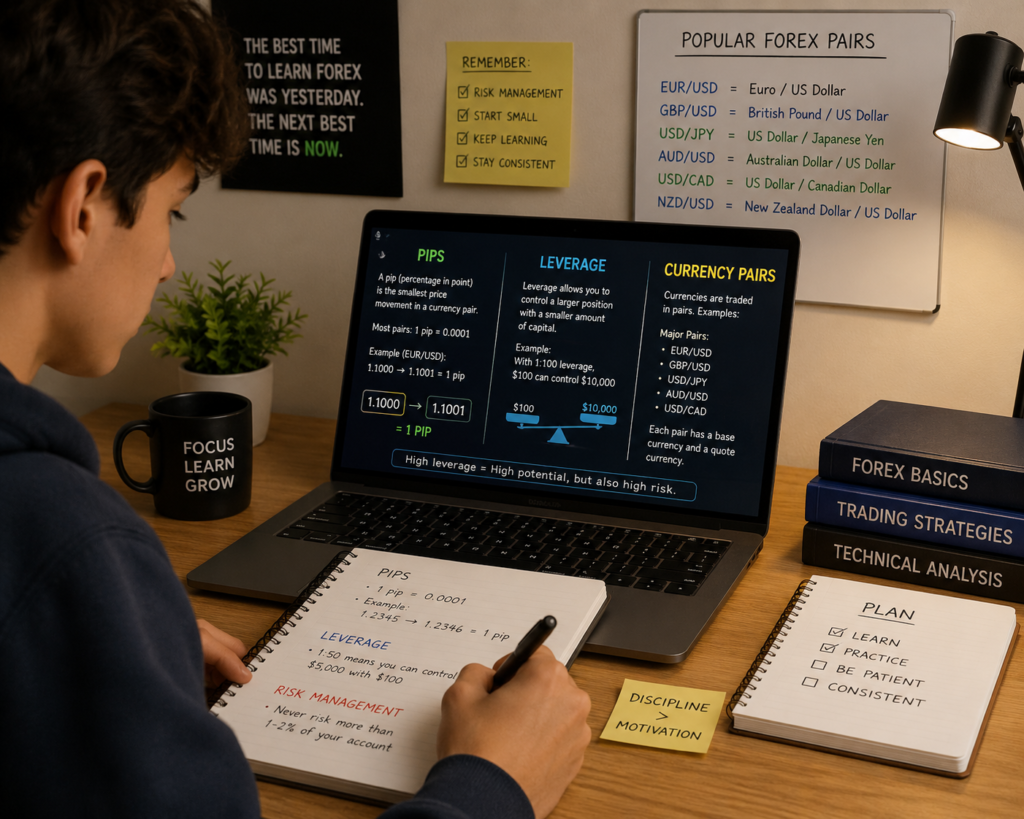
For example, understanding What Is a Pip in Forex? is essential before placing your first trade because profits and losses are measured in pips.
How to Avoid It
Spend time learning:
- Technical analysis
- Fundamental analysis
- Risk management
- Trading psychology
Use educational resources and practice on a demo account before risking real money.
2. Using Too Much Leverage
Leverage is one of the most attractive features of Forex trading, but it is also one of the most dangerous.
Leverage allows traders to control large positions using relatively small amounts of capital.
For example:
- Account Balance: $100
- Leverage: 1:100
- Position Size Controlled: $10,000
Why This Mistake Happens
Beginners see leverage as a way to multiply profits.
Unfortunately, leverage also multiplies losses.
Example
A trader using excessive leverage may lose a significant portion of their account after a small market movement.
This is why many accounts are wiped out within days or weeks.
How to Avoid It
Use leverage responsibly.
Before using borrowed capital, make sure you understand What Is Leverage in Forex?
Focus on preserving your capital rather than chasing large profits.
3. Ignoring Risk Management
Risk management separates successful traders from unsuccessful traders.
Many beginners spend months searching for profitable entry strategies but ignore the systems that protect their capital.
Why This Is Dangerous
Even the best trading strategy experiences losing trades.
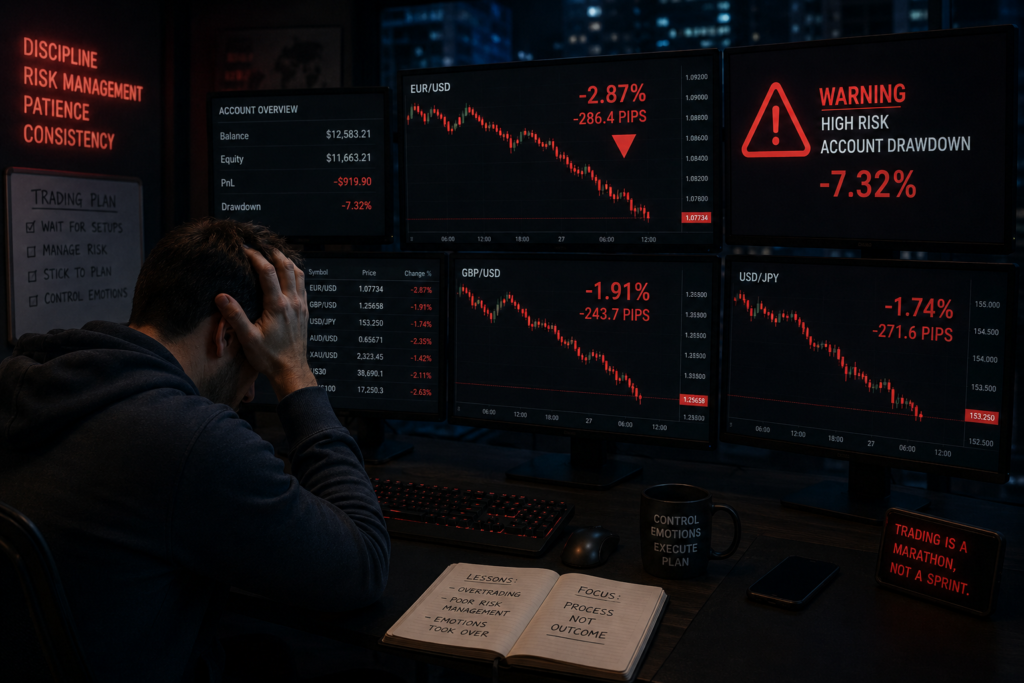
Without proper risk management, a few losses can destroy an account. Understanding the risks of Forex trading
Common Risk Management Errors
- Trading without stop-loss orders
- Risking too much money per trade
- Increasing position sizes after losses
- Trading emotionally
The 1% Rule
Many experienced traders risk no more than 1% of their account balance on a single trade.
For example:
- Account Balance: $1,000
- Maximum Risk Per Trade: $10
This helps traders survive losing streaks.
How to Avoid It
Learn What Is Risk Management in Forex? and make it the foundation of your trading approach.
Always use stop-loss orders and determine your risk before entering any trade.
ALT Text: Forex risk management example using the 1 percent rule
4. Trading Without a Plan
A trading plan is like a roadmap.
Without one, traders make random decisions based on emotions and market noise.
Why This Mistake Happens
Many beginners believe they can simply react to the market in real time. Track important economic events
The Problem
Without a plan, traders often:
- Enter trades impulsively
- Exit trades too early
- Hold losing trades too long
- Change strategies frequently
How to Avoid It
Create a written trading plan that includes:
- Entry rules
- Exit rules
- Risk limits
- Trading schedule
- Profit targets
Consistency is more important than perfection.
5. Letting Emotions Control Decisions
Forex trading is often described as a psychological game.
Fear and greed are responsible for many trading losses.
Fear
Fear causes traders to:
- Close winning trades too soon
- Avoid valid trading opportunities
- Panic during market fluctuations
Greed
Greed causes traders to:
- Risk too much money
- Hold trades too long
- Ignore exit strategies
How to Avoid It
Develop discipline by following your trading plan and accepting losses as part of the trading process.
Professional traders focus on long-term performance rather than individual trades.
6. Overtrading
One of the most common Forex trading mistakes is believing that more trades equal more profits.
In reality, overtrading usually leads to poor decision-making.
Signs of Overtrading
- Trading out of boredom
- Constantly looking for setups
- Taking low-quality trades
- Trading after a losing streak
How to Avoid It
Focus on quality setups rather than quantity.
Remember that some of the best traders in the world take fewer trades than beginners.
7. Skipping Demo Trading
A demo account provides a safe environment to practice trading.
Yet many beginners rush directly into live accounts.
Why This Is a Mistake
A demo account helps traders:
- Learn trading platforms
- Test strategies
- Understand market behavior
- Build confidence
How to Avoid It
Spend time on a demo account before trading real money.
Treat it as seriously as a live account.
8. Chasing Losses
After losing money, many traders feel pressure to recover losses immediately.
This often leads to revenge trading.
Why This Is Dangerous
Revenge trading usually results in:
- Larger position sizes
- Emotional decisions
- Additional losses
How to Avoid It
After a loss:
- Take a break
- Review your trade
- Return only when emotions are under control
Losses are part of every trader’s journey.
9. Blindly Following Trading Signals
Signal groups can be useful learning tools, but they should not replace your own education.
Why This Mistake Happens
Many beginners want quick results without learning analysis.
The Problem
When traders rely entirely on signals, they never develop independent decision-making skills.
How to Avoid It
Use signals to learn, not to depend on.
Your goal should be to understand why a trade is being taken.
10. Expecting to Get Rich Quickly
Perhaps the most damaging mistake of all is expecting instant wealth.
The Reality
Professional traders spend years developing their skills.
Consistent profitability requires:
- Education
- Discipline
- Risk management
- Experience
How to Avoid It
Treat Forex trading as a skill rather than a shortcut.
Focus on long-term growth instead of short-term profits.
Bonus Mistake: Not Keeping a Trading Journal
A trading journal helps traders track progress and identify patterns.
Record:
- Entry points
- Exit points
- Risk levels
- Emotions
- Lessons learned
A journal turns every trade into a learning opportunity.
Why Risk Management Matters More Than Strategy
Many beginner traders spend months searching for the perfect trading strategy. They jump from one indicator to another, buy expensive courses, and constantly change their approach whenever they experience a few losses.
The reality is that no trading strategy wins 100% of the time.
Even professional traders experience losing trades and losing streaks. What separates successful traders from unsuccessful ones is not the ability to predict every market movement, but their ability to manage risk effectively.
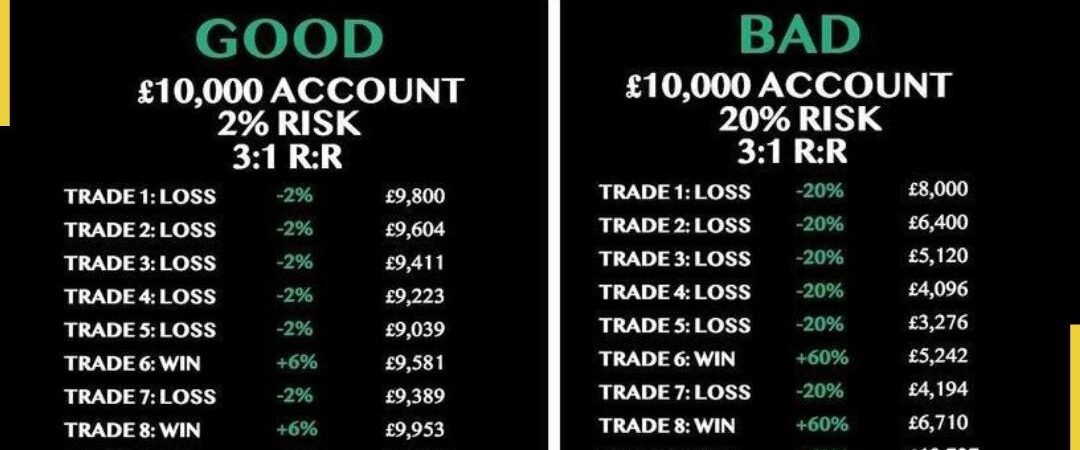
Imagine two traders using the same strategy.
Trader A risks 10% of their account on every trade.
Trader B risks only 1% of their account on every trade.
After five consecutive losses, Trader A would lose nearly half of their trading capital. Trader B would still have most of their account intact and enough capital to continue trading.
This simple example demonstrates why risk management is more important than finding a perfect strategy.
Key Risk Management Principles
Position Sizing
Position sizing refers to how much money you allocate to a single trade.
A common recommendation is to risk only 1%–2% of your account balance per trade.
Stop-Loss Orders
A stop-loss order automatically closes a trade when a predetermined loss level is reached.
Every trade should have a stop-loss because unexpected market movements can happen at any time.
Learn more in our guide: What Is a Stop Loss in Forex?
Risk-to-Reward Ratio
Many successful traders use a minimum risk-to-reward ratio of 1:2.
This means risking $10 to potentially earn $20.
Even if only half of their trades are successful, they can still remain profitable over time.
Capital Preservation
Your first goal as a trader should not be making money.
Your first goal should be protecting your capital.
Without capital, you cannot continue trading or take advantage of future opportunities.
Real-Life Example of How Beginner Mistakes Lead to Losses
To better understand how these mistakes work together, let’s look at a realistic scenario.
Imagine a beginner trader named Daniel.
Daniel sees social media posts showing large Forex profits and decides to open a trading account with $200.
Instead of learning the basics, he immediately starts trading.
He uses maximum leverage because he wants to grow his account quickly.
After losing his first trade, Daniel doubles his position size to recover the loss.
Unfortunately, the market moves against him again.
Frustrated and emotional, he continues placing random trades throughout the day.
Within a week, Daniel loses most of his account.
What went wrong?
Daniel made several common Forex trading mistakes:
- He skipped education.
- He used excessive leverage.
- He ignored risk management.
- He traded emotionally.
- He chased losses.
Now imagine a different trader.
Sarah spends several weeks learning the basics.
She practices on a demo account.
She risks only 1% per trade and follows a written trading plan.
While Sarah still experiences losses, she protects her account and gradually improves her skills.
Over time, Sarah develops consistency while Daniel continuously struggles.
This example highlights why discipline is often more important than strategy.
A Beginner’s Roadmap to Forex Success
Many people enter Forex trading without a clear learning path.
The following roadmap can help beginners build a strong foundation.
Month 1: Learn the Fundamentals
Focus on understanding:
- Currency pairs
- Pips
- Spreads
- Leverage
- Trading sessions
This is also a good time to read beginner educational resources and learn Forex terminology.
Month 2: Learn Chart Analysis
Study:
- Support and resistance
- Trend identification
- Candlestick patterns
- Basic technical indicators
You should also learn How to Read Forex Charts for Beginners.
Month 3: Practice on a Demo Account
Use a demo account to:
- Test strategies
- Learn order execution
- Build confidence
Treat your demo account as if it were real money.
Month 4: Develop a Trading Plan
Your trading plan should include:
- Entry rules
- Exit rules
- Risk management rules
- Daily trading limits
Consistency becomes more important than profits at this stage.
Month 5 and Beyond: Focus on Improvement
Keep a trading journal and review your performance regularly.
Success comes from gradual improvement rather than overnight results.
Key Lessons Every Beginner Trader Should Remember
Before you place your next trade, remember these important lessons:
- Forex trading is a skill, not a shortcut to wealth.
- Risk management matters more than any trading strategy.
- Protecting capital should always be your top priority.
- Every successful trader experiences losses.
- Consistency is more important than perfection.
- Patience often produces better results than constant trading.
- Education is one of the best investments a trader can make.
The traders who succeed are usually not the smartest or luckiest. They are the most disciplined and consistent.
By avoiding the common Forex trading mistakes discussed in this article, you can significantly improve your chances of becoming a successful trader over the long term.
Frequently Asked Questions (FAQ)
What is the biggest Forex trading mistake beginners make?
The biggest Forex trading mistake beginners make is trading without proper education. Many new traders focus on making money quickly instead of learning market fundamentals, risk management, and trading psychology. Without a solid foundation, traders are more likely to make emotional decisions and experience unnecessary losses.
Can I start Forex trading with a small amount of money?
Yes, many brokers allow traders to start with relatively small amounts of capital. However, beginners should focus on learning and managing risk rather than trying to grow a small account quickly. Starting small helps reduce emotional pressure while gaining experience.
How much should I risk per trade?
Many experienced traders follow the 1% rule, which means risking no more than 1% of their account balance on a single trade. For example, if your account balance is $1,000, your maximum risk per trade would be $10.
Proper risk management helps traders survive losing streaks and stay in the market long enough to improve their skills.
Why do most beginner Forex traders lose money?
Most beginner traders lose money because they:
- Use excessive leverage
- Ignore risk management
- Trade emotionally
- Overtrade
- Lack a trading plan
- Expect quick profits
Successful trading requires discipline, patience, and continuous learning.
Is Forex trading gambling?
Forex trading becomes gambling when trades are placed without analysis, planning, or risk management. Professional trading involves using strategies, managing risk, analyzing market conditions, and following a structured trading plan.
The difference between gambling and trading is preparation and discipline.
How long does it take to become a profitable trader?
There is no fixed timeline. Some traders become consistently profitable within a year, while others may take several years.
The speed of progress depends on:
- Education
- Practice
- Discipline
- Risk management
- Experience
Most successful traders view Forex as a long-term skill rather than a quick way to make money.
Should beginners use leverage?
Beginners should use leverage carefully and understand how it works before applying it to live trades. While leverage can increase profits, it can also increase losses significantly.
New traders should prioritize learning proper position sizing and risk management before using high leverage.
Is a demo account important?
Yes. A demo account allows beginners to practice trading without risking real money. It helps traders learn platform features, test strategies, and build confidence before moving to a live account.
Many successful traders spend weeks or months practicing on a demo account before trading real funds.
What is the best way to learn Forex trading?
The best way to learn Forex trading is through a combination of:
- Structured education
- Demo trading
- Risk management practice
- Market analysis
- Keeping a trading journal
Continuous learning and practical experience are essential for long-term success.
Can Forex trading become a full-time career?
Some traders eventually make Forex trading their primary source of income. However, this typically requires years of experience, a proven strategy, strong risk management, and emotional discipline.
Beginners should focus on learning and consistency before considering full-time trading.
Final Thoughts
Forex trading offers exciting opportunities for individuals who are willing to invest time in learning and developing their skills. However, long-term success in the Forex market does not come from luck, secret strategies, or shortcuts. It comes from education, discipline, patience, and a commitment to continuous improvement.
Many beginner traders enter the market with high expectations, hoping to make quick profits within a short period. Unfortunately, this mindset often leads to costly mistakes such as overtrading, using excessive leverage, ignoring risk management, and making emotional decisions. As we have discussed throughout this guide, these mistakes are among the most common reasons new traders lose money.
The encouraging news is that every mistake covered in this article can be avoided and corrected. By taking the time to understand how the Forex market works, developing a well-structured trading plan, practicing proper risk management, and maintaining emotional discipline, you can significantly improve your chances of becoming a more confident and consistent trader.
It is also important to remember that losses are a natural part of trading. Even the most experienced and successful traders experience losing trades. The difference is that successful traders know how to manage their losses, protect their capital, and stay focused on their long-term goals. Instead of viewing losses as failures, treat them as learning opportunities that can help you grow and improve your trading skills.
Forex trading should be approached as a journey rather than a destination. Focus on building strong habits, gaining experience, and improving your decision-making process one trade at a time. Consistency is far more valuable than chasing large profits, and protecting your trading capital should always be your top priority.
As you continue your Forex education, stay committed to learning, remain patient during difficult periods, and avoid the temptation of get-rich-quick schemes. The traders who achieve long-term success are usually those who prioritize knowledge, discipline, and risk management above everything else.
The Forex market will continue to create opportunities every day. Your responsibility is to prepare yourself with the skills, mindset, and discipline needed to recognize and take advantage of those opportunities when they arise. With the right approach and a commitment to continuous improvement, you can build a solid foundation for long-term success in the world of Forex trading.
Disclaimer
The information provided in this article is for educational and informational purposes only and should not be considered financial, investment, or trading advice. Forex trading involves substantial risk and may not be suitable for all investors.
Always conduct your own research and consult a qualified financial professional before making trading decisions. Never trade with money you cannot afford to lose.
Past performance does not guarantee future results. BuildSmartAfri is not responsible for any financial losses resulting from the use of information contained in this article.