Introduction
AI Ethics Explained: Benefits, Risks, and Challenges. Artificial intelligence is rapidly becoming part of everyday life. People now use AI to write content, study, create images, analyze information, automate business tasks, communicate with customers, develop software, and make decisions more efficiently.
Organizations are also applying AI in areas such as healthcare, education, banking, recruitment, transportation, cybersecurity, and customer service. If you’re completely new to artificial intelligence, start with our guide on What Is Artificial Intelligence? to understand the basic concepts before exploring the ethical questions surrounding AI.
These technologies can provide significant benefits. AI can help people complete repetitive tasks faster, analyze large amounts of information, improve accessibility, support research, and increase productivity.
However, the growing use of AI also raises important questions.
What happens when an AI system produces a biased result?
Who is responsible when an AI-assisted decision causes harm?
How should companies protect personal information used by AI systems?
Can people tell when images, videos, or information have been generated by AI?
Should important decisions be made entirely by machines?
Questions like these are at the heart of AI ethics.
As artificial intelligence becomes more capable and influential, developing AI isn’t only about asking:
“Can we build this?”
We also need to consider:
“Should we use it this way, what risks could arise, and what safeguards are appropriate?”
Understanding AI ethics therefore helps individuals, businesses, students, developers, and organizations think more carefully about how artificial intelligence should be designed and used.
What Is AI Ethics?
AI ethics refers to the principles and practices used to guide the responsible development, deployment, and use of artificial intelligence. International organizations have also developed principles for responsible AI. UNESCO’s Recommendation on the Ethics of Artificial Intelligence addresses areas including human rights, fairness, transparency, accountability, privacy, and human oversight.
In simple terms, AI ethics asks:
How can we benefit from artificial intelligence while protecting people from unnecessary harm?
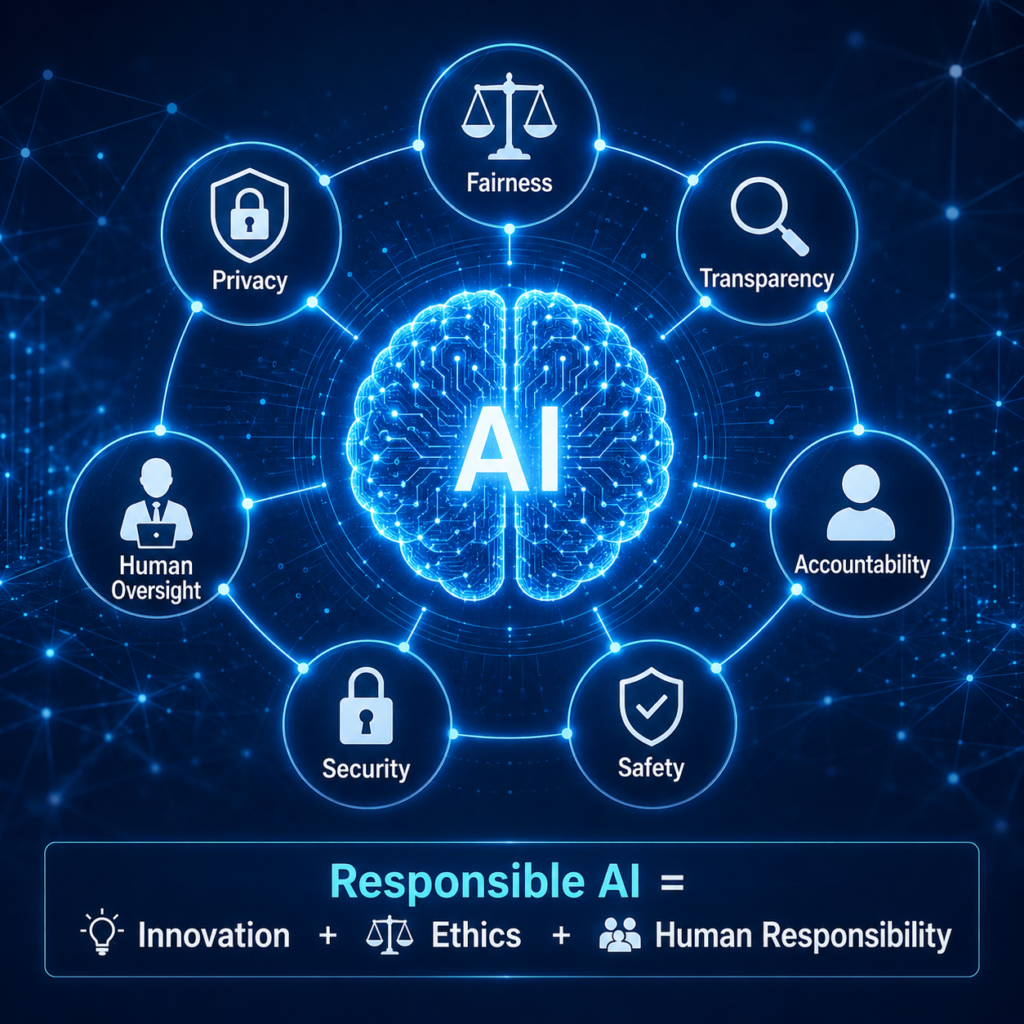
It considers issues such as fairness, privacy, transparency, accountability, safety, security, and human oversight.
For example, imagine a company uses an AI system to help screen job applications.
The technology might save recruiters considerable time by analyzing thousands of applications. However, ethical questions arise if the system consistently disadvantages certain groups of qualified applicants.
The issue is no longer simply whether the AI can process applications quickly.
We also need to ask:
- Is the system treating applicants fairly?
- What data was used to develop or evaluate it?
- Can its decisions or recommendations be meaningfully reviewed?
- Is applicants’ personal information protected?
- Can a human challenge or override an inappropriate recommendation?
- Who is accountable for the final hiring decision?
These are examples of AI ethics in practice.
Key Principles of AI Ethics
Although ethical frameworks can differ, several ideas commonly appear in discussions about responsible AI.
Fairness: AI systems should be evaluated for unfair or discriminatory outcomes.
Transparency: People should receive appropriate information about when and how AI is being used, particularly where it meaningfully affects them.
Privacy: Personal and sensitive information should be handled responsibly and protected appropriately.
Accountability: Organizations and people deploying AI should remain responsible for how systems are used and the consequences of important decisions.
Safety and Security: AI systems should be designed, tested, and monitored to reduce foreseeable harm and resist misuse where appropriate.
Human Oversight: For consequential decisions, AI can support human judgment without automatically replacing meaningful human review.
These principles can be summarized as:
Useful AI + Fairness + Privacy + Transparency + Accountability + Safety + Human Oversight = More Responsible AI
AI ethics doesn’t necessarily mean stopping innovation. Instead, it encourages society to develop and use AI while considering both its potential benefits and possible consequences.
As AI becomes more integrated into important areas of society, these ethical considerations become increasingly important which leads us to the next question: Why does AI ethics matter?
Why Is AI Ethics Important?
AI systems increasingly influence activities that can affect people’s opportunities, information, privacy, finances, education, and work. As their use expands, it becomes important to consider not only what AI can do, but also how it affects individuals and society. The OECD AI Principles provide internationally recognized principles for trustworthy AI, including human rights, transparency, robustness, security, safety, and accountability.
AI ethics provides a framework for thinking about these consequences before problems become more difficult to address. Responsible AI use also starts with giving AI clear instructions and understanding its limitations. Our guide on How to Write Effective AI Prompts explains how to provide context, requirements, and structured instructions while keeping human review involved.
1. AI Can Influence Important Decisions
AI can assist organizations in areas such as recruitment, lending, education, healthcare, fraud detection, and customer management.
These applications can improve efficiency, but mistakes or unfair patterns may have significant consequences.
For example, imagine an AI-assisted recruitment system consistently gives lower rankings to qualified candidates from a particular group because of patterns in the data used to develop or operate the system.
Without appropriate testing and human review, those patterns could influence real employment opportunities.
Responsible AI therefore requires organizations to consider:
Accuracy → Fairness → Human Review → Accountability
The more consequential the decision, the more important appropriate safeguards become.
2. AI Systems Can Reflect or Amplify Bias
AI systems learn patterns from data and are also shaped by design choices, objectives, and deployment environments.
If those inputs contain historical inequalities, incomplete representation, measurement problems, or other biases, an AI system may reproduce or even amplify unfair outcomes.
For example, an AI system trained primarily using data representing one population may perform less reliably when used with populations that were poorly represented.
Addressing AI bias can involve better data practices, testing across relevant groups, ongoing monitoring, and meaningful human oversight.
3. Personal Data and Privacy Need Protection
Many AI applications depend on large amounts of information.
Depending on the system, this may include information about people’s behavior, preferences, communications, images, location, finances, or other personal details.
This creates important privacy questions:
What information is being collected?
Why is it needed?
How is it stored and protected?
Who can access it?
How long is it retained?
Businesses and individuals should therefore be careful about the information they provide to AI services, particularly when handling confidential or sensitive data.
4. AI Can Produce Convincing but Incorrect Information
Generative AI can produce text, images, audio, and video that appear convincing even when the underlying information is inaccurate or misleading.
For example, an AI assistant might provide a confident answer containing incorrect statistics, nonexistent references, or outdated information.
This is why users should not assume:
Confident AI Response = Correct Information
A safer approach is:
AI Output → Human Review → Verify Important Claims → Use Responsibly
This becomes especially important when AI is used for academic research, journalism, financial decisions, healthcare information, legal matters, or other high-impact purposes.
5. AI Makes Creating Misleading Content Easier
Generative AI can create realistic-looking images, voices, videos, and written content.
These capabilities have many legitimate creative uses, but they can also be misused to produce deepfakes, impersonation, scams, fabricated evidence, or misinformation.
As AI-generated media becomes more realistic, people may find it increasingly difficult to distinguish authentic content from manipulated material.
Responsible AI therefore involves not only building safer systems but also encouraging transparency, media literacy, verification, and responsible use.
6. Accountability Still Matters
When AI contributes to a harmful or incorrect decision, an important question arises:
Who is responsible?
An organization should not automatically avoid responsibility simply because an AI system produced a recommendation.
People and organizations deploying AI need appropriate processes for reviewing its performance, handling mistakes, responding to complaints, and determining who has authority over important decisions.
AI should therefore support accountability rather than create a situation where everyone can say:
“The computer made the decision.”
7. Trust Is Important for AI Adoption
People are more likely to trust AI systems when they believe those systems are being used responsibly.
If customers believe a company is secretly collecting their information, if employees believe workplace AI is unfair, or if users repeatedly encounter misleading AI-generated information, trust can decline.
Responsible practices around privacy, transparency, fairness, security, and accountability can therefore benefit both users and organizations.
The Main Goal of AI Ethics
AI ethics is not simply about finding reasons to restrict artificial intelligence.
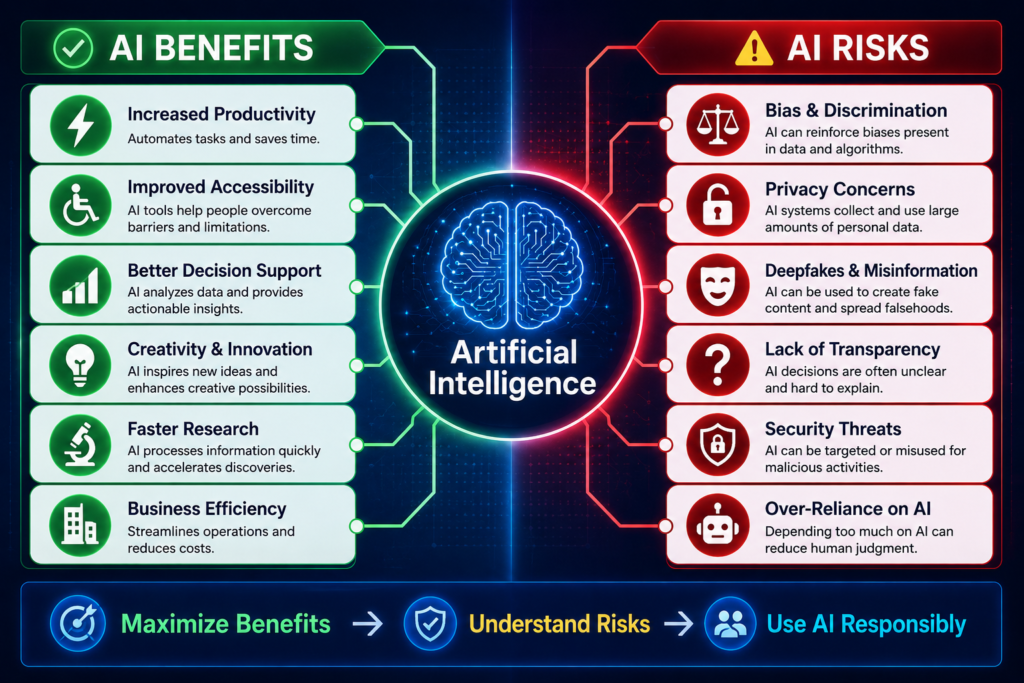
Its broader goal is to help society receive the benefits of AI while identifying, reducing, and managing its risks.
A useful way to think about it is:
Innovation without safeguards → Greater potential for harm
Excessive restriction without considering benefits → Lost opportunities
Responsible innovation → Benefits + Risk Management + Human Oversight
Understanding this balance becomes clearer when we examine the other side of the discussion: the major benefits that responsible AI can provide to individuals, businesses, and society.
Benefits of Responsible Artificial Intelligence
AI ethics is often discussed in terms of risks, but artificial intelligence can also provide significant benefits when it is designed, deployed, and used responsibly. If you’re still exploring what different AI platforms can do, our guide to the Best AI Tools for Beginners introduces useful tools for writing, research, productivity, design, and other everyday tasks.
The purpose of responsible AI is not to eliminate AI innovation. It is to help individuals and organizations gain useful benefits while reducing avoidable harm.
Here are some of the major potential benefits.
1. Increased Productivity and Efficiency
One of AI’s most practical benefits is its ability to assist with repetitive and time-consuming tasks.
Businesses can use AI to help with:
- Drafting documents and emails
- Summarizing information
- Organizing data
- Customer-support workflows
- Content creation
- Administrative tasks
- Research assistance
- Software development
For example, a small business owner might use an AI assistant to create an initial draft of a customer email instead of writing every message from scratch. For practical examples of these technologies in business, explore our guide to the Best AI Tools for Small Businesses, covering tools for content creation, design, automation, marketing, customer management, and productivity.
The human can then review and edit the message before sending it.
A responsible workflow looks like:
AI Assistance → Human Review → Final Decision
This allows AI to improve productivity without removing human responsibility.
2. Better Decision Support
AI systems can analyze large amounts of information and identify patterns that might be difficult or time-consuming for humans to find manually.
This can support decision-making in areas such as business forecasting, fraud detection, logistics, manufacturing, and healthcare.
However, there is an important distinction:
Decision Support ≠ Automatic Decision Authority
For consequential decisions, AI-generated recommendations should be evaluated alongside appropriate human expertise, context, and oversight.
3. Improved Accessibility
AI can make digital information and services more accessible to people with different needs.
Examples include:
Speech-to-text tools that convert spoken language into written text.
Text-to-speech systems that read digital content aloud.
Automatic captions that make video content easier to access.
Translation tools that help people communicate across languages.
AI assistants that can simplify complicated information or explain concepts in different ways.
When developed inclusively, these technologies can help more people participate in education, employment, communication, and digital services.
4. Faster Research and Information Processing
Researchers, students, businesses, and professionals often work with large amounts of information.
AI can assist with tasks such as organizing material, summarizing documents, identifying patterns, generating research questions, and exploring possible explanations.
For example, instead of manually reviewing hundreds of customer comments individually, a business might use AI to help identify recurring themes.
However, AI-generated summaries and conclusions should still be checked against the original information when accuracy matters.
5. More Personalized Services
AI can help organizations adapt services to different users.
Examples include:
- Personalized learning materials
- Product recommendations
- Customer-support assistance
- Content recommendations
- Language-learning exercises
- Accessibility features
In education, for example, an AI system might provide additional explanations or practice questions based on areas where a student needs more help.
Personalization can be useful, but organizations must still consider privacy, fairness, transparency, and appropriate data use.
6. Supporting Creativity and Innovation
Generative AI can assist people with brainstorming, writing, design, music, software development, image creation, and other creative activities.
A business owner might use AI to brainstorm advertising ideas.
A programmer might use an AI assistant to explain code.
A student might use it to generate practice questions.
A designer might experiment with different visual concepts.
The strongest approach is often not:
Human vs AI
but:
Human Creativity + AI Assistance
Humans still provide goals, judgment, experience, context, and final creative direction.
7. Helping Small Businesses Compete
Large companies traditionally have greater access to specialized teams, software, and resources.
AI tools can make certain capabilities more accessible to smaller organizations.
A small business can now use AI assistance for:
Marketing → Content → Design → Customer Service → Research → Automation → Productivity
This doesn’t automatically make a small business successful, but it can reduce the time and resources required for certain tasks.
Responsible use also means checking AI-generated marketing claims, protecting customer information, and maintaining appropriate human involvement.
Responsible AI Creates the Greatest Opportunity
The benefits of artificial intelligence become more sustainable when ethical considerations are built into how the technology is used.
For example:
AI + Privacy Protection → More Responsible Data Use
AI + Human Oversight → Better Control Over Important Decisions
AI + Bias Testing → Greater Opportunity to Detect Unfair Outcomes
AI + Transparency → Better Understanding and Trust
AI + Security → Reduced Exposure to Certain Risks
The goal should therefore be to maximize useful applications while identifying and managing potential harms.
And those potential harms matter. Despite its benefits, artificial intelligence introduces serious ethical concerns that individuals, businesses, developers, and governments need to understand.
Major Ethical Risks of Artificial Intelligence
Artificial intelligence can create significant benefits, but it also introduces risks that need to be understood and managed.
These risks don’t mean AI should not be used. Instead, they highlight why responsible development, appropriate safeguards, and human oversight matter. Organizations looking for a structured approach to AI risks can consult the U.S. National Institute of Standards and Technology’s AI Risk Management Framework, which provides guidance for managing risks associated with AI systems.
1. Bias and Discrimination
AI systems can produce unfair outcomes when the data, design choices, objectives, or environments involved contain biases.
Imagine a company using an AI system to help evaluate job applicants. If the system was developed using historical hiring data containing discriminatory patterns, it could potentially reproduce some of those patterns.
Bias can affect areas such as:
- Recruitment
- Lending
- Education
- Healthcare
- Insurance
- Facial recognition
- Public services
Organizations should therefore evaluate AI systems for unfair outcomes and continue monitoring them after deployment.
Biased Inputs + Poor Testing → Greater Risk of Unfair Outcomes
Responsible AI requires careful data practices, testing, monitoring, and appropriate human review.
2. Privacy and Data Protection
AI systems can process enormous amounts of information, sometimes including personal or sensitive data.
For example, users may provide AI services with documents, photographs, customer information, business records, conversations, or other data. Organizations processing personal information with AI should also understand applicable data-protection requirements. The UK’s Information Commissioner’s Office provides guidance on AI and data protection.
This raises questions such as:
What information is being collected?
How is that information being used?
Who has access to it?
How long will it be retained?
Is it adequately protected?
Businesses should be particularly careful when using AI tools with customer or employee information.
Users should also avoid casually sharing passwords, banking credentials, private identification information, confidential documents, or other sensitive information with AI services.
3. Misinformation and Deepfakes
Generative AI can create realistic text, images, audio, and video.
These capabilities have legitimate uses in education, entertainment, marketing, and creativity, but they can also be misused.
For example, someone could create:
- Fake photographs
- Fabricated news stories
- AI-generated voices impersonating another person
- Manipulated videos
- Fake social media content
- Misleading advertisements
A realistic-looking piece of content isn’t necessarily authentic.
As generative AI becomes more capable, digital literacy and source verification become increasingly important.
People should ask:
Who published this? → What evidence supports it? → Can I verify it elsewhere?
4. Lack of Transparency
Some AI systems can be difficult for users to understand.
A person may receive a recommendation, score, classification, or decision without clearly understanding how the system reached that result.
This becomes particularly concerning when AI influences consequential decisions.
For example, if an automated system contributes to rejecting someone’s loan application, the affected person may reasonably want to understand the relevant factors and whether the result can be reviewed.
Responsible AI therefore requires appropriate levels of transparency and explainability, especially where decisions significantly affect people.
5. Security and Malicious Use
AI can help improve cybersecurity, but it can also be misused by malicious actors.
Potential misuse can include assisting with:
- Phishing and scams
- Impersonation
- Social engineering
- Automated misinformation
- Fraud
- Certain cyberattacks
AI can make some deceptive activities easier to scale or personalize.
This creates an ongoing challenge: organizations developing useful AI capabilities must also consider how those capabilities could be abused.
Security safeguards, monitoring, access controls, and responsible-use policies can help reduce these risks.
6. Over-Reliance on AI
Another ethical concern is becoming too dependent on AI-generated recommendations.
AI can sound confident even when its response is inaccurate.
If people stop questioning AI output, errors may influence important decisions.
For example:
AI says something → User assumes it’s correct → No verification → Wrong decision
A safer approach is:
AI Recommendation → Human Evaluation → Verification → Decision
This is particularly important in healthcare, finance, law, education, security, and other high-impact areas.
AI should support human reasoning rather than discourage people from thinking critically.
7. Job and Workplace Disruption
AI and automation can change how work is performed.
Some repetitive tasks may become increasingly automated, while other jobs may change as workers begin using AI tools alongside traditional skills.
This can create benefits such as improved productivity, but it may also create challenges for workers whose roles are significantly affected.
Potential concerns include:
- Certain tasks becoming automated
- Workers needing new digital skills
- Changes in job responsibilities
- Workplace monitoring
- Unequal access to AI training
- Pressure to adapt quickly
The impact will vary significantly across industries and occupations.
Education, reskilling, and responsible workplace policies can therefore play an important role as AI adoption increases.
AI Risk Doesn’t Mean AI Should Be Avoided
The existence of risks doesn’t automatically mean that artificial intelligence is harmful or should not be used.
Almost every powerful technology involves trade-offs.
The important question is whether those risks are identified, evaluated, reduced, and monitored appropriately.
A responsible approach looks like:
Identify Risk → Assess Impact → Add Safeguards → Maintain Human Oversight → Monitor Results → Improve
The challenge is that doing this consistently isn’t always easy. AI technology develops quickly, laws differ between countries, organizations have different incentives, and responsibility can become complicated when many people and systems are involved.
These issues lead directly to the next section: the key challenges of putting AI ethics into practice.
Key Challenges in AI Ethics
Understanding ethical principles is relatively straightforward. Applying them consistently in the real world is much more difficult.
AI systems are developing quickly, operate across different countries and industries, and can involve developers, businesses, governments, and millions of users. This creates several important challenges.
1. AI Technology Is Developing Quickly
AI capabilities can change faster than laws, policies, and organizational procedures.
New AI tools can introduce capabilities that weren’t widely available only a short time earlier, making it difficult for regulators and organizations to anticipate every potential use or risk.
This creates an ongoing cycle:
New AI Capability → New Opportunities → New Risks → New Safeguards
Responsible AI policies therefore need to be reviewed and updated as technology changes.
2. Different Countries Have Different Rules
AI is used globally, but countries don’t necessarily regulate it in the same way. One major example of AI-specific regulation is the European Union’s AI Act, which establishes a risk-based legal framework for AI systems within its scope.
Different jurisdictions may have different requirements concerning:
- Personal data
- Consumer protection
- Automated decisions
- Copyright
- Workplace technology
- Transparency
- AI safety
A company operating internationally may therefore need to comply with several different legal frameworks.
This makes global AI governance complicated.
3. Determining Responsibility Can Be Difficult
Suppose an AI-assisted system makes a recommendation that contributes to a harmful decision.
Who should be responsible?
Is it:
The AI developer?
The company deploying the system?
The employee using it?
The organization that supplied the data?
In practice, responsibility may depend on how the system was designed, deployed, monitored, and used.
This is why organizations need clearly defined responsibilities rather than treating AI as an independent decision-maker that can be blamed when something goes wrong.
4. Balancing Innovation and Safety
Another challenge is finding an appropriate balance between encouraging useful innovation and managing genuine risks.
If safeguards are too weak, harmful applications may spread.
If requirements are poorly designed or unnecessarily restrictive, beneficial innovation may become harder.
The goal is therefore not simply:
More AI = Better
or
Less AI = Safer
A more useful goal is:
Responsible Innovation = Useful AI + Appropriate Safeguards
The appropriate safeguards will depend on the context and potential consequences of the application.
5. Keeping Humans Meaningfully Involved
Simply putting a person somewhere in an AI workflow doesn’t automatically provide meaningful human oversight.
For example, imagine an AI system recommends rejecting an application and an employee approves the recommendation without examining the evidence.
Technically, a human was involved—but meaningful review may not have occurred.
Effective human oversight means the person should have enough information, authority, time, and expertise to question or override the AI when appropriate.
6. Measuring Fairness Isn’t Always Simple
Organizations may agree that AI should be fair, but defining and measuring fairness can become complicated.
Different groups may be affected differently, and different definitions of fairness can sometimes conflict.
Organizations therefore need to examine the specific context in which an AI system operates rather than relying on a simple claim that:
“Our AI is unbiased.”
Testing, documentation, monitoring, and feedback from affected people can help identify potential problems.
7. Maintaining Public Trust
AI adoption also depends on trust.
People may become uncomfortable when they don’t understand:
- Whether AI is being used
- What information is being collected
- Why an automated recommendation was made
- Whether they can challenge a decision
- Who is responsible when something goes wrong
Organizations can improve trust by communicating appropriately about how AI is used and establishing processes for addressing errors and complaints.
Real-World Examples of AI Ethics
These challenges become easier to understand through practical examples.
Example 1: AI in Recruitment
A company uses AI to rank job applicants.
Benefit: Recruiters can process applications faster.
Ethical risk: The system could unfairly disadvantage certain applicants.
Responsible approach: Test the system for unfair outcomes, maintain meaningful human review, and monitor its performance.
Example 2: AI-Generated Misinformation
Someone creates a realistic AI-generated video showing a public figure apparently saying something they never said.
Benefit of the technology: AI video generation can support legitimate creative work.
Ethical risk: The same technology can facilitate impersonation and misinformation.
Responsible approach: Use appropriate disclosure and verification mechanisms and avoid deceptive uses.
Example 3: AI in Education
A student asks an AI assistant to complete an entire assignment and submits the response without reviewing or understanding it.
Benefit: AI can support explanations, brainstorming, and studying.
Ethical risk: Over-reliance can undermine learning and may violate academic rules.
A better approach is:
AI Assistance → Learn → Verify → Create Your Own Work
Example 4: Customer Data and AI
A business employee copies confidential customer information into an AI service without checking the organization’s privacy requirements or the service’s data policies.
Benefit: AI could help analyze or organize information.
Ethical risk: Sensitive customer information could be handled inappropriately.
Responsible approach: Follow organizational data policies and understand the AI provider’s privacy and security controls before processing sensitive information.
Example 5: AI-Assisted Healthcare
An AI system helps a healthcare professional identify patterns in medical information.
Potential benefit: AI can provide useful decision support.
Ethical risk: An incorrect recommendation could contribute to harm if trusted without appropriate clinical judgment.
Responsible approach: Use AI as appropriate decision support while qualified professionals retain responsibility for consequential medical decisions.
These examples demonstrate an important principle:
The same AI capability can provide benefits or create risks depending on how it is designed and used.
The next section should therefore focus on the practical solution: How Individuals and Businesses Can Use AI Responsibly, with a simple responsible-AI checklist readers can follow.
How Individuals and Businesses Can Use AI Responsibly
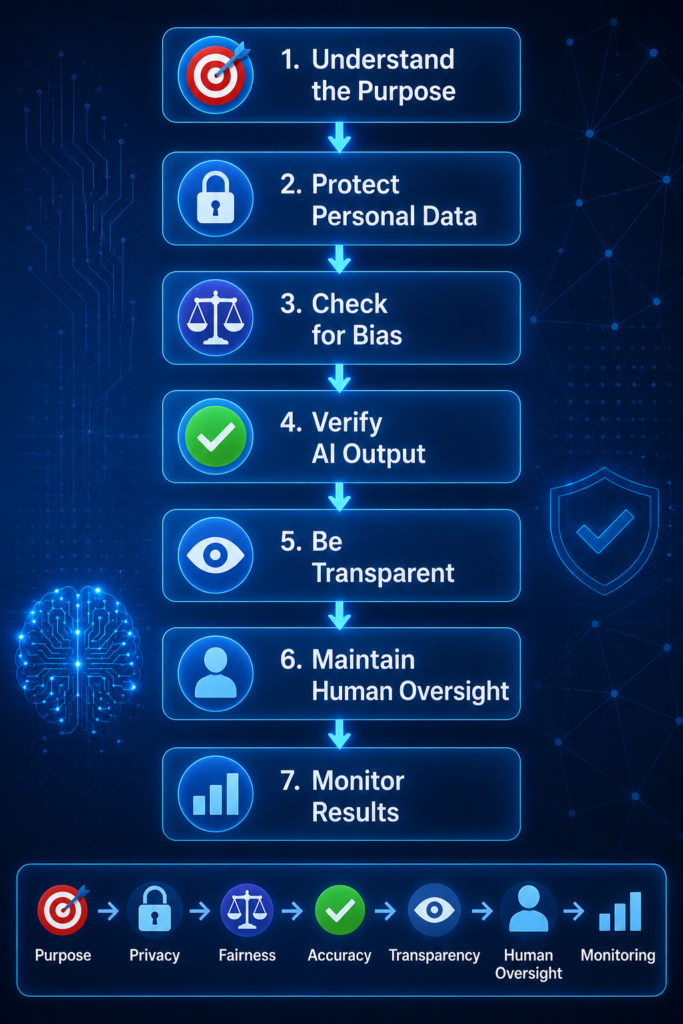
Responsible AI isn’t only the responsibility of technology companies and governments. Individuals, students, employees, and businesses also influence how AI affects society through the ways they use it.
You don’t need to be an AI expert to use these tools more responsibly. A few practical habits can make a significant difference.
1. Understand Why You Are Using AI
Before using an AI system, clearly identify the problem you’re trying to solve.
Ask:
What task do I want AI to help with?
Does AI actually make sense for this task?
What could happen if the AI gets it wrong?
Using AI to brainstorm social media captions, for example, generally carries different risks from using AI to influence hiring, lending, medical, or financial decisions.
The potential consequences should influence the level of oversight required.
2. Protect Personal and Sensitive Data
Be careful about the information you enter into AI tools.
Avoid unnecessarily providing:
- Passwords and login credentials
- Banking information
- Confidential customer records
- Private employee information
- Authentication keys
- Sensitive business documents
- Personally identifiable information
Businesses should establish clear policies explaining what employees can and cannot share with AI systems.
Before processing sensitive information, review the provider’s current privacy, security, retention, and data-use policies.
3. Verify Important AI-Generated Information
AI-generated answers can sound convincing while still containing errors.
Don’t automatically publish or act on important information simply because an AI generated it.
Instead:
AI Generates → Human Reviews → Reliable Sources Verify → Final Decision
Fact-check important statistics, quotations, references, dates, product information, and other factual claims.
Extra care is necessary for high-impact areas such as healthcare, finance, law, security, and education.
4. Check for Bias and Unfair Outcomes
Businesses using AI to evaluate or make recommendations about people should consider whether the system could unfairly disadvantage certain individuals or groups.
This is especially important in areas such as:
Recruitment • Lending • Insurance • Education • Healthcare
Organizations should test relevant systems, monitor outcomes, provide appropriate review mechanisms, and investigate complaints rather than assuming an AI system is automatically neutral.
5. Be Transparent About AI Use When Appropriate
People should receive appropriate information when AI meaningfully affects their experience or when AI-generated content could reasonably be mistaken for something else.
For example, businesses should avoid using AI-generated testimonials that falsely appear to come from real customers.
Similarly, deceptive AI-generated images, audio, or videos should not be presented as authentic events.
Transparency helps maintain trust.
6. Keep Humans Involved in Important Decisions
AI can provide recommendations, summaries, predictions, and analysis, but consequential decisions often require human judgment.
Human oversight is particularly important when decisions affect someone’s:
- Health
- Employment
- Education
- Finances
- Safety
- Legal rights or opportunities
The person reviewing the AI should have genuine authority to question or override its recommendation.
7. Monitor AI After Deployment
Responsible AI doesn’t end when a system is launched.
Businesses should continue monitoring how AI performs.
Ask:
Is it producing accurate results?
Are unexpected problems appearing?
Are customers reporting issues?
Have circumstances changed since the system was introduced?
Are safeguards still effective?
AI systems and the environments in which they operate can change, so ongoing monitoring matters.
A Simple Responsible AI Checklist
Before using AI for an important task, remember:
Purpose → Privacy → Fairness → Accuracy → Transparency → Human Oversight → Monitoring
Purpose: Is AI appropriate for this task?
Privacy: Are we protecting personal and confidential information?
Fairness: Could the system produce unfair outcomes?
Accuracy: Have important outputs been checked?
Transparency: Should people know AI is being used?
Human Oversight: Who reviews important recommendations and makes the final decision?
Monitoring: How will we identify and respond to problems?
This checklist won’t address every possible ethical issue, but it provides a practical starting point.
The Role of Governments, Companies, Developers, and Users
Responsible AI requires participation from different groups.
Governments and regulators can establish laws, standards, and protections addressing areas such as privacy, discrimination, consumer protection, and AI safety.
AI developers and technology companies can test systems, improve security, document limitations, evaluate risks, and build appropriate safeguards.
Businesses and organizations are responsible for deciding where and how AI is deployed, protecting data, training employees, monitoring outcomes, and maintaining accountability.
Individual users also have responsibilities. They can verify important information, protect sensitive data, avoid deceptive uses, respect applicable rules, and maintain critical thinking when interacting with AI.
The responsibility therefore shouldn’t fall on only one group.
Developers + Businesses + Governments + Users → Shared Responsibility for Better AI Outcomes
As artificial intelligence becomes increasingly integrated into society, responsible use will require cooperation between all of these groups.
Frequently Asked Questions About AI Ethics
1. What Is AI Ethics in Simple Terms?
AI ethics refers to principles and practices that guide how artificial intelligence should be developed and used responsibly.
It focuses on questions involving fairness, privacy, transparency, accountability, safety, security, and human oversight.
In simple terms:
AI Ethics = Using AI in ways that seek useful benefits while reducing unnecessary harm.
2. Why Is AI Ethics Important?
AI can influence decisions and activities involving employment, education, healthcare, finance, communication, privacy, and many other areas.
Without appropriate safeguards, AI systems can contribute to problems such as unfair outcomes, privacy violations, misinformation, security risks, and harmful over-reliance.
AI ethics helps individuals and organizations consider these risks before and during the use of AI.
3. What Are the Biggest Ethical Risks of AI?
Some major ethical concerns include:
- Bias and discrimination
- Privacy and data protection
- Misinformation and deepfakes
- Lack of transparency
- Security and malicious use
- Over-reliance on automated recommendations
- Workplace and employment disruption
- Difficulty determining accountability
The level of risk depends heavily on how the AI system is designed, where it is used, and the consequences if something goes wrong.
4. Can Artificial Intelligence Be Biased?
Yes. AI systems can produce biased or unfair outcomes.
Bias can arise from training data, data collection methods, system design, objectives, evaluation methods, or the environment where an AI system is deployed.
This is why organizations should not simply assume:
“AI is a computer, therefore it must be neutral.”
Testing, monitoring, diverse data where appropriate, human review, and mechanisms for addressing problematic outcomes can help manage bias.
5. Is AI-Generated Information Always Reliable?
No.
Generative AI can sometimes produce incorrect, outdated, incomplete, or fabricated information while presenting it confidently.
Users should verify important information using reliable sources rather than assuming every AI-generated response is accurate.
Remember:
AI Output ≠ Automatically a Fact
6. How Can Small Businesses Use AI Responsibly?
Small businesses can start with several practical principles:
Protect customer data → Verify AI-generated information → Review marketing claims → Maintain human oversight → Monitor automated processes
Businesses should also understand the privacy and security policies of the AI services they use, particularly before processing confidential information.
7. Should AI Replace Human Decision-Making?
It depends on the task and its consequences.
Automating a low-risk repetitive administrative task is very different from using AI to make decisions affecting someone’s health, employment, finances, education, or legal opportunities.
For consequential decisions, meaningful human judgment and appropriate safeguards can be particularly important.
A useful principle is:
AI Assists → Humans Evaluate → Humans Remain Accountable
Final Thoughts
Artificial intelligence has enormous potential to improve productivity, accessibility, creativity, research, business operations, and many other areas of society.
But powerful technology also brings responsibility.
The goal of AI ethics isn’t to portray artificial intelligence as either completely good or completely dangerous. Instead, it is to ask how we can obtain useful benefits while recognizing and managing genuine risks.
Throughout this guide, we’ve explored important principles including:
Fairness • Privacy • Transparency • Accountability • Safety • Security • Human Oversight
We’ve also examined major concerns such as AI bias, misinformation, deepfakes, privacy risks, lack of transparency, malicious use, workplace disruption, and over-reliance on automated recommendations.
A responsible approach can be summarized as:
Understand the Purpose → Identify Risks → Protect Data → Check Fairness → Verify Outputs → Maintain Human Oversight → Monitor Results
As AI continues developing, governments, technology companies, businesses, educational institutions, and individual users will all have roles to play.
Responsible AI isn’t only about what technology can do.
It’s also about making thoughtful decisions about how, where, and why we use it.
Learn to Use AI Responsibly
AI literacy is becoming an increasingly valuable digital skill. Ready to develop your practical AI skills? Learn how to Write Effective AI Prompts and discover how clear instructions, relevant context, and human verification can improve the way you work with generative AI.
Don’t focus only on learning how to use AI tools. Learn how to evaluate their outputs, protect your information, recognize their limitations, and use them responsibly.
If you’re beginning your AI journey, continue exploring our BuildSmartAfri guides on AI tools, prompt engineering, online business, and digital skills to develop practical knowledge for using artificial intelligence more effectively.
Learn AI → Understand Its Limitations → Use It Responsibly → Keep Human Judgment Involved
Disclaimer
This article is provided for educational and informational purposes only and should not be considered legal, regulatory, financial, medical, cybersecurity, or other professional advice.
Artificial intelligence technologies, regulations, standards, and industry practices continue to evolve. Specific requirements may vary depending on your country, industry, organization, and intended AI application.
Examples in this article are simplified for educational purposes and should not be interpreted as conclusions about any particular AI system or organization.
Businesses and organizations considering AI for consequential applications should evaluate the relevant risks, applicable laws, professional requirements, security considerations, and appropriate safeguards for their specific circumstances.
AI-generated information should also be independently reviewed when accuracy matters.
Responsible AI begins with informed human judgment, appropriate safeguards, and accountability.