

Introduction
Affiliate marketing has become one of the most popular ways to build an online business because you can start without creating your own product, managing inventory, or handling customer deliveries. Instead, you recommend products or services offered by other companies and earn a commission when someone makes a qualifying purchase or completes another specified action through your affiliate link. Affiliate marketing is one of several ways to build a digital business. If you’re completely new to online entrepreneurship, start with our guide on What Is an Online Business? to understand the basics.
For beginners, this business model can be attractive because the startup costs can be relatively low. You can promote products through a blog, YouTube channel, social media account, email newsletter, or other online platforms. What matters most is building an audience, creating genuinely useful content, and recommending products that are relevant to the people you want to help.
However, affiliate marketing is not a get-rich-quick method. Simply joining an affiliate program and posting links everywhere is unlikely to create a sustainable business. Successful affiliate marketers typically spend time understanding their audience, producing helpful content, attracting targeted traffic, earning trust, and testing which recommendations actually serve their readers or viewers.
The basic process is straightforward:
Choose a Niche → Build a Platform → Join Affiliate Programs → Create Helpful Content → Add Affiliate Links → Attract Visitors → Generate Sales → Earn Commissions
In this detailed beginner’s guide, you’ll learn how to start affiliate marketing for beginners step by step. We’ll cover how affiliate marketing works, choosing a niche, finding affiliate programs, creating content, generating traffic, using affiliate links correctly, avoiding common mistakes, and building a strategy that can grow over time.
By the end, you’ll have a clear roadmap for starting your affiliate marketing journey even if you’ve never earned money online before.
What Is Affiliate Marketing?
Affiliate marketing is a type of online marketing where you promote another company’s product or service and earn a commission when someone takes a qualifying action through your unique affiliate link. Depending on the program, that action could be a purchase, registration, subscription, or another specified conversion. Affiliate marketing is commonly described as performance-based marketing, where advertisers reward publishers for generating desired outcomes such as sales or new customers. You can learn more from CJ Affiliate’s explanation of affiliate marketing
Instead of creating your own product, you connect potential customers with products or services that may help them. The company handles areas such as product development, payments, delivery, and customer service, while your main responsibility is attracting an audience and making useful, relevant recommendations.
There are usually three main parties involved:
1. The Merchant
The merchant is the company or individual selling the product or service. This could be an online store, software company, web-hosting provider, course creator, or another business.
2. The Affiliate
The affiliate is the person or business promoting the merchant’s offer. Affiliates may use blogs, YouTube videos, social media, email newsletters, or other content to reach potential customers.
3. The Customer
The customer is the person who clicks the affiliate’s recommendation and potentially purchases the product or completes the required action.
The process looks like this:
Merchant → Affiliate → Customer → Purchase/Action → Commission
What Is an Affiliate Link?
When you join an affiliate program, you typically receive a unique tracking link. This link helps the merchant identify visitors or conversions referred by you.
For example, imagine you run a technology blog and write an article about the best laptops for students. You recommend a laptop and include your affiliate link. A reader clicks the link, visits the retailer, and makes a qualifying purchase. If the purchase meets the affiliate program’s terms, you receive a commission.
How Are Affiliate Sales Tracked?
Affiliate programs commonly use tracking technologies and unique identifiers to attribute referrals. Some programs also use cookies with specific attribution periods. The exact tracking rules, commission rates, qualifying actions, and payment conditions vary from one affiliate program to another.
This is why beginners should always read an affiliate program’s terms before promoting its products.
Affiliate marketing is therefore more than simply sharing links. A sustainable approach is built around helpful content, relevant recommendations, targeted traffic, and audience trust.
How Does Affiliate Marketing Work?
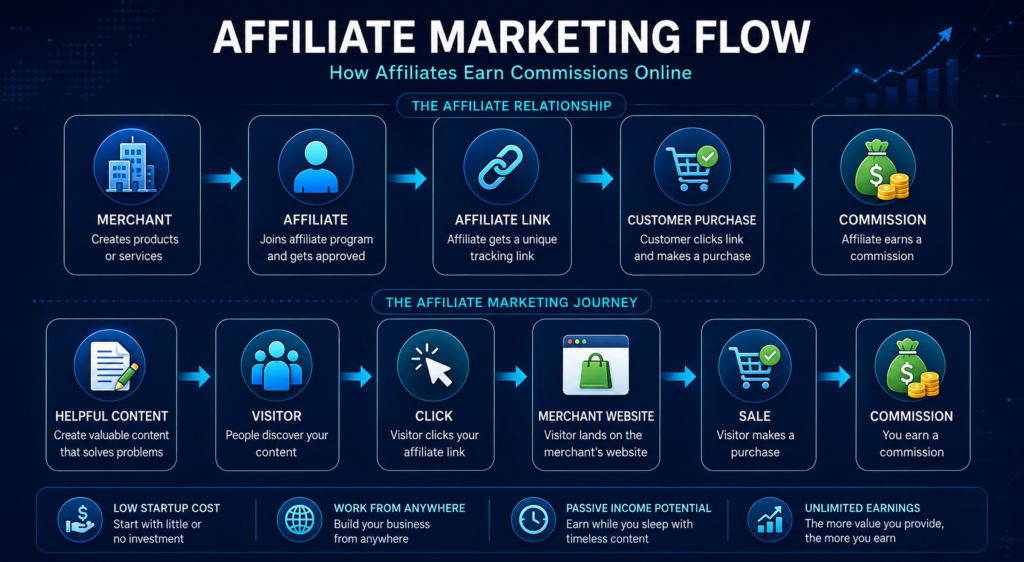
Affiliate marketing works by connecting a business that wants to sell a product or service with an affiliate who can introduce that product to potential customers. When the affiliate generates a qualifying sale or other specified action, the affiliate earns a commission.
The basic process looks like this:
Join an Affiliate Program → Get Your Affiliate Link → Create Helpful Content → Attract Visitors → Visitor Clicks Your Link → Customer Makes a Purchase → You Earn a Commission
Let’s break down each step.
1. Join an Affiliate Program
First, you find a company or affiliate network that offers products or services related to your niche. You apply to its affiliate program and, if approved, gain access to products you can promote.
2. Get Your Unique Affiliate Link
The affiliate program provides a special tracking link connected to your account. This allows the company to identify customers you refer.
You should use your own affiliate link rather than simply copying the company’s normal product URL.
3. Create Helpful Content
Next, create content that helps people make decisions or solve problems. This could include:
- Product reviews
- Tutorials
- Comparison articles
- Buying guides
- YouTube videos
- Social media content
- Resource pages
Instead of repeatedly telling people to buy something, explain why, when, and for whom a product may be useful.
4. Attract Potential Customers
People need to discover your content before affiliate marketing can work. You can attract visitors through Google Search, YouTube, social media, email marketing, and other relevant channels.
For example, someone searching Google for “best laptops for university students” might discover your article comparing several suitable laptops.
5. The Visitor Clicks Your Affiliate Link
Suppose the reader finds one of your recommendations useful and clicks your affiliate link.
The merchant’s affiliate system records information needed to attribute that referral according to the program’s tracking rules.
6. The Customer Makes a Qualifying Purchase
The visitor reaches the merchant’s website and decides whether to purchase. You don’t normally process the payment yourself the merchant handles the transaction, product delivery, returns, and customer support.
Whether you receive credit for the transaction depends on the affiliate program’s attribution rules and terms.
7. You Earn a Commission
When a qualifying conversion is successfully attributed to you, the commission appears in your affiliate account. Programs may have minimum payout thresholds, payment schedules, validation periods, and different payment methods.
Practical Example
Imagine you create a blog about website building.
You publish an article titled:
“How to Start a Blog for Beginners”
Inside the article, you explain how to create a website and recommend a web-hosting service that has an affiliate program.
A reader discovers your article through Google, follows your hosting affiliate link, and purchases an eligible hosting plan.
The process becomes:
Google Search → Your Blog → Hosting Recommendation → Affiliate Link → Hosting Company → Qualifying Purchase → Commission
The important point is that the content comes first. Your goal should be helping readers make informed decisions rather than inserting affiliate links everywhere. When your recommendations are relevant and trustworthy, affiliate links can become a natural part of useful content.
Why Affiliate Marketing Is Good for Beginners
Affiliate marketing can be an attractive online business model for beginners because it removes many of the challenges involved in creating and selling your own products. Your main focus is on building an audience, creating useful content, and connecting people with relevant products or services. One advantage of affiliate marketing is its relatively low barrier to entry. Our guide on how to start an online business with little money explores other ways beginners can launch an online business on a limited budget.
Here are some of the main advantages.
1. Low Startup Costs
You don’t necessarily need a large amount of money to begin affiliate marketing. You can start by creating content on a blog, YouTube channel, or social media platform.
Your initial expenses may include things like a domain name, web hosting, content tools, or equipment, depending on the platform you choose.
2. You Don’t Need Your Own Product
Creating a product can require significant time and money. With affiliate marketing, you promote products or services that already exist.
This allows you to concentrate on marketing and content creation instead of product development.
3. No Inventory or Shipping
If you’re promoting physical products, you normally don’t need to purchase or store inventory.
When someone buys through your affiliate link, the merchant handles the transaction and fulfillment. This can make affiliate marketing easier to manage than running a traditional online store.
4. You Can Work From Anywhere
Because most of the work happens online, affiliate marketing can be managed from almost anywhere with a reliable internet connection.
You can create articles, record videos, research products, analyze performance, and manage your affiliate accounts using a computer or smartphone.
5. Many Niches to Choose From
Affiliate marketing exists across many industries, including:
- Technology
- Software
- Education
- Travel
- Fashion
- Business
- Web hosting
- Productivity tools
- Home and lifestyle
This gives beginners the opportunity to choose a niche that matches their knowledge, interests, and audience. Affiliate marketing isn’t the only business model available. Explore our Best Online Business Ideas for Beginners if you’re still deciding which online business matches your skills and interests.
6. You Can Build Multiple Traffic Sources
You aren’t limited to one platform. For example, you could publish an in-depth article on your website, create a related YouTube video, share shorter content on social media, and build an email audience.
Over time, these channels can work together to send people to your useful affiliate content.
7. It Can Scale Over Time
A useful article or video can continue attracting visitors after you publish it, although traffic and rankings are never guaranteed.
As you create more quality content and build an audience, you may generate more affiliate clicks and potential conversions without increasing your workload at exactly the same rate.
Affiliate Marketing Is Not Easy Money
These advantages don’t mean affiliate marketing guarantees income.
A new affiliate could spend months creating content without earning meaningful commissions. Results depend on factors such as your niche, content quality, traffic, audience trust, product selection, conversion rates, competition, and affiliate program terms.
That’s why beginners should approach affiliate marketing as a real online business, not a shortcut to quick money.
The better approach is:
Learn → Create Value → Build an Audience → Recommend Relevant Products → Track Results → Improve
With that foundation established, the next and most important part is learning how to start affiliate marketing for beginners’ step by step.
How to Start Affiliate Marketing for Beginners: Step-by-Step
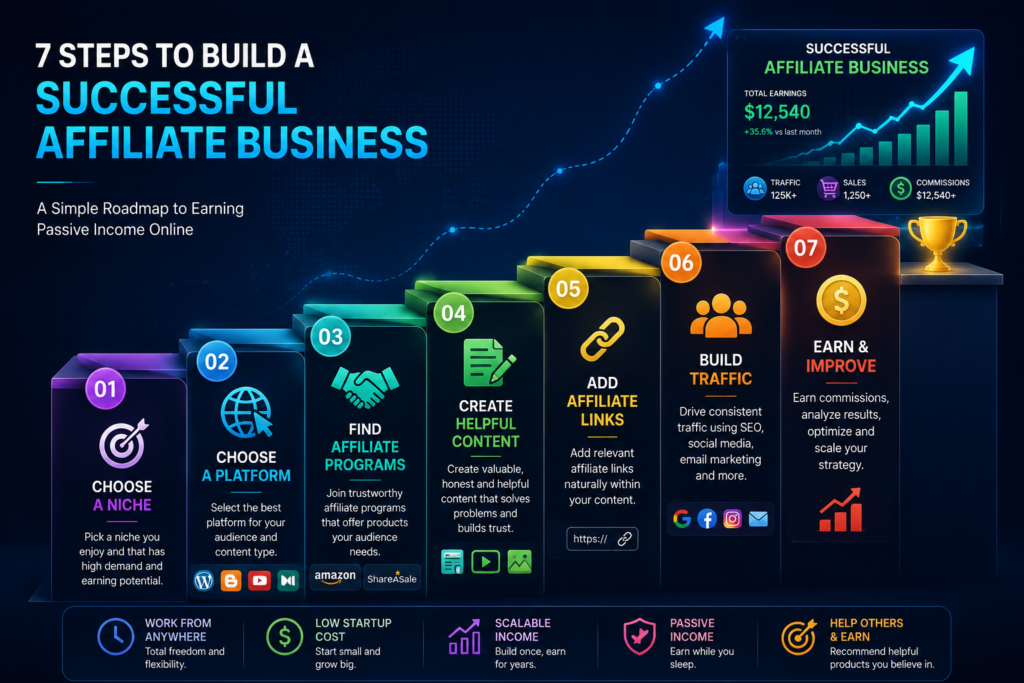
Now that you understand how affiliate marketing works, the next step is putting it into practice. You don’t need to create everything at once. Start with a clear niche, one main content platform, and a small number of relevant products.
Step 1: Choose Your Affiliate Marketing Niche
A niche is the specific topic or market your content focuses on. Choosing a focused niche makes it easier to understand your audience and recommend relevant products.
Popular affiliate marketing niches include:
- Technology and software
- AI tools
- Web hosting and website building
- Personal finance
- Education
- Travel
- Beauty and fashion
- Fitness
- Online business
- Home and lifestyle
For example, instead of creating a website about everything related to technology, you could focus specifically on AI tools for content creators or laptops for students.
When choosing a niche, consider three things:
Your knowledge or interest + Audience demand + Products you can genuinely recommend
Don’t select a niche only because you see high commission rates. You need enough interest in the topic to consistently create useful content.
Step 2: Choose Your Content Platform
Next, decide where you’ll build your audience.
A blog or website is useful for publishing views, tutorials, comparisons, and buying guides that can attract visitors through search engines. A website can become an important platform for publishing tutorials, reviews, comparisons, and buying guides. Our guide on How to Start a Blog That Makes Money explains the process of building and growing a blog.
YouTube works particularly well for demonstrations, tutorials, product reviews, and comparisons.
Platforms such as TikTok, Instagram, and Facebook can help you reach audiences through shorter content.
You don’t need to master every platform immediately. A beginner could start with:
Blog + YouTube
or
YouTube + Social Media
Start with one primary platform and expand once you have a consistent content workflow.
Step 3: Find Relevant Affiliate Programs
Once you’ve chosen your niche, look for companies selling products your audience might genuinely need.
There are two common ways to find programs.
Direct affiliate programs are operated by individual companies. You apply directly through the company’s website.
Affiliate networks bring many merchants and affiliate programs together on one platform, making it possible to discover and manage multiple partnerships.
Before joining any program, check:
- Product relevance
- Commission structure
- Attribution/tracking terms
- Payment schedule
- Minimum payout requirements
- Geographic restrictions
- Promotional rules
- Program reputation
Don’t choose a program solely because it offers a high commission.
Step 4: Apply to Affiliate Programs
Affiliate programs usually require an application.
You may be asked for information such as your website, social media profile, YouTube channel, niche, audience, traffic sources, and how you plan to promote products.
Some programs accept beginners, while others require an established website or audience.
Make sure your platform looks legitimate before applying. If you’re using a blog, publish several useful articles and create essential pages such as About, Contact, Privacy Policy, and Affiliate Disclosure.
Never provide false traffic or audience information to improve your chances of approval.
Step 5: Choose the Right Products to Promote
Getting accepted doesn’t mean you should promote every available product.
Ask yourself:
Does this product solve a real problem for my audience?
For example, if you run a blog teaching beginners how to build websites, relevant recommendations might include:
- Web hosting
- WordPress themes
- Website tools
- Email marketing software
- SEO tools
Randomly promoting unrelated products can weaken your audience’s trust.
Whenever possible, recommend products you’ve personally used or can evaluate responsibly. If you haven’t personally tested something, don’t pretend that you have.
Step 6: Create Valuable Affiliate Content
Content is one of the most important parts of affiliate marketing.
Instead of publishing:
“Buy this product now!”
create content that helps someone understand a problem and make an informed decision. Creating quality affiliate content consistently can require significant time. Explore our Best AI Tools for Content Creators to discover tools that can assist with research, writing workflows, graphics, and content production.
Useful affiliate content can include:
- How-to tutorials
- Product reviews
- Product comparisons
- Buying guides
- Best-product lists
- Case studies
- YouTube demonstrations
For example, someone searching:
“Best AI writing tools for bloggers”
is likely trying to compare options before making a decision.
A detailed article explaining the strengths, limitations, pricing considerations, and ideal users of several tools can help that reader while naturally creating opportunities for relevant affiliate links.
Step 7: Add Affiliate Links Naturally
Once you’ve created helpful content, place affiliate links where they genuinely help the reader take the next step.
For example:
“If you want to explore the tool yourself, you can view its plans and features here.”
Avoid filling every paragraph with affiliate links. Too many links can make your content look promotional and reduce reader trust.
Your affiliate link should support the content—not become the entire purpose of the content.
Step 8: Clearly Disclose Affiliate Relationships
Readers should know when you may receive compensation from recommendations.
Place a clear affiliate disclosure somewhere readers can easily notice it, particularly before or near affiliate recommendations where appropriate.
For example:
Affiliate Disclosure: Some links in this article are affiliate links. If you make a purchase through one of these links, we may earn a commission at no additional cost to you.
You should also follow the disclosure requirements that apply to your location, audience, platforms, and the affiliate programs you participate in.
Step 9: Drive Targeted Traffic
Affiliate marketing requires people to discover your content.
You can build traffic through:
SEO: Create useful articles targeting questions people search for on Google and other search engines.
YouTube: Publish tutorials, comparisons, reviews, and demonstrations.
Social Media: Use platforms such as Facebook, TikTok, Instagram, and others relevant to your audience.
Email Marketing: Build an email audience you can communicate with directly, while following applicable marketing and consent rules.
Quality matters more than simply chasing large visitor numbers. A smaller audience genuinely interested in your niche may be more valuable than thousands of unrelated visitors.
Step 10: Track Your Results and Improve
Don’t simply publish affiliate links and forget about them.
Most affiliate dashboards provide performance information such as:
Clicks → Conversions → Commission
You should also monitor which articles or videos attract visitors and which recommendations generate meaningful engagement.
For example, if a detailed tutorial generates more conversions than a general product article, that tells you something about what your audience finds valuable.
Use those insights to improve existing content and decide what to create next.
A Simple Beginner Strategy
If you’re completely new, keep your first strategy simple:
Choose 1 Niche → Choose 1 Main Platform → Join 2–3 Relevant Programs → Publish Helpful Content → Build Traffic → Track Results → Improve
You don’t need dozens of affiliate programs or hundreds of articles before you can begin.
The goal is to create a trustworthy system where useful content attracts the right audience, relevant recommendations help them make decisions, and qualifying conversions can generate commissions.
Best Affiliate Marketing Platforms and Networks for Beginners
Once you understand the basics of affiliate marketing, the next step is finding reputable programs with products or services that fit your audience. An affiliate network acts as a middle layer between affiliates and multiple brands, often providing tracking, reporting, links, and commission management in one place. Beginners looking for different brands and affiliate opportunities can explore Awin, which connects creators and affiliate partners with thousands of brands across different industries. Another platform worth exploring is impact.com’s affiliate marketplace, where affiliates can discover brands, generate tracking links, and monitor partnership performance.
You don’t need to join every network you find. Start with one or two that offer products closely related to your niche.
1. Amazon Associates
Amazon Associates is Amazon’s affiliate program and can be useful for content creators who recommend physical products sold on Amazon.
For example, a technology blogger might create articles about laptops, computer accessories, monitors, keyboards, or other electronics and link readers to relevant products. Bloggers and publishers who recommend physical products can also research Amazon Associates and review its current eligibility requirements, commission structure, and operating agreement before applying.
One advantage is the enormous range of products available. However, commission rates and program rules vary, so always check the current terms before building your strategy around it.
Best for: Product reviews, buying guides and physical-product niches.
2. Awin
Awin is a large affiliate network connecting publishers and creators with brands across areas including retail, technology, travel, fashion and other sectors. Awin currently says its ecosystem includes more than 30,000 brands and over 1 million approved partners.
A beginner can browse available advertisers and apply to programs relevant to their audience.
For example, someone running a travel blog could look for travel-related programs, while a technology publisher could search for suitable electronics or technology brands.
Best for: Bloggers and creators who want access to a broad selection of brands.
3. impact.com
impact.com provides a marketplace where affiliates and creators can discover and work with brands across categories such as retail, travel, beauty, fitness and financial services. It also provides reporting and tracking tools for managing partnerships.
This can be particularly useful as your affiliate business grows because you can manage multiple partnerships and analyze their performance from one platform.
Best for: Content creators, publishers and affiliates looking for partnerships across multiple industries.
4. CJ Affiliate
CJ Affiliate is another established affiliate network connecting publishers with brands. CJ describes affiliate marketing as performance-based marketing in which advertisers reward publishers for outcomes such as transactions or new-customer acquisition.
Publishers can use the platform to find advertisers, generate tracking links and monitor affiliate performance.
If you’re building a professional blog with commercial content such as reviews, comparisons and buying guides, CJ may be worth exploring as your website develops.
Best for: Bloggers, publishers and more established content websites.
5. PartnerStack
PartnerStack focuses heavily on B2B software and SaaS partnerships. Its marketplace allows partners to discover software companies with partnership programs, making it particularly relevant to technology, software, AI and online-business content. If your content focuses on software, AI, technology, or online business, you can explore PartnerStack, which focuses on partnerships with B2B software brands.
For example, someone creating content about:
- Business software
- Marketing tools
- Productivity applications
- AI software
- Online business tools
could potentially find relevant programs through PartnerStack.
Best for: Technology, software, SaaS, AI and online-business creators.
Direct Affiliate Programs Are Important Too
You don’t always need an affiliate network.
Many companies operate their own affiliate or partner programs. If you already use a product and regularly mention it in your content, visit the company’s official website and look for pages labelled:
Affiliate Program, Partner Program, Referral Program, or Become a Partner.
Direct programs can sometimes be a better fit because you’re intentionally choosing a product that already matches your content rather than searching for something simply because it pays a commission.
What Should Beginners Look for Before Joining?
Don’t ask only:
“Which program pays the highest commission?”
Instead, consider the full picture:
Product relevance → Product quality → Audience needs → Commission structure → Tracking rules → Payout requirements → Program reputation
For example, earning a high percentage from a poor product your audience doesn’t need isn’t necessarily better than earning a smaller commission from something your readers genuinely value.
Also remember that commission rates, eligibility, attribution windows, payment methods and program rules can change. Always check the latest terms on the affiliate program’s official website before applying or publishing promotional content.
For beginners, the goal isn’t to join 20 networks. Start with 2–3 relevant programs, learn how they work, create genuinely useful content around appropriate products, and expand your partnerships as your audience grows.
How to Create Affiliate Content That Converts

Joining affiliate programs is only the beginning. To generate commissions, you need content that attracts the right audience, answers their questions, and helps them make informed purchasing decisions.
The goal shouldn’t be to push people into buying products. Strong affiliate content solves a problem first and recommends a product second.
1. Write Helpful Product Reviews
Product reviews can work well because readers searching for reviews are often already considering a purchase.
A useful review should explain:
- What the product does
- Key features
- Advantages and disadvantages
- Who it’s best suited for
- Important limitations
- Pricing considerations
- Alternatives worth considering
- Your experience, if you’ve actually used it
Avoid describing every product as “the best.” Readers are more likely to trust a balanced review that discusses both strengths and weaknesses.
2. Create Product Comparison Content
Comparison articles help readers choose between two or more products.
For example:
Canva vs Adobe Express: Which Is Better for Beginners?
Instead of simply declaring a winner, compare factors such as features, ease of use, pricing, limitations, and ideal users.
You can then include affiliate links for eligible products where appropriate.
3. Publish “Best” List Articles
Another popular format is a curated list targeting a specific need.
Examples include:
10 Best AI Tools for Content Creators
7 Best Laptops for University Students
5 Best Website Builders for Beginners
These articles can have strong commercial intent because readers are actively comparing options.
However, don’t create huge lists simply to include more affiliate links. Select products that genuinely fit the reader’s needs and explain why each one deserves consideration.
4. Create How-To Tutorials
Tutorials are particularly useful because they solve specific problems while naturally introducing relevant products.
For example, an article titled:
How to Start a Blog That Makes Money
could teach readers how to choose a niche, register a domain, set up WordPress, create content, and grow traffic.
When discussing web hosting, you could naturally recommend an appropriate hosting provider through an affiliate link if you have a relationship with that company.
The recommendation fits because the product helps the reader complete the task.
5. Create Buying Guides
Buying guides help readers understand what they should consider before purchasing something.
Suppose your niche is laptops. You could publish:
How to Choose the Best Laptop for Students
The article could explain processors, RAM, storage, battery life, display quality, portability, and budget before recommending suitable models.
This approach builds trust because you’re educating readers rather than immediately asking them to purchase.
6. Use Video Content
Affiliate marketing isn’t limited to written articles.
You can create YouTube videos, short-form videos, demonstrations, tutorials, and comparisons.
For example, you could make a video showing how an AI tool works and direct interested viewers to an appropriately disclosed affiliate link, subject to the platform’s and affiliate program’s rules.
Video can be especially useful when people want to see a product or software interface before making a decision.
Match Content With Search Intent
Understanding search intent can improve your affiliate content.
Someone searching:
“What is web hosting?”
is probably still learning.
Someone searching:
“Best web hosting for beginners”
may be comparing options.
Someone searching:
“Host A vs Host B”
may be much closer to making a decision.
Create content for different stages of that journey rather than publishing only sales-focused articles.
A useful content path could look like:
Educational Article → Tutorial → Comparison → Product Recommendation → Affiliate Link
Don’t Sacrifice Trust for Commissions
Your audience’s trust is one of your most valuable assets.
Don’t recommend a poor product simply because it offers a higher commission. Don’t claim you’ve personally tested something when you haven’t, and don’t hide important disadvantages that could affect a reader’s decision.
A reader who trusts your recommendations may return for future advice. Someone who feels misled probably won’t.
The principle to remember is:
Solve the Problem → Educate the Reader → Build Trust → Recommend Relevant Products → Let the Reader Decide
High-converting affiliate content isn’t necessarily the content with the most affiliate links. It’s content that helps the right reader make a confident and informed decision.
How to Get Traffic to Your Affiliate Content
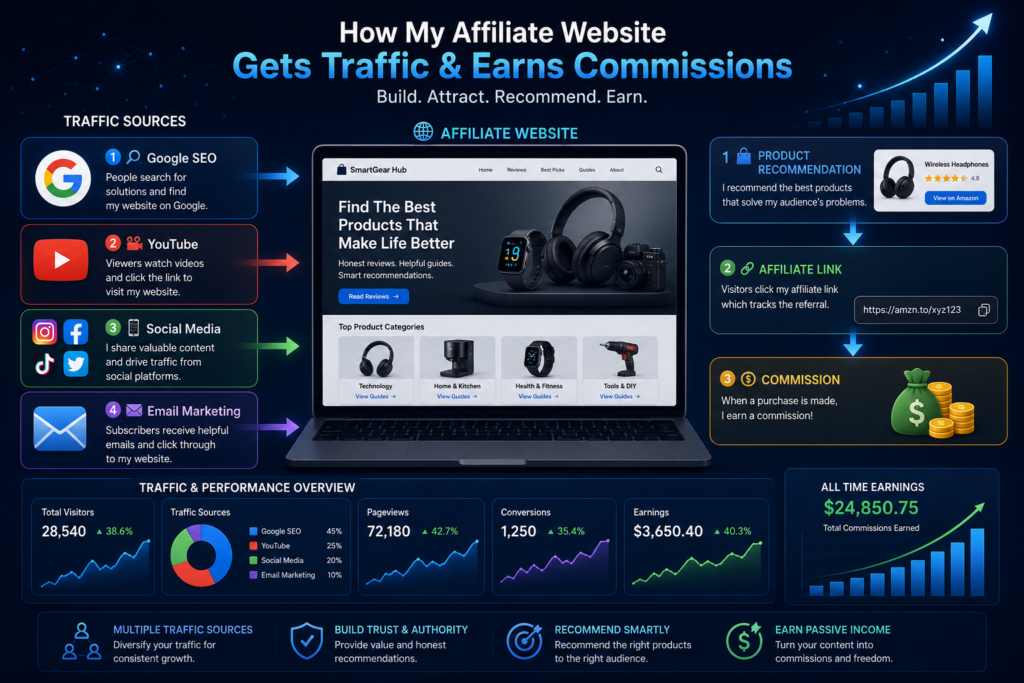
Creating useful affiliate content is important, but it won’t generate results if nobody sees it. Traffic simply means the people who visit your website, watch your videos, read your emails, or interact with your content.
For affiliate marketing, the goal isn’t just to attract as many people as possible. You want targeted traffic—people who are genuinely interested in the problems, products, or services you discuss.
Here are some of the main ways beginners can build traffic.
1. Use SEO to Get Search Traffic
Search engine optimization (SEO) can help your articles become more discoverable when people search for relevant information. If you’re building affiliate traffic through blogging, Google’s official Search Central documentation provides guidance on creating search-friendly websites and understanding how Google Search works.
For example, if your website focuses on AI tools, you might create articles around searches such as:
- Best AI tools for students
- Best AI tools for content creators
- How to use AI for blogging
- AI writing tools for beginners
- Canva alternatives for beginners
Instead of targeting only broad, highly competitive keywords, beginners can also focus on specific questions and long-tail keywords.
Your articles should provide genuinely useful answers while using clear titles, headings, internal links, descriptive images, and other basic SEO practices.
SEO usually takes time, so don’t expect every new article to immediately receive significant Google traffic.
2. Create YouTube Videos
YouTube can be especially useful for affiliate marketing because viewers can see how products work before deciding whether they’re right for them.
You could create:
Tutorials:
“How to Create a Website with WordPress”
Reviews:
“Is This AI Writing Tool Worth Using?”
Comparisons:
“Tool A vs Tool B: Which Is Better?”
Lists:
“5 Best AI Tools for Content Creators”
Where permitted, you can include clearly disclosed affiliate links in appropriate locations, such as your video description.
You can also connect your website and YouTube content. For example:
YouTube Video → Detailed Blog Article → Product Recommendation → Affiliate Link
3. Use Social Media
Social media platforms can help you distribute your content and build an audience.
Depending on your niche, you might use platforms such as Facebook, Instagram, TikTok, LinkedIn, or X.
Instead of constantly posting affiliate links, create short pieces of useful content that encourage people to learn more.
For example, you could turn one detailed blog article into:
1 Blog Post → 1 YouTube Video → 3 Short Videos → 5 Social Posts
This allows you to get more value from the research you’ve already completed.
4. Build an Email List
An email list allows interested readers to subscribe and receive future content directly from you.
For example, you could offer a useful free resource such as:
“10 Free AI Tools Every Content Creator Should Know”
Readers who want the guide could subscribe to your newsletter, provided you collect and use their information appropriately.
You can then send useful tutorials, new articles, resources, and relevant product recommendations over time.
Don’t turn every email into a sales message. Focus primarily on providing value and building trust.
5. Participate in Relevant Online Communities
Online communities can also help you understand your audience and attract visitors.
You might participate in relevant Facebook groups, forums, question-and-answer communities, or other niche-specific spaces.
However, avoid joining communities simply to drop affiliate links. Many communities prohibit promotional or affiliate links, and spamming can damage your reputation.
Instead, answer questions, contribute useful information, and share your content only when it is genuinely relevant and permitted.
Don’t Depend on Only One Traffic Source
Depending entirely on one platform can be risky.
Search rankings can change. Social media algorithms can change. Platforms can modify their policies or reduce your reach.
Over time, a stronger strategy might look like:
Google SEO + YouTube + Social Media + Email
You don’t need to build all four immediately. Beginners should usually master one primary traffic source first, then gradually add others.
Most importantly, focus on attracting the right people, not simply achieving impressive visitor numbers.
A smaller audience actively searching for solutions in your niche can potentially generate better affiliate results than a huge audience with little interest in the products you recommend.
Practical Affiliate Marketing Example
To understand how affiliate marketing can work in practice, let’s look at a simple example of a beginner building an affiliate business from the ground up.
Example: Ama Starts a Technology Blog
Ama is interested in technology, AI tools, and digital skills. She wants to start an online business but doesn’t have her own products to sell, so she decides to try affiliate marketing.
Instead of covering every technology topic, she chooses a more focused niche:
Technology and AI Tools for Students and Content Creators
She creates a simple blog and begins publishing useful articles that answer questions her target audience may be searching for.
For example:
- 10 Best AI Tools for Content Creators
- Best AI Image Generators for Beginners
- Best Laptops for University Students
- How to Start a Blog for Beginners
- Best Productivity Tools for Students
Step 1: Ama Creates Helpful Content
Ama doesn’t begin by filling her website with affiliate links.
She focuses first on publishing useful tutorials, comparisons, and educational articles. Her goal is to help readers solve problems and make better decisions.
Over time, some of her articles begin attracting visitors from search engines and social media.
Step 2: She Finds Relevant Affiliate Programs
Ama researches affiliate programs related to products she already discusses.
For example, she might find programs for:
- AI software
- Website hosting
- Productivity tools
- Design software
- Online learning platforms
- Technology products
She reads each program’s requirements and applies to the ones that fit her audience.
Step 3: She Adds Relevant Affiliate Links
Suppose Ama publishes an article titled:
Best AI Tools for Content Creators
Instead of placing random affiliate links throughout the article, she explains what each tool does, its advantages and disadvantages, who it might be suitable for, and important considerations before choosing it.
If one of those companies has approved her for its affiliate program, she can include her disclosed affiliate link where it naturally helps interested readers explore the product.
Step 4: A Reader Finds Her Article
Imagine someone searches Google for:
“best AI tools for content creators”
The person discovers Ama’s article and reads her recommendations.
One particular tool appears suitable for what the reader needs, so they click Ama’s affiliate link.
The journey becomes:
Google Search → Ama’s Blog → Helpful Article → Product Recommendation → Affiliate Link → Merchant’s Website
Step 5: Ama Earns a Commission
If the reader completes a qualifying purchase and the transaction is attributed to Ama according to the affiliate program’s terms, Ama earns a commission.
For example, imagine purely for illustration that an eligible product costs $100 and the program pays a 10% commission on that particular sale.
Ama’s commission would be:
$100 × 10% = $10
That doesn’t mean every visitor earns her $10. Most visitors may never click an affiliate link, and many people who click won’t purchase.
Step 6: She Studies What Works
After publishing consistently, Ama notices that her AI-tool tutorials attract more targeted visitors and affiliate clicks than some of her general technology articles.
Instead of randomly creating more content, she uses that information to produce related articles, such as:
Best Free AI Tools for Bloggers
AI Writing Tools for Beginners
Tool A vs Tool B
How to Use AI for Content Creation
She can also turn those articles into videos and social media posts, giving her additional ways to reach potential readers.
The Complete Affiliate Marketing Journey
Ama’s business can be summarized as:
Choose a Niche → Create a Blog → Publish Helpful Content → Build Traffic → Join Relevant Affiliate Programs → Recommend Useful Products → Generate Clicks → Qualifying Sales → Earn Commissions → Analyze & Improve
Key Lesson
The important part of this example isn’t the affiliate link—it’s everything that happens before the affiliate link.
Ama first creates useful content, attracts the right audience, and helps readers understand their options. Affiliate marketing becomes the monetization method attached to that value.
That’s the mindset beginners should develop:
Don’t start by asking, “How can I get people to click my affiliate links?”
Start by asking:
“What problem can I help my audience solve?”
When useful content, targeted traffic, audience trust, and relevant recommendations work together, affiliate marketing has a much stronger foundation for long-term growth.
How Much Money Can Beginners Make with Affiliate Marketing?
One of the most common questions beginners ask is: “How much money can I make from affiliate marketing?”
There is no fixed amount. Some beginners may earn nothing for their first few months, while others may eventually build meaningful income. Your results depend on your niche, traffic, audience trust, products, commission structure, and how well your content converts visitors into customers.
Affiliate marketing income can be understood using a simple process:
Traffic → Affiliate Link Clicks → Conversions → Commission
A Simple Affiliate Marketing Earnings Example
Imagine your blog receives 5,000 visitors per month.
Suppose:
- 10% click an affiliate link = 500 clicks
- 4% of those visitors make a qualifying purchase = 20 sales
- Average commission per sale = $10
Your estimated affiliate earnings would be:
20 sales × $10 = $200 per month
This is only an example not a prediction or guarantee. Actual conversion rates and commissions can be much higher or lower.
What Determines How Much You Can Earn?
Several factors influence affiliate marketing income.
1. Website or Content Traffic
Generally, having more targeted visitors creates more opportunities for affiliate clicks. However, traffic quality matters more than simply having large numbers.
2. Your Niche
Different niches have different products, customer behavior, competition levels, and commission structures.
For example, physical products may have different commission economics from software subscriptions or digital products.
3. Purchase Intent
Someone reading:
“What Is Web Hosting?”
may simply be learning.
Someone searching:
“Best Web Hosting for Beginners”
may be closer to choosing a provider.
Content targeting people who are actively comparing solutions can therefore play an important role in an affiliate strategy.
4. Conversion Rate
Your conversion rate represents how many referred visitors complete the required action.
Useful content, relevant recommendations, audience trust, and a good merchant experience can all affect conversions.
5. Commission Structure
Affiliate programs use different compensation models. Depending on the program, you might receive a percentage of an eligible purchase, a fixed amount, or recurring commissions for certain subscription products.
Always check the individual program’s current terms.
Don’t Focus Only on Monthly Income
As a beginner, your first goals could be smaller:
First 100 Visitors → First Affiliate Click → First Conversion → First Commission → First Consistent Month
These milestones help you understand whether your strategy is working.
For example, if an article receives plenty of visitors but almost nobody clicks your affiliate links, you may need to improve the relevance or placement of your recommendations.
If many people click but very few convert, you might need to reconsider the product, audience intent, or merchant offer.
Can Affiliate Marketing Become Passive Income?
Affiliate content can sometimes continue generating traffic and commissions after it has been published, but calling affiliate marketing completely passive can be misleading.
Successful affiliates often need to:
- Update old articles
- Check broken links
- Replace discontinued products
- Monitor affiliate program changes
- Create new content
- Improve SEO
- Analyze conversions
- Maintain audience trust
Think of affiliate marketing as a business that can become more scalable over time, rather than guaranteed passive income.
For beginners, the better goal isn’t to ask “How quickly can I make thousands?”
Instead, focus on building:
Quality Content + Targeted Traffic + Audience Trust + Relevant Recommendations + Continuous Improvement
When those pieces grow together, your opportunities to earn affiliate commissions can grow with them.
Common Affiliate Marketing Mistakes Beginners Should Avoid
Affiliate marketing may sound simple join a program, share a link, and earn commissions—but building a sustainable affiliate business requires more than that. Many beginners make mistakes that reduce trust, traffic, and conversions.
Understanding these mistakes early can save you time and help you build a stronger affiliate marketing strategy.
1. Choosing a Niche Only Because It Looks Profitable
One common mistake is selecting a niche solely because other affiliates appear to be making money from it.
A profitable-looking niche isn’t automatically the right niche for you. If you have little interest in the topic, you may struggle to research products and consistently create useful content.
Instead, look for a balance between:
Your Interest or Knowledge + Audience Demand + Monetization Opportunities
2. Promoting Too Many Unrelated Products
Beginners sometimes join numerous affiliate programs and promote almost anything that offers a commission.
This can confuse your audience and weaken your credibility.
If your website focuses on AI and technology, recommending AI software, laptops, web hosting, and productivity tools may make sense. Randomly promoting unrelated products simply because they offer high commissions probably doesn’t.
Keep your recommendations relevant to your audience.
3. Choosing Products Based Only on High Commissions
A product offering a large commission isn’t necessarily a good product to recommend.
Before promoting something, consider:
- Does it solve your audience’s problem?
- Is the company reputable?
- Is the product reasonably good?
- Who is it suitable for?
- Are there important disadvantages?
- Would you feel comfortable recommending it?
Protecting your audience’s trust is more important than chasing one high-paying commission.
4. Creating Content Only to Sell
If every article says “Buy this,” “Click here,” or “Get this product now,” readers may quickly lose interest.
Successful affiliate content should primarily educate or help.
Instead of creating:
“Buy This AI Tool Today”
you could publish:
“How to Choose the Best AI Writing Tool for Your Needs”
Teach readers what to consider, compare suitable options, explain limitations, and then provide relevant recommendations.
Remember:
Help First → Recommend Second → Sell Third
5. Copying Product Information
Don’t simply copy descriptions from a merchant’s website and turn them into an article.
Readers can already find that information on the company’s website.
Add genuine value through explanations, comparisons, examples, screenshots where appropriate, testing or firsthand experience when you have it, and practical advice.
Your content should answer the questions the product’s sales page doesn’t.
6. Publishing Low-Quality AI Content
AI tools can help with brainstorming, research organization, outlining, editing, and content workflows. However, publishing large amounts of unverified AI-generated content can create problems.
Affiliate content should be accurate, original, useful, and written for real people.
If you’re discussing product features, prices, policies, or specifications, verify important information using reliable and current sources.
Use AI as an assistant, not as a replacement for research and judgment.
7. Ignoring Affiliate Disclosures
If you may earn money from an affiliate recommendation, don’t hide that relationship. Affiliate marketers should clearly disclose material relationships with brands. The U.S. Federal Trade Commission’s Endorsement Guides provide guidance on truthful endorsements and disclosure of relationships that could affect how consumers evaluate a recommendation
Clearly disclose affiliate links so readers understand that you may receive compensation if they purchase through them. The FTC’s affiliate disclosure guidance specifically says affiliate relationships should be disclosed clearly and conspicuously; it also advises placing the disclosure close to the recommendation where appropriate.
A simple disclosure could say:
Affiliate Disclosure: This article contains affiliate links. We may earn a commission if you make a qualifying purchase through these links, at no additional cost to you.
Make sure your disclosures comply with applicable laws, platform requirements, and individual affiliate-program rules.
8. Spamming Affiliate Links
Posting your affiliate link repeatedly across Facebook groups, comment sections, forums, or private messages isn’t a sustainable marketing strategy.
It can damage your reputation and may violate community or affiliate-program rules.
A better approach is:
Create Valuable Content → Attract Interested People → Provide Relevant Recommendation → Include Affiliate Link
Give people a reason to trust the recommendation before asking them to click.
9. Ignoring SEO and Traffic Generation
Having affiliate links doesn’t automatically generate sales.
You need people to discover your content.
Learn how to attract targeted visitors through channels such as SEO, YouTube, social media, and email marketing.
For bloggers in particular, publishing helpful articles around questions your target audience searches for can form an important part of a long-term traffic strategy.
10. Expecting Fast Money
This is perhaps the biggest mistake.
A beginner may publish five articles, receive little traffic, earn nothing for a month, and conclude that affiliate marketing doesn’t work.
Building an audience takes time.
Instead of constantly checking your earnings, monitor progress such as:
Content Published → Traffic → Affiliate Clicks → Conversions → Commissions
Your first commission—even if it’s small—can provide useful evidence about what content, audience, and products are working.
11. Buying Too Many Expensive Tools and Courses
You don’t need every premium SEO tool, AI subscription, marketing course, or website plugin when you’re starting.
Begin with the essentials. Invest in additional tools only when you understand how they will improve your business.
Affiliate marketing should not become a situation where you’re spending hundreds of dollars every month before you’ve learned how to attract your first targeted visitors.
12. Giving Up Too Early
Affiliate marketing can take time to gain momentum, especially when relying on organic content.
Your early articles may receive little traffic. Your first videos may get very few views. Some affiliate applications may even be rejected.
Use these experiences to improve.
Publish → Measure → Learn → Improve → Repeat
The beginners who develop valuable skills and consistently improve their content give themselves a stronger foundation than those constantly jumping from one “make money online” strategy to another.
The Better Approach
Avoiding these mistakes comes down to one simple principle:
Put your audience before your commission.
Build your affiliate marketing business around helping people solve problems and make informed decisions. If your audience trusts your content and your recommendations genuinely match their needs, monetization can become a natural part of the value you provide.
Frequently Asked Questions About Affiliate Marketing
Before starting affiliate marketing, beginners often have questions about costs, websites, followers, income, and how long it takes to see results. Here are answers to some of the most common questions. If you’re completely new to AI, read What Is Artificial Intelligence (AI)? A Beginner’s Guide before exploring how AI tools can support your affiliate marketing workflow.
1. Is Affiliate Marketing Free to Start?
It is possible to begin affiliate marketing with very little money, especially if you use free platforms such as social media or YouTube.
However, building a professional affiliate business may involve expenses such as a domain name, web hosting, email marketing software, content creation tools, or other services.
You don’t need to purchase everything at once. Start with the essentials and invest more as your business grows.
2. Do I Need a Website for Affiliate Marketing?
Not always. Some affiliate programs allow promotion through YouTube, social media, newsletters, or other approved channels.
However, having your own website can be valuable because it gives you greater control over your content and allows you to publish detailed reviews, comparisons, tutorials, and buying guides.
Always check the promotional methods permitted by each affiliate program.
3. Can I Do Affiliate Marketing Without Showing My Face?
Yes. Affiliate marketing doesn’t necessarily require you to appear on camera.
You can create:
- Blog articles
- Screen-recording tutorials
- Product demonstrations
- Voice-over videos
- Educational graphics
- Faceless videos
What matters is creating accurate and genuinely helpful content that builds trust with your audience.
4. How Long Does Affiliate Marketing Take to Work?
There is no guaranteed timeline.
Some beginners may generate a commission relatively quickly, while others may spend months building content and traffic before earning anything.
Your results depend on factors such as your niche, competition, content quality, traffic source, audience, products, and consistency.
Treat affiliate marketing as a long-term business rather than expecting immediate income.
5. Can Students Start Affiliate Marketing?
Yes. Students can learn affiliate marketing and build content around areas they understand or are willing to research carefully.
For example, a student interested in technology could create content about laptops, educational software, productivity tools, or AI tools for students.
Just remember that individual affiliate programs may have eligibility requirements, including age, location, platform, or payment requirements.
6. Do I Need Thousands of Followers?
No.
A large audience can help, but audience relevance and intent are often more important than follower count.
For example, 1,000 people actively searching for a specific solution may be more valuable for an affiliate business than 50,000 followers who have little interest in the products being recommended.
Focus on attracting the right audience rather than chasing numbers alone.
7. Can I Use AI for Affiliate Marketing?
Yes. AI tools can assist with tasks such as brainstorming content ideas, creating outlines, organizing research, editing drafts, repurposing content, and improving workflows.
However, you should review and verify your content before publishing it. Don’t use AI to fabricate personal product experiences, customer testimonials, prices, features, or other factual claims.
Human judgment, research, and audience trust remain important.
8. Is Affiliate Marketing Passive Income?
Affiliate marketing can become more scalable as older articles or videos continue attracting visitors, but it isn’t completely passive.
You may still need to update content, replace outdated recommendations, check affiliate links, create new content, monitor traffic, and respond to changes in affiliate programs.
Think of affiliate marketing as an online business that can continue generating value from previously created content—not guaranteed money without ongoing work.
Final Thoughts
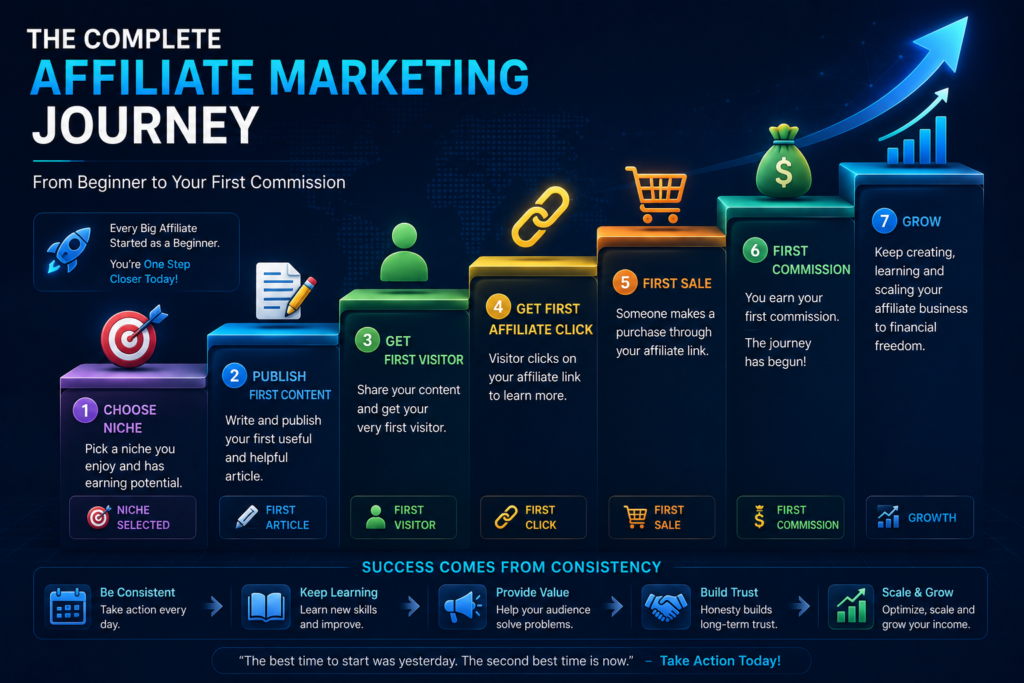
Learning how to start affiliate marketing for beginners isn’t about finding a secret link or joining the highest-paying program. It’s about building a system that connects useful content with people who are searching for solutions.
The complete journey looks like this:
Choose a Niche → Choose Your Platform → Find Relevant Affiliate Programs → Create Helpful Content → Build Targeted Traffic → Recommend Useful Products → Generate Affiliate Clicks → Earn Qualifying Commissions → Analyze → Improve
If you’re completely new, keep things simple.
Choose one niche you can consistently create content around. Start with one primary platform, such as a blog or YouTube channel. Join a small number of reputable affiliate programs with products that genuinely fit your audience.
Then focus on creating useful content.
Your first goal shouldn’t necessarily be earning thousands of dollars. Aim for smaller milestones:
First Article → First 100 Visitors → First Affiliate Click → First Conversion → First Commission
Once you understand what works, you can publish more content, improve your SEO, expand to additional platforms, grow your email audience, and explore more relevant affiliate partnerships.
Most importantly, protect your audience’s trust. Recommend products because they may genuinely help your readers—not simply because they offer commissions.
Value First → Trust Second → Monetization Third → Growth Over Time
Affiliate marketing doesn’t guarantee success, but with useful content, targeted traffic, responsible recommendations, patience, and continuous improvement, it can become a practical online business model worth exploring.
Ready to Start Affiliate Marketing?
Start today by choosing your niche and identifying the problems your target audience needs help solving. Then create your first genuinely useful piece of content.
Continue exploring BuildSmartAfri for beginner-friendly guides about online business, blogging, AI tools, content creation, digital skills, and strategies for building your online presence.
Disclaimer
This article is for educational and informational purposes only and should not be considered financial or business advice. Affiliate marketing income is not guaranteed. Results vary depending on factors including your niche, traffic, audience, content quality, affiliate programs, conversion rates, competition, and effort.
Some affiliate programs also have specific eligibility, disclosure, promotional, and payment requirements. Always review the current terms of any affiliate program you join and comply with applicable laws and platform policies.