
Introduction:
How to Calculate Position Size in Forex Trading: 10 Simple Methods for Beginners. One of the biggest reasons beginner Forex traders lose money isn’t because they choose the wrong trades, it’s because they trade the wrong position size. If you’re completely new to the currency market, start with our What Is Forex Trading? A Beginner’s Guide before learning how to calculate position size.
Imagine opening a trade that moves against you by just a few pips, only to discover you’ve lost a large portion of your trading account. This situation is common among beginners who focus on finding the “perfect” trade but ignore one of the most important aspects of successful trading: position sizing.
Position sizing determines how much of a currency pair you should buy or sell on each trade based on your account size and risk tolerance. It helps you manage risk, protect your capital, and stay in the market long enough to improve your trading skills.
Professional traders understand that preserving capital is just as important as making profits. Even the best trading strategy will eventually fail if you risk too much on a single trade. On the other hand, using the correct position size allows you to survive losing streaks while giving your winning trades enough room to grow your account over time.
Whether you’re trading with a $100, $1,000, or $10,000 account, the principles of position sizing remain the same. You should never decide your lot size based on emotions or guesswork. Instead, every trade should be calculated using a clear and consistent risk management plan.
In this comprehensive guide, you’ll learn:
- What position size means in Forex trading.
- Why position sizing is critical for long-term success.
- The standard formula used by professional traders.
- Ten practical methods for calculating position size.
- Real-world examples using different account sizes.
- Common mistakes beginners should avoid.
- Free tools that make position size calculations easier.
By the end of this article, you’ll have the confidence to calculate your position size before every trade, helping you protect your trading capital and become a more disciplined Forex trader.
What Is Position Size in Forex Trading?
Position size refers to the number of units or lots you buy or sell when opening a Forex trade. Understanding position sizing is one of the most important skills every Forex trader needs to manage risk effectively. After opening your first trading account, one of the next skills to master is calculating the correct position size for every trade. Learn how to get started in our guide on How to Open Your First Forex Trading Account.
Simply put, it answers one important question:
“How large should this trade be?”
Many beginners mistakenly believe that position size is the same as lot size. While the two are closely related, they are not exactly the same.
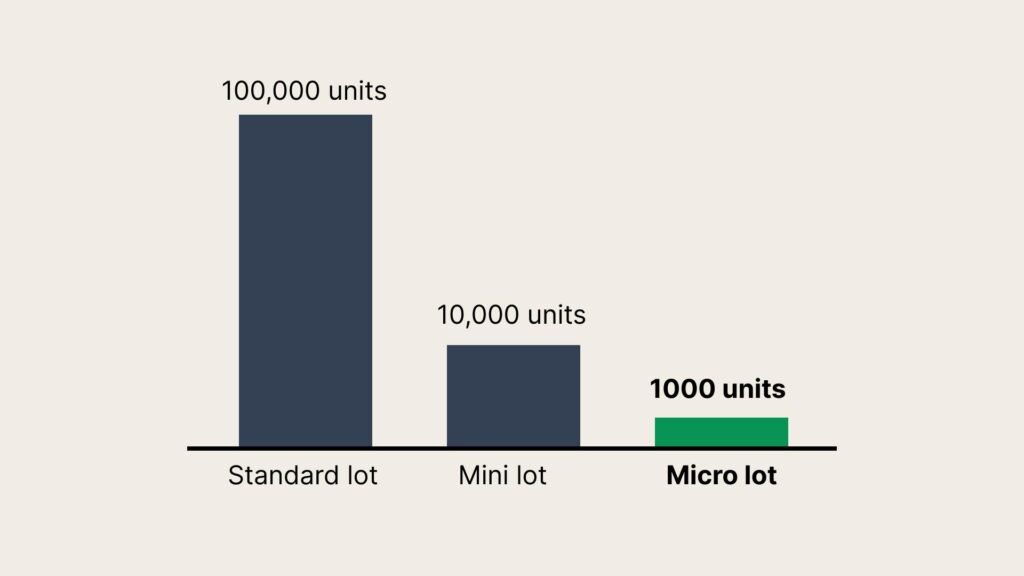
A lot size is the standard measurement used by Forex brokers to define the volume of a trade.
Common Forex lot sizes include:
- Standard Lot: 100,000 units of the base currency.
- Mini Lot: 10,000 units.
- Micro Lot: 1,000 units.
- Nano Lot: 100 units (offered by some brokers).
Your position size is the specific lot size you choose after considering factors such as:
- Your account balance.
- The percentage of your account you’re willing to risk.
- The distance between your entry price and stop-loss.
- The value of each pip for the currency pair you’re trading.
Example
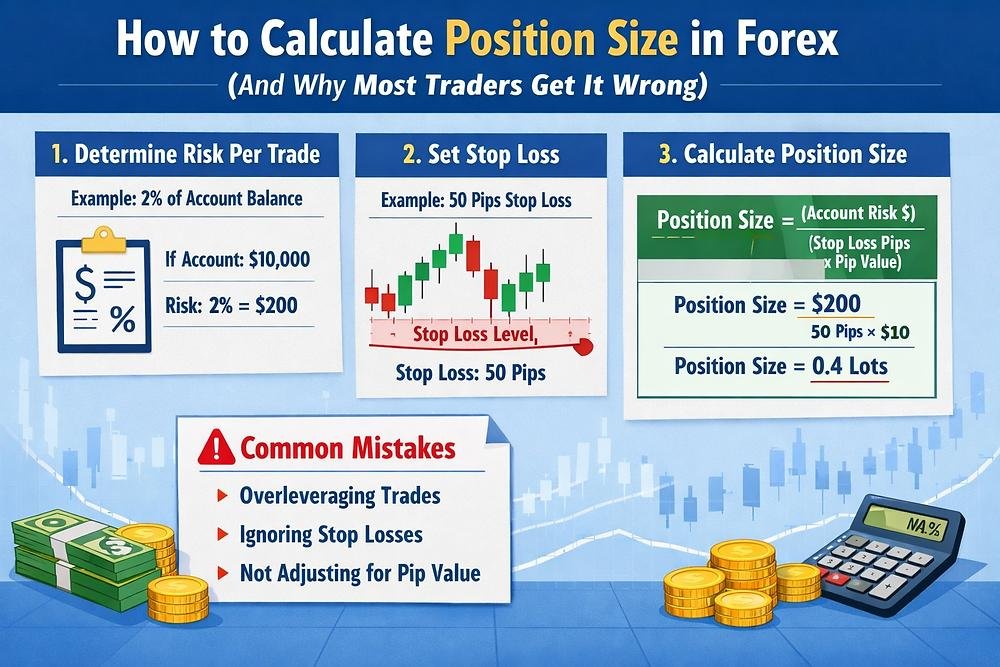
Suppose you have a trading account worth $1,000.
You decide that you will risk only 1% on your next trade.
That means the maximum amount you’re willing to lose is:
$1,000 × 1% = $10
If your stop-loss is 20 pips, your position size must be calculated so that a 20-pip loss equals $10.
Instead of guessing your lot size, you calculate it based on your predefined risk. This approach keeps your losses consistent regardless of market conditions.
Why Position Size Matters
Position sizing plays a major role in protecting your trading account.
Without proper position sizing:
- A single losing trade can wipe out weeks or months of profits.
- Emotional trading becomes more common.
- Traders are tempted to revenge trade after losses.
- Account drawdowns become much larger.
With proper position sizing:
- Every trade follows the same level of risk.
- Losing streaks become easier to recover from.
- Trading becomes more consistent.
- Capital is preserved for future opportunities.
One of the golden rules of professional trading is:
Never decide your lot size first. Decide your risk first, then calculate the correct position size.
This simple habit separates disciplined traders from gamblers.
In the next section, we’ll explore why proper position sizing is one of the most powerful risk management techniques in Forex trading and how it can dramatically improve your long-term trading performance.
How to Calculate Position Size in Forex Trading: 10 Simple Methods for Beginners
If you prefer automatic calculations, a Forex Position Size Calculator can help determine the correct lot size based on your account balance and stop-loss.
Why Proper Position Sizing Is Important in Forex Trading
If there is one habit that separates successful Forex traders from those who constantly lose money, it is effective risk management. At the heart of risk management lies one critical concept: position sizing. Effective risk management helps traders protect their capital and stay consistent over the long term. Before calculating your position size, you should know how to identify quality trade setups. Our How to Read Forex Charts guide will help you analyze the market more confidently.
Many beginner traders spend hours learning technical analysis, candlestick patterns, and trading strategies. However, they often overlook how much money they should risk on each trade. As a result, even a good trading strategy can fail because the trader is risking too much. Before calculating your position size, it’s important to understand the pip value of the currency pair you’re trading.
Proper position sizing is not about making bigger profits; it is about protecting your trading capital so you can continue trading tomorrow.
Let’s explore why position sizing is one of the most important skills every Forex trader should master.
1. It Protects Your Trading Capital
Your trading account is your business capital. Without it, you cannot continue trading.
Every trade carries some level of risk because no trading strategy wins 100% of the time.
By calculating the correct position size before entering a trade, you limit how much money you can lose if the market moves against you.
For example:
Account Balance:
$2,000
Risk Per Trade:
1%
Maximum Loss:
$20
Regardless of how volatile the market becomes, your loss is limited to $20 if your stop-loss is hit.
This approach prevents one bad trade from causing serious damage to your account.
Remember:
Your first goal in Forex trading is not to make money; it is to protect your capital.
Without capital, there are no future trading opportunities.
2. It Helps You Control Risk Consistently
One common mistake beginners make is risking different amounts on every trade.
For example:
- Monday: Risk $10
- Tuesday: Risk $80
- Wednesday: Risk $25
- Thursday: Risk $150
This inconsistency makes it almost impossible to evaluate trading performance.
Professional traders maintain a consistent risk percentage.
For example:
- Every trade risks exactly 1%
- Every trade risks exactly 2%
This consistency makes long-term performance easier to measure and improves discipline.
3. It Reduces Emotional Trading
Trading large position sizes often creates unnecessary emotional pressure.
Imagine opening a trade where you could lose half of your account.
You’ll likely:
- Panic when price moves slightly against you.
- Close profitable trades too early.
- Remove your stop-loss.
- Make impulsive decisions.
Now imagine risking only 1% of your account.
Small market fluctuations won’t affect your emotions as much because you know your loss is controlled.
Position sizing helps traders remain calm and follow their trading plan.
4. It Prevents Account Blow-Ups
Many beginner traders believe increasing their lot size will help them recover losses faster.
Unfortunately, this usually produces the opposite result.
Consider this example:
Trader A
Account:
$1,000
Risks:
25% per trade
Four consecutive losing trades:
- Trade 1 → $750
- Trade 2 → $562.50
- Trade 3 → $421.88
- Trade 4 → $316.41
More than two-thirds of the account has disappeared after only four losses.
Now compare that with Trader B.
Account:
$1,000
Risks:
1% per trade
After four losing trades:
Account balance:
Approximately $960
Trader B still has enough capital to continue trading and recover from losses.
This example demonstrates why professional traders focus more on limiting losses than maximizing profits.
5. It Supports Long-Term Growth
Forex trading is a marathon, not a sprint.
Trying to double your account every week usually leads to excessive risk-taking and large losses.
Instead, successful traders aim for steady and consistent growth.
For example:
Starting Balance:
$1,000
Average Monthly Growth:
5%
Although this may seem slow at first, consistent growth combined with disciplined position sizing can significantly increase an account over time.
The goal is not to become rich overnight.
The goal is to stay profitable for years.
6. It Makes Every Trade Objective
Without position sizing, many beginners decide their lot size based on feelings.
Examples include:
- “This setup looks perfect, so I’ll trade bigger.”
- “I lost yesterday, so I’ll increase my lot size.”
- “I feel lucky today.”
Professional traders don’t make decisions this way.
Instead, they calculate position size using predefined rules based on:
- Account balance
- Risk percentage
- Stop-loss distance
- Pip value
This removes emotion from the decision-making process and creates a repeatable trading routine.
7. It Works with Every Trading Strategy
Whether you’re:
- Trend Trading
- Scalping
- Swing Trading
- Day Trading
- Breakout Trading
Position sizing remains equally important.
Even the best trading strategy will experience losing trades.
Proper position sizing ensures those losses remain manageable.
Think of it this way:
Your trading strategy helps you find opportunities.
Your position size determines how much you risk on those opportunities.
Both are essential for long-term success.
8. It Improves Your Risk-to-Reward Ratio
Position sizing works hand in hand with stop-loss placement and take-profit targets.
For example:
Risk:
$20
Potential Profit:
$40
Risk-to-Reward Ratio:
1:2
Even if you win only half of your trades, maintaining favorable risk-to-reward ratios can keep your trading account profitable over time.
Without proper position sizing, achieving consistent risk-to-reward ratios becomes much more difficult.
9. It Builds Trading Discipline
Discipline is one of the most valuable qualities a Forex trader can develop.
Calculating your position size before every trade creates a routine.
Eventually, it becomes second nature.
Before entering any trade, disciplined traders ask themselves:
- What is my account balance?
- How much am I willing to risk?
- Where is my stop-loss?
- What is the correct lot size?
This process helps eliminate impulsive trading decisions.
10. It Gives You Confidence
One overlooked benefit of proper position sizing is confidence.
When you know every trade follows the same risk management rules, you no longer fear individual losses.
Instead of worrying about losing money on one trade, you focus on executing your trading plan consistently.
This shift in mindset is what allows experienced traders to think in probabilities rather than emotions.
Remember:
A losing trade does not mean you’re a bad trader.
It simply means one trade didn’t work out.
Proper position sizing ensures that one loss never becomes a disaster.
Key Takeaway
Position sizing is much more than a mathematical calculation.
It is a powerful risk management tool that helps you:
- Protect your capital.
- Control losses.
- Reduce emotional trading.
- Build consistency.
- Improve discipline.
- Stay in the market longer.
Professional traders understand that survival comes before profits.
If you can protect your trading account during losing periods, you’ll always have the opportunity to profit when high-quality setups appear.
In the next section, we’ll break down the standard Forex position size formula step by step and show you exactly how to calculate the correct position size for any trade using simple examples that even complete beginners can follow.
Practical Examples: How to Calculate Position Size Step by Step
Understanding the formula is one thing but applying it in real trading situations is what builds confidence. Let’s walk through three practical examples using different account sizes and stop-loss distances. Even the best trend trading strategy won’t protect your account if you use the wrong position size. Read our Trend Trading for Beginners guide to combine good entries with proper risk management.
The Forex Position Size Formula
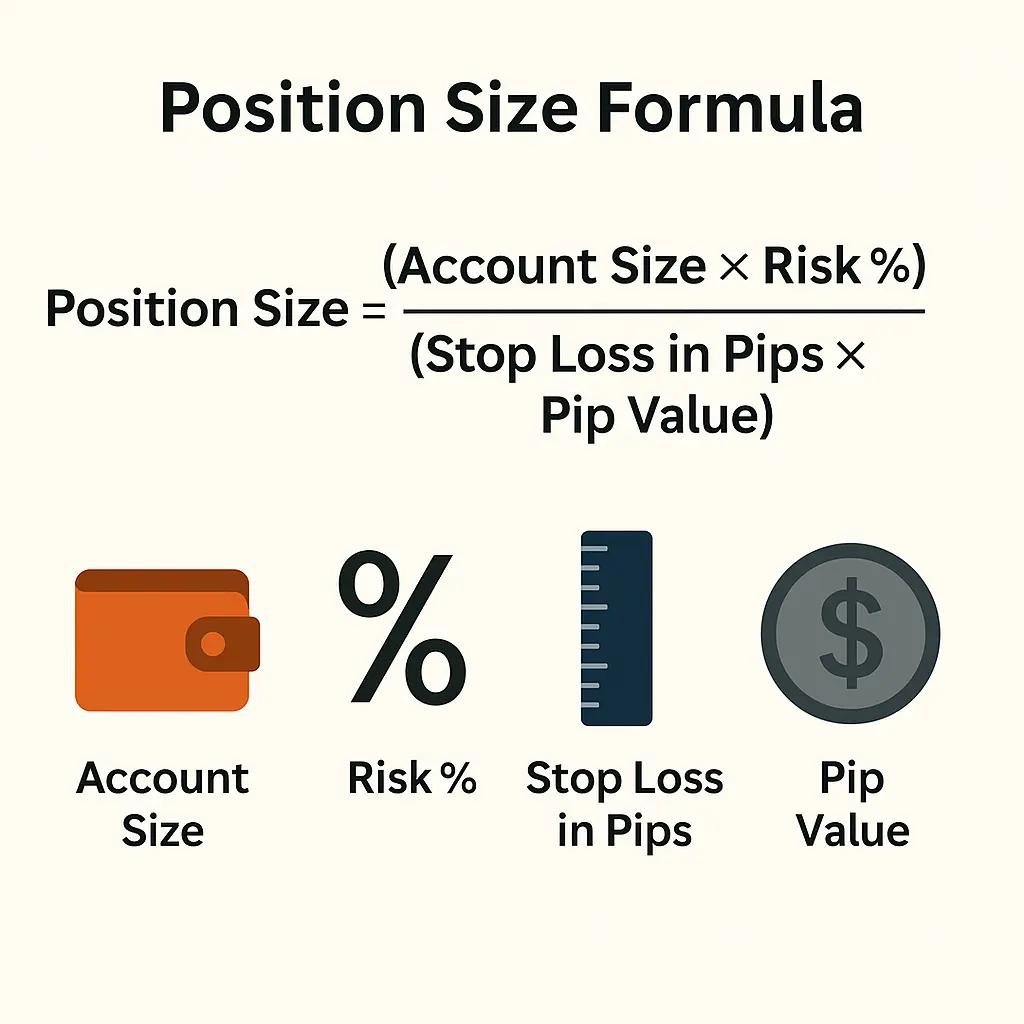
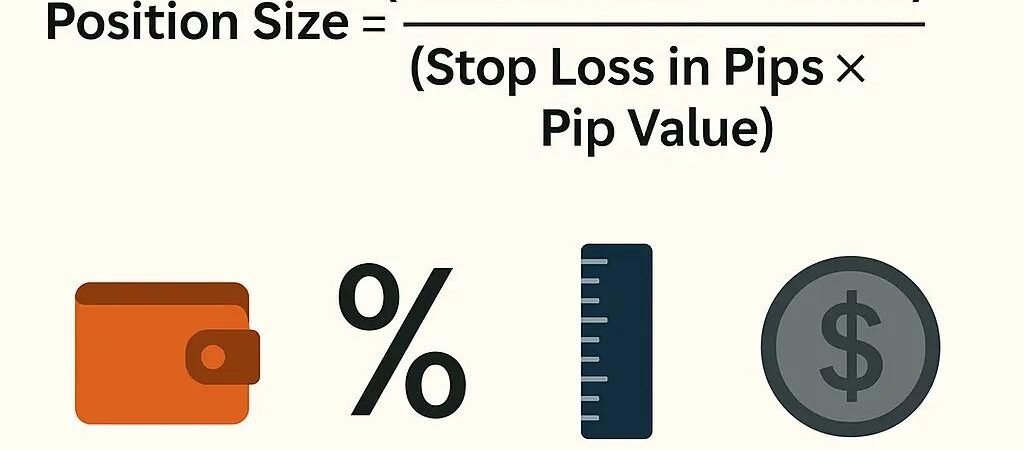
Remember the basic formula:
Position Size = Risk Amount ÷ (Stop-Loss in Pips × Pip Value)
For simplicity, we’ll assume the pip value is approximately $1 per pip for the calculated position size. Your broker or a position size calculator will determine the exact lot size automatically.
Example 1: Beginner With a $500 Trading Account
Imagine you’re just starting your Forex journey with a $500 trading account.
You decide to follow a strict risk management rule by risking only 1% of your account on each trade.
Step 1: Calculate Your Risk Amount
Account Balance:
$500
Risk Percentage:
1%
Risk Amount:
$500 × 1% = $5
This means you should never lose more than $5 on this trade.
Step 2: Determine Your Stop-Loss
After analyzing the chart, you place your stop-loss 25 pips away from your entry price.
Step 3: Calculate Position Size
Maximum Risk:
$5
Stop-Loss:
25 pips
Risk Per Pip:
$5 ÷ 25 = $0.20 per pip
Your broker’s position size calculator may suggest a trade size close to 0.02 lots (Micro Lots).
If your stop-loss is hit, your total loss will remain close to $5, exactly as planned.
Example 2: Intermediate Trader With a $1,000 Account
Now imagine your trading account has grown to $1,000.
You continue following good risk management by risking 2% per trade.
Step 1: Calculate Risk Amount
Account Balance:
$1,000
Risk Percentage:
2%
Risk Amount:
$20
Step 2: Determine Stop-Loss
You identify a trade setup requiring a 40-pip stop-loss.
Step 3: Calculate Position Size
Maximum Risk:
$20
Stop-Loss:
40 pips
Risk Per Pip:
$20 ÷ 40 = $0.50 per pip
The appropriate position size may be approximately 0.05 lots.
Although the stop-loss is wider than in the previous example, your total risk remains fixed at $20.
This demonstrates why position size changes depending on your stop-loss distance.
Example 3: Swing Trader With a $5,000 Account
Swing traders usually hold positions for several days, meaning they often use wider stop-losses.
Suppose your account balance is $5,000, and you choose to risk 1%.
Step 1: Calculate Risk Amount
Account Balance:
$5,000
Risk Percentage:
1%
Risk Amount:
$50
Step 2: Determine Stop-Loss
Because this is a swing trade, your stop-loss is 100 pips.
Step 3: Calculate Position Size
Maximum Risk:
$50
Stop-Loss:
100 pips
Risk Per Pip:
$50 ÷ 100 = $0.50 per pip
Even though your account is much larger, the wider stop-loss means your position size remains relatively modest.
This illustrates an important principle:
A larger trading account does not always mean using a larger lot size.
The correct position size always depends on your predefined risk and stop-loss distance.
Comparing the Three Examples
| Account Balance | Risk % | Maximum Risk | Stop-Loss | Approximate Position Size |
|---|---|---|---|---|
| $500 | 1% | $5 | 25 pips | 0.02 lots |
| $1,000 | 2% | $20 | 40 pips | 0.05 lots |
| $5,000 | 1% | $50 | 100 pips | 0.05 lots |
Notice how the lot size changes based on both the account balance and the stop-loss distance.
Key Lessons From These Examples
These examples highlight several important principles every beginner should remember:
- Always decide how much you’re willing to risk before opening a trade.
- Never choose your lot size based on emotion or guesswork.
- Wider stop-losses require smaller position sizes to keep your risk under control.
- Larger account balances don’t automatically mean larger trades.
- Consistency in position sizing helps protect your trading capital during losing streaks.
The most successful Forex traders don’t ask, “How much money can I make from this trade?”
Instead, they first ask:

“How much am I prepared to lose if this trade doesn’t work?”
By answering that question before every trade, you’ll develop the discipline and consistency needed to succeed in the Forex market over the long term.
Frequently Asked Questions (FAQ)
1. What is position size in Forex trading?
Position size is the amount of a currency pair you buy or sell in a single trade. It determines how much money you stand to gain or lose based on your stop-loss distance and the amount of risk you’re willing to take.
Rather than choosing a random lot size, professional traders calculate their position size using their account balance, risk percentage, and stop-loss.
2. Why is position sizing important?
Position sizing is one of the most important aspects of risk management because it protects your trading account from excessive losses.
Without proper position sizing, even a few losing trades can significantly reduce your account balance.
Correct position sizing helps you:
- Protect your capital.
- Maintain consistent risk.
- Reduce emotional trading.
- Improve long-term profitability.
3. How much should beginners risk per trade?
Most professional traders recommend risking 1% or less of your account balance on each trade.
For example:
- $500 account → Risk $5
- $1,000 account → Risk $10
- $5,000 account → Risk $50
Keeping your risk small allows you to survive losing streaks while continuing to trade confidently.
4. Does leverage affect position size?
Yes.
Leverage allows you to control larger positions with less capital, but it does not change how much you should risk on a trade. While leverage allows traders to control larger positions with less capital, it should never replace proper risk management.
Many beginners mistakenly believe that because they have high leverage, they should trade larger lot sizes.
This often leads to overtrading and unnecessary losses.
Always calculate your position size based on your risk management plan—not on the maximum leverage your broker offers.
5. Can I use the same position size for every trade?
Not always.
Your position size should change depending on:
- Your account balance.
- Your chosen risk percentage.
- The size of your stop-loss.
- The currency pair you’re trading.
If your stop-loss is wider, your lot size should usually be smaller.
If your stop-loss is tighter, your lot size may be larger while maintaining the same level of risk.
6. Which lot size is best for beginners?
For most beginners:
- Micro Lots (0.01) are the safest starting point.
- Mini Lots (0.10) may be suitable as your account grows.
- Standard Lots (1.00) are generally better suited for experienced traders with larger accounts.
Always calculate your position size instead of choosing a lot size based on guesswork.
7. Are position size calculators accurate?
Yes.
Position size calculators are excellent tools that help traders avoid manual calculation errors.
However, you should still understand the basic formula so you know how the calculator reaches its result.
Understanding the calculation improves your confidence and trading discipline.
8. What happens if I risk too much on one trade?
Risking too much increases the chances of blowing your trading account.
For example, if you risk 20% of your account on one trade, just five consecutive losses could leave you with a fraction of your original capital.
Professional traders focus on preserving capital by risking only a small percentage per trade.
Final Thoughts
Learning how to calculate your position size is one of the most valuable skills you can develop as a Forex trader. Every trade should include stop-loss orders to ensure your calculated position size aligns with your maximum acceptable risk.
While many beginners spend most of their time searching for winning strategies and perfect trade entries, experienced traders know that long-term success depends just as much on managing risk as it does on finding profitable opportunities. Practice calculating your position size in a demo account before risking real money. Our Demo Trading vs Live Trading guide explains why this step is essential.
Position sizing helps you trade with confidence because every trade follows a structured plan rather than emotion or guesswork. Instead of wondering whether your lot size is too large or too small, you’ll know that every position is based on your account balance, your stop-loss, and your chosen level of risk. Position sizing should be part of every Forex Trading Plan for Beginners, helping you manage risk consistently across all trades.
As you continue your Forex journey, remember these key principles:
- Always calculate your position size before entering a trade.
- Risk only a small percentage of your account on each position.
- Never increase your lot size simply to recover previous losses.
- Use stop-loss orders on every trade.
- Review your position sizing regularly as your account balance changes.
Successful trading is not about winning every trade; it is about managing losses, protecting your capital, and allowing profitable trades to outweigh losing one’s over time.
With patience, discipline, and proper position sizing, you’ll be better equipped to handle market uncertainty and build a consistent trading approach.
Make position sizing a habit before every trade, and you’ll be taking one of the most important steps toward becoming a smarter and more disciplined Forex trader.
Continue Your Forex Learning Journey
Ready to strengthen your Forex knowledge? Continue with these beginner-friendly guides:
- What Is Forex Trading? A Beginner’s Guide
- How to Choose the Best Forex Broker for Beginners
- How to Open Your First Forex Trading Account
- Demo Trading vs Live Trading: Which Should Beginners Start With?
- Trend Trading for Beginners: How to Follow Market Direction
- How to Use an Economic Calendar in Forex Trading
- How Stop-Loss Orders Help Limit Investment Losses and Risk
- How to Create a Forex Trading Plan for Beginners
Each article is designed to help you build a strong foundation in Forex trading, improve your decision-making, and develop the confidence needed to trade responsibly.
Disclaimer
The information provided in this article is for educational and informational purposes only and should not be considered financial, investment, or trading advice.
Forex trading involves substantial risk, and losses can exceed your initial investment. Past performance does not guarantee future results. Always conduct your own research, develop a trading plan, and use proper risk management before placing any trades.
If you are new to Forex trading, consider practicing on a demo account before trading with real money. Never risk money that you cannot afford to lose.