
Introduction:
What are currency pairs in Forex? The Forex market is the largest financial market in the world, with trillions of dollars traded daily by banks, institutions, businesses, governments, and individual traders. Unlike stock markets where traders buy and sell shares of companies, Forex trading involves the exchange of one currency for another. This exchange takes place through what are known as currency pairs. Before learning currency pairs, beginners should understand important Forex concepts such as pips, spreads, leverage, and margin.
Understanding currency pairs is one of the most important concepts for every Forex trader. Before learning technical analysis, risk management, or trading strategies, traders must first understand what a currency pair is and how it works. Without this knowledge, it becomes difficult to understand price movements, trade execution, or profit calculations.
Every trade in the Forex market involves a currency pair because currencies are always traded against one another. When you buy one currency, you are simultaneously selling another currency. This unique structure is what makes Forex trading different from many other financial markets. Forex trading basics
For beginners, currency pairs may initially seem confusing because they are represented by abbreviations such as EUR/USD, GBP/USD, or USD/JPY. However, once you understand how these pairs are structured, reading and analyzing them becomes much easier.
In this guide, you will learn what currency pairs are, how they work, the different types of currency pairs, and how beginners can choose the right pairs to trade.
What Are Currency Pairs in Forex?
A currency pair is the quotation of two different currencies where the value of one currency is measured against the value of another. In Forex trading, currencies are always traded in pairs because every transaction involves exchanging one currency for another.
For example:
- EUR/USD
- GBP/USD
- USD/JPY
- AUD/USD
These pairs represent the relationship between two currencies. The first currency is known as the base currency, while the second currency is called the quote currency.
When traders buy or sell a currency pair, they are speculating on whether the value of the base currency will rise or fall relative to the quote currency.
For example, if a trader believes the Euro will strengthen against the US Dollar, they may buy EUR/USD. If the trader believes the Euro will weaken against the US Dollar, they may sell EUR/USD.
Every Forex trade involves this comparison between two currencies, making currency pairs the foundation of Forex trading.
How Currency Pairs Work
Currency pairs show how much of the quote currency is needed to purchase one unit of the base currency. The movement of currency pairs is measured in pips, the smallest price unit in most Forex pairs.
For example:
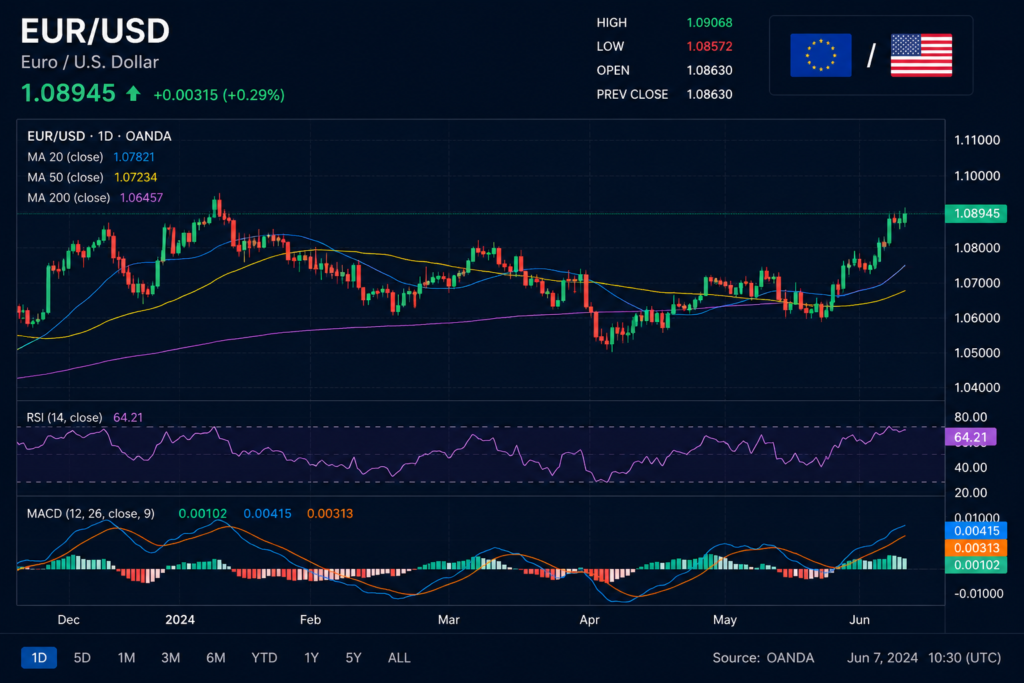
EUR/USD = 1.1000
This means:
1 Euro = 1.10 US Dollars
If the price rises to:
EUR/USD = 1.1200
This means the Euro has strengthened against the US Dollar because it now requires more US Dollars to buy one Euro.
Conversely, if the price falls to:
EUR/USD = 1.0800
The Euro has weakened against the US Dollar because fewer US Dollars are needed to purchase one Euro.
Forex traders profit by correctly predicting whether a currency pair will rise or fall in value.
Because currencies constantly fluctuate due to economic events, interest rates, political developments, and market sentiment, currency pair prices are always changing throughout the trading day.
Base Currency vs Quote Currency
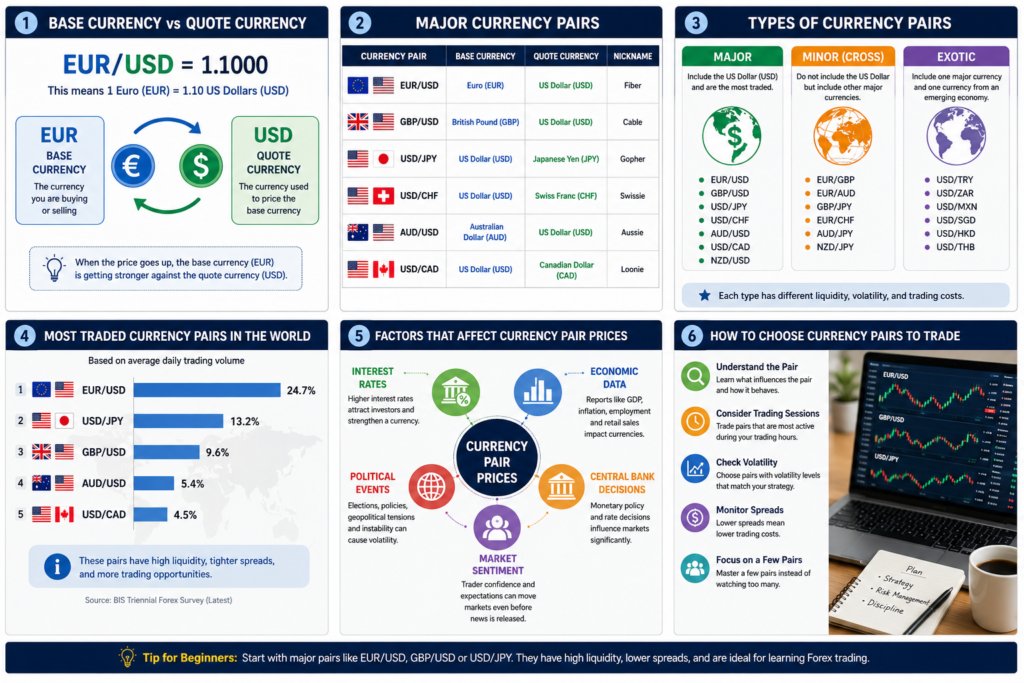
Understanding the difference between the base currency and quote currency is essential for reading Forex prices correctly.
Base Currency
The base currency is always the first currency in a pair.
Example:
EUR/USD
The Euro (EUR) is the base currency.
The base currency represents the currency being bought or sold.
Quote Currency
The quote currency is the second currency in a pair.
Example:
EUR/USD
The US Dollar (USD) is the quote currency.
The quote currency shows how much is required to buy one unit of the base currency.
Example
GBP/USD = 1.2500
This means:
1 British Pound = 1.25 US Dollars
In this example:
- GBP = Base Currency
- USD = Quote Currency
Understanding these roles helps traders interpret price movements and execute trades more confidently.
Types of Currency Pairs
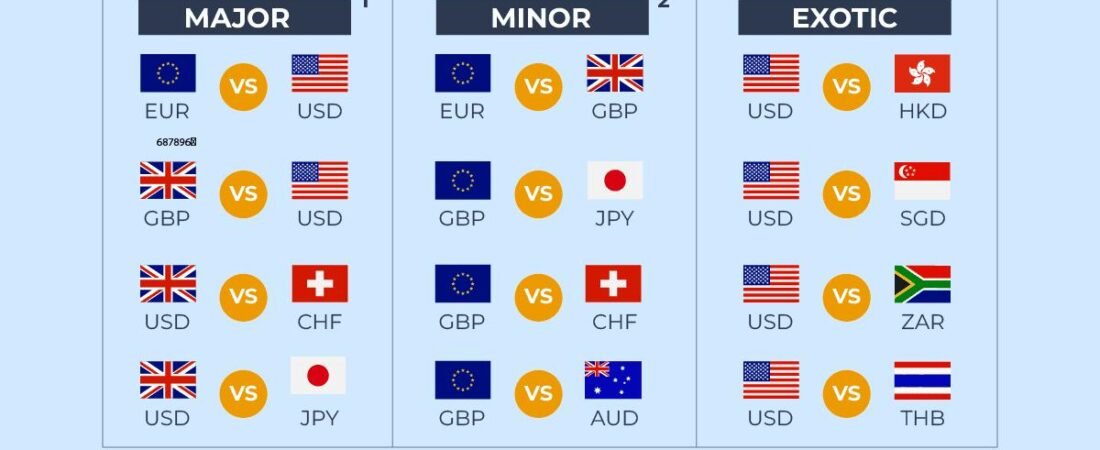
Currency pairs are generally divided into three categories:
- Major Currency Pairs
- Minor Currency Pairs
- Exotic Currency Pairs
Each category has different characteristics, levels of liquidity, and trading costs.
Major Currency Pairs
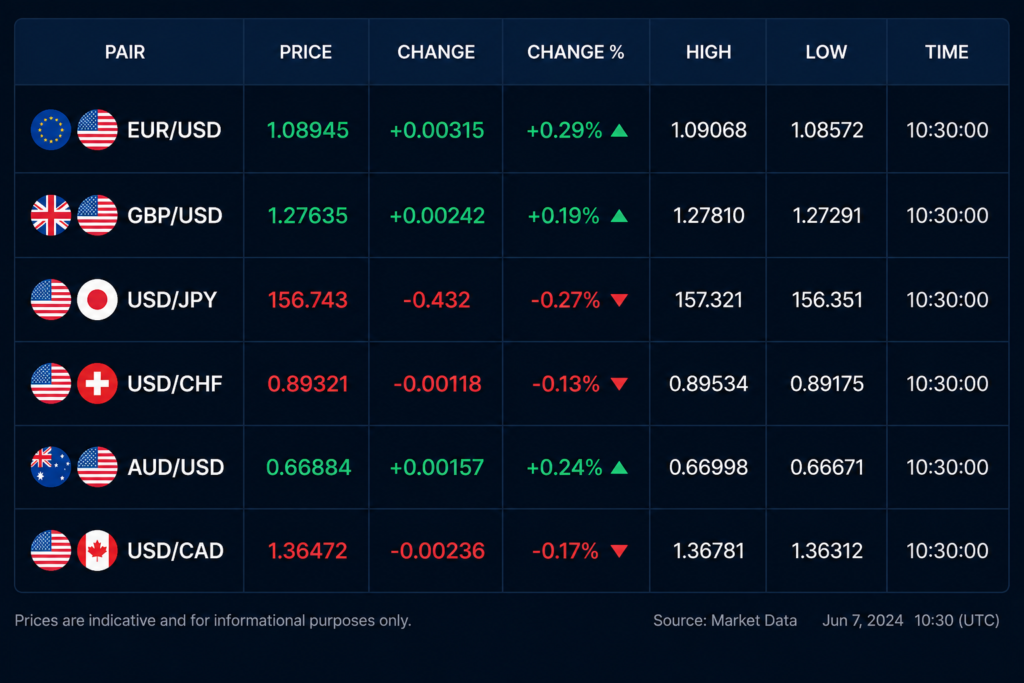
Major currency pairs are the most traded currency pairs in the world. They always include the US Dollar and typically have high liquidity, tighter spreads, and greater trading volume. Major currency pairs often have lower spreads compared to minor and exotic pairs.
Examples include:
- EUR/USD (Euro / US Dollar)
- GBP/USD (British Pound / US Dollar)
- USD/JPY (US Dollar / Japanese Yen)
- USD/CHF (US Dollar / Swiss Franc)
- AUD/USD (Australian Dollar / US Dollar)
- USD/CAD (US Dollar / Canadian Dollar)
- NZD/USD (New Zealand Dollar / US Dollar)
Major pairs are generally recommended for beginners because they:
- Have lower spreads
- Offer higher liquidity
- Experience smoother price movements
- Receive extensive market analysis
Because of their popularity, major pairs often provide the best trading conditions for new traders.
Minor Currency Pairs
Minor currency pairs, sometimes called cross-currency pairs, do not include the US Dollar.
Examples include:
- EUR/GBP
- EUR/AUD
- GBP/JPY
- EUR/CHF
- AUD/JPY
These pairs are still actively traded but typically have slightly lower liquidity than major pairs.
Minor pairs can provide unique trading opportunities because their price movements are influenced by the economic conditions of the countries involved rather than the US Dollar.
While many experienced traders trade minor pairs successfully, beginners often start with major pairs before exploring cross-currency pairs.
Exotic Currency Pairs
Exotic currency pairs consist of one major currency and one currency from a developing or emerging economy.
Examples include:
- USD/TRY (US Dollar / Turkish Lira)
- USD/ZAR (US Dollar / South African Rand)
- USD/MXN (US Dollar / Mexican Peso)
- USD/SGD (US Dollar / Singapore Dollar)
Exotic pairs generally have:
- Lower liquidity
- Higher spreads
- Greater volatility
- Increased trading risk
Although exotic pairs can provide larger price movements and profit opportunities, they can also be more unpredictable.
For this reason, many beginners avoid exotic pairs until they gain more experience in Forex trading.
Most Traded Currency Pairs in the World
Some currency pairs dominate the Forex market because of their high liquidity, strong economies, and widespread global use. These pairs account for a significant percentage of daily Forex trading volume and are closely monitored by traders worldwide. Before trading these popular pairs, it is important to open a Forex trading account with a reputable broker.
EUR/USD
The EUR/USD is the most traded currency pair in the world. It represents the relationship between the Euro and the US Dollar. Because it involves two of the world’s largest economies, it typically has high liquidity and low spreads.
Many beginners prefer EUR/USD because it is widely analyzed, relatively stable compared to some other pairs, and often experiences smooth price movements. MetaTrader trading platform
USD/JPY
The USD/JPY pair represents the US Dollar and the Japanese Yen. It is known for its strong liquidity and significant trading volume. Economic news from both the United States and Japan can greatly influence this pair.
GBP/USD
Often called “Cable,” GBP/USD is one of the most actively traded currency pairs. It tends to be more volatile than EUR/USD, meaning it can provide larger price movements but may also involve higher risk.
AUD/USD
The AUD/USD pair reflects the relationship between the Australian Dollar and the US Dollar. It is influenced by commodity prices, economic data, and global market sentiment.
USD/CAD
This pair represents the US Dollar and the Canadian Dollar. Oil prices often influence USD/CAD because Canada is a major oil-producing country.
Understanding these popular currency pairs can help beginners focus on markets with high liquidity and abundant educational resources.
Factors That Affect Currency Pair Prices
Currency pair prices constantly fluctuate because of various economic, political, and financial factors. Understanding these influences can help traders make more informed decisions. Economic news, leverage, and market volatility can significantly affect currency pair movements.
Interest Rates
Interest rates are one of the most important drivers of currency values. When a country’s central bank raises interest rates, its currency may become more attractive to investors, increasing demand and potentially strengthening the currency.
Economic Data
Reports such as:
- Employment statistics
- Inflation figures
- Gross Domestic Product (GDP)
- Retail sales reports
can significantly impact currency prices.
Strong economic data often supports a country’s currency, while weak data may cause it to weaken.
Political Events
Elections, government policies, political instability, and international relations can influence investor confidence and currency values.
Political uncertainty often leads to increased market volatility.
Central Bank Decisions
Central banks such as the Federal Reserve and the European Central Bank play major roles in Forex markets. Their decisions regarding interest rates and monetary policy can cause significant movements in currency pairs.
Market Sentiment
Investor confidence and market expectations can influence currencies even before official economic data is released. Traders often react to anticipated events, creating price movements based on sentiment rather than current conditions.
Which Currency Pair Is Best for Beginners?
Many new traders wonder which currency pair they should trade first. While there is no perfect answer for everyone, some pairs are generally more beginner-friendly than others. Beginners should combine their choice of currency pair with proper risk management techniques.
Most experienced traders recommend starting with major currency pairs because they typically offer:
- High liquidity
- Lower spreads
- Greater market analysis availability
- More predictable price behavior
Common beginner-friendly pairs include:
- EUR/USD
- GBP/USD
- USD/JPY
- AUD/USD
Among these, EUR/USD is often considered the best starting point because it is heavily traded and widely covered by analysts and educational resources.
Beginners should avoid choosing pairs solely because they appear to move quickly. Larger price movements may seem attractive, but they often come with increased risk and volatility.
How to Choose Currency Pairs to Trade
Selecting the right currency pairs is an important part of building a trading strategy. Forex chart analysis tools
Understand the Pair
Before trading any currency pair, learn what drives its price movements. Different pairs react to different economic events and market conditions.
Consider Trading Sessions
Some currency pairs are more active during specific trading sessions. For example:
- EUR/USD often experiences significant activity during London and New York sessions.
- AUD/USD may be more active during Asian trading hours.
Check Volatility
Some pairs move more aggressively than others. Beginners often benefit from starting with moderately volatile pairs before attempting highly volatile markets.
Monitor Spreads
Lower spreads generally reduce trading costs. Major currency pairs usually offer tighter spreads than minor or exotic pairs.
Focus on a Few Pairs
Many beginners make the mistake of monitoring too many currency pairs at once. It is often more effective to specialize in a small number of pairs and learn their behavior thoroughly.
Common Currency Pair Mistakes Beginners Make
Trading Too Many Pairs
New traders often believe they need to trade every opportunity available. This can lead to confusion and poor decision-making.
Ignoring Economic News
Economic events can significantly impact currency prices. Failing to monitor important news releases may expose traders to unexpected volatility.
Choosing Exotic Pairs Too Early
Exotic pairs can be attractive because of their larger price movements, but they often involve wider spreads and greater unpredictability.
Not Understanding Base and Quote Currencies
Some beginners place trades without fully understanding which currency they are buying or selling. This can lead to incorrect assumptions about market direction.
Following Popular Pairs Blindly
Just because a currency pair is popular does not mean it is always suitable for a trader’s strategy. Proper analysis is still essential.
Frequently Asked Questions
What is a currency pair in Forex?
A currency pair is the quotation of two currencies where the value of one currency is measured against another. Forex traders buy one currency while simultaneously selling another.
Why are currencies traded in pairs?
Currencies are traded in pairs because every Forex transaction involves exchanging one currency for another. The value of a currency can only be measured relative to another currency.
What is the difference between major, minor, and exotic pairs?
Major pairs include the US Dollar and have high liquidity. Minor pairs exclude the US Dollar but involve major global currencies. Exotic pairs combine a major currency with a currency from an emerging economy.
Which currency pair is best for beginners?
Many beginners start with EUR/USD because of its high liquidity, lower spreads, and extensive market analysis.
Can beginners trade exotic currency pairs?
Yes, but many experienced traders recommend learning with major pairs first because they are generally easier to understand and trade.
Final Thoughts
Understanding currency pairs is one of the most important steps in learning Forex trading. Since every trade involves the exchange of one currency for another, currency pairs form the foundation of the entire Forex market.
By learning the difference between base and quote currencies, understanding the categories of major, minor, and exotic pairs, and recognizing the factors that influence price movements, traders can build a stronger understanding of how the market operates. Once you understand currency pairs, the next step is learning how to use trading platforms and manage risk effectively.
For beginners, focusing on major currency pairs such as EUR/USD, GBP/USD, and USD/JPY can provide a more manageable learning experience. These pairs typically offer higher liquidity, lower spreads, and greater access to educational resources and market analysis.
As your knowledge and experience grow, you can explore additional currency pairs and develop strategies that match your trading goals and risk tolerance. Remember that successful Forex trading begins with a strong foundation, and understanding currency pairs is a critical part of that foundation.
Disclaimer
This article is intended for educational and informational purposes only and does not constitute financial, investment, or trading advice. Forex trading involves substantial risk and may not be suitable for all investors. Always conduct your own research, practice proper risk management, and consider your financial circumstances before making trading decisions.