
Introduction:
How Much Money Do You Need to Start Forex Trading? One of the most common questions asked by new traders is:
“How much money do I need to start Forex trading?”
The answer may surprise you. Technically, you can start Forex trading with as little as $10, $50, or $100, depending on the broker you choose. However, just because you can start with a small amount of money does not necessarily mean it is the best approach.
Many beginners enter the Forex market believing they need thousands of dollars to begin trading, while others are attracted by social media claims that they can turn a small deposit into a fortune within a few weeks. Both beliefs can create unrealistic expectations and lead to poor decision-making. If you’re completely new to trading, you can learn the basics of Forex trading and account management through Babypips’ free educational resources.
The truth is that there is no single amount of money that guarantees success in Forex trading. Successful traders understand that profitability depends far more on education, discipline, risk management, and consistency than on the size of their trading account. If you’re completely new to trading, start with our Forex Trading for Beginners: The Complete A–Z Guide (2026) to understand how the Forex market works before risking real money.
Forex trading involves buying one currency while simultaneously selling another in the hope of profiting from changes in exchange rates. Because the market is highly liquid and offers leverage, traders can control positions that are significantly larger than the money deposited in their accounts. While this creates opportunities, it also increases risk and makes proper money management essential.
Before deciding how much money to deposit into a trading account, beginners should ask themselves several important questions:
- How much money can I comfortably afford to lose?
- What are my financial goals?
- Do I fully understand the risks involved in Forex trading?
- Have I practiced on a demo account?
- Am I prepared to learn and trade patiently?
These questions matter because Forex trading is not a guaranteed way to make money. Like any skill, trading requires education, practice, and time. Depositing money into a trading account without understanding how the market works can lead to unnecessary losses and frustration.
It is also important to understand that starting with a larger account does not automatically make someone a better trader. In fact, many successful traders began with small accounts and focused on developing good habits before increasing their trading capital. Building strong trading skills and protecting your capital should always take priority over trying to make quick profits.
Throughout this guide, you will learn:
- Whether there is a minimum amount required to start Forex trading
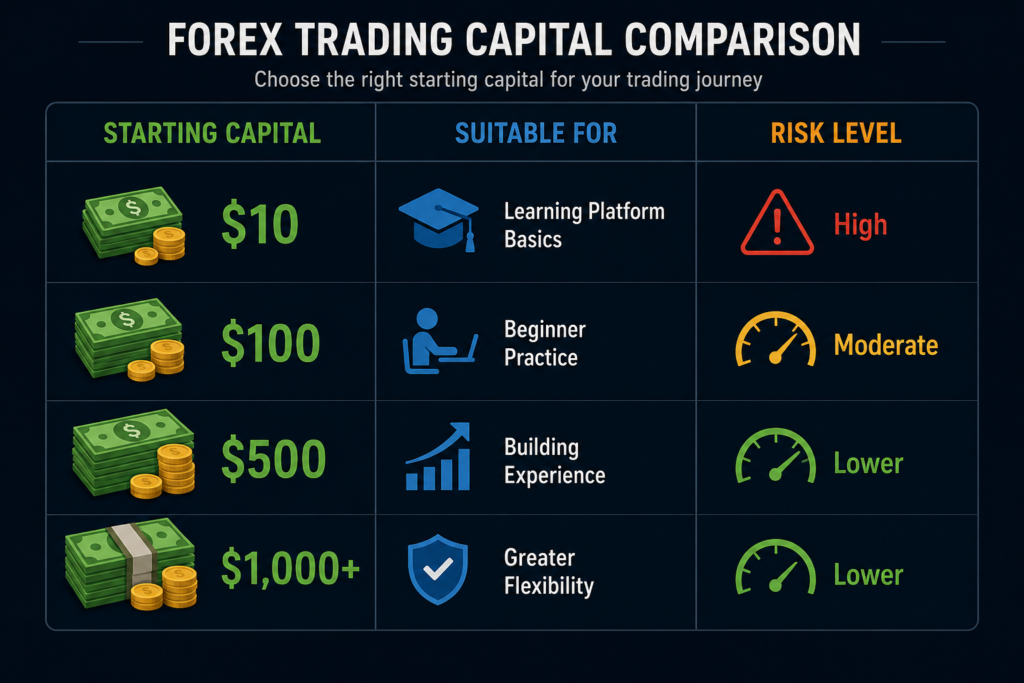
- Whether you can realistically start with $10, $100, or $500
- How leverage affects the amount of money you need
- Why risk management matters more than account size
- The common mistakes beginners make when funding their accounts
- How much money beginners should realistically start with
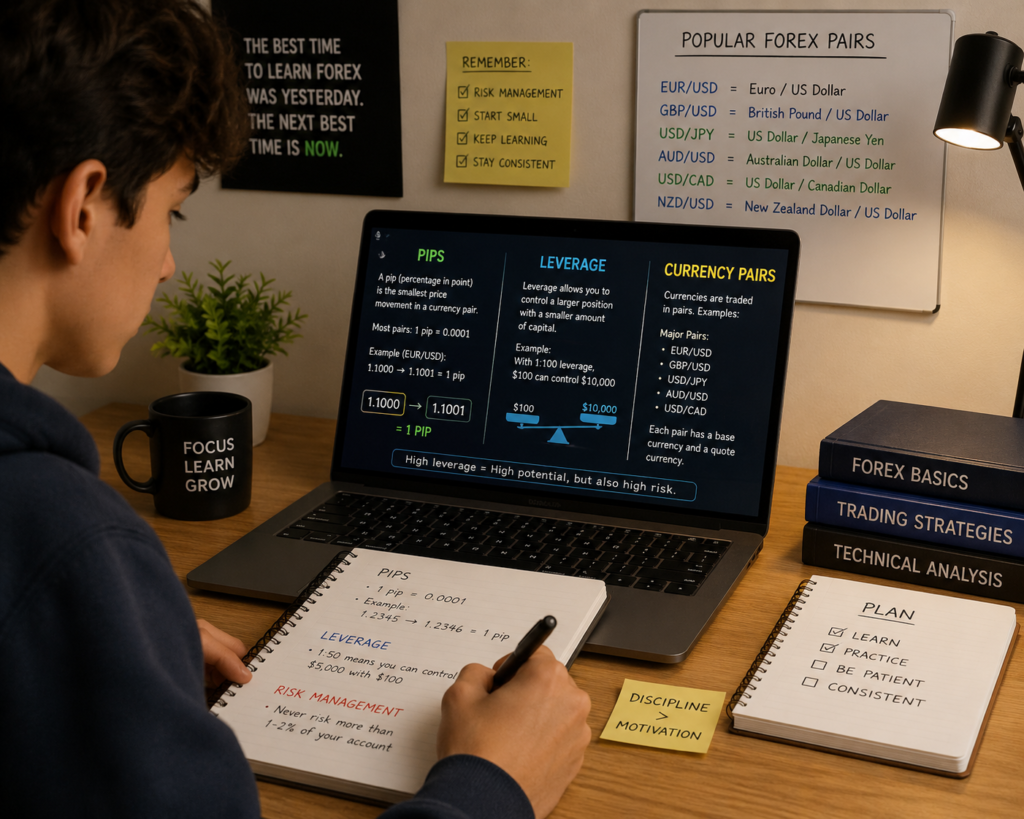
By the end of this guide, you will have a clear understanding of how much money you need to start Forex trading and how to approach your trading journey with realistic expectations and responsible money management.
Is There a Minimum Amount Required to Start Forex Trading?
One of the biggest misconceptions about Forex trading is that you need a large amount of money to get started. In reality, there is no universal minimum amount required to start trading Forex. The amount you need depends on several factors, including your broker, trading strategy, risk tolerance, and financial goals.
Today, many Forex brokers offer accounts designed specifically for beginners, allowing traders to open an account with a relatively small deposit. Some brokers accept deposits as low as $10, while others may require $50, $100, or more. This accessibility has made Forex trading available to people from different financial backgrounds around the world.
However, it is important to understand that the minimum deposit required by a broker is not necessarily the amount you should start with. Just because a broker allows you to open an account with $10 does not mean that $10 is sufficient for meaningful trading or long-term growth.
For example, a trader with a $10 account has very limited room for error. A few losing trades could significantly reduce the account balance, making it difficult to continue trading effectively. Small accounts also place psychological pressure on beginners, who may feel tempted to take excessive risks in an attempt to grow their money quickly.
A larger account balance generally provides greater flexibility. It allows traders to manage risk more effectively, withstand normal market fluctuations, and follow proper money management rules without constantly worrying about running out of capital.
When determining how much money you need to start Forex trading, consider the following factors:
1. Broker Requirements
Different brokers have different account types and minimum deposit requirements.
Examples include:
- Micro accounts
- Cent accounts
- Standard accounts
- ECN accounts
Beginner-friendly accounts often require smaller deposits, while professional account types may require significantly more capital.
2. Trading Goals
Your goals play a major role in determining how much money you should start with.
Ask yourself:
- Are you trading to learn?
- Are you testing a strategy?
- Are you hoping to generate supplemental income?
- Are you planning to become a full-time trader?
A beginner learning the basics may not need a large account. On the other hand, traders seeking meaningful monthly returns may require significantly more capital.
3. Risk Management
Risk management is arguably more important than account size.
Professional traders often risk only 1% to 2% of their account on a single trade. This helps protect their capital during losing streaks.
For example:
- Account Balance: $100
- 1% Risk Per Trade: $1
- Account Balance: $1,000
- 1% Risk Per Trade: $10
A larger account allows traders to apply proper risk management more comfortably while still maintaining reasonable profit potential.
4. Leverage Availability
Leverage allows traders to control larger positions with a smaller amount of money.
For example, with 1:100 leverage:
- $100 can control a $10,000 position.
While leverage can increase potential profits, it can also magnify losses. This is why traders should never rely on leverage as a substitute for proper capital and risk management.
The Reality for Beginners
The good news is that you do not need thousands of dollars to begin learning Forex trading. Many successful traders started with small accounts while focusing on education and skill development.
The bad news is that starting with a very small account often leads to unrealistic expectations. Many beginners deposit $10 or $20 hoping to make hundreds of dollars quickly, only to discover that successful trading requires patience, consistency, and disciplined risk management.
Instead of focusing solely on the minimum amount required to open an account, beginners should focus on having enough capital to:
- Follow proper risk management rules
- Practice responsible position sizing
- Survive normal losing streaks
- Learn without emotional pressure
- Build long-term trading habits
In the next sections, we’ll examine whether it is realistic to start Forex trading with $10, $100, $500, or $1,000 and what each account size can realistically achieve.
How Forex Trading Capital Works
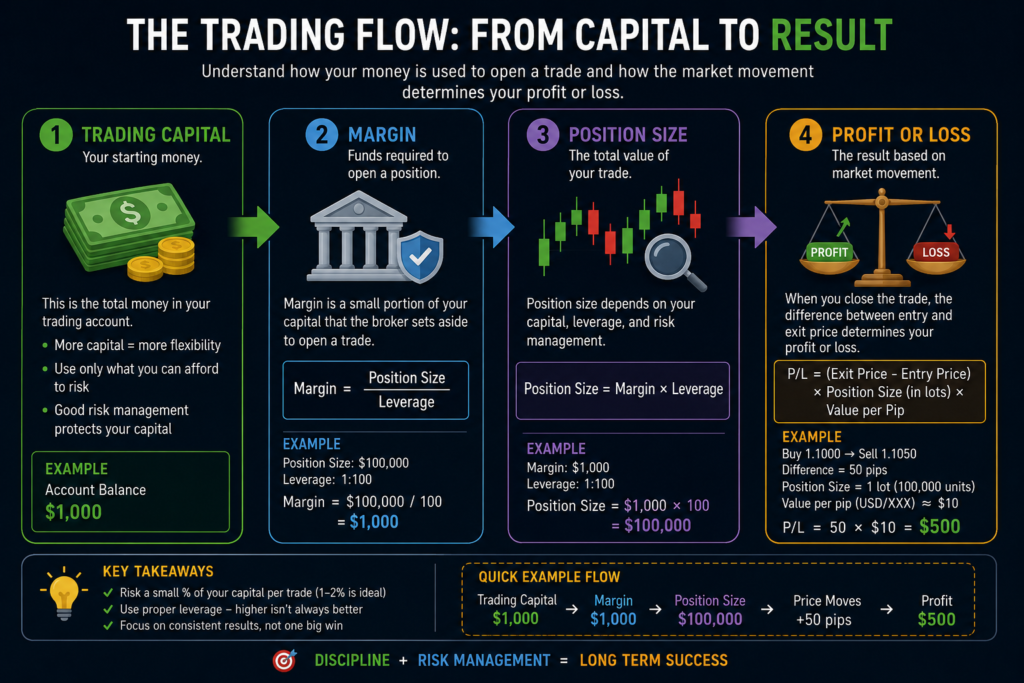
Before deciding how much money you need to start Forex trading, it is important to understand how trading capital works.
Trading capital refers to the money you deposit into your trading account. This money serves as your working capital and allows you to open and manage trades in the Forex market. Before deciding how much money to deposit, it is important to understand What Is Leverage in Forex? because leverage directly affects your buying power and risk exposure.
Unlike many traditional investments, Forex trading uses leverage, which means traders can control positions that are much larger than their account balances. For example, if a broker offers leverage of 1:100, a trader with $100 can potentially control a trading position worth $10,000.
While this may sound attractive, leverage should not be confused with free money. Leverage increases both profit potential and risk. A larger position can generate bigger gains, but it can also lead to larger losses.
Your trading capital performs several important functions:
- It acts as collateral for your trades.
- It determines how much risk you can take.
- It helps you withstand losing streaks.
- It influences your position size and flexibility.
A common misconception among beginners is that more capital automatically guarantees more profits. In reality, profitable trading depends more on skill, discipline, and risk management than on account size.
For example:
Trader A starts with $5,000 but risks too much and trades emotionally.
Trader B starts with $500, follows a trading plan, and manages risk carefully.
Over time, Trader B may outperform Trader A because successful trading is built on consistency rather than account size.
This is why beginners should view their initial trading capital as learning capital rather than income-producing capital. The primary goal during the early stages of trading should be developing skills and protecting capital while gaining experience.
Can You Start Forex Trading with $10?
Technically, yes.
Many brokers now offer micro accounts and cent accounts that allow traders to start with as little as $10.
However, starting with such a small amount comes with limitations.
With only $10 in your account:
- Risk management becomes difficult.
- Position sizes are extremely limited.
- A few losing trades can significantly reduce your account balance.
- Emotional pressure may increase because every dollar matters.
Some beginners are attracted to videos and social media posts showing people turning $10 into hundreds or thousands of dollars. While this may occasionally happen, it is extremely risky and not a realistic expectation for most traders. Many beginners lose money because they try to grow small accounts too quickly. Learn how to avoid these errors in Forex Trading Mistakes: 10 Costly Beginner Errors and How to Avoid Them.
Successful trading is generally built through consistency and discipline rather than attempting to turn small amounts into large fortunes quickly.
Starting with $10 can still have value if your goal is:
- Learning how trading platforms work
- Understanding order execution
- Practicing emotional control
- Experiencing real market conditions with minimal financial risk
Think of a $10 account as an educational tool rather than an opportunity to generate significant income.
Can You Start Forex Trading with $100?
Yes.
A $100 account is one of the most common starting points for beginner traders.
Compared to a $10 account, $100 provides greater flexibility and allows traders to practice more realistic risk management techniques.
With $100, beginners can:
- Open small positions
- Practice using stop-loss orders
- Learn proper position sizing
- Experience market fluctuations
- Build trading discipline
However, beginners should have realistic expectations.
A $100 account is unlikely to produce large monthly profits. Attempting to generate substantial income from such a small account often encourages traders to use excessive leverage and take unnecessary risks.
For example:
If you follow the 1% risk management rule:
Account balance: $100
Maximum risk per trade: $1
This may not sound exciting, but protecting your capital is one of the most important habits a trader can develop.
A $100 account should primarily be viewed as a learning account designed to help traders gain experience and develop consistency.
Can You Start Forex Trading with $500?
Absolutely.
Many experienced traders consider $500 to be a more practical starting point for beginners.
A $500 account provides:
- More flexibility
- Better risk management opportunities
- Greater ability to withstand losses
- Reduced emotional pressure
- More realistic position sizing
For example:
Account balance: $500
1% risk per trade: $5
Although $5 per trade may still seem small, it allows beginners to practice proper money management while gaining valuable experience.
A $500 account also reduces the temptation to take excessive risks simply to generate meaningful returns.
More importantly, it provides enough room to make mistakes and learn from them without immediately wiping out the account.
Beginners should still approach a $500 account with realistic expectations.
The objective should be:
- Learning consistently
- Protecting capital
- Building confidence
- Developing profitable habits
The money earned during this stage is often less important than the skills acquired.
Can You Start Forex Trading with $1,000 or More?
Yes, and many traders consider this a comfortable starting amount.
A $1,000 account offers several advantages:
- Greater flexibility
- Improved risk management
- Lower emotional stress
- More trading opportunities
- Better ability to withstand market fluctuations
Following the 1% risk rule:
Account balance: $1,000
Maximum risk per trade: $10
This allows traders to participate more comfortably while maintaining disciplined risk management practices.
A $1,000 account also allows traders to think longer term. Instead of chasing unrealistic profits, they can focus on gradual account growth and skill development.
However, having a larger account does not automatically guarantee success.
Many traders lose thousands of dollars because they:
- Overtrade
- Ignore risk management
- Use excessive leverage
- Trade emotionally
- Lack a trading plan
The market rewards discipline, not account size.
A skilled trader with $500 may outperform an undisciplined trader with $10,000.
The Role of Leverage in Forex Trading
Leverage is one of the unique features that makes Forex trading accessible to people with relatively small amounts of capital.
Leverage allows traders to control larger market positions than their account balance would normally permit.
For example:
Leverage: 1:100
Trading capital: $100
Potential buying power: $10,000
Because of leverage, beginners often believe they can make substantial profits from very small accounts.
While leverage can increase profit potential, it also magnifies losses.
For example:
A small market movement against your position may result in losses that are significantly larger than expected.
This is why leverage is often described as a double-edged sword.
Used responsibly, leverage can improve capital efficiency.
Used recklessly, leverage can quickly destroy a trading account.
Many beginner traders fail because they confuse leverage with guaranteed profits. Instead of using leverage conservatively, they take oversized positions and expose themselves to unnecessary risks.
Professional traders generally use leverage carefully and prioritize capital preservation above everything else.
Why Risk Management Matters More Than Account Size
One of the biggest lessons in Forex trading is that account size matters far less than risk management.
You can start with $100, $500, or even $10,000 and still lose money if you fail to manage risk properly.
Risk management is the process of protecting your trading capital by controlling potential losses.
Successful traders understand that losses are part of trading. Their goal is not to avoid losses entirely but to ensure that no single trade can significantly damage their account.
Good risk management practices include:
- Using stop-loss orders
- Limiting risk per trade
- Avoiding excessive leverage
- Maintaining proper position sizes
- Following a trading plan
Consider these two traders:
Trader A starts with $5,000 and risks 30% on every trade.
Trader B starts with $500 and risks only 1% per trade.
Despite having less capital, Trader B may survive and grow consistently while Trader A quickly depletes the account.
This illustrates a simple but powerful truth:
In Forex trading, protecting your capital is more important than having a large account balance.
Your first goal as a beginner should not be making money quickly.
Your first goal should be learning how to stay in the market long enough to develop the knowledge, discipline, and experience necessary for long-term success.
Common Mistakes Beginners Make When Funding Their Forex Accounts
Many beginner traders lose money not because they started with too little capital, but because they make poor decisions when funding and managing their trading accounts. Understanding these mistakes can help you avoid unnecessary losses and build a stronger foundation for your trading journey.
Starting with Money You Cannot Afford to Lose
One of the biggest mistakes beginners make is depositing money that they need for essential expenses such as rent, school fees, food, or emergency savings.
Forex trading carries significant risks, and losses are part of the learning process. Trading with money you cannot afford to lose creates emotional pressure and often leads to poor decision-making.
Before opening a live account, make sure your trading capital is money that will not affect your financial stability if you lose it.
Expecting to Get Rich Quickly
Social media is filled with stories of traders turning small deposits into large fortunes overnight. These stories often create unrealistic expectations.
Many beginners deposit small amounts such as $50 or $100 and immediately try to make thousands of dollars within a few weeks. To achieve these unrealistic goals, they often use excessive leverage and take unnecessary risks.
Successful trading is usually a gradual process that requires patience, discipline, and continuous learning.
Depositing Too Much Too Soon
Some beginners make the opposite mistake by depositing large amounts of money before understanding how the market works.
Having more money in your account does not automatically make you a better trader. In fact, larger accounts can sometimes lead to larger losses when traders lack proper education and risk management skills.
It is generally better to start small, gain experience, and gradually increase your capital as your knowledge and confidence improve.
Ignoring Risk Management
Many beginners focus entirely on profits while neglecting risk management.
They enter trades without stop-loss orders, risk large portions of their accounts on single trades, and fail to consider the consequences of losing.
Professional traders understand that protecting capital is their first priority. Managing risk effectively helps traders survive difficult market conditions and stay in the game long enough to improve their skills.
Overtrading Small Accounts
A small account often creates the temptation to trade frequently in an attempt to grow the account quickly.
Overtrading usually leads to:
- Poor-quality trades
- Emotional decisions
- Excessive transaction costs
- Increased stress
- Unnecessary losses
Remember that trading more frequently does not necessarily lead to better results. Sometimes the best decision is to wait patiently for high-quality opportunities.
How Much Money Should Beginners Start With?
There is no perfect amount of money that guarantees success in Forex trading. The ideal starting amount depends on your financial situation, goals, and risk tolerance.
However, beginners should focus less on finding the perfect deposit amount and more on building proper trading habits.
Starting with $10 to $100
This amount can be useful if your primary goal is education and practice.
Advantages:
- Minimal financial risk
- Opportunity to experience real market conditions
- Helps build confidence gradually
Limitations:
- Limited flexibility
- Higher emotional pressure
- Smaller profit potential
- Difficult to apply certain risk management strategies
Starting with $500
Many traders consider $500 a practical starting point for beginners.
Advantages:
- More flexibility
- Better position sizing
- Improved risk management
- Less pressure to overtrade
This amount allows beginners to practice responsible trading while keeping financial risk relatively manageable.
Starting with $1,000 or More
A larger account balance provides greater flexibility and can reduce emotional pressure.
Advantages:
- Greater ability to withstand losses
- More trading opportunities
- Better implementation of risk management strategies
- More realistic profit expectations
However, a larger account should never replace proper education and discipline.
A Practical Recommendation for Beginners
For most beginners, the primary objective should not be making large profits immediately.
Instead, focus on:
- Learning how the market works
- Understanding technical and fundamental analysis
- Developing a trading plan
- Practicing risk management
- Building emotional discipline
Many successful traders spent months or even years developing their skills before consistently making profits.
Your first deposit should be viewed as an investment in your education rather than a shortcut to financial freedom.
Beginner Checklist Before Depositing Money
Before opening a live trading account, ask yourself the following questions:
✅ Do I understand how Forex trading works?
✅ Have I practiced on a demo account?
✅ Do I understand leverage and its risks?
✅ Can I read basic Forex charts?
✅ Do I know how to use stop-loss orders?
✅ Do I have a trading plan?
✅ Am I using money I can afford to lose?
✅ Am I prepared to learn patiently and manage my expectations?
If you can answer “yes” to most of these questions, you are in a much better position to begin your Forex trading journey responsibly. Successful traders regularly track important economic events that affect currency prices because major news announcements can significantly influence market volatility. Before funding a live account, beginners should learn What Is Technical Analysis? so they can understand charts, trends, and market behavior.
Final Thoughts
Forex trading is one of the few financial markets where you can start with a relatively small amount of money. Depending on your broker, it is possible to begin trading with as little as $10, $50, or $100. However, the amount of money you start with is far less important than how you manage it.
Many beginners believe they need a large account to succeed, while others think they can turn a small deposit into a fortune overnight. In reality, successful trading is built on education, discipline, patience, and proper risk management.
Whether you start with $100, $500, or $1,000, your initial focus should be on learning the market, protecting your capital, and developing consistent trading habits. Every successful trader was once a beginner who had to learn through practice and experience.
Remember that Forex trading is a marathon, not a sprint. Building knowledge and preserving your capital today can create opportunities for long-term growth and success in the future.
Disclaimer
The information provided in this article is for educational purposes only and should not be considered financial or investment advice. Forex trading involves significant risk and may not be suitable for all investors. Past performance does not guarantee future results. Always conduct your own research, use proper risk management techniques, and never trade with money that you cannot afford to lose. Before depositing money into a live account, every beginner should spend time understanding the risks of Forex trading and the potential for losses.