Introduction
Artificial intelligence is changing cybersecurity in two important ways. On one side, organizations can use AI to detect suspicious activity, analyze large amounts of security data, identify potential threats, and respond to certain incidents faster. On the other side, attackers can also misuse AI to make phishing messages more convincing, create deceptive content, automate parts of attacks, and search for weaknesses more efficiently.
This creates an important cybersecurity challenge:
AI can strengthen cyber defense, but it can also increase cyber risks.
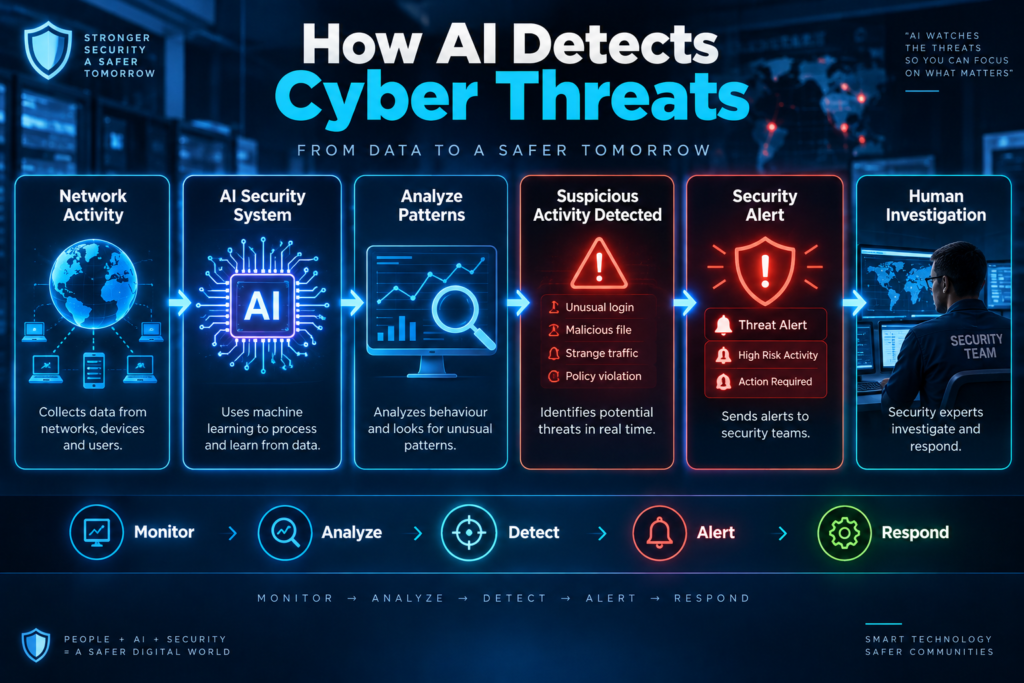
For example, a cybersecurity system could use AI to identify unusual login activity and alert a security team before serious damage occurs. At the same time, a criminal could use generative AI to create convincing phishing emails designed to trick employees into revealing sensitive information.
As AI becomes more widely used in businesses, schools, governments, financial services, and everyday digital tools, understanding these opportunities and risks becomes increasingly important.
In this beginner-friendly guide, we’ll explain AI cybersecurity, how artificial intelligence can improve cyber defense, the risks associated with AI-powered attacks, and practical ways individuals and organizations can use AI more securely.
What Is AI Cybersecurity?
AI cybersecurity refers to the use of artificial intelligence and machine learning technologies to help protect computers, networks, applications, and data from cyber threats.
Traditional cybersecurity systems often depend on predefined rules and known threat patterns. For example, antivirus software may detect a malicious file because it matches the signature of malware that security researchers have already identified.
AI can add another layer by analyzing large amounts of data and identifying unusual patterns that may indicate a potential threat.
A simple way to understand it is:
Cybersecurity Data → AI Analysis → Suspicious Activity Detected → Alert or Response → Human Review
For example, imagine an employee normally logs into a company system from Accra during working hours. If the same account suddenly attempts multiple logins from an unusual location at an unusual time, an AI-assisted security system may flag the behavior for investigation.
What Can AI Do in Cybersecurity?
AI can assist cybersecurity teams with tasks such as detecting unusual network activity, identifying suspicious emails, analyzing malware, monitoring user behavior, prioritizing security alerts, and helping security professionals investigate potential incidents.
However, AI cybersecurity has two sides.
Defenders can use AI to strengthen security, while cybercriminals may misuse AI to create more convincing scams, phishing messages, deepfakes, or other malicious content.
This creates an ongoing competition:
AI for Cyber Defense ↔ AI Misused for Cyberattacks
AI should therefore be viewed as a cybersecurity tool rather than a complete replacement for security professionals. Strong cybersecurity still requires secure systems, good policies, employee awareness, regular updates, access controls, monitoring, and human judgment.
How AI Is Used in Cybersecurity
Cybersecurity systems generate huge amounts of information from network activity, login attempts, emails, devices, applications, and security alerts. AI can help security teams analyze this information faster and identify activity that may require investigation.
Here are some of the main ways AI is used in cybersecurity.
1. Threat Detection
AI can analyze activity across networks and systems to identify unusual patterns that may indicate a cyber threat.
For example:
Normal Activity → AI Monitoring → Unusual Behavior Detected → Security Alert → Human Investigation
If an account suddenly attempts hundreds of logins or accesses systems in an unusual way, an AI-assisted security system may flag the activity for further investigation.
2. Phishing and Email Security
Phishing attacks often use emails or messages designed to trick people into clicking malicious links, opening harmful attachments, or revealing sensitive information.
AI-assisted email security can analyze signals such as message content, sender behavior, links, and patterns associated with suspicious messages.
A potential workflow is:
Incoming Email → Security Analysis → Suspicious Indicators Detected → Email Flagged/Blocked → User or Security Team Alerted
However, AI detection is not perfect, so employee awareness remains important.
3. Malware Detection
Traditional antivirus tools often rely partly on known malware signatures. AI and machine learning can also help analyze characteristics and behavior that may indicate malicious software, including threats that do not exactly match previously identified samples.
This can help security teams investigate suspicious files and activity more efficiently.
4. Fraud and Suspicious Activity Detection
AI can help organizations identify unusual behavior associated with possible fraud.
For example, a system might notice:
Unusual Login → Unexpected Transaction Pattern → Risk Detected → Additional Verification
This can be particularly useful where organizations must analyze large volumes of activity quickly.
5. Security Alert Prioritization
Large organizations may receive many security alerts every day. Investigating every alert with equal priority can be difficult.
AI can assist by analyzing and prioritizing alerts so cybersecurity professionals can focus on potentially serious threats first.
6. Incident Response
When a potential cyberattack occurs, speed matters.
AI-assisted security systems may help collect relevant information, summarize alerts, identify affected systems, or automate certain predefined defensive actions.
But important responses should still involve appropriate human oversight, particularly when actions could disrupt business systems or legitimate users.
AI Supports Security Professionals
The most effective model is not:
❌ AI Replaces Cybersecurity Professionals
Instead:
AI Detection + Security Automation + Human Expertise = Stronger Cyber Defense
AI can process large amounts of information quickly, while cybersecurity professionals provide the context, judgment, investigation, and decision-making required to respond appropriately.
This leads to one of AI’s biggest advantages in cybersecurity: its potential to help organizations detect threats faster and improve their defensive capabilities.
Opportunities and Benefits of AI in Cybersecurity
AI creates several opportunities for improving cybersecurity. Its biggest advantage is the ability to analyze large amounts of security data quickly and help identify suspicious activity that humans may struggle to monitor manually.
1. Faster Threat Detection
AI can continuously analyze network traffic, login activity, device behavior, and other security signals. When unusual patterns appear, the system can flag them for investigation.
This can help organizations detect potential threats earlier.
2. Improved Detection of Unusual Behavior
Some cyberattacks do not exactly match previously known threats. Machine learning can help identify behavior that differs from normal activity.
For example, if an employee account suddenly downloads unusually large amounts of sensitive data, the system may recognize the activity as suspicious.
3. Security Automation
AI can help automate repetitive cybersecurity tasks such as analyzing alerts, classifying suspicious activity, summarizing incidents, and prioritizing potential threats.
This allows cybersecurity professionals to spend more time investigating serious security problems.
4. Better Phishing and Fraud Detection
AI-assisted security tools can analyze emails, transactions, login patterns, and other signals to identify possible phishing or fraudulent activity.
For example:
Suspicious Email → AI Analysis → Risk Detected → Warning or Block → Human Review
5. Faster Incident Response
When an attack occurs, responding quickly can reduce potential damage. AI can help security teams gather information, identify affected systems, prioritize alerts, and support predefined response processes.
6. Managing Large Amounts of Security Data
Modern organizations generate enormous amounts of cybersecurity data. Manually reviewing everything is difficult.
AI can process this information at scale and help security teams identify which events deserve immediate attention.
Key Benefit
The real opportunity is not simply replacing traditional cybersecurity with AI. It is combining both:
AI Speed + Automation + Human Expertise = Stronger Cybersecurity
However, the same capabilities that make AI useful for defenders can also be misused by attackers. This introduces a new set of cybersecurity risks.
Major Cybersecurity Risks Created by AI
While AI can strengthen cybersecurity, it can also give cybercriminals new ways to make attacks faster, more convincing, and harder to detect. The technology itself is not necessarily the threat; the risk often comes from how people misuse it.
1. More Convincing Phishing Attacks
Generative AI can help attackers produce professional-looking phishing emails and messages with fewer spelling and grammar mistakes. The European Union Agency for Cybersecurity (ENISA) has also examined cybersecurity threats affecting AI systems throughout the AI lifecycle.
Instead of an obviously suspicious message, a victim might receive a convincing email that appears to come from a bank, employer, or trusted organization.
AI-Generated Message → Victim Trusts It → Malicious Link → Credentials or Data Stolen
2. Deepfakes and Impersonation
AI can generate realistic-looking images, videos, and voices. Criminals may misuse these capabilities to impersonate executives, relatives, public figures, or other trusted people.
For example, an employee could receive a fake voice message appearing to come from a manager requesting an urgent payment.
3. AI-Assisted Malware and Cyberattacks
Attackers may use AI tools to assist with parts of malicious activity, such as researching targets, generating deceptive content, or modifying malicious code.
This could reduce the time and technical effort required for some attacks.
4. Automated Social Engineering
Social engineering attacks manipulate people rather than directly attacking technology.
AI can help criminals create personalized scam messages using information available online, making fraudulent communication appear more believable. For organizations using generative AI, the NIST Generative AI Profile provides additional guidance for identifying and managing risks associated with generative AI systems.
5. Data Privacy Risks
AI systems often process large amounts of information. Employees who paste passwords, confidential business documents, customer information, or other sensitive data into inappropriate AI tools may unintentionally expose that information.
A simple rule is:
Sensitive Data + Unapproved AI Tool = Potential Security Risk
6. False Positives and Incorrect Decisions
AI security systems are not perfect. They may incorrectly classify legitimate activity as dangerous or fail to identify a genuine threat.
Organizations should therefore avoid depending entirely on automated decisions for critical cybersecurity situations.
7. Attacks Against AI Systems
AI systems themselves can become targets. Attackers may attempt to manipulate inputs, steal sensitive model or application data, exploit insecure integrations, or interfere with how an AI-enabled system behaves.
The Main Risk
The cybersecurity challenge is becoming increasingly two-sided:
Cyber Defenders + AI 🛡️ ↔ AI + Cybercriminals ⚠️
This is why organizations need more than AI tools. Strong passwords, multi-factor authentication, software updates, employee awareness, access controls, backups, monitoring, and human oversight remain essential parts of cybersecurity.
AI in Cyberattacks vs AI in Cyber Defense
Artificial intelligence has created a new cybersecurity environment where both defenders and attackers can use AI capabilities. The difference lies in how the technology is applied.
AI in Cyber Defense 🛡️
Organizations can use AI to strengthen security by helping them:
- Detect unusual network activity.
- Identify suspicious emails and phishing attempts.
- Analyze large numbers of security alerts.
- Detect possible fraud or unauthorized access.
- Support faster incident investigation and response.
- Monitor systems for abnormal behavior.
For example, AI may detect several unusual login attempts and immediately flag the account for investigation before more serious damage occurs.
AI in Cyberattacks ⚠️
Cybercriminals can also misuse AI to improve parts of their attacks. Examples include:
- Creating convincing phishing emails.
- Generating fake voices, images, or videos for impersonation.
- Personalizing social engineering scams.
- Automating research about potential targets.
- Assisting with malicious code or attack preparation.
- Producing large amounts of deceptive content quickly.
This can make some attacks faster, cheaper, and more convincing.
Quick Comparison
| AI for Cyber Defense | AI Misused in Cyberattacks |
|---|---|
| Threat detection | Phishing and scams |
| Fraud detection | Social engineering |
| Malware analysis | Assistance with malicious activity |
| Security monitoring | Deepfake impersonation |
| Alert prioritization | Automated target research |
| Incident-response support | Large-scale deceptive content |
The cybersecurity landscape can therefore be summarized as:
AI-Powered Attack ⚠️ → Detection & Analysis → AI-Assisted Defense 🛡️ → Human Decision
The goal should not be to depend entirely on AI. Organizations need to combine AI capabilities, traditional security controls, trained cybersecurity professionals, and human judgment to build stronger defenses.
How Businesses and Individuals Can Use AI Safely
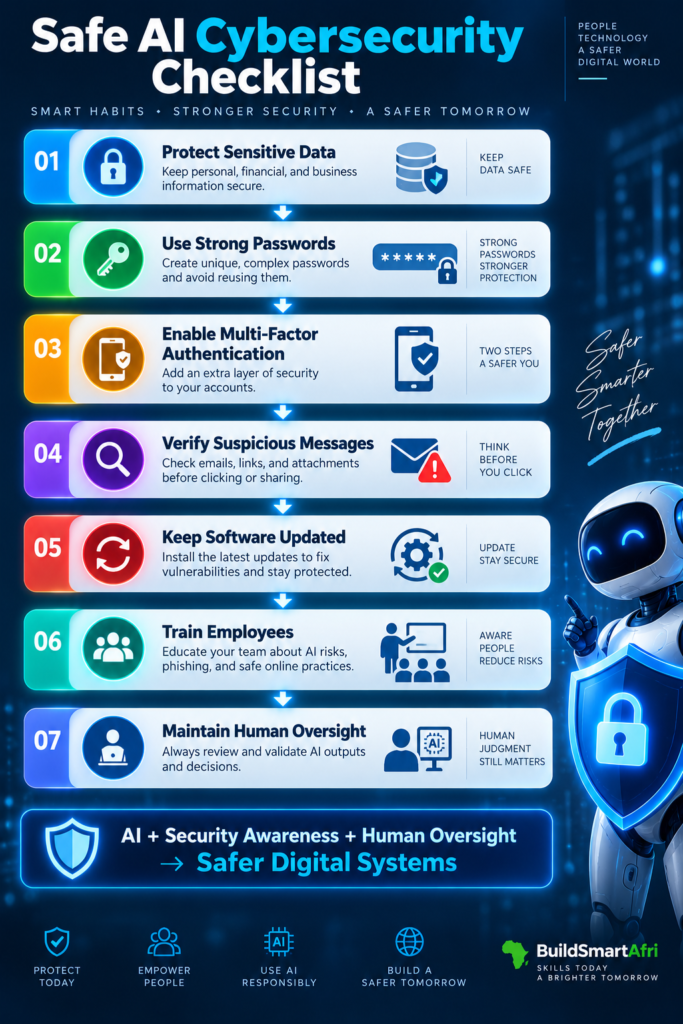
AI can improve cybersecurity, but it should be used alongside strong security practices. Both businesses and individuals can reduce AI-related risks by following a few important steps.
1. Protect Sensitive Information
Avoid entering passwords, financial details, confidential company information, customer records, or other sensitive data into AI tools unless the tool is approved for that purpose and appropriate protections are in place.
2. Use Strong Account Security
Protect important accounts with strong, unique passwords and enable multi-factor authentication (MFA) whenever possible. This adds another layer of protection if a password is stolen.
3. Verify Suspicious Messages
AI can make phishing emails, fake messages, voices, and images more convincing. Do not automatically trust a message simply because it looks professional.
Before sending money or sharing sensitive information, verify unusual requests through another trusted communication method.
4. Keep Software Updated
Regularly update operating systems, browsers, applications, security tools, and other software. Updates often contain fixes for known security vulnerabilities.
5. Train Employees
Businesses should educate employees about phishing, deepfakes, social engineering, password security, and responsible AI use. Human awareness remains an important defense against cyberattacks. Businesses can also use the NIST Cybersecurity Framework as a reference for understanding and improving how they manage cybersecurity risks.
6. Maintain Human Oversight
Organizations should not allow AI to make every critical cybersecurity decision automatically. Businesses using AI should establish clear rules covering which AI tools employees can use, what information can be shared with them, who has access, and how AI-generated outputs should be reviewed. NIST AI Risk Management Framework
A safer approach is:
AI Detects → Security Team Reviews → Decision Made → Action Taken
7. Create an AI Security Policy
Businesses using AI should establish clear rules covering which AI tools employees can use, what information can be shared with them, who has access, and how AI-generated outputs should be reviewed.
Ultimately, AI should strengthen existing cybersecurity practices rather than replace them.
Strong Security Controls + AI Tools + Employee Awareness + Human Oversight = Safer AI Use
The Future of AI and Cybersecurity
As artificial intelligence continues to improve, it will likely become an increasingly important part of both cyber defense and cyber threats.
Cybersecurity teams can use more advanced AI systems to analyze threats, detect unusual behavior, investigate security incidents, and respond to attacks more efficiently. This could help organizations identify certain threats before they cause serious damage.
At the same time, cybercriminals may continue using AI to make phishing, impersonation, social engineering, and other attacks more convincing and scalable.
What We Can Expect
The future of AI cybersecurity will likely involve:
- Faster threat detection through AI-assisted monitoring.
- More automated security operations for repetitive tasks.
- Improved fraud and anomaly detection.
- More sophisticated phishing and deepfake scams.
- Greater demand for professionals with both AI and cybersecurity skills.
- Stronger policies and security controls around organizational AI use.
Humans Will Still Matter
Even with advanced AI, human expertise will remain essential. AI systems can produce incorrect results, miss threats, or flag legitimate activity as suspicious.
The strongest approach will therefore combine technology with people:
AI + Cybersecurity Tools + Skilled Professionals + Human Judgment = Stronger Digital Security
The future of cybersecurity is unlikely to be humans versus AI. Instead, it will increasingly depend on how effectively humans use AI while managing the new risks it creates.
For businesses and individuals, the goal should be simple: take advantage of AI’s security benefits without ignoring its cybersecurity risks.
Frequently Asked Questions About AI Cybersecurity
1. What is AI cybersecurity?
AI cybersecurity is the use of artificial intelligence and machine learning to support cybersecurity activities, such as detecting suspicious behavior, analyzing threats, identifying fraud, and prioritizing security alerts.
2. How does AI improve cybersecurity?
AI can analyze large amounts of security data quickly and identify unusual patterns that may indicate an attack. It can also help automate repetitive security tasks and support faster threat detection and incident investigation.
3. Can hackers use AI for cyberattacks?
Yes. Cybercriminals can misuse AI to create more convincing phishing messages, impersonation scams, deepfake content, automated social engineering, and to assist with other malicious activities.
4. Can AI completely replace cybersecurity professionals?
No. AI can assist cybersecurity professionals, but human expertise and judgment remain essential. AI systems can make mistakes, generate false alerts, or fail to understand the full context of a security incident.
5. What are the biggest risks of AI in cybersecurity?
Major risks include AI-generated phishing, deepfake impersonation, privacy problems, automated scams, AI-assisted attacks, and over-reliance on automated security decisions.
6. How can businesses protect themselves from AI-related cyber threats?
Businesses should combine AI security tools with strong passwords, multi-factor authentication (MFA), regular software updates, employee cybersecurity training, access controls, secure data practices, and human oversight.
7. Is AI good or bad for cybersecurity?
AI can be both an opportunity and a risk. When used responsibly, it can strengthen cyber defense. When misused by attackers, it can make certain cyber threats more scalable and convincing.
Final Thoughts
Artificial intelligence is becoming an important part of modern cybersecurity. It can help organizations detect suspicious activity, analyze threats, automate repetitive security tasks, identify fraud, and respond to potential incidents more efficiently.
However, AI also introduces new risks. Cybercriminals can misuse it to create more convincing phishing attacks, deepfakes, impersonation scams, social engineering campaigns, and other cyber threats.
The key lesson is that AI is not automatically good or bad for cybersecurity—it depends on how it is used.
A strong cybersecurity approach combines:
AI Technology + Security Controls + Cybersecurity Awareness + Human Expertise = Stronger Protection
Businesses and individuals should take advantage of AI’s benefits while continuing to protect sensitive information, use multi-factor authentication, update software, verify suspicious communications, and maintain human oversight.
As AI continues to evolve, understanding both its opportunities and risks will become increasingly important for staying safe in the digital world.
Take the Next Step
Want to understand AI beyond cybersecurity? Explore more beginner-friendly artificial intelligence, digital skills, and technology guides on BuildSmartAfri to learn how AI is changing the way we work, learn, and do business.
Disclaimer
This article is for educational and informational purposes only. It does not provide professional cybersecurity, legal, or technical advice. Cybersecurity threats and AI technologies change rapidly, so individuals and organizations should consult qualified cybersecurity professionals when dealing with serious security risks or incidents.