
Introduction:
Demo Trading vs Live Trading: Which Should Beginners Start With?
One of the biggest questions new Forex traders ask is:
Should I start with a demo account or begin trading with real money immediately?
The answer to this question can significantly influence your learning experience, confidence, and long-term success as a trader. Since Forex trading involves both technical skills and emotional discipline, many beginners struggle to decide whether they should start with a demo account or a live account.
Many beginners are eager to start making money and jump directly into live trading without understanding how the Forex market works. Others spend months practicing on demo accounts but never transition to real trading because they feel unprepared.
Both approaches have advantages and disadvantages.
Forex trading is more than simply buying and selling currencies. Successful trading requires knowledge, discipline, risk management, emotional control, and practical experience. Developing these skills takes time.
This is where demo accounts and live accounts become important.
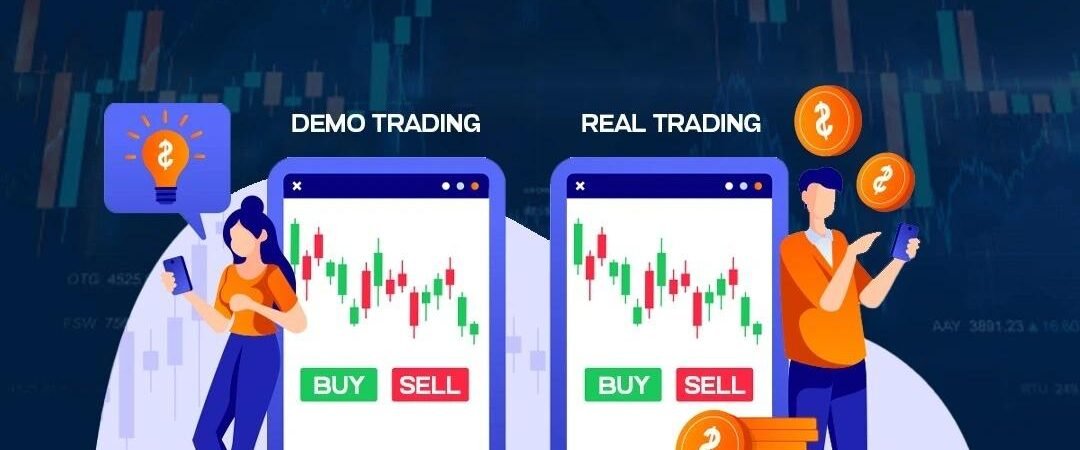
A demo account allows traders to practice in a simulated market environment using virtual money. It provides an opportunity to learn trading platforms, test strategies, and gain experience without risking real funds.
A live account, on the other hand, involves trading with actual money. Every decision carries real financial consequences, and traders experience the emotional pressures that accompany gains and losses.
Understanding the differences between demo trading and live trading can help beginners make informed decisions and avoid unnecessary mistakes.
Imagine two beginner traders.
Sarah opens a demo account and spends several weeks learning how to use trading platforms, understand charts, and practice risk management.
Michael immediately opens a live account because he wants to start making money quickly.
Within a few weeks, Sarah becomes comfortable placing trades and managing risks.
Meanwhile, Michael becomes frustrated after making emotional decisions and losing money because he did not fully understand the market.
Although both traders started at the same time, their learning experiences are completely different.
This example highlights an important lesson:
Learning before risking real money often provides a stronger foundation for long-term trading success.
However, this does not necessarily mean beginners should remain on demo accounts forever.
The key question is not whether demo trading or live trading is better.
The real question is:
Which one should beginners start with, and when should they transition from practice to real trading?
In this guide, you will learn:
- What demo trading is
- What live trading is
- The advantages and disadvantages of each
- The psychological differences between demo and live accounts
- Common beginner mistakes
- How long beginners should practice on demo accounts
- When to transition to live trading
- Practical examples and frequently asked questions
- A beginner roadmap for starting Forex trading responsibly
By the end of this guide, you will understand how to use both demo trading and live trading effectively as part of your Forex learning journey.
What Is Demo Trading?
Demo trading refers to practicing in financial markets using virtual money instead of real money.
Most Forex brokers provide free demo accounts that simulate real market conditions and allow beginners to experience trading without financial risk.
A demo account usually provides access to:
- Real-time price charts
- Trading platforms
- Technical indicators
- Order execution tools
- Risk management features
- Market analysis tools
The major difference is that the money being traded is not real.
Why Demo Accounts Exist
Forex trading involves many concepts that can feel overwhelming for beginners.
New traders must learn:
- Currency pairs
- Price movements
- Charts
- Trading platforms
- Order types
- Risk management
- Position sizing
- Trading psychology
Learning all these concepts while simultaneously risking real money can be stressful.
Demo accounts provide a safe environment where traders can practice and make mistakes without financial consequences.
Practical Example
Suppose you open a demo account with $10,000 in virtual funds.
You decide to buy EUR/USD.
The market moves higher, and your virtual account shows a profit.
Later, you open another trade and experience a loss.
Throughout this process, you are learning:
- How trades are executed
- How profits and losses work
- How stop-loss orders function
- How market prices move
Even though the money is virtual, the learning experience can be extremely valuable.
Advantages of Demo Trading
1. No Financial Risk
The biggest advantage of demo trading is that mistakes do not cost real money. Demo accounts give traders an opportunity to practice risk management principles and understand how to protect their capital before trading with real money
Beginners can:
- Experiment with strategies
- Learn platform functions
- Practice placing trades
- Make mistakes and learn from them
without risking their savings.
This allows traders to focus on learning rather than worrying about losses.
2. Learn How Trading Platforms Work
Trading platforms can initially feel confusing.
Beginners need time to understand:
- Charts
- Indicators
- Buy and sell buttons
- Stop-loss orders
- Take-profit orders
- Account management tools
Demo accounts allow traders to become comfortable with these features.
Practical Example
Imagine accidentally placing a trade that is much larger than intended.
On a demo account, the mistake becomes a learning experience rather than a financial disaster.
3. Test Trading Strategies
Every trader eventually needs a trading strategy.
A demo account provides an excellent environment for testing:
- Trend-following strategies
- Breakout strategies
- Support and resistance strategies
- Risk management rules
- Entry and exit techniques
Strategies should be practiced before being applied to real money.
4. Build Confidence
Confidence develops through repetition and experience.
Each trade placed on a demo account improves familiarity with:
- Market movements
- Platform functions
- Decision-making processes
- Risk management principles
As experience increases, beginners often feel more prepared for real trading.
5. Develop Good Habits
Successful trading depends heavily on discipline.
Demo accounts help beginners practice:
- Patience
- Following trading plans
- Risk management
- Trade journaling
- Reviewing performance
Developing these habits early can benefit traders later when real money becomes involved.
Disadvantages of Demo Trading
Although demo trading offers many benefits, it also has limitations.
Many beginners become comfortable using demo accounts but struggle when they transition to live trading. Understanding these limitations can help traders use demo accounts effectively while preparing for real-market conditions.
1. There Are No Real Financial Consequences
The biggest limitation of demo trading is that the money is not real.
Because there is no financial risk, traders often behave differently than they would with actual money.
Practical Example
Suppose you have $10,000 in virtual funds.
You decide to risk $1,000 on a single trade.
If the trade loses money, there are no real consequences because the funds are virtual.
However, if that $1,000 were real money, your emotions and decision-making process would likely be very different.
This is why some traders perform exceptionally well on demo accounts but struggle when they begin trading live.
2. Demo Trading Cannot Fully Teach Emotional Control
Trading psychology is one of the most important skills in Forex.
Emotions often influence decision-making more than technical knowledge.
Common trading emotions include:
- Fear
- Greed
- Anxiety
- Excitement
- Frustration
- Overconfidence
A demo account cannot fully replicate these emotions because no real money is involved.
Practical Example
Imagine placing a trade on your demo account.
The market moves against you by 100 pips.
You remain calm because no money is actually being lost.
Now imagine the same trade using your savings.
Suddenly, your emotions become much stronger.
You may:
- Panic and close the trade too early
- Remove your stop-loss
- Increase your position size
- Make impulsive decisions
This emotional pressure simply cannot be fully experienced on a demo account.
3. Unrealistic Risk-Taking
Because demo money feels unlimited, many beginners develop bad habits.
Some traders:
- Open excessively large positions
- Ignore risk management rules
- Overtrade
- Place random trades
- Chase unrealistic profits
These habits can become dangerous when transitioning to live trading.
Practical Example
A beginner turns a $10,000 demo account into $50,000 within a few weeks by taking extremely large risks.
They become confident and believe they are ready for live trading.
However, when trading real money, the same risky behavior quickly leads to losses.
This happens because demo success does not always reflect real trading discipline.
4. Demo Trading May Create False Confidence
Performing well on a demo account can sometimes create the illusion that trading is easy.
The absence of emotional pressure often makes decision-making feel simple.
Practical Example
A beginner achieves consistent profits on a demo account and immediately believes they have mastered Forex trading.
They switch to live trading and suddenly experience:
- Fear of losing money
- Hesitation
- Emotional stress
- Difficulty following their trading plan
The trader quickly realizes that trading with real money feels completely different.
Confidence built on a demo account is valuable, but it should always be accompanied by realistic expectations.
What Is Live Trading?
Live trading refers to buying and selling currencies using real money.
Every decision made in a live account has genuine financial consequences.
Profits are real.
Losses are also real.
A live trading account typically provides:
- Real-time market access
- Trading platforms
- Charting tools
- Technical indicators
- Order execution features
- Deposit and withdrawal options
From a technical perspective, live accounts and demo accounts often appear similar.
The major difference is psychological.
In live trading, every trade affects your actual finances.
Why Live Trading Is Different
When real money is involved, traders experience emotions that cannot be fully replicated in a practice environment.
These emotions influence:
- Decision-making
- Discipline
- Risk tolerance
- Confidence
- Patience
Practical Example
Suppose you deposit $500 into a live trading account.
You decide to risk 2% on a trade.
Maximum Risk:
$500 × 2% = $10
The market begins moving against your position.
Even though your planned loss is only $10, you may suddenly feel:
- Nervous
- Frustrated
- Tempted to remove your stop-loss
- Eager to recover losses quickly
These emotional reactions are normal.
Learning to manage them is part of becoming a successful trader.
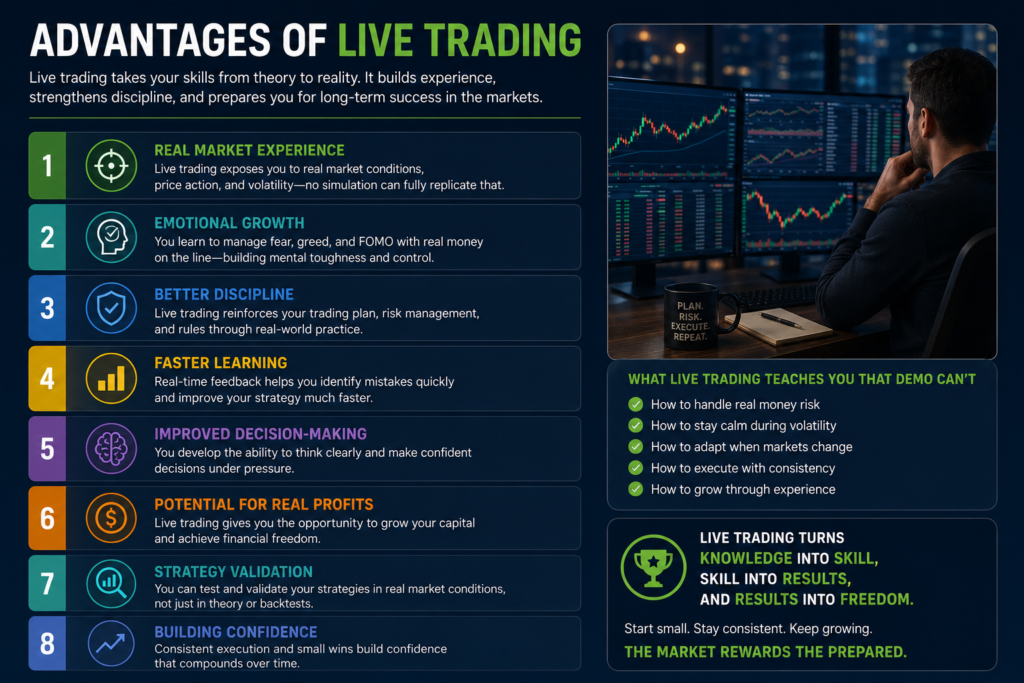
Advantages of Live Trading
1. Teaches Real Trading Psychology
The biggest advantage of live trading is that it exposes traders to genuine emotions.
Traders learn:
- Emotional discipline
- Patience
- Self-control
- Risk management under pressure
- Decision-making with financial consequences
These skills cannot be fully developed through demo trading alone.
2. Encourages Better Risk Management
Real money changes the way traders think about risk.
Because losses have financial consequences, traders often become more cautious and disciplined.
Practical Example
A trader who risks $10 of real money is usually much more careful than someone risking $10 of virtual money.
This encourages responsible decision-making and reinforces proper risk management habits.
3. Builds Real Trading Experience
Experience gained through live trading is extremely valuable.
Traders learn:
- How they react under pressure
- Their personal strengths and weaknesses
- How emotions affect decisions
- The importance of discipline
Every trade becomes a learning opportunity.
4. Creates Accountability
Demo accounts sometimes encourage careless behavior because mistakes have no financial cost.
Live accounts create accountability.
Every decision matters.
Every mistake provides feedback.
Every profit and loss teaches valuable lessons.
This accountability often accelerates personal growth as a trader.
Practical Example: Demo Trading vs Live Trading
Consider two beginners.
Trader A
- Practices for several months on a demo account
- Learns platform functions
- Develops a trading plan
- Practices risk management
- Tests strategies thoroughly
Trader B
- Opens a live account immediately
- Has little market knowledge
- Risks excessive amounts of money
- Makes emotional decisions
- Lacks a structured plan
After several months, Trader A often feels more prepared and confident because they have developed skills before risking real money.
Trader B, however, may experience unnecessary losses and frustration because they entered the market without adequate preparation.
This example demonstrates why many successful traders recommend using demo accounts first and transitioning gradually into live trading.
Disadvantages of Live Trading
While live trading offers valuable learning experiences, it also presents challenges that every beginner should understand before risking real money. Beginners should also understand leverage in Forex trading because leverage can magnify both profits and losses, especially when real money is involved.
1. Emotional Pressure Can Lead to Poor Decisions
The biggest challenge of live trading is the emotional pressure that comes with risking real money.
When money is on the line, even small price movements can trigger strong emotions.
Common emotions include:
- Fear of losing money
- Greed and overconfidence
- Anxiety and stress
- Frustration after losses
- Excitement after wins
These emotions often cause traders to abandon their trading plans.
Practical Example
Suppose you have a $500 trading account.
You risk $10 on a trade.
The market moves against your position.
Although you planned to lose only $10 if the trade fails, you begin to feel uncomfortable.
You may:
- Close the trade too early
- Remove your stop-loss
- Increase your risk
- Enter additional trades impulsively
Emotional trading often leads to unnecessary mistakes.
2. Beginners May Lose Money Quickly
Every beginner makes mistakes.
Without proper preparation, these mistakes can become expensive.
Common beginner mistakes include:
- Trading without a plan
- Risking too much money
- Using excessive leverage
- Overtrading
- Ignoring stop-loss orders
- Trading based on emotions
Practical Example
A beginner deposits $1,000 and risks 20% on every trade.
After several losing trades, a large portion of the account is gone.
The trader becomes discouraged and may quit before developing proper skills.
This is why capital preservation should always be the first priority.
3. Psychological Stress Can Become Overwhelming
Many beginners underestimate how stressful live trading can be.
Watching profits fluctuate and losses occur in real time can create mental pressure.
Some traders experience:
- Difficulty sleeping
- Constant market checking
- Anxiety before placing trades
- Fear of missing opportunities
- Stress after losses
Practical Example
A trader continuously monitors charts throughout the day, worrying about every price movement.
Instead of trading according to their plan, they become emotionally exhausted.
Successful traders learn that managing emotions is just as important as analyzing charts.
Demo Trading vs Live Trading: Key Differences
| Feature | Demo Trading | Live Trading |
|---|---|---|
| Money Used | Virtual money | Real money |
| Financial Risk | None | Real risk |
| Emotions | Limited | High |
| Learning Platforms | Yes | Yes |
| Testing Strategies | Excellent | Yes |
| Building Confidence | Excellent | Yes |
| Developing Emotional Control | Limited | Excellent |
| Real Consequences | None | Yes |

Psychological Differences Between Demo and Live Trading
This is where many beginners struggle. Developing strong trading psychology is essential because emotions such as fear and greed often influence decision-making in live trading environments.
Technically, demo accounts and live accounts may look almost identical.
Psychologically, they are completely different experiences.
Demo Trading Psychology
Because there is no financial risk:
- Fear is minimal
- Confidence is often high
- Decisions feel easier
- Losses seem less important
Live Trading Psychology
Because real money is involved:
- Losses feel painful
- Fear becomes stronger
- Profits create excitement
- Mistakes feel more significant
- Decision-making becomes more difficult
Practical Example
Imagine making a $50 profit.
On a demo account, it feels nice.
On a live account, the same profit may create excitement and overconfidence.
Now imagine losing $50.
On a demo account, it is simply another learning experience.
On a live account, it may create frustration and emotional reactions.
This difference explains why many traders perform well on demo accounts but struggle when they transition to real trading.
When Should Beginners Transition to Live Trading?
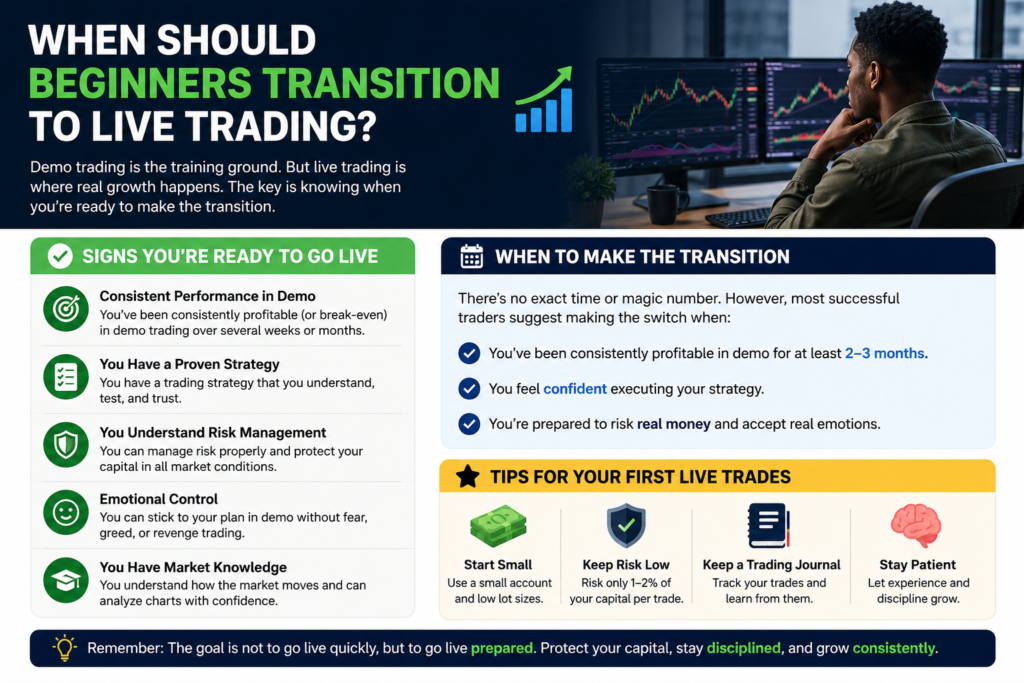
There is no perfect timeline.
Some traders may need several weeks of practice, while others may need several months.
However, beginners should consider moving to live trading only after they can consistently:
✔ Navigate the trading platform confidently
✔ Understand how currency pairs work
✔ Use stop-loss and take-profit orders correctly
✔ Follow a trading plan
✔ Apply risk management rules
✔ Maintain discipline
✔ Demonstrate consistent results on a demo account
A Smart Transition Approach
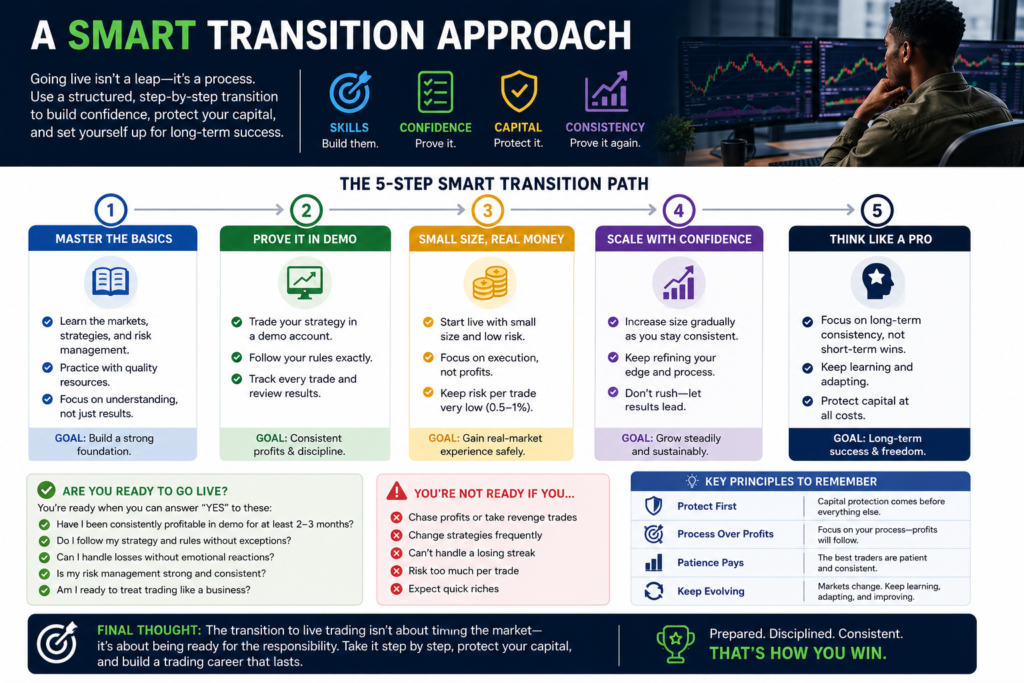
Instead of immediately depositing a large amount of money, consider this gradual approach:
Stage 1: Demo Trading
Focus on:
- Learning the platform
- Understanding the market
- Testing strategies
- Practicing risk management
Stage 2: Small Live Account
Trade with an amount you can comfortably afford to lose.
The goal is not making money quickly.
The goal is learning how emotions affect your decision-making.
Stage 3: Build Experience Gradually
As discipline and consistency improve:
- Continue learning
- Review your performance
- Improve your strategy
- Increase account size gradually
Remember:
Treat your first live account as a learning account, not a get-rich-quick opportunity.
Frequently Asked Questions (FAQ)
Should beginners start with a demo account?
Yes.
A demo account allows beginners to practice and learn without risking real money.
How long should I use a demo account?
There is no fixed timeframe.
Practice until you understand the platform, have a trading plan, and can manage risk consistently.
Is demo trading exactly like live trading?
No.
Market conditions may be similar, but emotions are completely different because demo trading involves virtual money.
Can I become profitable using only a demo account?
Demo accounts help develop skills, but real trading experience is necessary to learn emotional discipline.
How much money should I use when transitioning to live trading?
Start with an amount you can comfortably afford to lose.
Your first goal should be gaining experience, not generating large profits.
Final Thoughts
So, which should beginners start with?
The answer is clear:
Beginners should start with demo trading and then gradually transition to live trading.
Demo accounts provide a safe environment to:
- Learn how Forex works
- Understand trading platforms
- Practice strategies
- Develop risk management habits
- Build confidence
However, demo accounts cannot teach every aspect of trading.
Eventually, every trader must experience real markets and real emotions.
Live trading teaches lessons that cannot be fully replicated in practice environments.
The most effective approach is to use both.
Think of demo trading as learning to drive in an empty parking lot.
Think of live trading as driving on real roads.
Practicing first makes the real experience safer and more manageable.
Remember:
Forex trading is a journey of continuous learning. Success rarely comes from rushing into the market. It comes from preparation, discipline, patience, and consistent improvement over time.
Continue Your Forex Learning Journey
If you found this guide helpful, continue building your trading knowledge with these beginner-friendly resources:
What Is Forex Trading? A Beginner’s Guide
Forex Trading Risks for Beginners
What Is Leverage in Forex Trading?
Risk Management in Forex Trading: The Beginner’s Guide
How Stop-Loss Orders Help Limit Investment Losses and Risk
How to Create a Forex Trading Plan for Beginners
The more you learn and practice, the more prepared you will be to make informed trading decisions.
Start with learning. Practice with purpose. Trade responsibly.
Disclaimer
The information provided in this article is for educational and informational purposes only and should not be considered financial or investment advice.
Forex trading involves significant risk and may not be suitable for every investor. Past performance does not guarantee future results, and there is always the possibility of losing part or all of your invested capital.
Before trading with real money, conduct your own research, understand the risks involved, and consider seeking advice from a qualified financial professional.
Always trade responsibly and never risk money that you cannot afford to lose.