
Introduction:
How to Create Your First Forex Trading Plan: A Step-by-Step Guide for Beginners (2026). Many people enter the Forex market with excitement and high expectations. They spend hours watching YouTube videos, following trading influencers on social media, and searching for strategies that promise quick profits. Some even jump straight into live trading without fully understanding how the market works. Before diving deeper into trading, it is important to understand how the Forex market works, and this guide on Forex market basics provides a clear explanation of how currencies are traded globally and why the market is the largest financial market in the world. Before creating a trading plan, it is important to understand how the Forex market works in general. If you are completely new, you can start with our guide on What is Forex Trading?
Unfortunately, this approach often leads to frustration and losses.
One of the biggest reasons many beginner traders struggle is not because they lack intelligence or motivation. Instead, they lack a structured trading plan.
A Forex trading plan is like a roadmap. Imagine planning a road trip without knowing your destination, the route to take, or the amount of fuel you need. You would likely get lost, waste resources, and become frustrated.
Trading without a plan works in a similar way.
Without clear rules, traders often make decisions based on emotions rather than logic. They enter trades impulsively, hold losing positions for too long, risk too much money on single trades, and constantly switch strategies whenever the market becomes difficult.
Professional traders understand that successful trading is not about predicting every market movement correctly. Instead, it is about having a structured process for making decisions consistently.
A well-designed trading plan provides direction and discipline. It helps traders know:
- Which currency pairs to trade
- When to enter trades
- When to avoid trading
- How much money to risk
- Where to place stop losses
- When to take profits
- How to evaluate and improve performance
A trading plan also helps remove emotions from decision-making. Fear, greed, impatience, and overconfidence are some of the biggest enemies of successful trading. Having clear rules makes it easier to remain disciplined even when markets become volatile.
It is important to understand that a trading plan does not guarantee profits. Losses are a normal part of trading. However, a trading plan can help you manage risks, protect your capital, and improve consistency over time.
Think of your trading plan as your personal business plan for the Forex market. Every professional business operates according to a plan, and successful traders approach trading in exactly the same way.
In this guide, you will learn how to create your first Forex trading plan step by step. By the end of this article, you will understand how to build a simple, practical, and beginner-friendly trading plan that can guide your decisions and support your long-term growth as a trader.

What Is a Forex Trading Plan?
A Forex trading plan is a written set of rules and guidelines that outlines how you will approach the market. It serves as a personal framework that helps you make objective decisions instead of reacting emotionally to market movements.
In simple terms, a trading plan answers important questions such as:
- What are my trading goals?
- Which currency pairs will I trade?
- What trading style suits me?
- What conditions must be present before I enter a trade?
- How much money am I willing to risk?
- When should I exit a trade?
- How will I measure my performance?
A trading plan is not the same as a trading strategy.
A trading strategy focuses specifically on finding trading opportunities. For example, your strategy may involve buying when a moving average crossover occurs or selling when a support level breaks.
A trading plan is much broader.
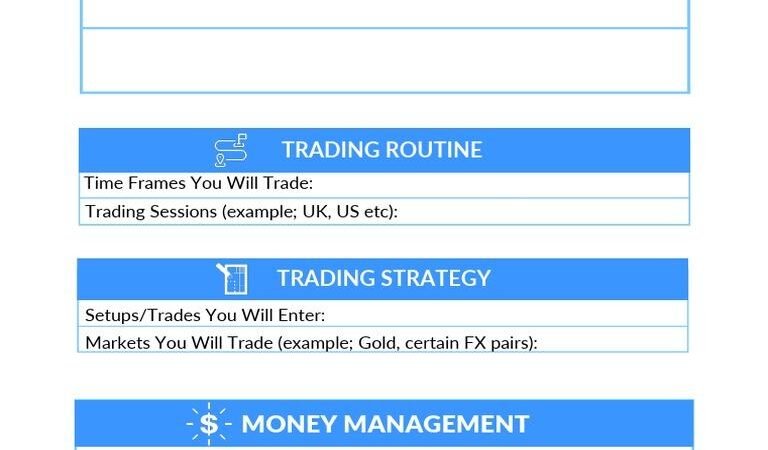
Your trading plan includes:
- Your goals
- Your schedule
- Your risk management rules
- Your trading strategy
- Your money management guidelines
- Your performance review process
Think of it this way:
Trading Strategy = The engine
Trading Plan = The entire vehicle
You may have a good strategy, but without a proper plan, you may still struggle because you lack structure and discipline.
Why Every Trader Needs a Trading Plan
The Forex market moves continuously and can be highly emotional.
Prices rise and fall every second. News events can cause sudden volatility, and social media often creates excitement and fear among traders.
Without a plan, many beginners:
- Enter trades impulsively
- Chase market movements
- Increase position sizes after losses
- Remove stop losses
- Overtrade
- Abandon strategies too quickly
These behaviors often lead to inconsistent results and unnecessary losses.
A trading plan creates structure.
Instead of asking, “What should I do now?” every time prices move, you simply follow your predefined rules.
Professional traders understand that consistency is more important than excitement.
They treat trading like a business rather than a form of gambling.
Every decision is based on a plan.
This disciplined approach allows them to remain calm, manage risks effectively, and focus on long-term improvement rather than short-term emotions.
Key Takeaway
A Forex trading plan is a written framework that guides your decisions in the market. It defines your goals, trading rules, risk management procedures, and methods for evaluating performance. While it cannot guarantee profits, a well-structured trading plan can improve discipline, reduce emotional trading, and increase your chances of long-term success.
Why Every Beginner Needs a Forex Trading Plan
Many beginners enter the Forex market with one primary goal: making money.
While there is nothing wrong with wanting to earn profits, focusing solely on money without having a structured approach often leads to poor decisions. The excitement of seeing price movements can tempt traders to act impulsively, ignore risks, and abandon their strategies when things do not go as expected. Many beginners fail because they skip important foundational knowledge like risk management and trading psychology.
This is exactly why every beginner needs a Forex trading plan.
A trading plan provides structure, discipline, and consistency. It acts as a guide that helps traders make decisions based on logic and predefined rules rather than emotions and guesswork.
Think of it this way:
A pilot would never fly an airplane without a flight plan.
A business owner would never run a company without goals and strategies.
Likewise, a trader should never participate in the Forex market without a trading plan.
The Forex market is unpredictable. Prices can rise and fall rapidly due to economic news, political events, and changes in market sentiment. Without a plan, it becomes very easy to lose focus and make emotional decisions.
Here are some of the major reasons every beginner needs a Forex trading plan.
1. It Provides Direction
A trading plan gives you a clear sense of direction.
Instead of randomly entering trades, you know:
- Which currency pairs you want to trade
- What market conditions you are looking for
- When to enter the market
- When to stay out of the market
- When to exit your trades
Having this structure removes uncertainty and allows you to trade with greater confidence.
Without a plan, trading becomes reactive. You constantly chase market movements and make decisions based on whatever is happening at the moment.
A trading plan helps you remain focused on your objectives.
2. It Reduces Emotional Trading
Emotions are among the biggest reasons traders fail.
Fear can cause traders to close profitable trades too early.
Greed can encourage traders to risk too much money.
Frustration after losses can lead to revenge trading.
Excitement after wins can create overconfidence and careless decisions.
A trading plan helps minimize emotional reactions because your decisions are already predetermined.
Instead of asking:
“Should I enter this trade?”
your plan tells you whether the conditions for entry have been met.
Instead of wondering:
“Should I hold this losing trade?”
your plan already defines where your stop loss should be.
The more you follow your plan, the less influence emotions have over your decisions.
3. It Improves Discipline
Successful trading requires discipline.
Many beginners constantly switch strategies because they expect immediate results.
They may follow one strategy today and another strategy tomorrow.
This lack of consistency makes it difficult to determine what actually works.
A trading plan encourages patience and discipline.
You learn to:
- Wait for quality trading opportunities
- Follow your rules consistently
- Avoid impulsive decisions
- Accept losses as part of the process
- Focus on long-term improvement
Discipline may not be exciting, but it is one of the most important qualities of successful traders.
4. It Helps Protect Your Trading Capital
Capital preservation is essential in Forex trading.
You cannot continue learning and improving if you lose your entire account.
A trading plan includes risk management rules that help protect your money.
For example, your plan may state:
- Risk only 1% of your account per trade
- Always use a stop loss
- Never increase position size after losses
- Avoid trading during extremely volatile conditions
These rules prevent small mistakes from becoming devastating losses.
Professional traders understand that protecting capital is their first priority.
Profits come later.
5. It Makes Performance Easier to Evaluate
Without a plan, it is difficult to understand why you are winning or losing.
You may blame the market, your broker, or bad luck.
However, without consistent rules, there is no reliable way to measure performance.
A trading plan creates a framework that allows you to evaluate your decisions objectively.
You can ask questions such as:
- Did I follow my entry rules?
- Did I manage risk correctly?
- Was my stop loss appropriate?
- Did I follow my trading schedule?
- Which mistakes do I need to improve?
Over time, these evaluations help you identify weaknesses and become a more consistent trader.
6. It Encourages a Professional Mindset
Many beginners approach trading like gambling.
They place random trades, chase profits, and hope for quick results.
Professional traders think differently.
They approach trading as a business.
Businesses operate using:
- Goals
- Plans
- Rules
- Risk management procedures
- Performance evaluations
A trading plan helps you develop this professional mindset.
Instead of relying on hope and emotions, you begin making decisions based on preparation, discipline, and logical analysis.
This mindset shift is often what separates long-term traders from those who quit after a few losses.
Key Takeaway
Every beginner needs a Forex trading plan because it provides structure, reduces emotional decision-making, improves discipline, protects trading capital, and creates a system for continuous improvement. The Forex market is challenging enough on its own. Having a clear plan allows you to approach trading with confidence, consistency, and a professional mindset instead of relying on guesswork and emotions.
How to Build Your First Forex Trading Plan: A Step-by-Step Guide
Now that you understand why a trading plan is important, the next step is learning how to create one. Your trading plan does not have to be complicated. In fact, the best trading plans are often simple, practical, and easy to follow.
The goal is to create a set of rules that keeps you disciplined and helps you make consistent decisions in the market.
Step 1: Define Your Trading Goals
Every successful journey begins with clear goals.
Many beginners enter Forex with unrealistic expectations. They hope to become rich within a few weeks or turn a small account into a fortune overnight. Unfortunately, these expectations often lead to frustration and poor decision-making.
Instead of focusing solely on money, set realistic and measurable goals.
Examples of good beginner goals include:
- Learn the fundamentals of Forex trading.
- Understand technical analysis and chart reading.
- Develop strong risk management habits.
- Achieve consistency before focusing on profits.
- Practice on a demo account for several months.
Your goals should focus on learning and improvement rather than getting rich quickly.
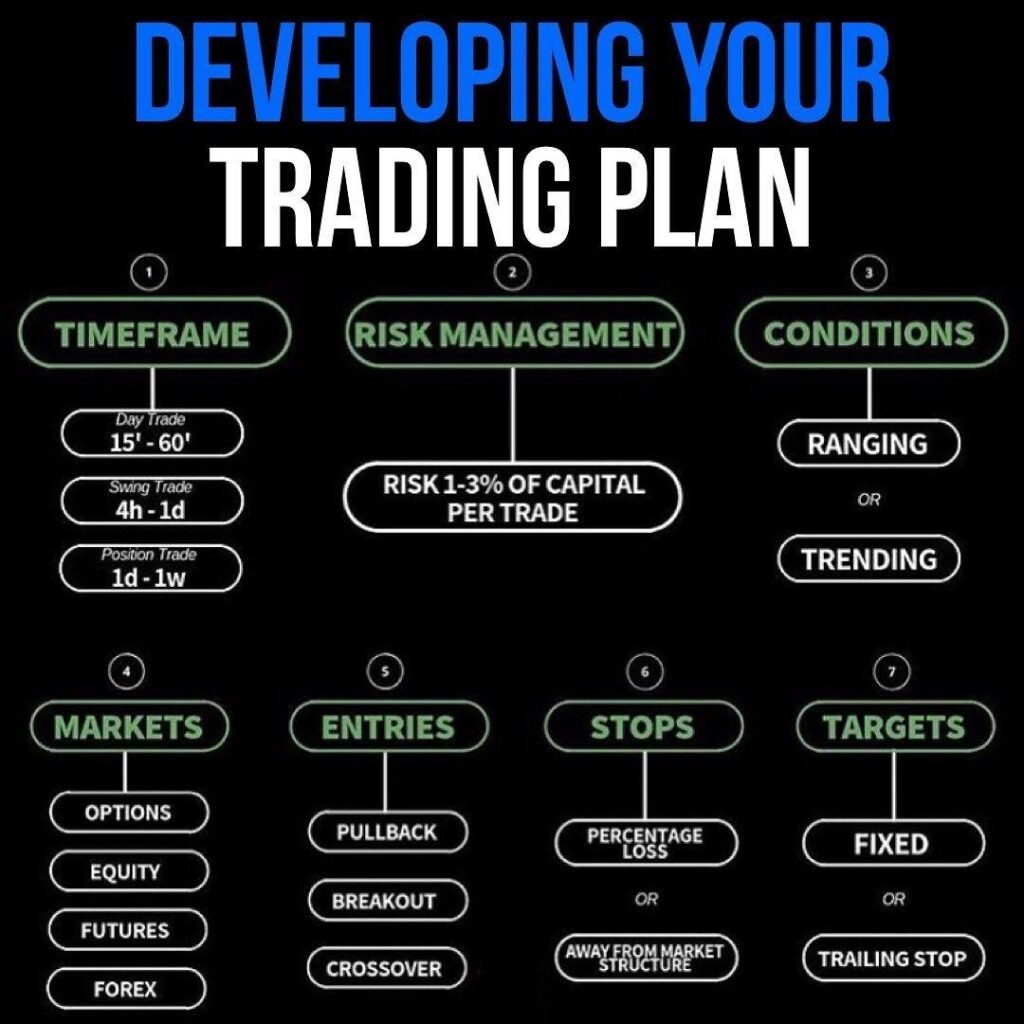
Step 2: Choose Your Trading Style
Different traders have different personalities and schedules. Your trading plan should fit your lifestyle.
Common trading styles include:
Scalping
Scalpers open and close trades within minutes.
Characteristics:
- High trading activity
- Fast decision-making
- Requires constant monitoring
Day Trading
Day traders open and close positions within the same day.
Characteristics:
- No overnight risk
- Moderate trading frequency
- Requires regular chart monitoring
Swing Trading
Swing traders hold trades for several days.
Characteristics:
- Less screen time
- Suitable for people with jobs or school commitments
- Focuses on larger price movements
Position Trading
Position traders hold trades for weeks or months.
Characteristics:
- Long-term approach
- Less stressful
- Relies heavily on broader market trends
As a beginner, choose a trading style that matches your schedule and personality. Trying to force yourself into a style that does not fit your lifestyle can quickly lead to burnout and frustration.
Step 3: Select the Currency Pairs You Will Trade
Many beginners make the mistake of trading too many currency pairs.
Every currency pair has unique characteristics, levels of volatility, and market behaviors.
For beginners, it is often better to focus on a few major pairs, such as:
- EUR/USD
- GBP/USD
- USD/JPY
- AUD/USD
Trading a small number of pairs allows you to become familiar with their movements and develop a deeper understanding of market behavior.
Step 4: Create Entry Rules
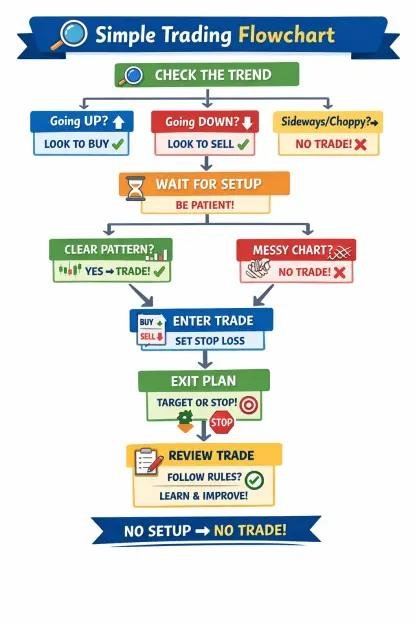
Your trading plan should clearly define the conditions that must exist before you enter a trade.
Examples of entry rules may include:
- Price must be in an uptrend.
- A support level must hold.
- A moving average crossover must occur.
- A candlestick confirmation pattern must appear.
Having clear entry rules prevents impulsive trading.
Instead of entering trades based on excitement or fear of missing out, you wait patiently until your conditions are met.
Step 5: Create Exit Rules
Knowing when to exit a trade is just as important as knowing when to enter.
Your trading plan should answer questions such as:
- Where will I place my stop loss?
- When will I take profits?
- Under what conditions will I close a trade early?
Examples of exit rules include:
- Use a risk-to-reward ratio of 1:2.
- Place stop losses below support levels.
- Close trades if market conditions change significantly.
Exit rules help eliminate emotional decision-making and encourage consistency.
Step 6: Define Your Risk Management Rules
Risk management is one of the most important components of any trading plan. One of the most important parts of trading success is protecting your capital, and understanding risk management principles can help traders learn how to minimize losses and stay in the market longer. Proper risk control is one of the most important skills in trading. Learn more about it in our detailed risk management guide.
Even professional traders experience losses. The difference is that they manage those losses carefully.
Examples of risk management rules include:
- Risk only 1% or 2% of your account on each trade.
- Always use stop losses.
- Avoid increasing trade sizes after losses.
- Do not risk money you cannot afford to lose.
Remember:
The first goal of trading is not to make money.
The first goal is to protect your capital.
Without capital, you cannot continue trading or improving your skills.
Step 7: Keep a Trading Journal
A trading journal helps you monitor your performance and learn from your experiences.
Information to record may include:
- Date of trade
- Currency pair traded
- Entry price
- Exit price
- Profit or loss
- Reason for taking the trade
- Lessons learned
Over time, your journal becomes one of your most valuable learning tools.
It helps you identify:
- Strengths
- Weaknesses
- Recurring mistakes
- Areas that need improvement
Step 8: Review and Improve Your Plan Regularly
A trading plan should evolve as your knowledge and experience grow.
Successful traders regularly evaluate their performance and make necessary adjustments.
Ask yourself questions such as:
- Am I following my rules consistently?
- Which mistakes occur repeatedly?
- Which strategies perform best?
- What improvements can I make?
Continuous improvement is an essential part of becoming a better trader.
Remember that no trading plan is perfect.
The goal is progress, not perfection.
Example of a Beginner Forex Trading Plan
Trading Style: Swing Trading
Currency Pairs: EUR/USD and GBP/USD
Risk Per Trade: 1%
Trading Hours: London and New York sessions
Entry Rules:
- Trade only in the direction of the trend.
- Wait for confirmation at support or resistance levels.
Exit Rules:
- Use a stop loss on every trade.
- Maintain a minimum risk-to-reward ratio of 1:2.
Performance Review:
- Record every trade in a journal.
- Review performance every weekend.
This simple framework provides structure and encourages disciplined decision-making.
Practical Example: Applying Risk Management in Your Trading Plan
Understanding risk management is easier when you see it in practice.
Imagine you have a trading account balance of:
$500
Your trading plan states that you should risk no more than 2% of your account on a single trade.
To calculate your maximum risk:
$500 × 2% = $10
This means that no matter how confident you feel about a trade, you should never allow yourself to lose more than $10 on that position.
Suppose you identify a buying opportunity on EUR/USD and decide to place a stop loss that is 50 pips away from your entry price. Since your maximum risk is $10, you would adjust your position size so that a 50-pip loss equals no more than $10.
This approach protects your account from significant losses.
Now imagine that you ignore your trading plan and risk $100 instead.
If the trade goes against you, you would lose 20% of your entire account in just one trade. Recovering from such a loss can be difficult and emotionally stressful.
By risking only a small percentage of your account on each trade, you give yourself the opportunity to survive losing streaks and continue improving as a trader.
Professional traders understand that preserving capital is more important than trying to win big on a single trade.
Remember:
Your first goal is not to make money. Your first goal is to protect your trading capital.
Common Trading Plan Mistakes Beginners Make
Creating a trading plan is important, but following it consistently is even more important. Many beginners have a plan but fail because they do not stick to it.
Here are some of the most common mistakes new traders make.
1. Trading Without Written Rules
Some traders keep their plans only in their heads.
This often leads to inconsistency because emotions can easily influence decisions.
A written trading plan provides clarity and accountability. It allows you to follow the same rules repeatedly and measure your performance objectively.
2. Changing Strategies Too Often
Many beginners expect immediate results.
After a few losing trades, they abandon their strategy and begin searching for another one.
Constantly changing strategies prevents traders from gaining enough experience to determine what works and what does not.
Successful traders understand that every strategy experiences both winning and losing periods.
Consistency is essential.
3. Risking Too Much Money
One of the fastest ways to destroy a trading account is by risking too much on individual trades.
Some beginners risk 20%, 30%, or even their entire account balance on a single trade because they hope to make large profits quickly.
Unfortunately, one bad trade can erase months of progress.
Most professional traders risk only a small percentage of their accounts on each position because protecting capital is essential for long-term survival.
4. Ignoring Stop Losses
A stop loss is one of the most important risk management tools available to traders.
Some beginners remove their stop losses when trades move against them because they hope the market will eventually reverse. Every trader should know how to protect their trades from large losses and learning about stop-loss orders helps beginners understand how to automatically close trades when the market moves against them.
Unfortunately, markets do not always return.
Ignoring stop losses can turn small losses into devastating ones.
Successful traders accept small losses because they understand that preserving capital is necessary for long-term success.
5. Trading Based on Emotions
Fear and greed can lead to poor decisions.
Fear may cause traders to close profitable trades too early.
Greed may encourage traders to increase position sizes unnecessarily.
Frustration after losses can lead to revenge trading.
Excitement after wins can create overconfidence.
A good trading plan reduces emotional decision-making by providing clear rules for every situation.
6. Failing to Review Performance
Many beginners place trades and move on without reviewing their results.
As a result, they repeat the same mistakes over and over again.
Reviewing your trades allows you to:
- Identify strengths
- Recognize weaknesses
- Improve decision-making
- Build better habits
- Refine your trading plan
Continuous improvement is one of the characteristics that separates successful traders from unsuccessful ones.
Frequently Asked Questions (FAQ)
Can I Trade Forex Without a Trading Plan?
Yes, you can trade without a trading plan, but doing so usually leads to inconsistent decisions and unnecessary losses.
Without clear rules, traders often rely on emotions, impulses, and guesswork. A trading plan provides structure and discipline, helping you make more logical and consistent decisions.
How Often Should I Update My Trading Plan?
Your trading plan should be reviewed regularly.
As your experience grows, you may discover areas that need improvement. Reviewing your plan monthly or after a significant number of trades allows you to evaluate your performance and make necessary adjustments.
Remember that your trading plan should evolve as your skills and knowledge improve.
Should Beginners Use Demo Accounts?
Absolutely.
Demo accounts allow beginners to practice trading without risking real money.
They provide an excellent environment for:
- Learning how the market works
- Testing trading strategies
- Practicing risk management
- Building confidence
- Developing discipline
Many successful traders spend considerable time on demo accounts before transitioning to live trading.
Is a Trading Plan the Same as a Trading Strategy?
No.
A trading strategy focuses specifically on finding trading opportunities and deciding when to enter or exit trades.
A trading plan is much broader.
It includes:
- Trading goals
- Trading schedules
- Risk management rules
- Trading strategies
- Performance reviews
- Continuous improvement plans
Think of it this way:
Trading Strategy = One component of your trading plan.
Trading Plan = The complete framework that guides your trading decisions and behavior.
Final Thoughts
Creating a Forex trading plan is one of the most important steps you can take as a beginner trader. While many people focus entirely on strategies and indicators, experienced traders understand that long-term success depends heavily on preparation, discipline, and consistency.
A trading plan serves as your personal roadmap in the Forex market. It helps you define your goals, manage risk, control emotions, and make decisions based on logic rather than impulse.
Will a trading plan guarantee profits?
No.
Losses are an unavoidable part of trading.
However, a well-designed trading plan can help you protect your capital, develop better habits, and significantly improve your decision-making process.
Remember that successful trading is not about finding a magical strategy or predicting every market movement correctly. It is about consistently following a structured process and continuously improving over time.
Every professional trader was once a beginner.
By taking the time to create and follow your own trading plan today, you are building the discipline and foundation needed for long-term success in the Forex market. A well-designed Forex trading plan for beginners can help you develop discipline, protect your capital, and build the habits needed for long-term success in the Forex market.
Disclaimer
The information provided in this article is for educational purposes only and should not be considered financial or investment advice. Forex trading involves substantial risk and may not be suitable for all investors. Currency prices can move rapidly, and traders may lose some or all of their invested capital.
Before trading with real money, continue your education, practice on demo accounts, develop strong risk management habits, and always conduct your own research. Never trade with money you cannot afford to lose.