
Introduction:

Top 20 Forex Terms Every Beginner Should Know (2026 Guide). Starting your Forex trading journey can feel exciting and overwhelming at the same time. As a beginner, you will quickly come across terms like pips, spreads, leverage, margin, support, and resistance. At first, these words may sound complicated or technical but understanding them is one of the most important steps toward becoming a confident and informed trader. If you’re completely new to trading, you can Learn the basics of the Forex market to better understand how currencies are exchanged globally.
Forex trading is more than simply buying and selling currencies. It is a financial market with its own language. Just as doctors, engineers, and lawyers use specialized terms in their professions, Forex traders also use specific terminology to communicate, analyze the market, and make trading decisions.
Imagine trying to play football without understanding terms like goal, penalty, offside, or corner kick. You would struggle to follow the game. In the same way, learning Forex terminology allows you to understand how the market works and gives you the knowledge needed to participate effectively.
Many beginners make costly mistakes because they start trading without fully understanding basic concepts. Some use leverage without understanding the risks, while others place trades without knowing what a pip or spread means. These misunderstandings often lead to poor decision-making and unnecessary losses.
Learning Forex terms provides several important benefits:
- It helps you understand educational materials more easily.
- It improves your ability to read market analysis and trading discussions.
- It allows you to communicate confidently with other traders.
- It helps you avoid beginner mistakes caused by confusion and misinformation.
- It builds a strong foundation for learning technical and fundamental analysis.
- It increases your confidence when making trading decisions.
Remember that becoming successful in Forex trading is a journey that begins with understanding the basics. The terms covered in this guide are among the most important concepts that every new trader should know before risking real money in the market.
By the end of this article, you will have a clearer understanding of the language of Forex trading and be better prepared to continue your trading education with confidence.
1. Forex (Foreign Exchange)
Forex, short for Foreign Exchange, is the global marketplace where currencies are bought and sold.
It is the largest financial market in the world, with trillions of dollars being traded every day by banks, businesses, governments, investment firms, and individual traders. If you’re completely new to trading, start with our Forex Trading for Beginners: The Complete A–Z Guide (2026) to understand how the Forex market works from the ground up.
Unlike stock markets, which focus on buying and selling company shares, the Forex market focuses entirely on currencies.
Examples of currencies traded in the Forex market include:
- US Dollar (USD)
- Euro (EUR)
- British Pound (GBP)
- Japanese Yen (JPY)
- Canadian Dollar (CAD)
- Australian Dollar (AUD)
The purpose of Forex trading is to profit from changes in currency exchange rates.
For example, if you believe the Euro will become stronger compared to the US Dollar, you may decide to buy EUR/USD. If the price rises, you can potentially make a profit.
One of the reasons Forex trading is popular is because the market operates 24 hours a day, five days a week, allowing traders from different parts of the world to participate at various times.
Understanding what Forex is forms the foundation for learning everything else about trading.
2. Currency Pair
Currencies are always traded in pairs because one currency is exchanged for another.
A currency pair consists of two currencies: Beginners can Explore live currency exchange rates and economic indicators to see how different currencies move in real-world market conditions.
Example:
EUR/USD
This pair compares the value of the Euro against the US Dollar.
If EUR/USD is trading at 1.1000, it means one Euro is worth 1.10 US Dollars.
Every Forex transaction involves simultaneously buying one currency and selling another.
Some of the most commonly traded currency pairs include:
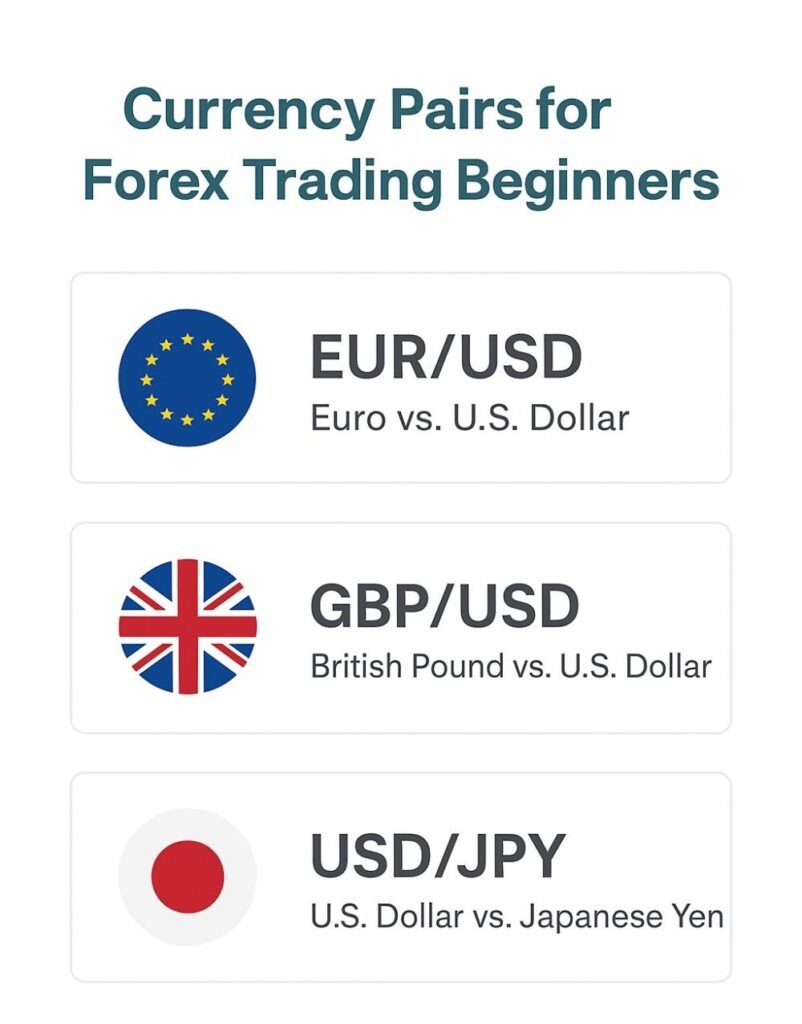
- EUR/USD – Euro versus US Dollar
- GBP/USD – British Pound versus US Dollar
- USD/JPY – US Dollar versus Japanese Yen
- USD/CAD – US Dollar versus Canadian Dollar
Currency pairs are generally divided into three categories:
Major Pairs
The most actively traded currencies in the world.
Examples:
- EUR/USD
- GBP/USD
- USD/JPY
Minor Pairs
Currency pairs that do not include the US Dollar.
Examples:
- EUR/GBP
- EUR/AUD
- GBP/JPY
Exotic Pairs
Pairs involving a major currency and a currency from an emerging economy.
Examples:
- USD/TRY
- USD/ZAR
- EUR/SGD
Understanding currency pairs is essential because every trading decision begins with analyzing how one currency is performing relative to another.
3. Base Currency
The base currency is the first currency listed in a currency pair.
Example:
EUR/USD
EUR is the base currency.
The base currency acts as the reference point for the pair.
When you see:
EUR/USD = 1.1000
This means one unit of the base currency (1 Euro) is worth 1.10 units of the quote currency (US Dollars).
Understanding the base currency helps traders understand what they are buying or selling.
For example:
Buying EUR/USD means:
- Buying Euros
- Selling US Dollars
Selling EUR/USD means:
- Selling Euros
- Buying US Dollars
Many beginners become confused about which currency they are actually trading. Understanding the concept of the base currency removes this confusion and makes it easier to understand market movements.
4. Quote Currency
The quote currency is the second currency listed in a currency pair.
Example:
EUR/USD
USD is the quote currency.
The quote currency tells you how much money is needed to purchase one unit of the base currency.
For example:
EUR/USD = 1.1000
This means it takes 1.10 US Dollars to purchase one Euro.
Another example:
GBP/USD = 1.3500
This means one British Pound is worth 1.35 US Dollars.
Understanding quote currencies helps traders interpret exchange rates and understand how profits and losses are measured.
Although the concepts of base and quote currencies seem simple, they form the foundation for understanding how Forex trading works.
5. Pip (Percentage in Point)
A pip, short for “Percentage in Point,” is one of the most important concepts in Forex trading. It represents one of the smallest standard price movements that a currency pair can make. Understanding pips becomes easier when you know how to read price charts. Learn What Is Technical Analysis? A Beginner’s Guide to Reading Forex Charts to improve your market analysis skills.
For most currency pairs, one pip equals the fourth decimal place.
For example:
EUR/USD moves from:
1.1000 → 1.1001
The price has moved by one pip.
If the price moves from:
1.1000 → 1.1010
The market has moved by ten pips.
Pips are extremely important because they are used to measure:
- Profits
- Losses
- Risk exposure
- Market movements
- Stop-loss distances
- Take-profit targets
For example, if you buy EUR/USD at 1.1000 and sell at 1.1020, the market has moved 20 pips in your favor.
Professional traders often discuss market movements in pips rather than in dollar amounts.
For example:
- “I made 50 pips today.”
- “My stop loss is 20 pips.”
- “The market dropped by 100 pips.”
Understanding pips is essential because almost every aspect of Forex trading, including risk management and performance tracking, depends on measuring price movements in pips.
6. Spread
The spread is the difference between the buying price (Ask) and the selling price (Bid) of a currency pair.
Every Forex trade has two prices:
Bid Price: The price at which you can sell.
Ask Price: The price at which you can buy.
Example:
EUR/USD
Bid Price: 1.1000
Ask Price: 1.1002
Spread = 2 pips
The spread represents the cost of entering a trade.
Think of the spread as similar to a transaction fee. Before your trade becomes profitable, the market must first move enough to cover the spread.
For example, if you buy EUR/USD with a spread of two pips, your trade begins with a small unrealized loss equal to those two pips.
Spreads can vary depending on:
- Market conditions
- Trading sessions
- Economic news releases
- Currency pair liquidity
- Broker pricing
Major currency pairs like EUR/USD generally have lower spreads because they are traded more actively.
Exotic currency pairs often have larger spreads because they are less liquid and experience lower trading volumes.
Understanding spreads helps traders estimate trading costs and avoid surprises when entering positions.
7. Leverage
Leverage is one of the most powerful and potentially dangerous tools in Forex trading. Before using leverage, it’s important to understand account size and realistic expectations. Read How Much Money Do You Need to Start Forex Trading? for a beginner-friendly breakdown.
Leverage allows traders to control larger trading positions using relatively small amounts of capital.
For example:
Leverage = 1:100
This means every $1 in your account allows you to control $100 in the market.
Suppose you have:
Account Balance = $100
Using 1:100 leverage, you can control a trading position worth:
$10,000
Leverage can significantly increase profits because even small market movements can generate larger returns.
However, leverage can also magnify losses.
For example:
Without leverage:
A 1% market movement may result in only a small gain or loss.
With high leverage:
The same 1% movement can produce much larger profits or losses.
This is why leverage is often described as a double-edged sword.
Many beginners are attracted to Forex trading because of leverage. Unfortunately, some misuse it by taking oversized positions and risking too much money.
Successful traders use leverage carefully.
They understand that leverage should be treated as a tool for capital efficiency rather than a shortcut to getting rich quickly.
The goal of professional traders is not to use the highest leverage possible but to manage leverage responsibly while protecting their trading capital.
8. Margin
Margin is the amount of money required to open and maintain a leveraged trading position.
Think of margin as a security deposit that your broker temporarily sets aside while your trade remains open.
For example:
Account Balance: $1,000
Required Margin: $100
This means your broker reserves $100 to support the trade.
The remaining balance remains available for other trading activities.
Margin makes leveraged trading possible because traders do not need to deposit the full value of the position.
However, margin should never be mistaken for free money.
Many beginners misunderstand margin and open positions that are too large for their account size.
When losses become too large, traders may experience a margin call.
A margin call occurs when account equity falls below the broker’s required level.
At this stage, brokers may:
- Restrict new trades
- Request additional funds
- Automatically close open positions
Understanding margin is critical because poor margin management is one of the most common reasons beginner traders lose money.
Successful traders monitor their margin carefully and avoid taking positions that expose their accounts to unnecessary risk.
9. Lot Size
A lot is the standard unit used to measure the size of a Forex trade. In simple terms, a lot determines how much of a currency you are buying or selling.
Understanding lot sizes is extremely important because your lot size directly affects how much money you can gain or lose on each trade.
Forex brokers generally offer four common lot sizes:
Standard Lot
A standard lot equals 100,000 units of the base currency.
Example:
If you buy one standard lot of EUR/USD, you are controlling 100,000 Euros.
Because the trade size is large, even small price movements can result in significant profits or losses.
Mini Lot
A mini lot equals 10,000 units of the base currency.
Mini lots are often suitable for traders with smaller account balances because they reduce risk compared to standard lots.
Micro Lot
A micro lot equals 1,000 units of the base currency.
Micro lots are very popular among beginners because they allow traders to gain real-market experience while keeping potential losses relatively small.
Nano Lot
Some brokers also offer nano lots, which equal 100 units of the base currency.
Nano lots are useful for practice and for traders with very small accounts.
Why Lot Size Matters
Imagine two traders:
Trader A uses one standard lot.
Trader B uses one micro lot.
If the market moves by 50 pips:
Trader A may make or lose a large amount of money.
Trader B may make or lose only a small amount.
The market movement is exactly the same, but the financial impact is completely different because of the lot size.
One of the biggest mistakes beginners make is using lot sizes that are too large for their account balances.
Successful traders carefully choose lot sizes that align with their risk management plans and account sizes.
10. Bid Price
The bid price is the price at which a broker is willing to buy a currency pair from you.
In simple terms, it is the price at which traders can sell.
Example:
EUR/USD
Bid Price: 1.1000
Ask Price: 1.1002
If you decide to sell EUR/USD, your trade will execute at the bid price of 1.1000.
The bid price is usually slightly lower than the ask price because brokers earn part of their revenue through the spread.
Why Understanding the Bid Price Is Important
Many beginners become confused because they expect their trades to enter or exit at the exact price shown on charts.
However, buying and selling occur at different prices.
Knowing how bid prices work helps traders:
- Understand trading costs
- Calculate spreads correctly
- Avoid confusion when entering trades
- Understand why trades may initially show a small loss
Understanding bid prices is one of the fundamental concepts that every Forex trader should know before placing real trades.
11. Ask Price
The ask price is the price at which a broker is willing to sell a currency pair to you.
In simple terms, it is the price at which traders can buy.
Using our previous example:
EUR/USD
Bid Price: 1.1000
Ask Price: 1.1002
If you want to buy EUR/USD, your trade will execute at the ask price of 1.1002.
The difference between the bid and ask prices is known as the spread.
Why the Ask Price Matters
Understanding the ask price helps traders understand why:
- Trades may begin with a small unrealized loss
- Buying and selling occur at different prices
- Spreads affect profitability
Suppose you buy EUR/USD at the ask price of 1.1002.
For your trade to become profitable, the market must move high enough to overcome the spread.
This is why understanding ask prices is essential when calculating profits, losses, and transaction costs.
12. Bull Market
A bull market refers to a market that is generally moving upward.
During a bull market, buyers are in control and prices tend to rise over time.
A bullish market is usually characterized by:
- Higher highs
- Higher lows
- Strong buying pressure
- Positive market sentiment
For example, if EUR/USD rises from:
1.0800 → 1.1200
over several weeks or months, the market may be considered bullish.
Why Bull Markets Matter
Bull markets create opportunities for traders who believe prices will continue rising.
Many traders look for:
- Buying opportunities
- Trend-following strategies
- Breakout setups
Bull markets often occur because of:
- Positive economic data
- Interest rate increases
- Strong investor confidence
- Increased demand for a currency
Understanding bullish conditions helps traders align their strategies with market direction rather than trading against strong trends.
13. Bear Market
A bear market refers to a market that is generally moving downward.
During a bear market, sellers dominate the market and prices tend to decline.
Bearish markets are usually characterized by:
- Lower highs
- Lower lows
- Strong selling pressure
- Negative market sentiment
For example, if GBP/USD falls from:
1.3500 → 1.2800
over several weeks, the market may be considered bearish.
Why Bear Markets Matter
Many beginners mistakenly believe traders can only profit when markets rise.
In Forex trading, traders can potentially profit in both rising and falling markets.
During bearish conditions, traders often look for:
- Selling opportunities
- Trend continuation setups
- Breakdown strategies
Bear markets can develop because of:
- Weak economic conditions
- Political uncertainty
- Lower interest rates
- Negative market sentiment
Successful traders learn how to identify bearish trends and adjust their strategies accordingly.
Understanding both bull and bear markets helps traders recognize market direction and make more informed trading decisions.
14. Volatility
Volatility refers to the degree of price movement in the Forex market over a specific period. In simple terms, volatility measures how quickly and how much prices rise and fall.
Some currency pairs experience small and gradual price movements, while others can move rapidly within minutes. The greater the price movement, the higher the volatility.
For example:
If EUR/USD moves between:
1.1000 → 1.1005
the market has experienced relatively low volatility.
However, if EUR/USD moves between:
1.1000 → 1.1100
within a short period, the market is considered highly volatile.
What Causes Volatility?
Several factors can increase market volatility, including:
- Major economic news releases
- Interest rate decisions
- Inflation reports
- Political events
- Geopolitical tensions
- Unexpected market events
- Changes in investor sentiment
For example, announcements from central banks often create sharp price movements because traders quickly react to new information.
Why Volatility Matters
Volatility creates both opportunities and risks.
High volatility can:
- Produce larger profit opportunities
- Generate strong market trends
- Create more trading setups
However, high volatility can also:
- Increase trading risks
- Trigger stop losses quickly
- Cause emotional decision-making
- Lead to larger losses if risk is poorly managed
Successful traders understand the importance of adapting their strategies to market volatility. During highly volatile periods, they often reduce position sizes and pay closer attention to risk management.
Understanding volatility helps traders prepare for changing market conditions instead of being surprised by sudden price movements.
15. Stop Loss
A stop loss is an order that automatically closes a trade when the market reaches a predetermined price level.
The primary purpose of a stop loss is to limit potential losses.
Think of a stop loss as an insurance policy for your trading account. It protects your capital when the market moves against your expectations.
For example:
You buy EUR/USD at:
1.1000
You decide that if the market falls to:
1.0980
you want the trade to close automatically.
You place your stop loss at 1.0980.
If the market reaches that price, the trade closes automatically and prevents further losses.
Why Stop Losses Are Important
No trader can predict market movements with complete certainty.
Even experienced traders have losing trades.
Without stop losses, small losses can become extremely large losses.
Stop losses help traders:
- Protect their trading capital
- Control risk exposure
- Prevent emotional decision-making
- Avoid catastrophic losses
- Maintain long-term survival in the market
One of the biggest mistakes beginners make is removing stop losses because they hope the market will reverse.
Unfortunately, hope is not a trading strategy.
Successful traders understand that preserving capital is more important than trying to avoid every losing trade.
For many professional traders, using a stop loss is not optional—it is an essential part of risk management.
16. Take Profit
A take-profit order automatically closes a trade once a predetermined profit target is reached.
While stop losses protect against excessive losses, take-profit orders help traders secure profits.
For example:
You buy EUR/USD at:
1.1000
You expect the market to rise to:
1.1050
You place a take-profit order at 1.1050.
If the market reaches that price, your trade closes automatically and locks in your profit.
Why Take-Profit Orders Matter
Many beginner traders struggle to decide when to close profitable trades.
Some close positions too early because they fear losing profits.
Others become greedy and hold trades for too long, hoping for even larger gains.
A take-profit order removes much of this emotional pressure.
It helps traders:
- Lock in profits automatically
- Follow their trading plans
- Avoid emotional decisions
- Improve consistency
- Maintain discipline
Successful traders often determine both their stop loss and take-profit levels before entering trades.
This approach encourages planning and reduces impulsive decision-making.
17. Support
Support is a price level where buying pressure tends to prevent prices from falling further.
At support levels, buyers become more active and demand often increases. Support, resistance, and trends are fundamental concepts in chart analysis. Explore What Is Technical Analysis? A Beginner’s Guide to Reading Forex Charts to learn how traders identify market opportunities.
Imagine a ball repeatedly bouncing off the floor.
In Forex trading, support acts in a similar way.
When prices approach support levels, they often slow down, stop falling, or even reverse upward.
For example:
EUR/USD falls several times to:
1.0800
and repeatedly moves higher afterward.
Traders may identify 1.0800 as a support level.
Why Support Matters
Support levels help traders:
- Identify potential buying opportunities
- Determine stop-loss placement
- Recognize possible market reversals
- Understand market behavior
However, support levels are not guaranteed to hold.
Sometimes prices break below support and continue moving lower.
Successful traders use support levels as areas of interest rather than absolute predictions.
Understanding support helps traders make more informed decisions instead of entering trades randomly.
18. Resistance
Resistance is a price level where selling pressure tends to prevent prices from moving higher.
At resistance levels, sellers become more active and supply increases.
Imagine a ball repeatedly hitting a ceiling and falling back down.
Resistance often behaves similarly.
For example:
GBP/USD rises multiple times to:
1.3000
but struggles to move above that level.
Traders may identify 1.3000 as a resistance level.
Why Resistance Matters
Resistance levels help traders:
- Identify potential selling opportunities
- Determine profit targets
- Recognize possible market reversals
- Improve market analysis
Just like support, resistance levels are not permanent barriers.
Sometimes prices break above resistance and continue rising.
Successful traders understand that support and resistance are tools that help identify high-probability areas rather than guarantee future price movements.
19. Trend
A trend refers to the general direction in which the market is moving.
Markets rarely move in straight lines. Instead, they tend to move in identifiable directions over time. Major economic announcements can significantly increase market volatility. Traders can Track important economic events and market news to prepare for potential price movements.
The three main types of trends are:
Uptrend
An uptrend occurs when prices form:
- Higher highs
- Higher lows
This indicates bullish market sentiment.
Downtrend
A downtrend occurs when prices form:
- Lower highs
- Lower lows
This indicates bearish market sentiment.
Sideways Trend
A sideways trend occurs when prices move within a range without a clear upward or downward direction.
Why Trends Matter
The phrase “the trend is your friend” is popular in Forex trading for a reason.
Trading in the direction of the trend often improves the probability of success.
Understanding trends helps traders:
- Identify market direction
- Find potential entry opportunities
- Avoid trading against strong momentum
- Develop more effective strategies
Many beginners lose money because they ignore trends and attempt to predict reversals too early.
Successful traders learn to recognize trends and adapt their trading decisions accordingly.
20. Risk Management
Risk management is the process of protecting your trading capital by controlling potential losses.
Many experienced traders believe that risk management is more important than any trading strategy because even profitable strategies can fail without proper risk control. Before trading with real money, beginners should Understand the risks associated with Forex trading and develop realistic expectations.
Risk management includes:
- Using stop losses
- Controlling position sizes
- Managing leverage responsibly
- Maintaining favorable risk-to-reward ratios
- Limiting losses on individual trades
Why Risk Management Is Essential
Imagine two traders:
Trader A risks 50% of their account on one trade.
Trader B risks only 1% of their account.
If both traders experience several losses, Trader A may quickly lose their entire account, while Trader B can continue trading and learning.
Successful traders understand that preserving capital is their first priority.
They know that opportunities will always exist in the Forex market, but they can only take advantage of those opportunities if they protect their accounts.
The goal of risk management is not to avoid losses completely.
The goal is to ensure that losses remain manageable and do not prevent long-term success.
For many professional traders, effective risk management is the foundation upon which all profitable trading is built.
Final Thoughts
Learning Forex trading begins with understanding its language.
Terms such as pips, leverage, margin, support, resistance, and risk management may seem intimidating at first, but they are the building blocks of every successful trader’s education.
Many beginners rush into trading and focus only on making money. However, experienced traders understand that knowledge comes first. The more familiar you become with Forex terminology, the easier it becomes to understand charts, analyze market conditions, follow educational content, and make informed trading decisions.
Remember that successful trading is not about memorizing definitions. It is about understanding how these concepts work together in real market situations.
Every professional trader was once a beginner who had to learn these same terms. By taking the time to build a strong foundation now, you are investing in your long-term growth and development as a trader.
Continue learning, practice consistently, and focus on understanding the market one concept at a time. Forex trading is a journey, and mastering its language is one of the first steps toward becoming a more confident and disciplined trader.
Disclaimer
The information provided in this article is for educational and informational purposes only and should not be considered financial, investment, or trading advice.
Forex trading involves significant risk and may not be suitable for all investors. Currency prices can be highly volatile, and traders may lose some or all of their invested capital.
The terms and concepts explained in this guide are intended to help beginners understand the fundamentals of Forex trading and build a strong educational foundation. However, understanding these terms alone does not guarantee profitability or trading success.
Before trading with real money, beginners should continue their education, practice using demo accounts, and develop proper risk management strategies. Never trade with money you cannot afford to lose, and always make trading decisions based on your own research, financial circumstances, and risk tolerance.
BuildSmartAfri is committed to providing educational content that promotes responsible trading, continuous learning, and realistic expectations rather than promises of quick or guaranteed profits.